
- An Exceptional Young Man
- An Apology
- Nothing of Note
- Follow Up on George Welsford
- Henry and Harry
- The Final Days
- A Service to Honour Jim Johnstone
- Travel Part Two
- Travels to the Sacred Lands
- Brotherhood and Friendship
- A Troubled Soul
- Faceless, but not forgotten
- Lads of the 38th
- “November’s sky is chill and drear, November’s life is red and sear.”
- A Fake Attack
- “Soldier of Christ Well Done”
- 2025 – A new year, a new project
- A Kiltie
- Serendipity
- Muddy Hell
- The Best Pal
- Pip Pip!
- O beloved Belgium, sacred land of our fathers
- A Dandy Chap
- On The Wings of The Morning
- Our Darling Soldier Boy
- The Boys from Alberta
- The Gales of November Came Early
- A Tale of Two James
- A Pilgrimage to the Sacred Lands
- He Will Not Return To Me
- To Live In The Hearts We Leave Behind Is Not To Die
- Capturing the Hangstellung
- Two Brothers, Three Telegrams
- Follow Me to Hell
- Absent Without Leave
- Four Days in October
- The Brothers Cameron
- Everyone Behaved Splendidly
- No Life Like It
- A Tale of Two Brothers and a Ridge Called Vimy
- Llandovery Castle!!!
- Halt! Who Goes There?
- The War That Won Me Over.
- An Exceptional Young Man
- An Apology
- Nothing of Note
- Follow Up on George Welsford
- Henry and Harry
- The Final Days
- A Service to Honour Jim Johnstone
- Travel Part Two
- Travels to the Sacred Lands
- Brotherhood and Friendship
- A Troubled Soul
- Faceless, but not forgotten
- Lads of the 38th
- “November’s sky is chill and drear, November’s life is red and sear.”
- A Fake Attack
- “Soldier of Christ Well Done”
- 2025 – A new year, a new project
- A Kiltie
- Serendipity
- Muddy Hell
- The Best Pal
- Pip Pip!
- O beloved Belgium, sacred land of our fathers
- A Dandy Chap
- On The Wings of The Morning
- Our Darling Soldier Boy
- The Boys from Alberta
- The Gales of November Came Early
- A Tale of Two James
- A Pilgrimage to the Sacred Lands
- He Will Not Return To Me
- To Live In The Hearts We Leave Behind Is Not To Die
- Capturing the Hangstellung
- Two Brothers, Three Telegrams
- Follow Me to Hell
- Absent Without Leave
- Four Days in October
- The Brothers Cameron
- Everyone Behaved Splendidly
- No Life Like It
- A Tale of Two Brothers and a Ridge Called Vimy
- Llandovery Castle!!!
- Halt! Who Goes There?
- The War That Won Me Over.
An Exceptional Young Man
30 January 206
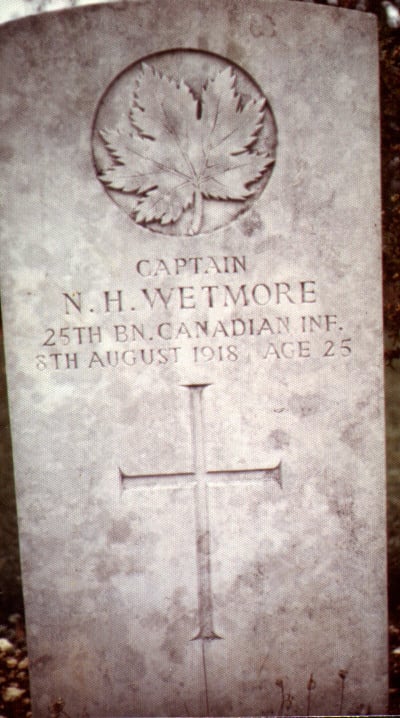
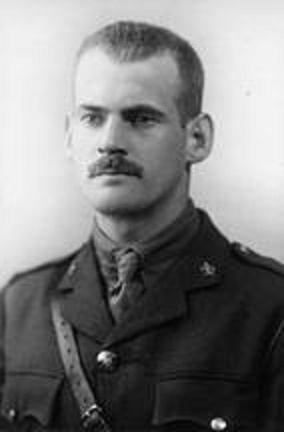
Captain Norman Howard Wetmore
It was a devastating injury – one so common to the front lines – and he’d been left partially paralyzed. That did not hold Norman Wetmore back and in five and a half months he was back in the firing lines with a promotion from Lieutenant to Temporary Captain.
Norman Howard Wetmore was born in Bloomfield Station, New Brunswick on Canada’s east coast on 16 May 1893. Bloomfield nestles among the ancient low hills of the Kennebecasis River valley. The river is narrow and sleepy, the hills pastoral. Even today, it is lightly populated, dotted with farms of hay fields, horses and cow pastures. My brother-in-law was born on one of those farms; his name is Wetmore too and Norman was his second cousin once removed. This story is personal.
Norman was the first child of William Elias Scovil and Eva Saline (Matthews) Wetmore. He was followed in 1896 by a sister, Clara, and in 1899 by twins, Clayton Berry and an unnamed boy who died before or shortly after birth. Sadly, Clayton died just nine years later in 1908 and the family was reduced to four.
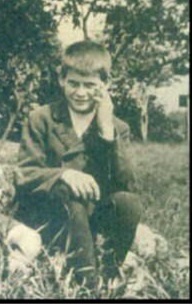
Norman was a tall lad, nearly 5’ 11” with fair hair and blue eyes. He was also highly intelligent and motivated. Following in his father’s footsteps, he joined the 8th Hussars militia as first an NCO, then a Lieutenant. When he went to Mount Allison University in Sackville, NB, he joined COTC and rose to Captain, all while earning a teaching diploma. He was granted a Superior license due to his “exceptional” grades, which allowed him to teach not just the basics of reading, writing, etc, but also geometry, algebra, bookkeeping, land surveying and navigation. Norman then returned to his roots and began teaching in the community school in the village of Apohaqui, just 21 km up the river from Bloomfield.
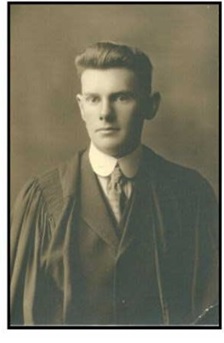
Norman graduating from Mount Allison University
I can imagine once war was declared, Norman may have wanted to join. Perhaps his commitment to his teaching contract, or his mother’s worry (she’d already buried two sons) prevented Norman joining right away. In August of 1915, when the war had been raging for a year, he signed his attestation papers – “N.H. Wetmore, Lieut” – with the 64th Overseas Battalion in Sussex on the 23rd. After months of training, the battalion embarked for England 31 March 1916, landing in Liverpool nine days later. In August 1916, Norman was transferred to the 25th Battalion, Nova Scotia Highlanders, B Company, and joined them in the field three days later, on 6 August, one of eight new officers for the battalion. The battalion was in training, out of the front line and there must have been great excitement when King George and the Prince of Wales visited on the 14th. A few days later, Norman arrived in the firing line.
In September 1916, the 25th Battalion, with the Fifth Brigade, marched through Albert, France, en route to Pozières. They were to take part in the battle to capture the village of Courcelette, a daylight attack, assembling and advancing over open farmland. It was a long and bloody advance, and during this, Norman was hit in the head by shrapnel and severely wounded. A depressed skull fracture, behind and above his right ear, left his left arm and leg paralyzed. It was a Blighty. Evacuated to a Casualty Clearing Station, he was then entrained to #20 General Hospital, Ètaples, France, where surgeons operated to removed the shrapnel and bone fragments. Within days, he began to improve, the feeling gradually returning to his affected limbs. In early October, he was sent to the IODE hospital at 1 Hyde Park Place, London. A medical board found he had some residual weakness in his left arm and leg, with difficulty picking up small objects such as a fork or spoon. He was granted leave back to Canada for three months (later extended to four) with expectation he would make a full recovery. What delight and relief his parents and sister must have felt to have him home and in one piece, but with much more anxiety would they have seen him leave again.
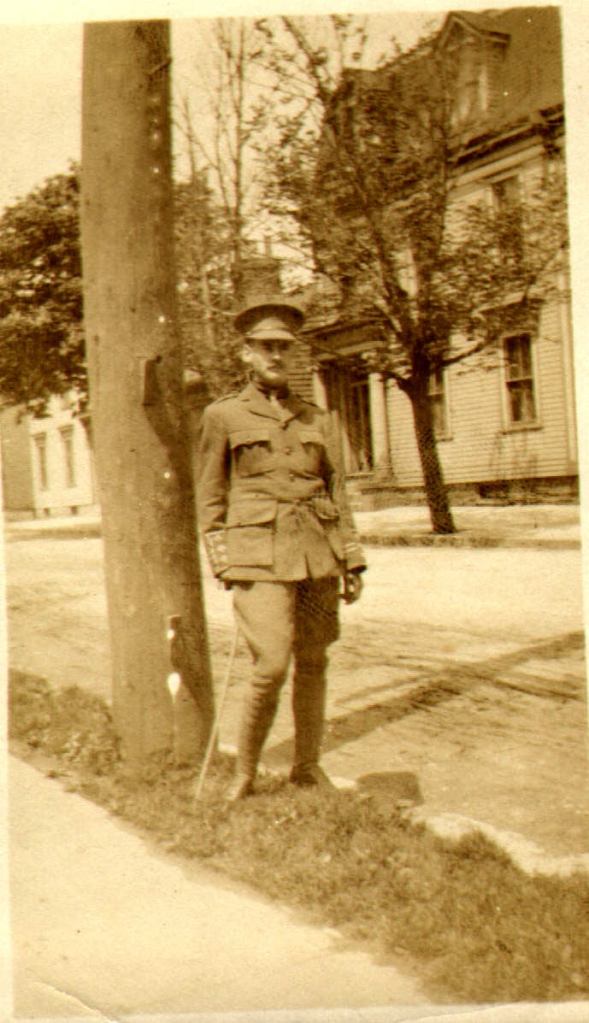
Norman on leave in New Brunswick 1916
His community held a party in his honour in January 1917, and another medical board found him fit for duty again in February. By April 1917, Norman was back in the field, although he missed the “party” at Vimy that Easter.
In November 1917, the Gazette reported Norman’s promotion to the rank of Temporary Captain, one which he would hold for the rest of his service. The 25th battalion was then involved in all the major battles fought in the subsequent months, fending off the Germans in the spring offensive of 1918, and into the beginning of the end, Canada’s 100 Days. It began with the Battle of Amiens. On 30 July, the men were loaded on a convoy of former London buses, a departure from forced marches designed to save the men’s feet. The attack was planned for 8 August with the 25th Battalion assembling the night before in front of Villers-Bretonneaux, prepared to advance on Weincourt, Guillaucourt and Marcelcave. The Allies’ advance was 10 miles deep and 15 miles wide. The Germans lost 30,000 men. In the words of German General Erich Ludendorff, it was “the black day of the German army”. It was a turning point, the Germans suddenly on the defensive and fast losing hope of anything but defeat. In just over two months, the war that had seemed unending would be over, the guns silenced. Unfortunately for Norman, he was injured for the second time, and this time he was not so lucky. He succumbed to his injuries within a few hours and is buried at Villers-Bretonneaux Military Cemetery. In December 1918, with the war over and his battalion waiting to get home, Norman was mentioned in despatches by Sir Douglas Haig.
An Apology
30 October 2025
This is an apology for neglecting my posting here. Life has been busy – excuses, excuses, right? – preparing for a big trip, sailing my boat to the Bahamas. Life on a boat isn’t conducive to writing or research, but I gave myself a kick in the seat of the pants to get back at it. Last week, I began looking into the last four of the 2nd Battalion R.E. Farm boys buried with Jim and to my horror and bafflement, I cannot retrieve any records from Library and Archives Canada. I can view the attestation papers only and nothing else. I don’t know if its because I am in the US, or because I am connecting through Starlink. I’ve tried using a VPN with no success. It’s frustrating and disheartening. I want to bring these young men’s stories to the public and I cannot get the most important information about them: their records of service. Until I get this figured out, this blog will stagnate, but I will be back! If not sooner, than when I am home for the month of December, during which time hopefully I can access records. Sorry and stay tuned!
Nothing of Note
23 July 2025

February of 1916 was a quiet month in the trenches in that low rolling countryside south of Ypres, near Mount Kemmel and Messine Ridge. The days alternated bright sun and rain, and late in the month there was snow. Jim described it as huge flakes like he’d seen at home in Nova Scotia. I’ve seen that kind of snow, flakes softly drifting down, no wind, the world hushed and beautiful. Those days were noted as quiet, even “very” quiet in the battalion war diary, with often “nothing of note” but the occasional desultory shells lobbed over by the enemy. But there was something of note that happened. Seven men died, their war ended swiftly and without any glory. I’ve told the stories of Harry and Henry, of James Maxwell and, of course, James Johnstone. There was a failed trench raid that cost the life of one of the most popular officers in the battalion (Captain George Richardson who is buried in Bailleul and is written about in my book Somewhere in Flanders). Here is the story of the last three who lie with their comrades in R.E. Farm cemetery.
Private John Clark is one of those disappointing cases where I cannot find much information and no photo. His family is a mystery; I can’t find any siblings, and having enlisted at only 18 years old (although he was assessed at being 19), he left no wife or children to mark his place in existence. He was born to Charles and Mary Clark on 26 November 1896 in Ridgetown Ontario, and in 1915 was living in Fraserburg, Muskoka, Ontario. Still a rural area, north of Toronto, Fraserburg is now part of Ontario’s “cottage country” where thousands of people flock to escape the hustle of city life. Then, the Clark family was busy running a farm. While not a big man at 5’ 7”, brown-haired, blue-eyed John was strong and muscled from hard work.
In January of 1915, John went to Windsor, Ontario to enlist in the 33rd Battalion. He would remain in Canada for many months, training no doubt, as the First Contingent went to the front, faced the trials of Second Ypres, Givenchy and Festubert. Finally, the battalion made its way to Montreal and embarked on the S.S. Hesperion on 17 August 1915. Arriving in Shorncliffe on 26 August, the 33rd was immediately absorbed into the 9th Reserve Battalion, and there John would linger on the idyllic shores of eastern England for the rest of the summer, the fall, and into the winter.
On 20 January 1916, more than a year since he enlisted, John was taken on strength of the 2nd Battalion. It would take nearly two more weeks before he joined the battalion in the field, on 2 February 1916. In another two weeks, he would be killed, not even while in the firing line. The battalion was at Tea Farm, approximately a kilometer and a half back from the front, in reserve battalion lines. A few German shells fell in the vicinity. At some point in the day, a working party of more than 350 men went to help a Engineering and Tunnelling Company. Its impossible to say where exactly John was or if he was part of the work party. All we do know is the day was bright with sunshine which would have been a nice break from the rain of the day before. Was this just plain bad luck, a case that his number was up? Did the year of playing at soldier in safety lull him into false confidence and carelessness? Had his parents even received a letter to say he was headed to the front lines? So many questions unanswered!
John was buried in plot III. A. 15 and beside him was an empty space, that would not be empty for too much longer, for that would be where Jim Johnstone would join John in rest.
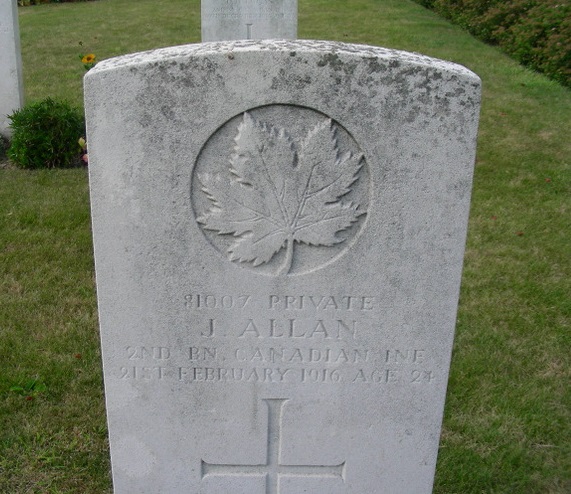
Private James Allan was another farmer, this time from out on the prairies in Manitoba. James came from a large family. His father, John, had emigrated from Scotland with his first wife, Elizabeth Robertson and their four sons, Alexander, Peter, John and James (Jim). Sadly, Elizabeth and her newborn daughter, also called Elizabeth, both died in 1882, along with 2-year-old Jim. Life was cruel then. John remarried Ann Reid Howie a year later, and welcomed Andrew, Mary, Helen, Isabella, (our) James, Martha and William, but was once again left a widower in 1900, when James was 8 years old.
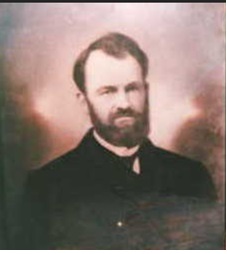
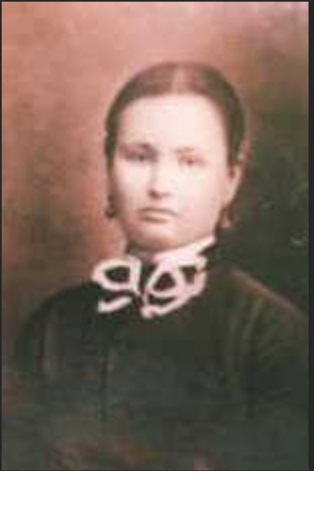
John and Ann Allan
James had been born in Hemiota, Manitoba on 1 November 1891. By December 1914, he was farming in Oakner, Manitoba, presumably still living with his father as he had been in 1911. The 23-year-old James was an imposing lad, standing 5’ 10” and weighing in at 165 pounds with a substantial 40” chest. Not just a farmer, James was also an athlete.
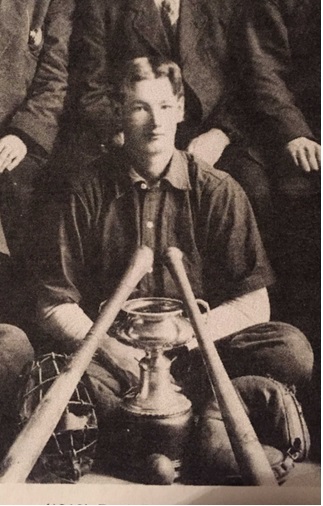
James Allan
By December 1914, 23-year-old James had decided to “do his bit”, enlisting in Winnipeg with the 32nd Battalion, and leaving for England in April 1915. On 5 May 1915, he was transferred to the 2nd Battalion but didn’t arrive to join the unit in the field until 31 July 1915.
While James may have missed the “big” battles and only arrived in time for occupying the quiet lines at Ploegsteert and Messine, it doesn’t mean he was safe. On 23 October 1915, he took a bullet to the neck, and although it was deemed a “slight” wound, he spent more than a month in the No.22 General Hospital in Camiers, France, and another full month at the Base Depot recovering. No doubt he wrote his father letting him know he was fine and how lucky he was. With a brand-new wound stripe sewn on his sleeve, James returned to the 2nd on Christmas Day 1915. On 1 February 1916, James was granted nine days leave. Considering that some who’d been in the line since March only got leave in January, he was very fortunate. Likely he headed to London for some sight-seeing, good food and fun. The 21st of February was Jim’s Nova Scotia-snow day, the huge flakes melting as fast as they hit the ground. It was “very quiet.” Again, there was nothing of note, except that is a small personal tragedy; James was not so lucky and was killed “in action”. Not much action, it seems. He lies in plot III.C.13
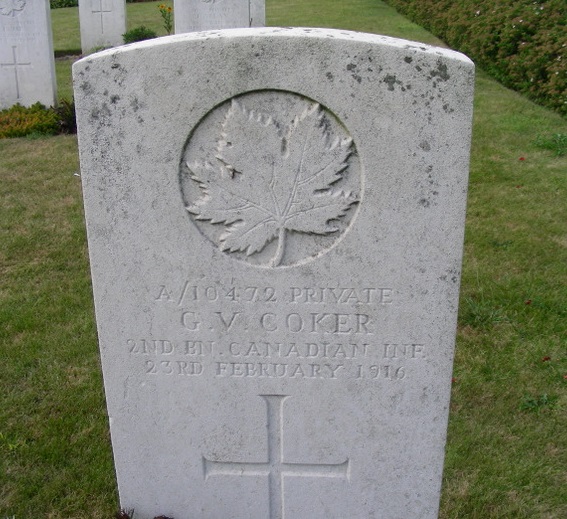
Jim Johnstone died the next day, followed by James Maxwell on the 23rd. Three James boys gone suddenly, almost unexpectedly, that meaningless attrition of war. Maxwell was not the only unmentioned loss on the 23rd; there was also George Coker.
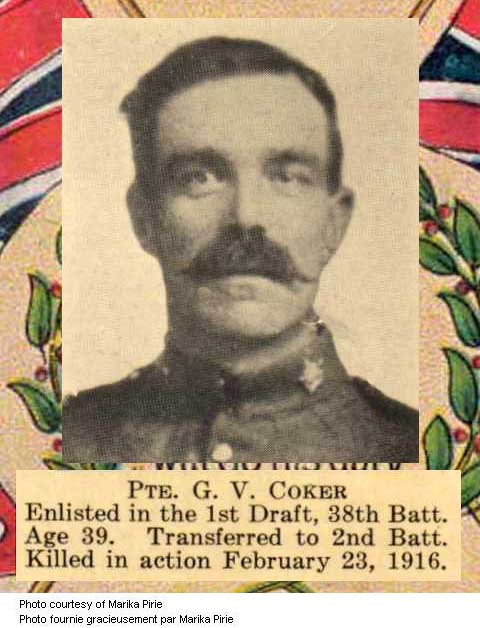
Private George Victor Coker was the eldest by far of the lot, and the most experienced military man, too. George was born on 23 July 1876 in London, England to Frederick and Jane Coker, fourth of their six children. Son of a bricklayer, George took a different path than his father, joining the Royal Marines Light Infantry on 21 December 1893. For the next 12 and a half years, he served on a number of ships: Hood, Thetis, Archeron, Katoomba and Diadem, acquiring a number of tattoos including an anchor and a soldier on his forearm.
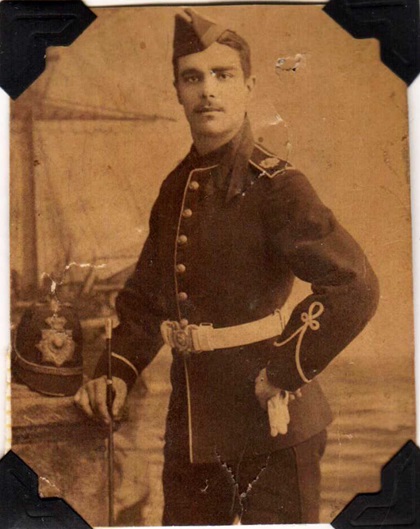
16-year-old George on his enlistment to the Royal Marines Light Infantry
Discharged from the service in July 1906, George made his way to Canada, where he fell in love and married a divorced woman ten years his senior with four children from her first marriage, Theresa Elizabeth (Hupfield) Wilson, on 4 June 1910. George and Theresa would have no children of their own, likely due to Theresa’s age.
The family was living in Ottawa when George enlisted on 23 February 1915. Dark-haired, hazel-eyed George was a half inch taller, at 5’7”, than on his enlistment in the Royal Marines as a 17-year-old, but he still was a dashing and handsome man, with a magnificent mustache.
George had joined the 38th Battalion, and of course, was transferred to the 12th Reserve Battalion on arrival in England. Undoubtedly, he took the opportunity to visit his family in London. In late August 1915, George was transferred to the 2nd Battalion. From this time there is nothing noteworthy on his record. He did his job quietly, willingly and without injury; he was an old hand who knew how to obey orders. On the cold, clear, quiet February day – exactly one year to the day that he’d signed his attestation papers – George was killed. He was laid to rest in plot III.B.13. Theresa never remarried.
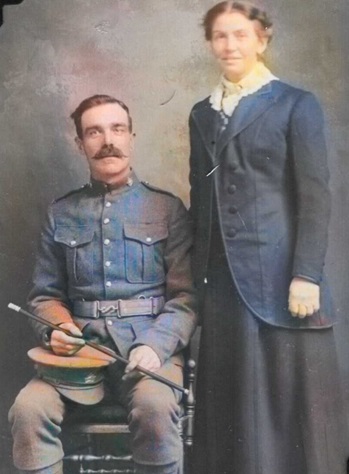
George and Theresa Coker
Follow Up on George Welsford
12 June 2025
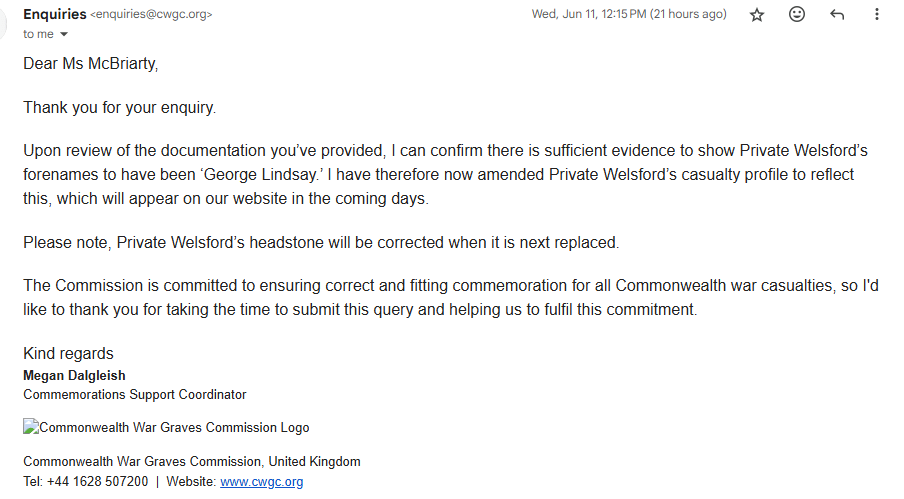
I want to give a huge shout out to the Commonwealth War Graves Commission in their incredible work and dedication to the war dead of both world wars. They are tireless in their care of the graves and the memories of the fallen. Their work is never ending, identifying remains of soldiers found during road repairs and building jobs, identifying those buried as “Know Unto God” and unidentified for decades, and correcting errors in those already identified. This is the third time I have sent them information, this time on George Welsford, who was marked as L. Welsford on his grave in R.E. Farm. They carefully verified the information I sent them and immediately set about correcting his information. Perhaps there is no family to ever know about the error or the correction, but that never means they neglect to update headstones and on line records. The men and women of the CWGC – from the gardeners to the researchers – are unsung heroes in commemorating those who gave their tomorrow for our today.
Henry and Harry
7 June 2025
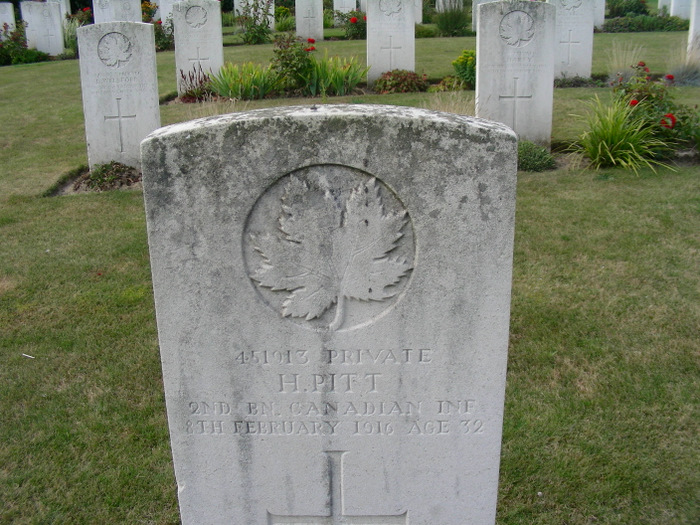
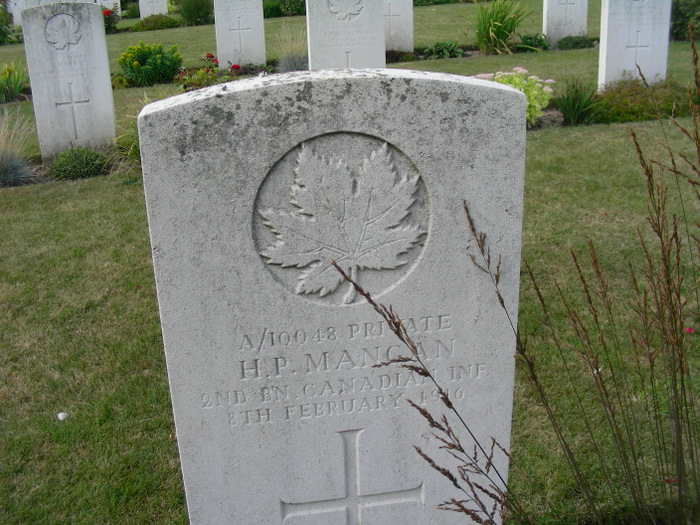
Private Henry Patrick Mangan was a Home Child, one of thousands sent from England to Canada in hopes of a better life than on the uncaring English urban streets. At 14, he was shipped from Liverpool to Montreal with a large group of other boys. While many of these children, especially boys, were harshly treated and abused as little more than unpaid labour, most did manage a better life. For Henry that meant a job, a wife and for a brief period, fatherhood. But Henry had had a rough start in life, and it did not fail to surface during his time at the front.
Henry was born on 8 July 1892. His parents are unknown. By 1901, he was a resident of St. Georges Industrial School in Liverpool, where he claimed on his attestation papers to have spent five years in their militia. Industrial schools were created to tackle child vagrancy. Harsh places of strict discipline, they nonetheless got poor, orphaned or homeless children, children whose parents could not control them or were not offering adequate care, off the streets. The schools taught these children trades in hopes of having them employable. Which category Henry fit – vagrant, orphaned or surrendered – is unknown. In July 1905, Henry was sent to Canada, probably because his run at St Georges had concluded. By 1912 he was working as a painter in Ottawa, Ontario, and on 23 November 1912, married Mabel Elsie Fiander, a young woman who had emigrated from Sheffield, England to Canada only four months before. On 26 June 1913, they welcomed a daughter. Perhaps she was born too early, as the poor baby died the next day. There would be no more children for the couple.

S.S. Missanabie
Henry enlisted in the CEF in February 1915 in Ottawa with the 38th Battalion. A slim 5’ 4” brown-haired, blue-eyed 22-year-old, he barely made the minimum physical requirements. Just four months later, on 24 June 1915, Henry sailed on the S.S. Missanabie to England with Elsie following. Elsie returned to Sheffield, probably to live with family, while Henry was transferred to the 12th Reserve Battalion. For a while, things must have been going well with his training. Within weeks of arriving, Henry was promoted to Lance-Corporal on 19 July 1915, however, it was not to last. His hard upbringing on the streets, in an industrial school, as a Home Child must have led him into conflict. By 13 August, he had been reduced in rank back to private and assessed a 24-day #2 Field Punishment (F.P.), with deduction in pay. In fact, almost $215 was deducted from Elsie’s pension payout, likely dating to this incident. What was #2 F.P.? While a step down from #1 and being tied to a fence or post for a set number of hours per day, an offender was still manacled and sometimes fettered while continuing to march and drill with his unit. In addition, Henry was subject to hard labour for those 24 days. Whether that occured or not is uncertain, for two weeks later, on 28 August 1915, Henry was sent to join the 2nd Battalion in the field.
Not all deaths at the front were the result of enemy action. Henry’s was a case in point of how dangerous all tools of the fighting were whether it was theirs or yours. Not quite a year from the date he’d enlisted, Henry was in a dugout with comrades. They, or one of them, must have had one of the Mill’s bombs most soldiers carried out to look at or fidget with. A Mill’s bomb was the name for the first English fragmentation grenade designed by William Mills, made with the typical “pineapple” cut design which exploded into nasty pieces. On 8 February 1916, someone accidentally dislodged the pin, and the grenade exploded. While others may have been injured and perhaps even died of those injuries later, Henry was killed outright. He was laid to rest in plot III.B.8.
Private Harry Pitt died the same day as Henry Mangan but in vastly different circumstances. While they were both English ex-pats, they were also very different men. Harry was 11 years older, a substantial 5’ 10” which was very tall for the era, 165 pounds, with a broad chest. A farmer, Harry was used to hard work and discipline. He never married.
Harry was born on 9 April 1883, to George and Caroline Pitt of 18 Wallace Rd, Victoria Park, London. In 1909, as a 26-year-old, he emigrated to Canada, arriving on the Empress of Britain in Quebec in October. By1915, when he enlisted, he was farming in the Niagara region of Ontario, a warm and richly fertile area known for agriculture (now especially growing grapes for its wine industry). Harry joined the 58th Battalion on 30 June 1915 and on 17 August 1915, was on his way home to England on the S.S. Hesperian (which would be torpedoed and sunk a month later). His father was dead by then, but I must hope he was able to visit his mother. Harry was immediately placed in No. 3 Company of the 12th Reserve Battalion on 26 August and spent the next three and a half months training. On 13 December 1915, he finally was transferred to the 2nd Battalion and joined the unit in the trenches near Wulverghem a day later.
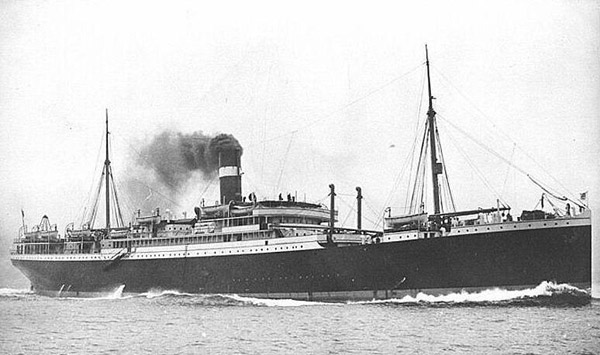
S.S. Hesperian
Arguably, Canadians pioneered and perfected the art of trench raiding. Trench raiding was a nighttime operation of stealthily creeping across no-man’s-land, dashing into the enemy trenches to grab prisoners and therefore information valuable to HQ. Raids were carried out by volunteers, and were nasty, brutish events, the weapons carried into them often makeshift and silently deployable. On the night of 8 February 1916, one such “stunt” as Jim Johnstone called it, was planned. Jim had volunteered, and so it seems had Harry. In command of this raid was Captain George Richardson, eventually a Canadian Hockey Hall of Famer, and whose story I wrote about in Somewhere in Flanders. Richardson would not survive this raid, and neither would Harry. The shelling meant to break the wire failed and merely alerted the Germans who were waiting. The advance party, of which Harry was likely a part, came under heavy fire; Richardson was badly shot up trying to come to their rescue. The war diary fails to remark on this terrible cost, merely saying “scheme postponed”. While Richardson survived long enough to be evacuated to a hospital in nearby Bethune, where he is buried, Harry lies close to where he fell, at R.E. Farm cemetery in plot III.B.7, side by side with his countryman, Henry.
The Final Days
26 May 2025
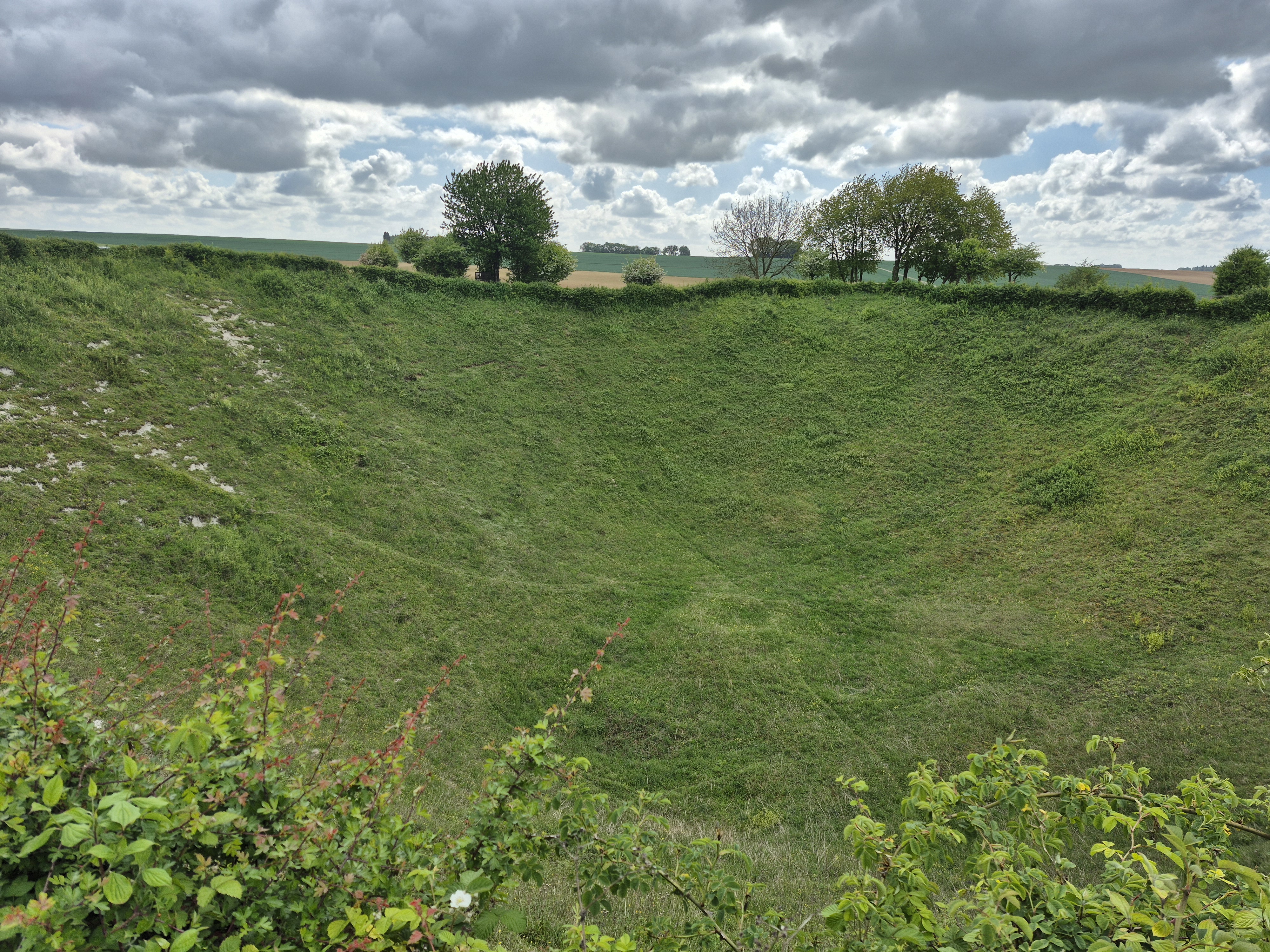
It was such a short trip and we packed a great deal into those six days. I completely forgot to write about the sites we visited in France on the Monday, day three. Leaving Ypres early, we headed south to the Somme. There we visited Beaumont-Hamel, Lochnagar Crater, the Canadian Monument in Courcelette, The British Tank Division Monument, the Windmill and finally drove to Cambrai to visit a friend’s great-uncle. In a tiny, out of the way cemetery, along with the Canadian casualties of the 100 Days/Canal du Nord fighting, there were the graves of a RCAF Lancaster bomber crew, lost in a bombing raid over Cambrai in 1944.
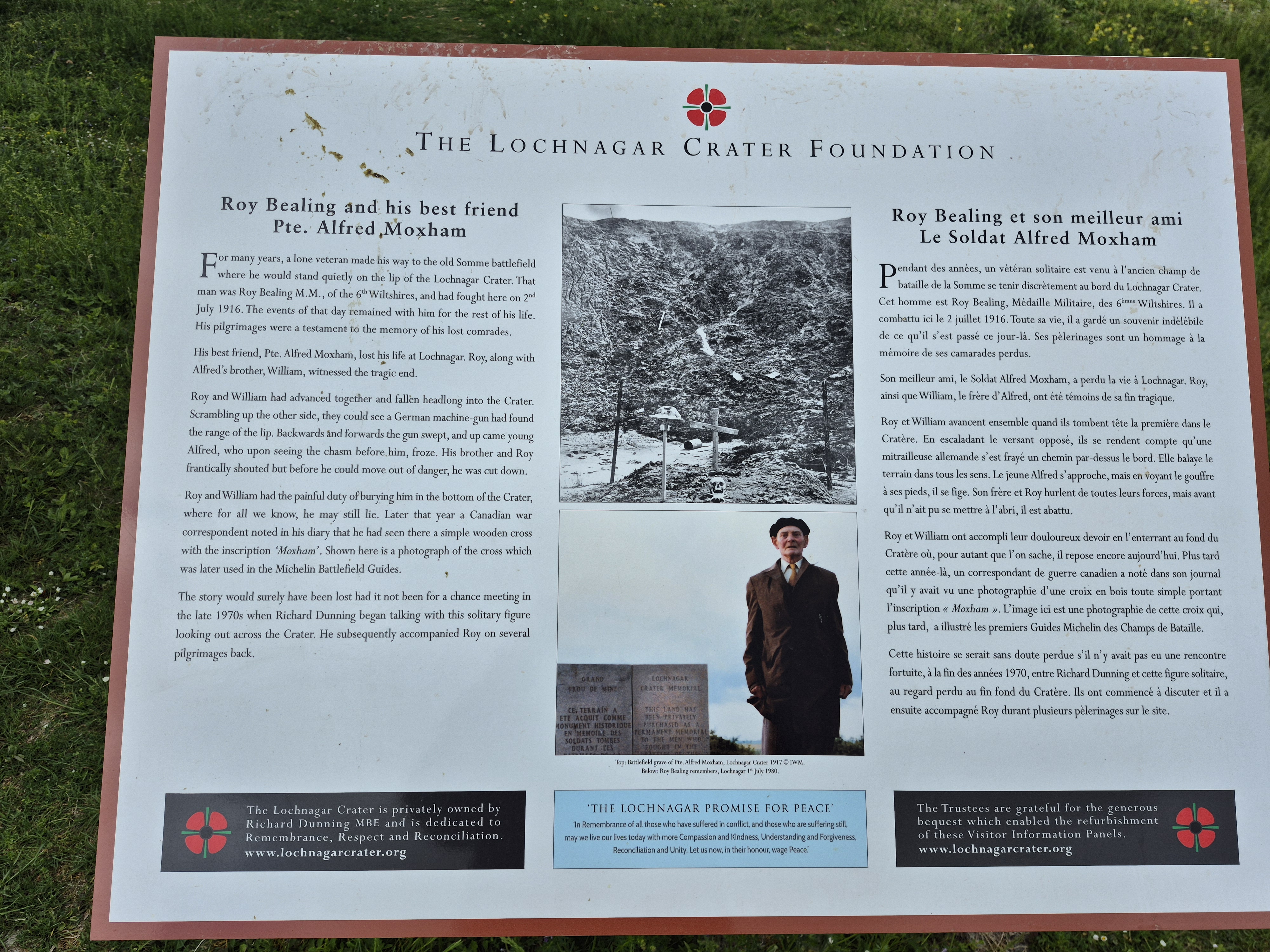
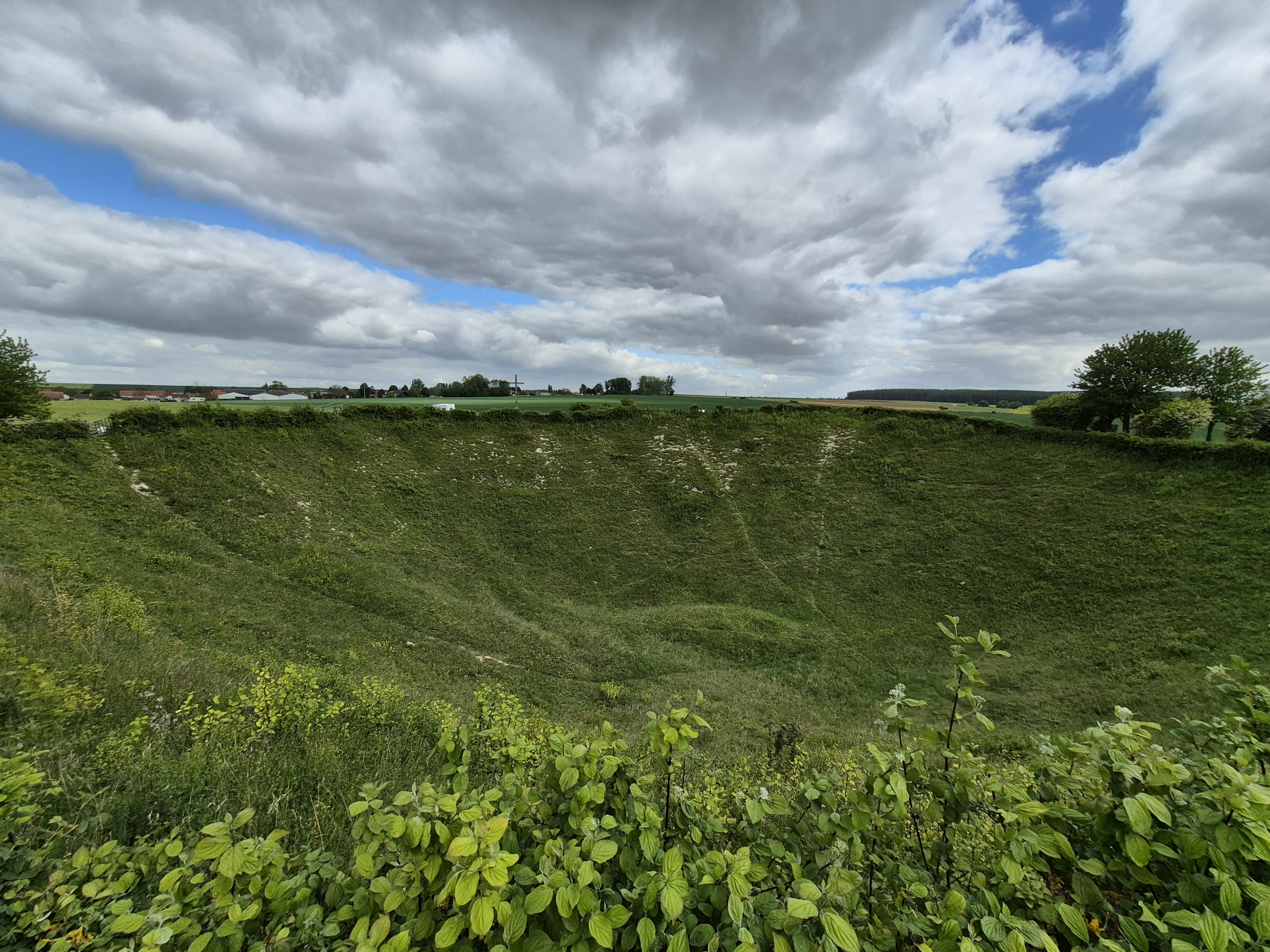

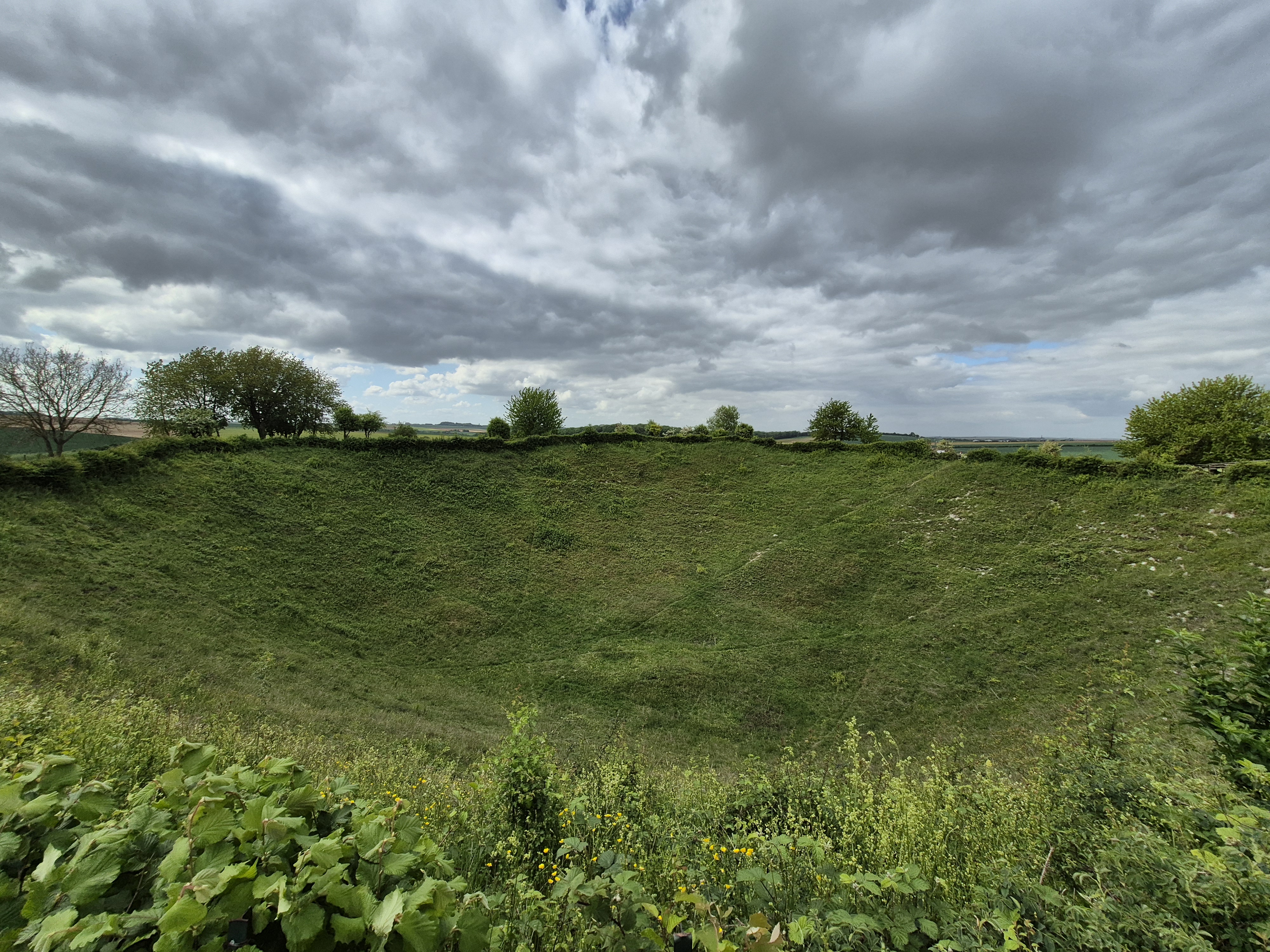
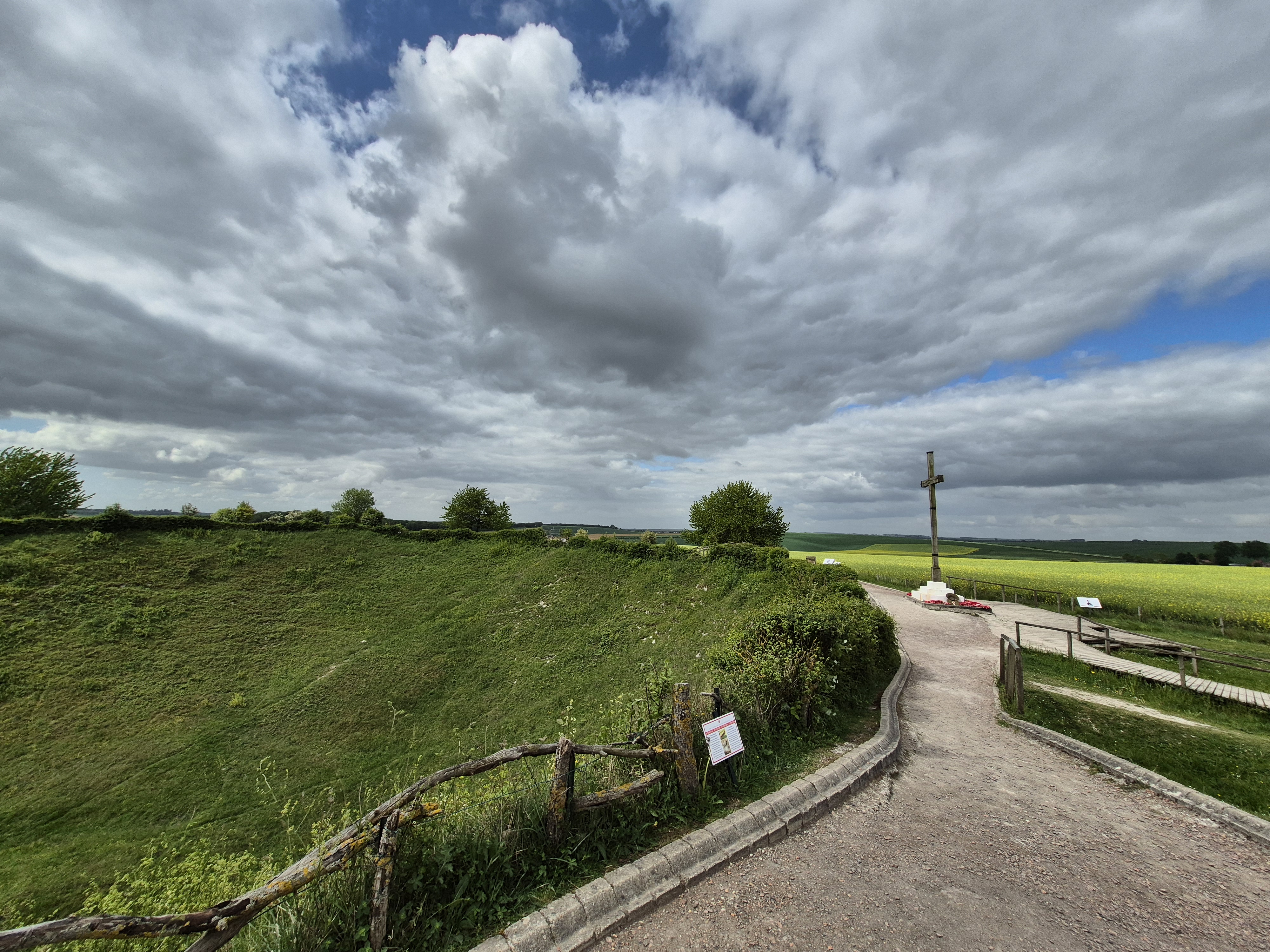
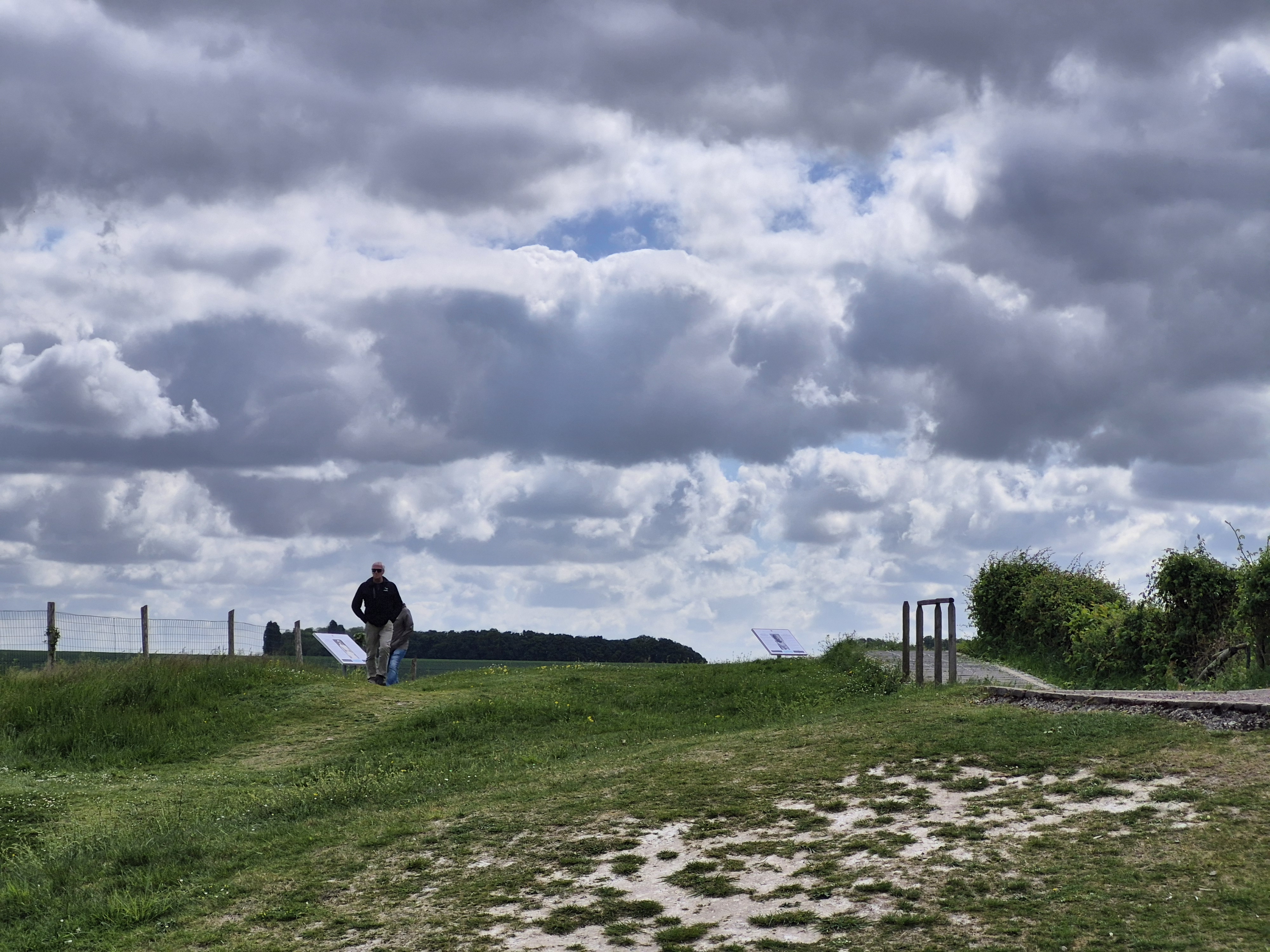
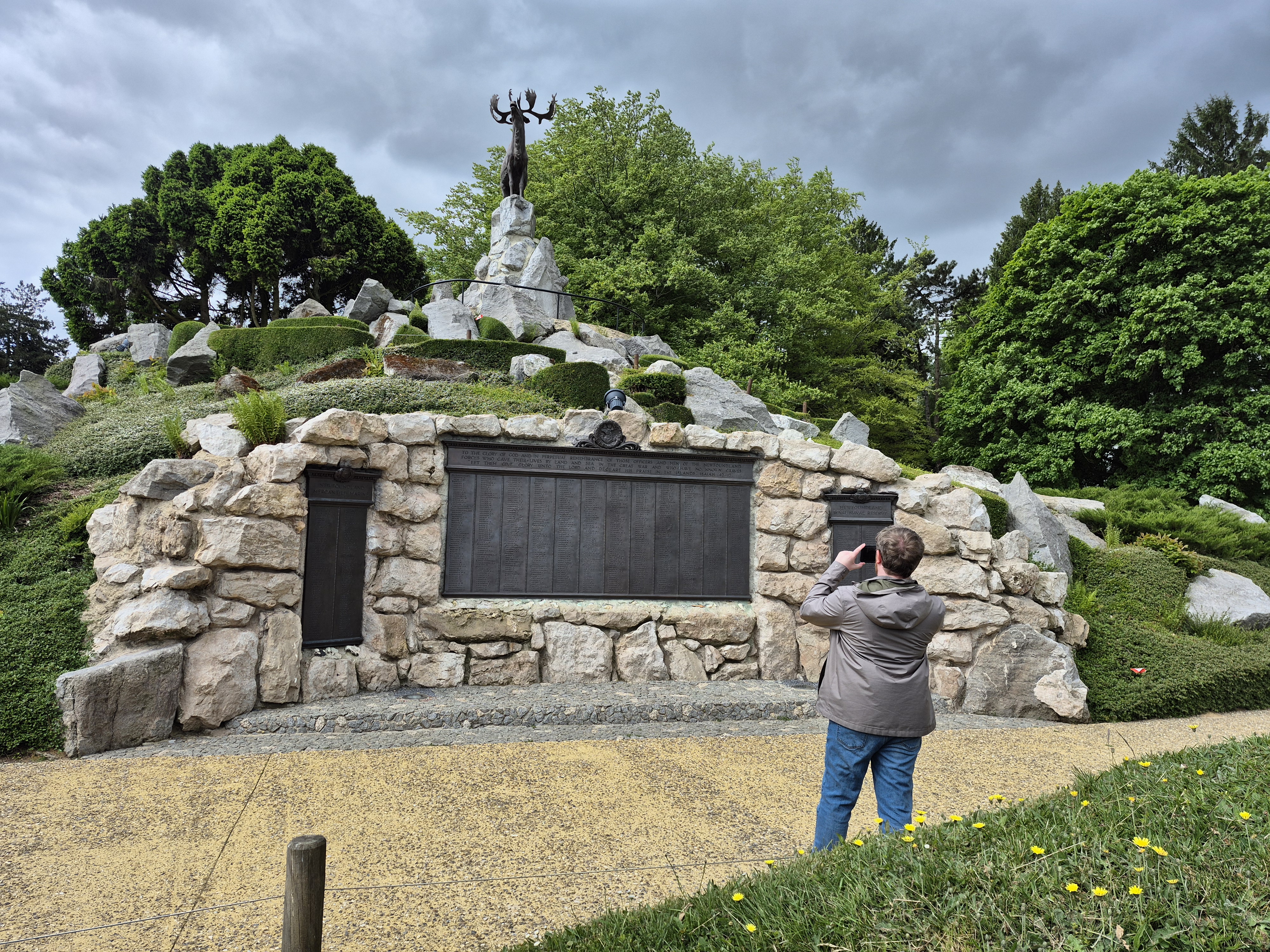
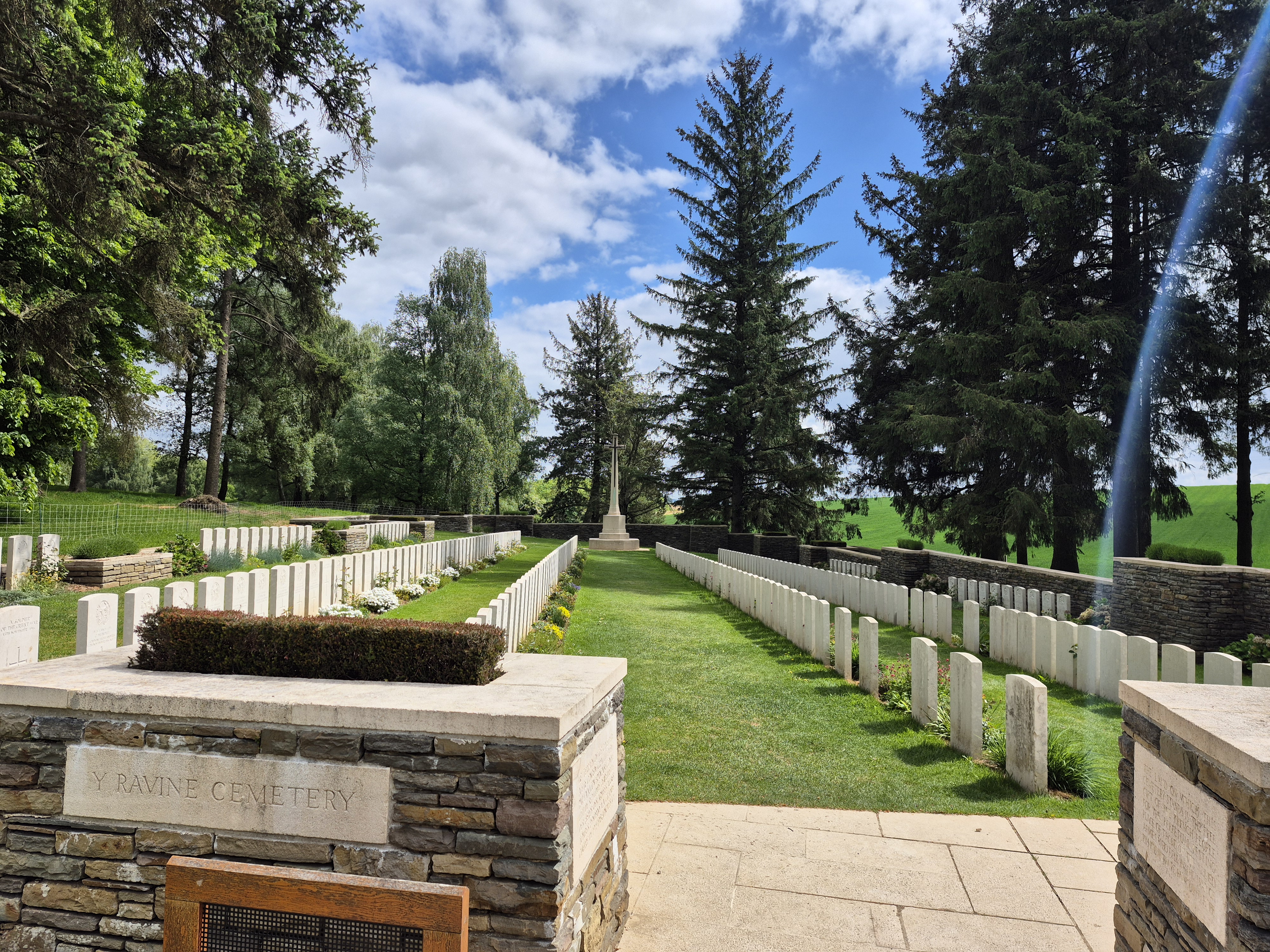
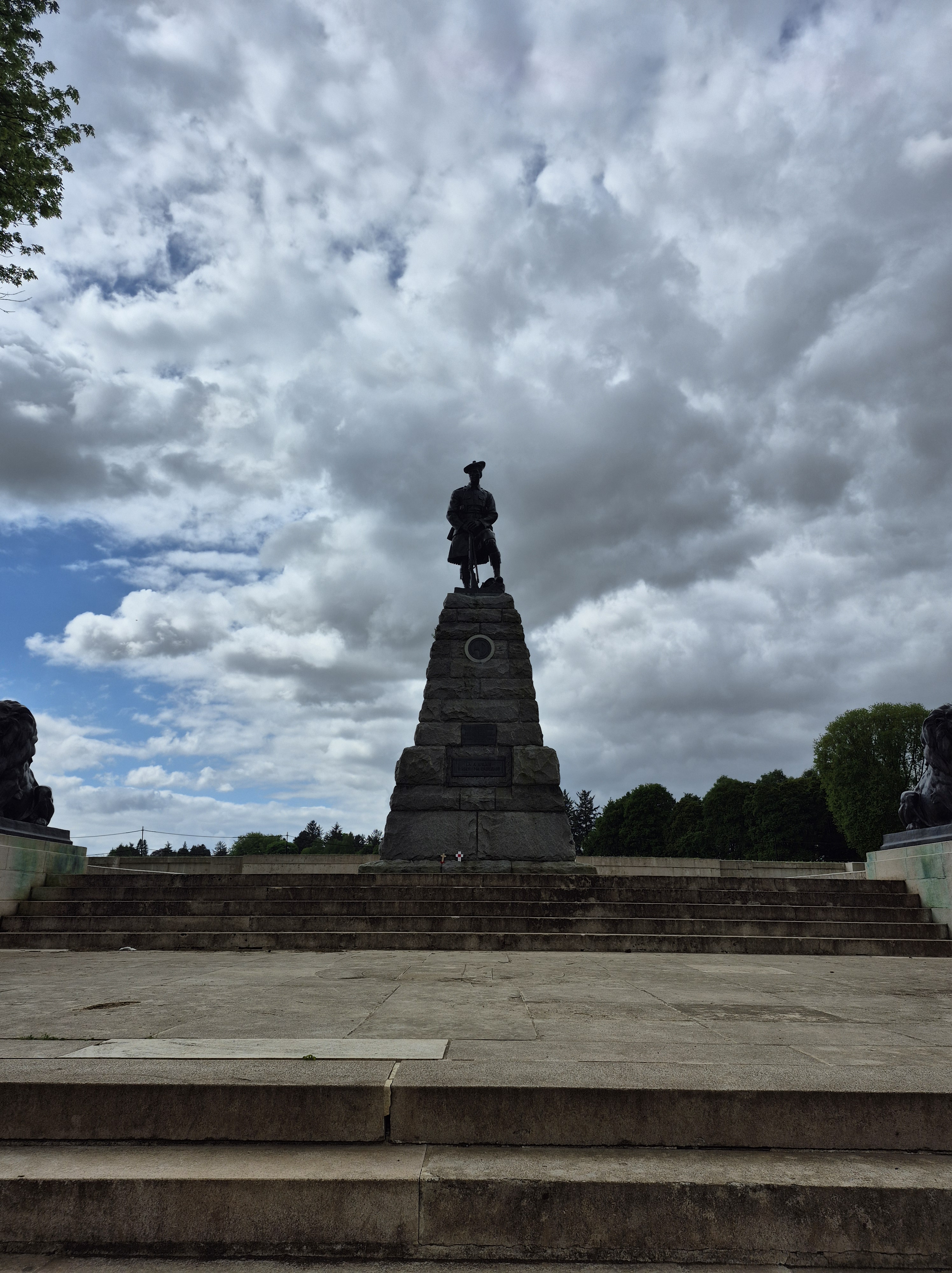
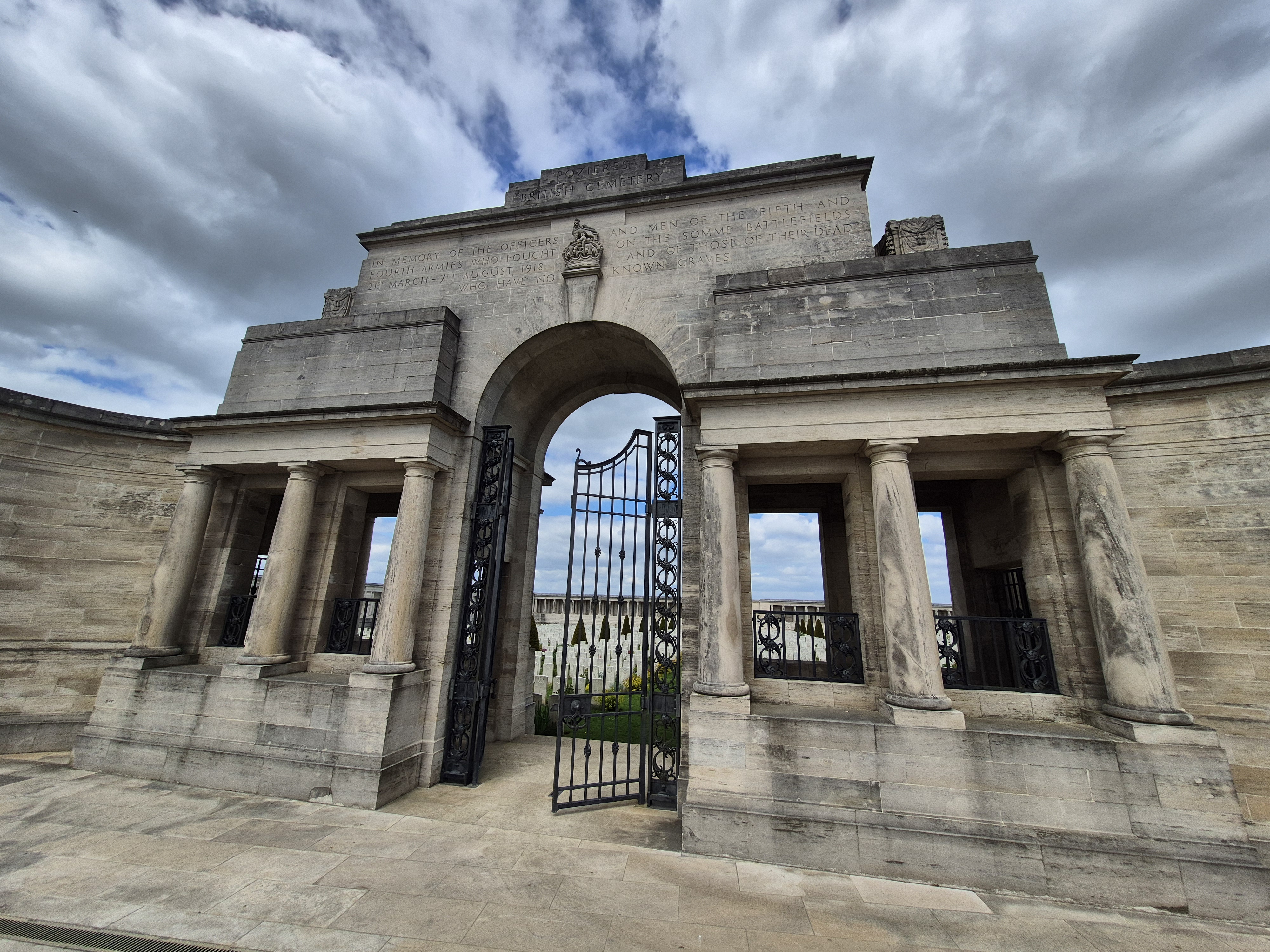
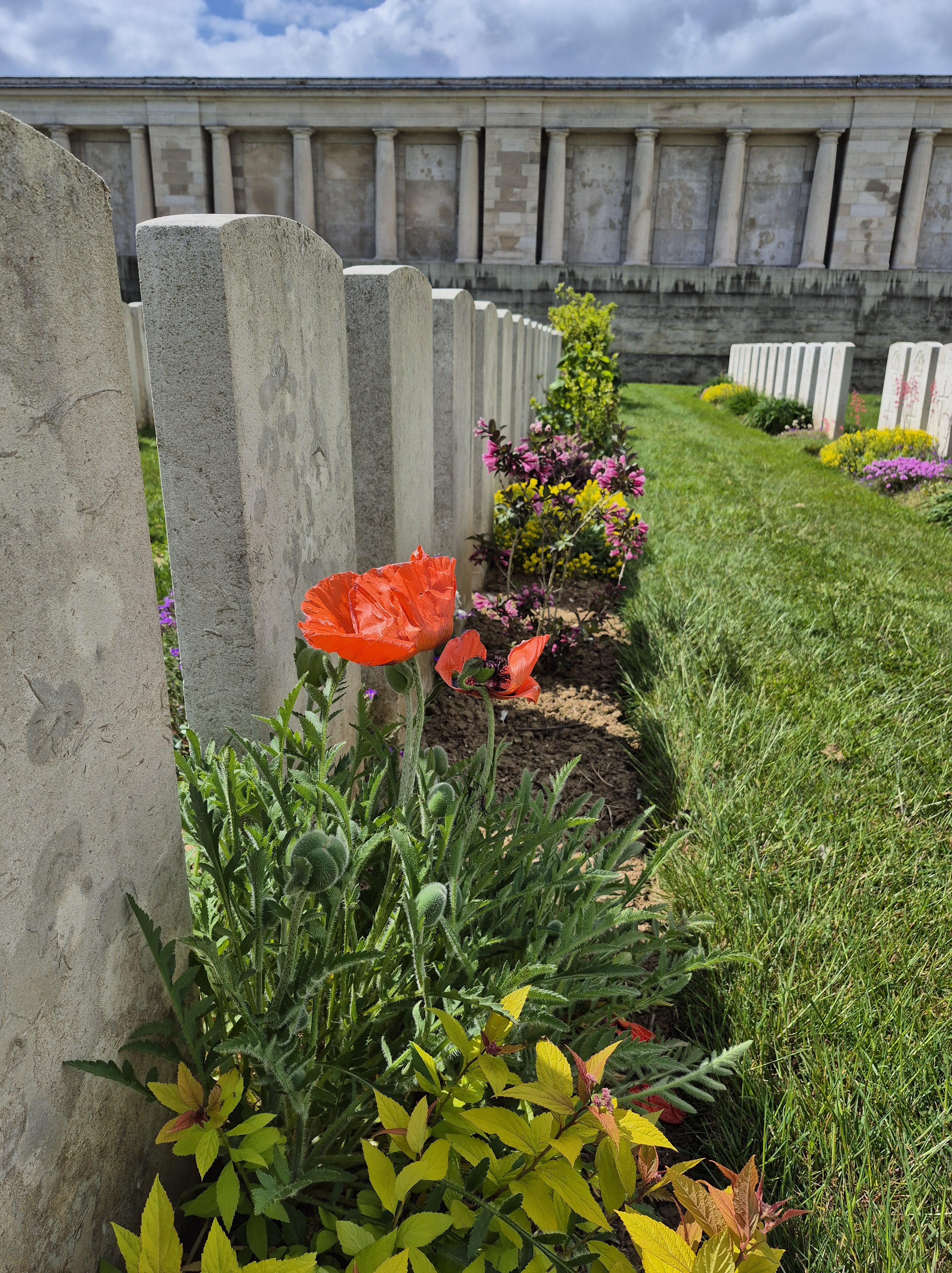
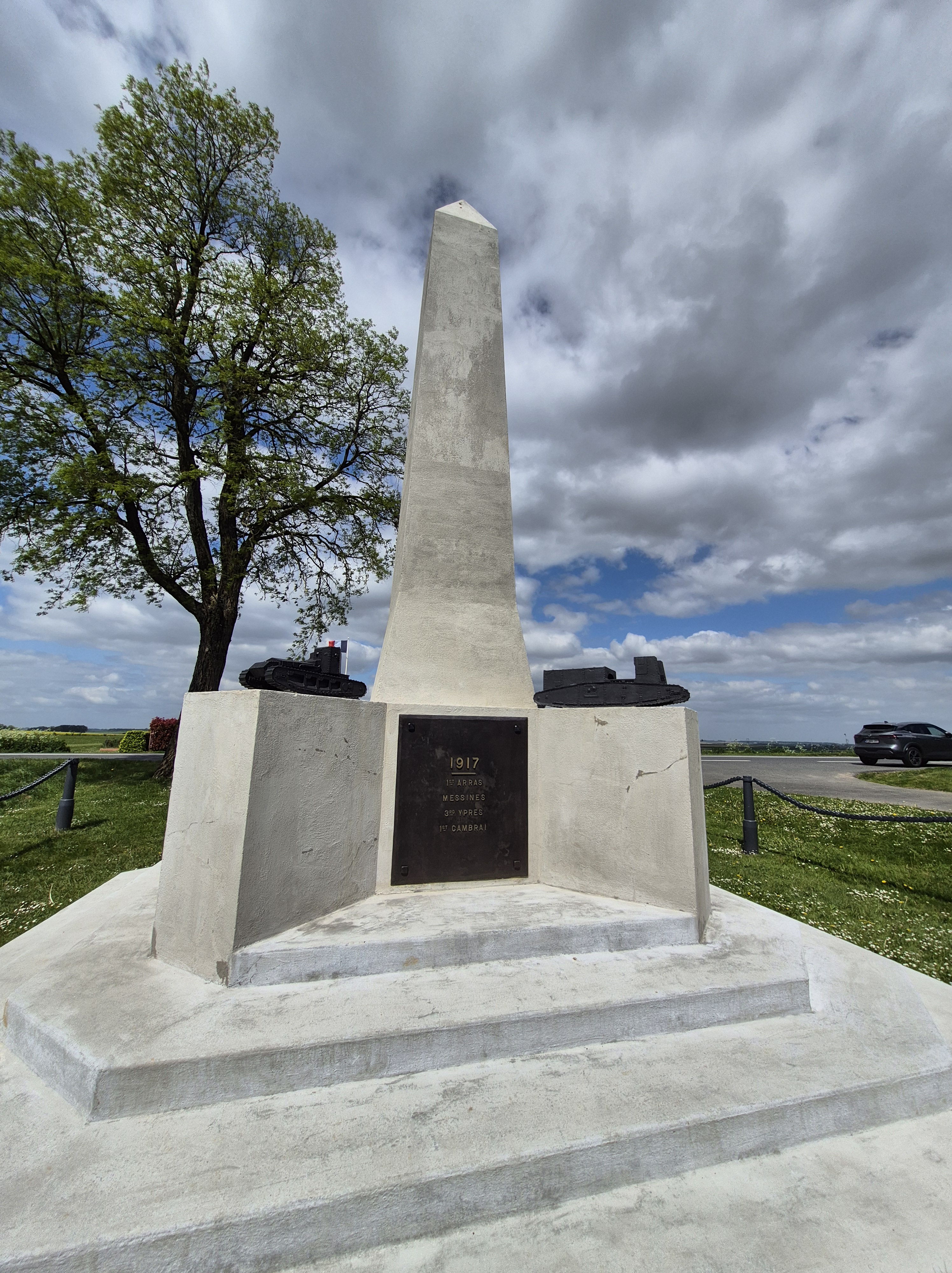
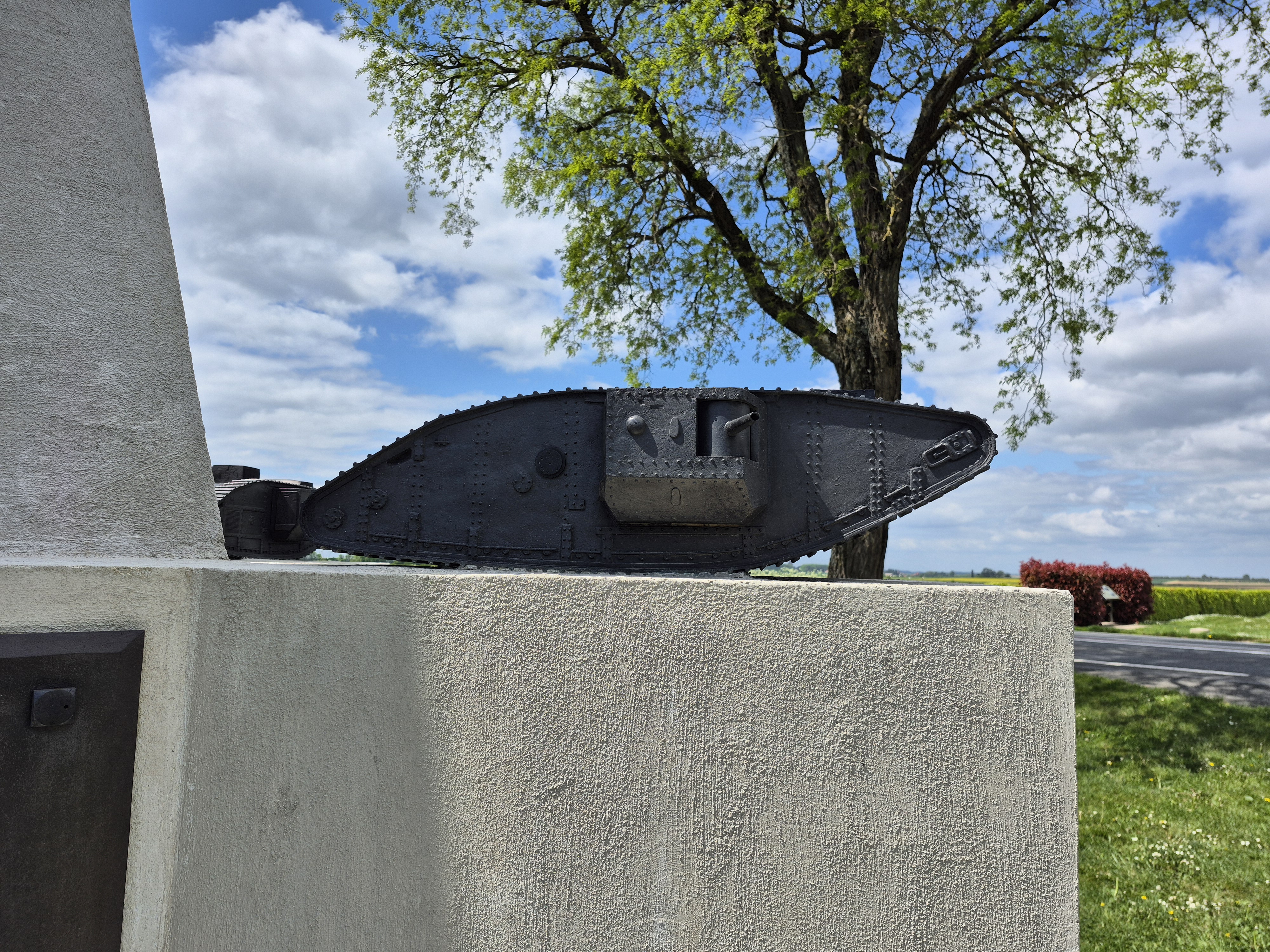
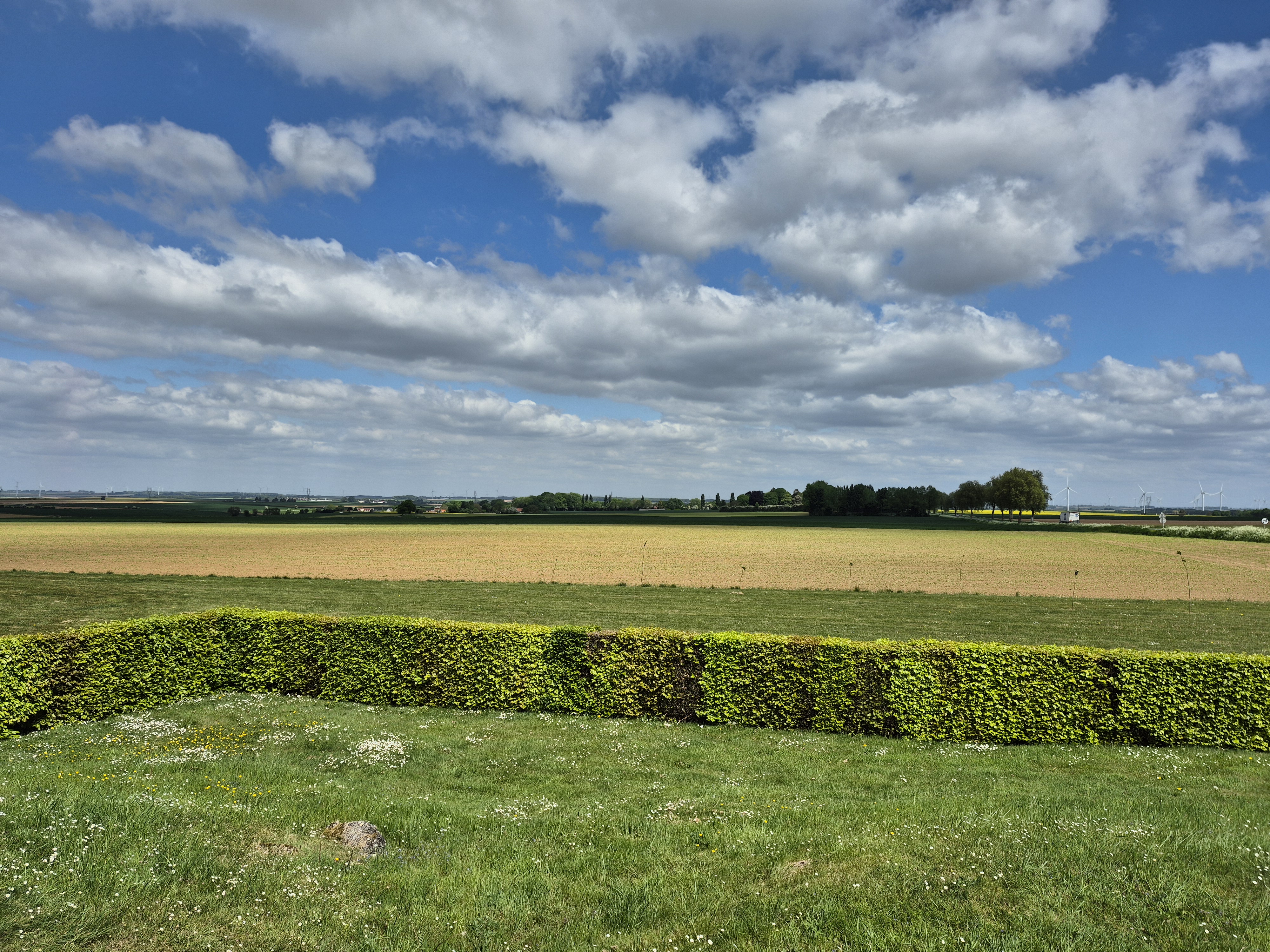
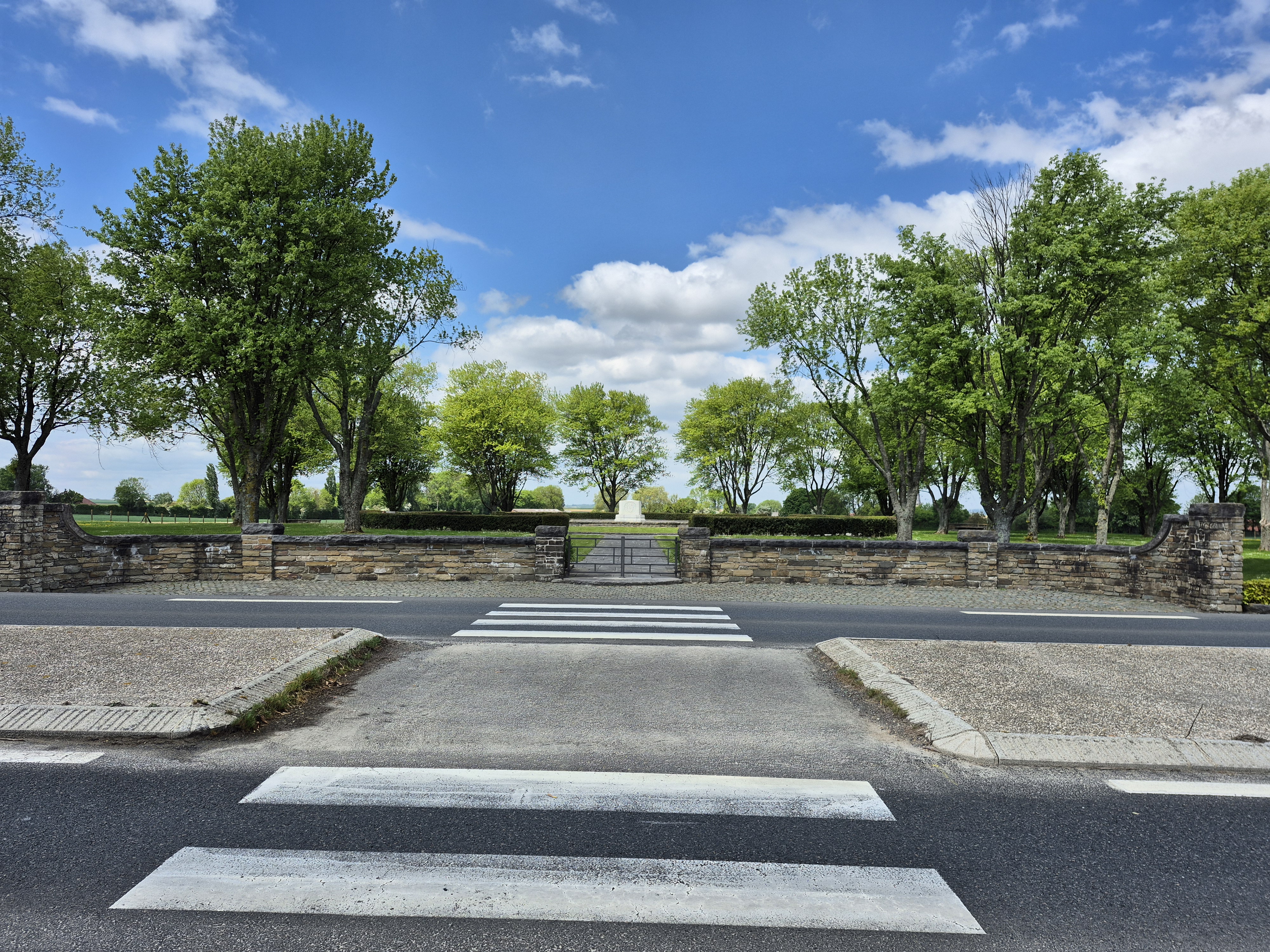
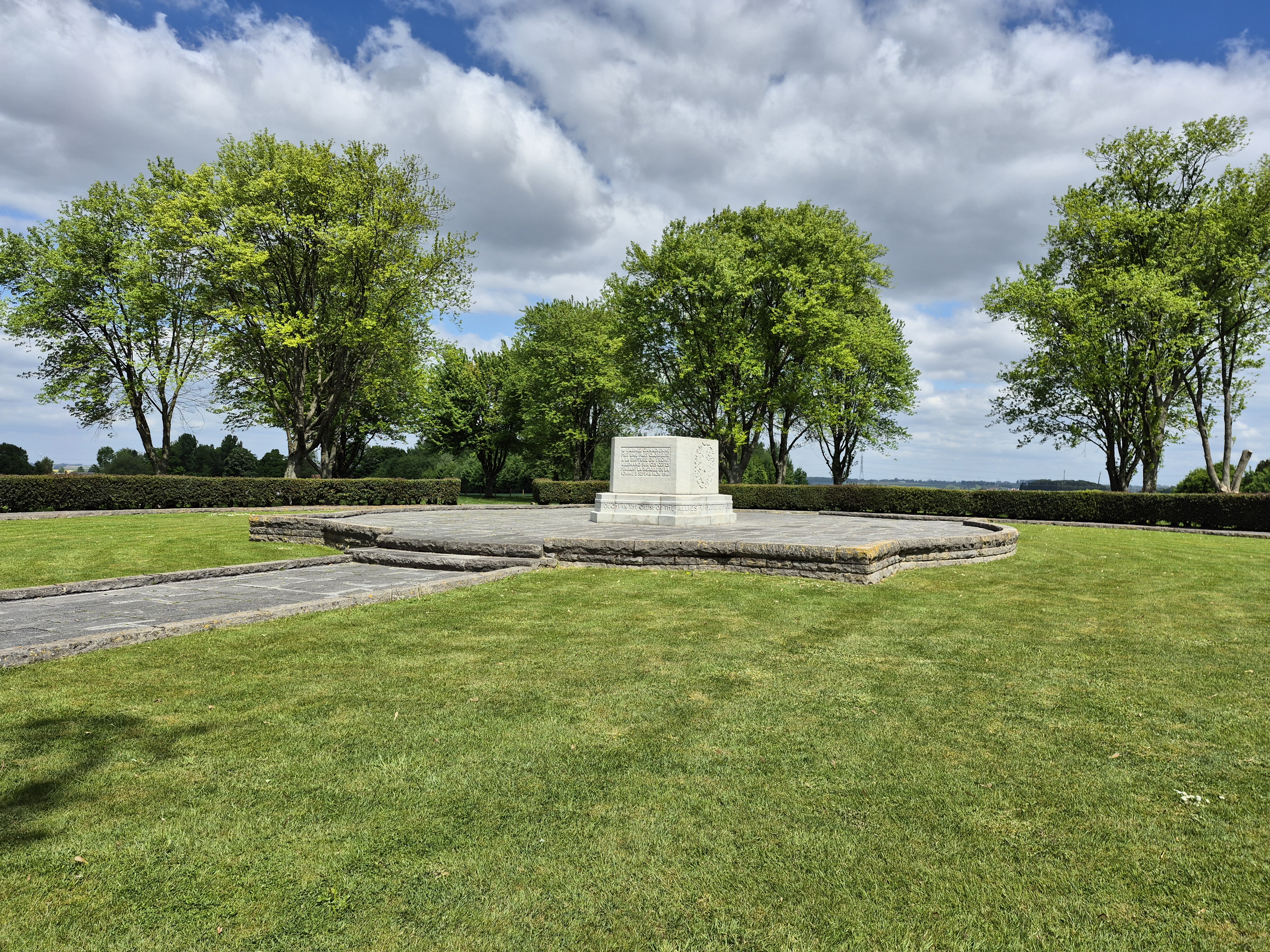
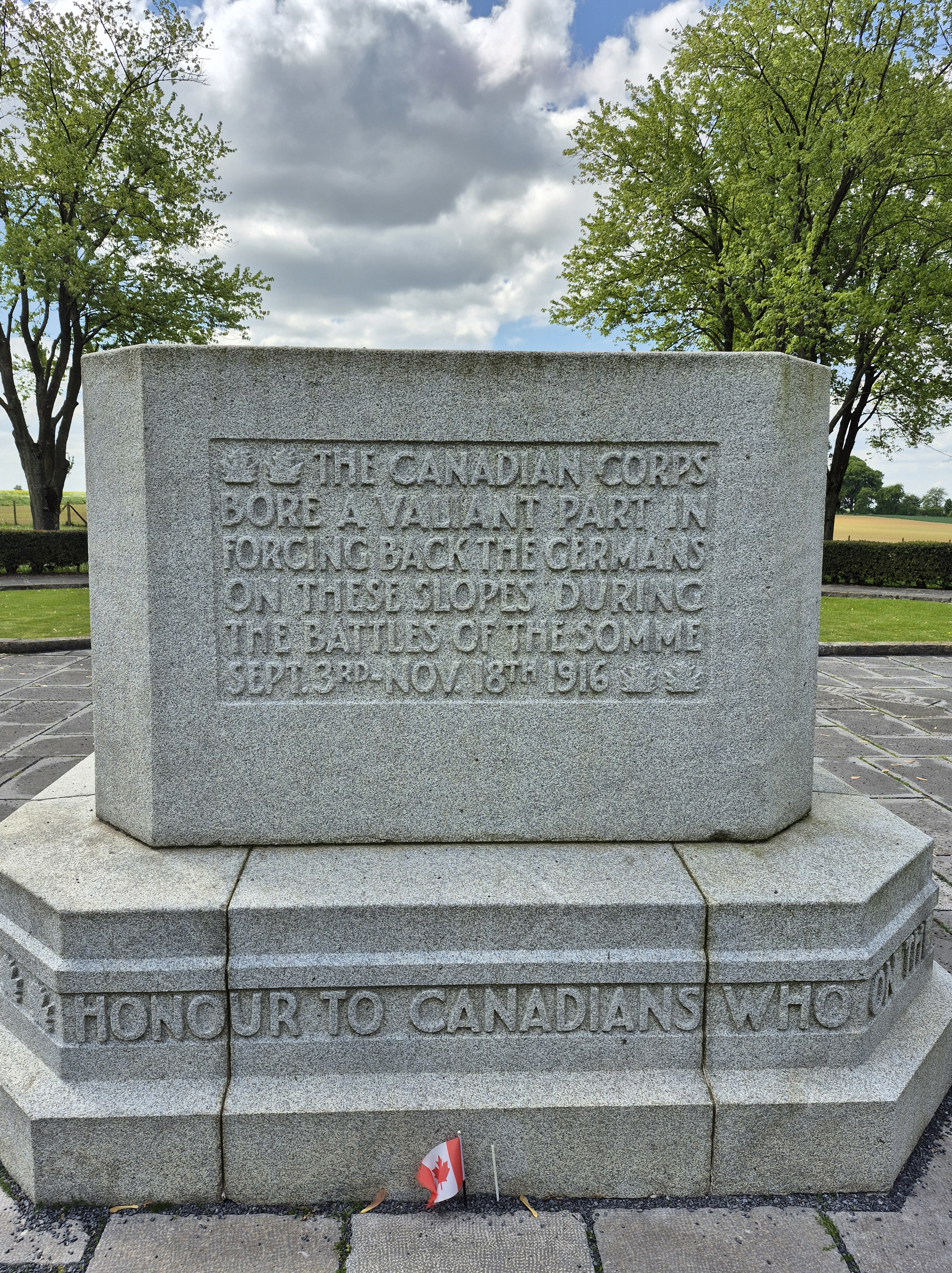
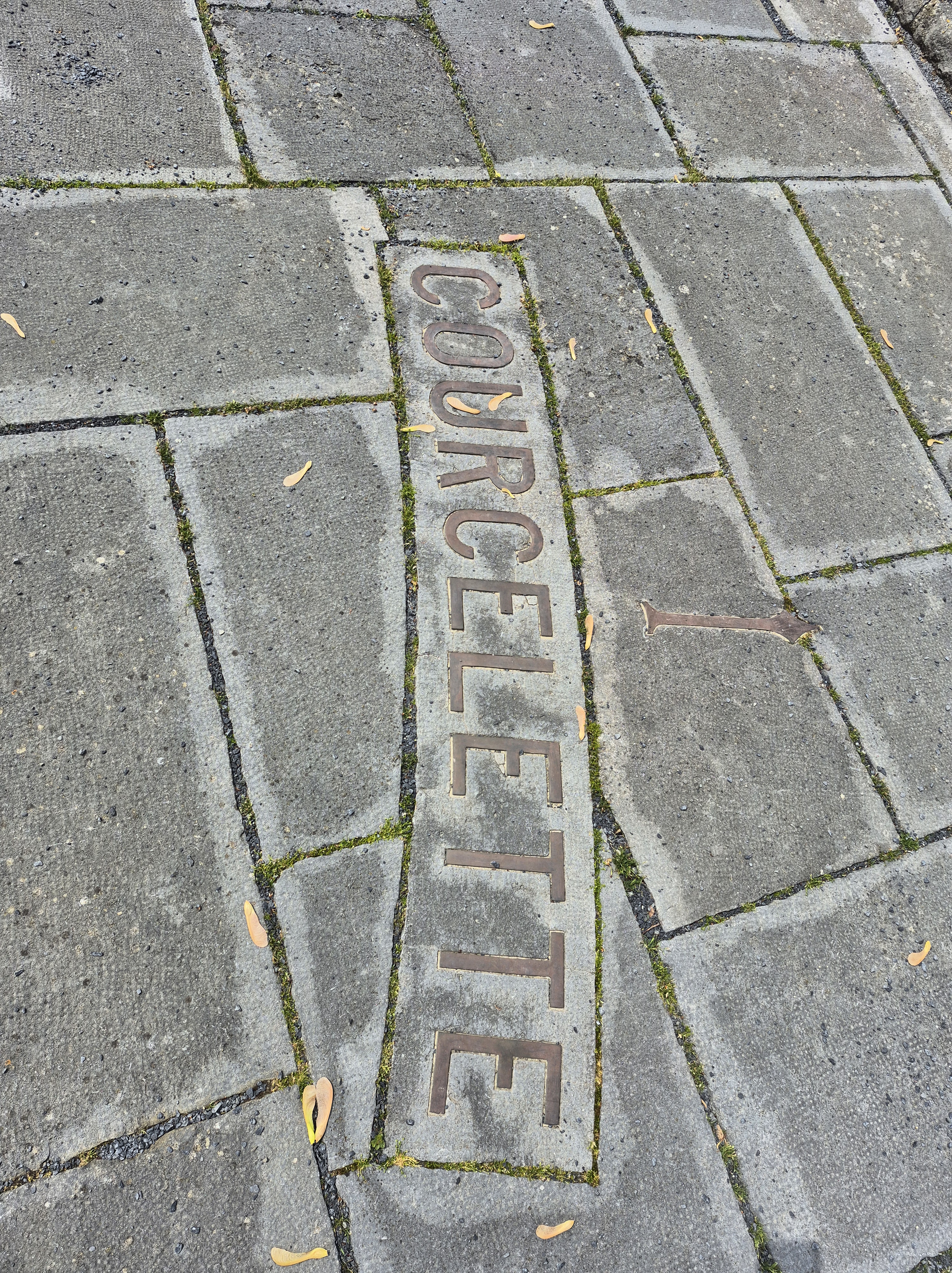
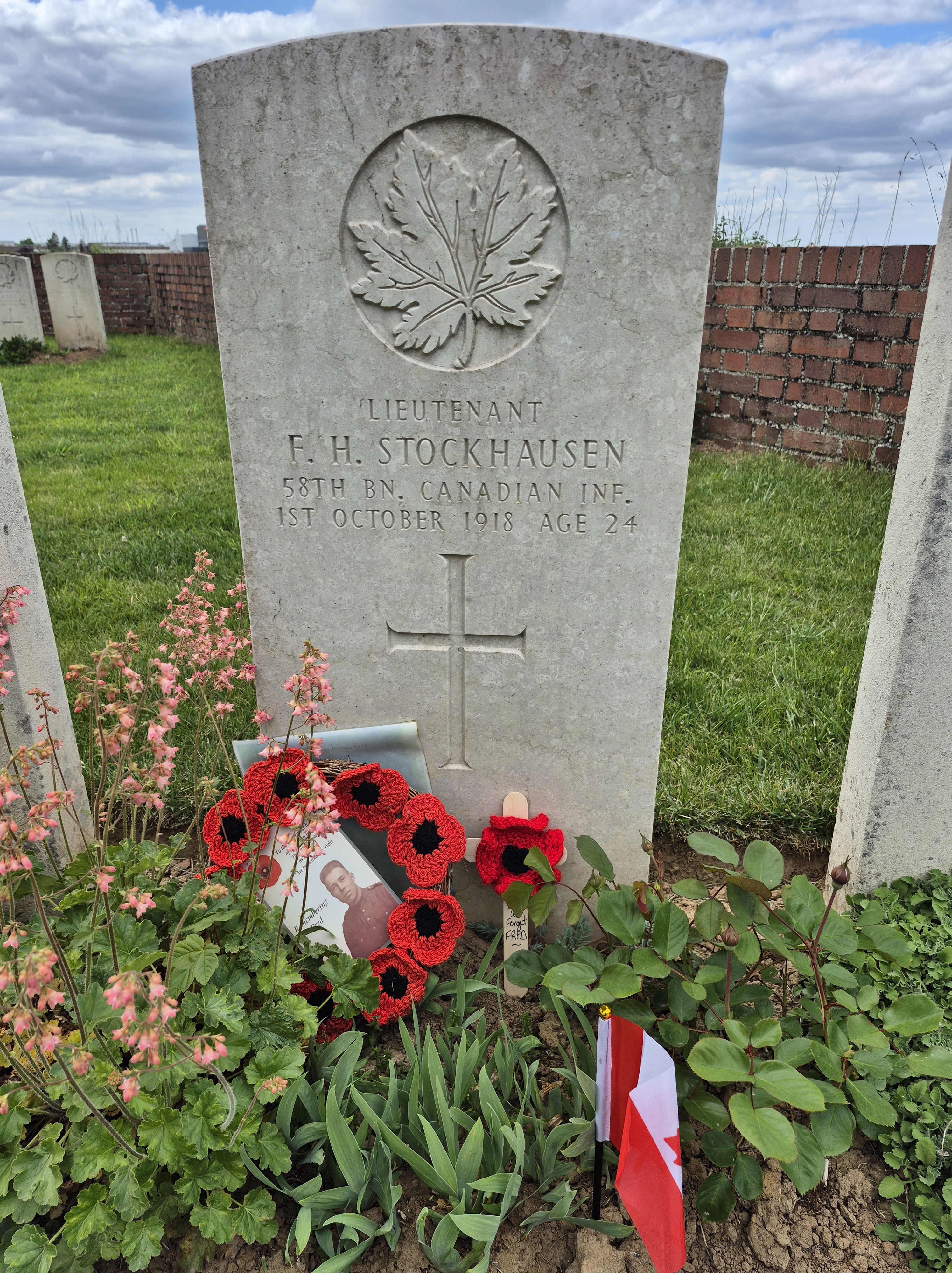
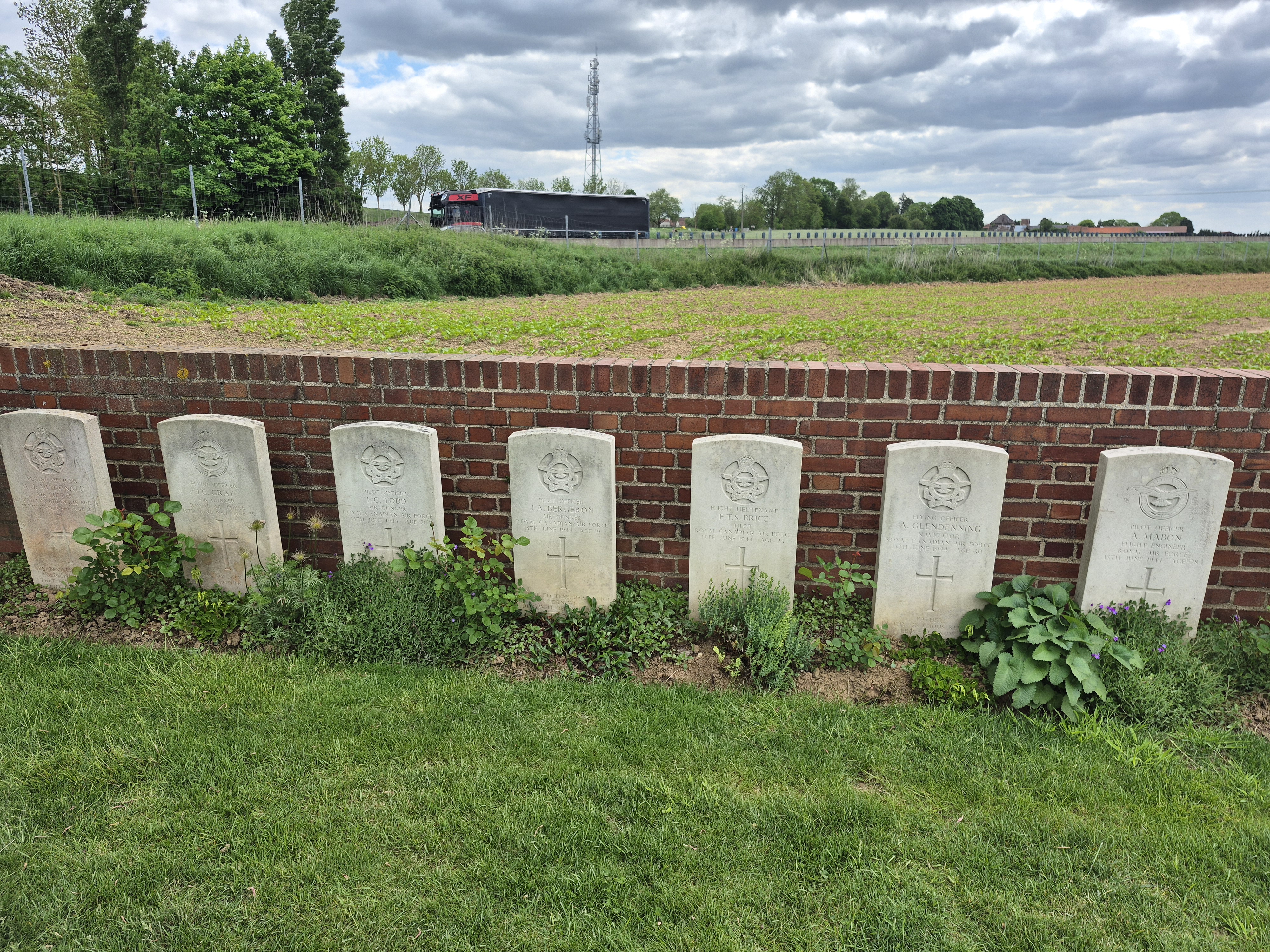
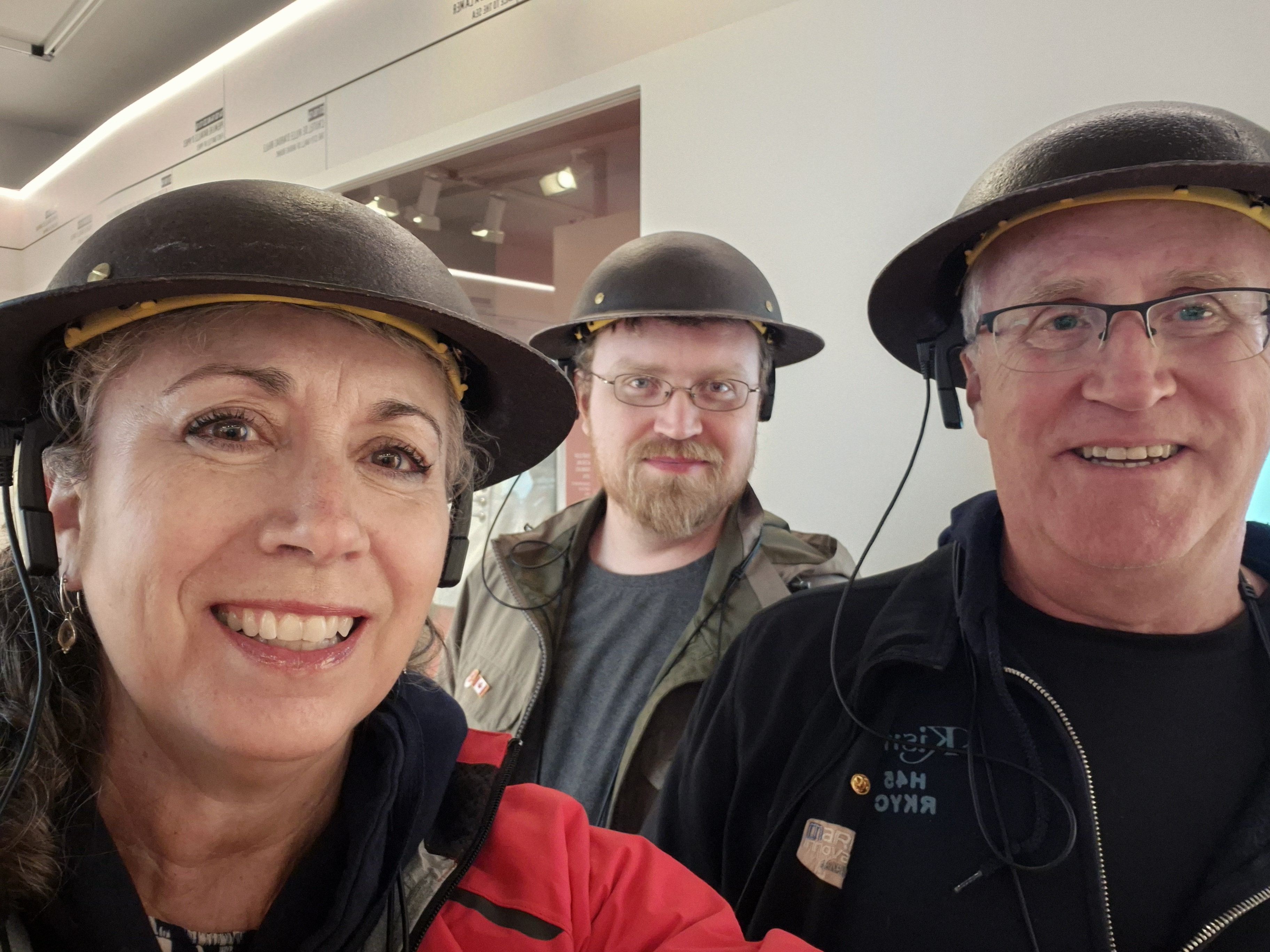
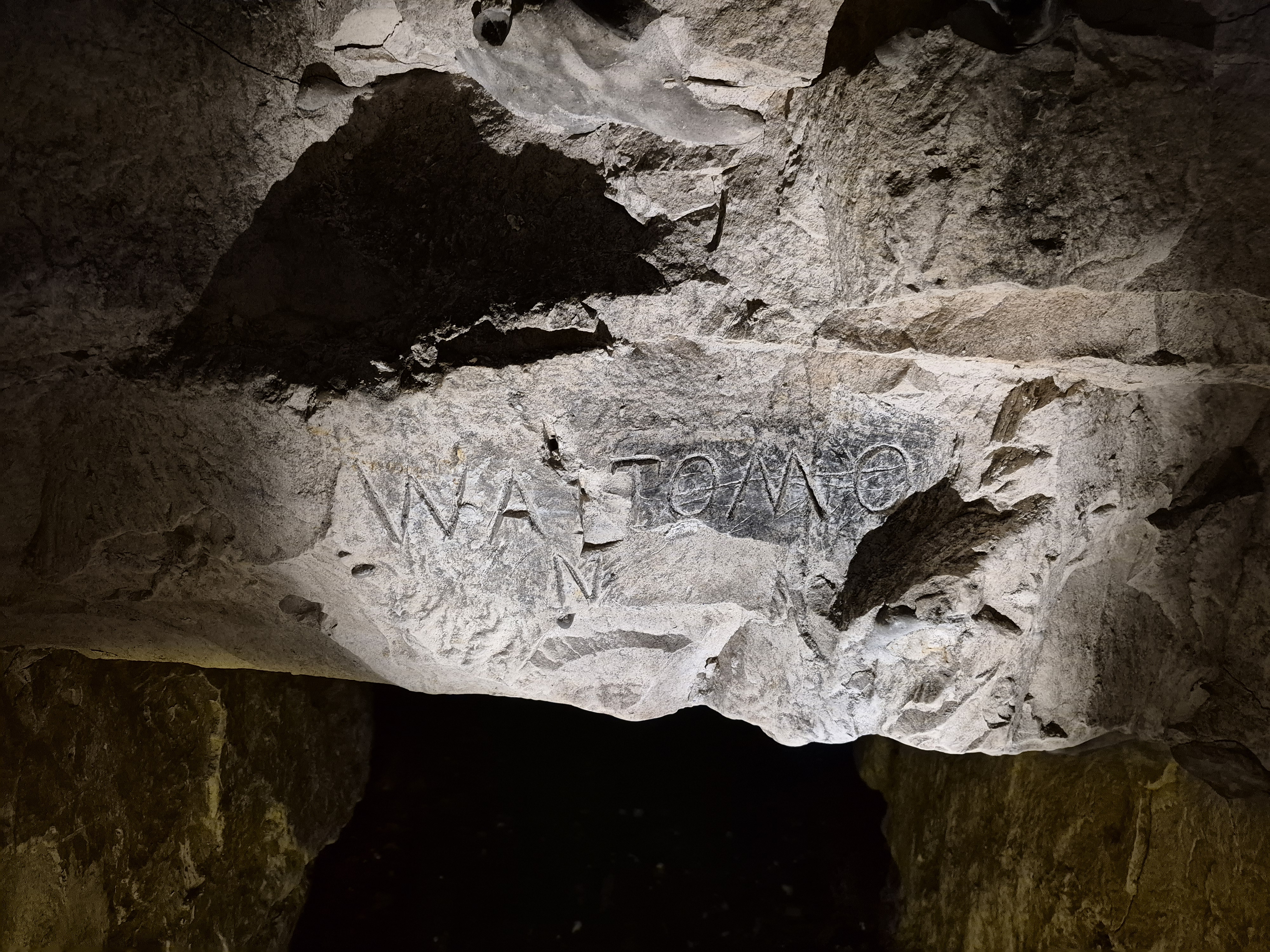
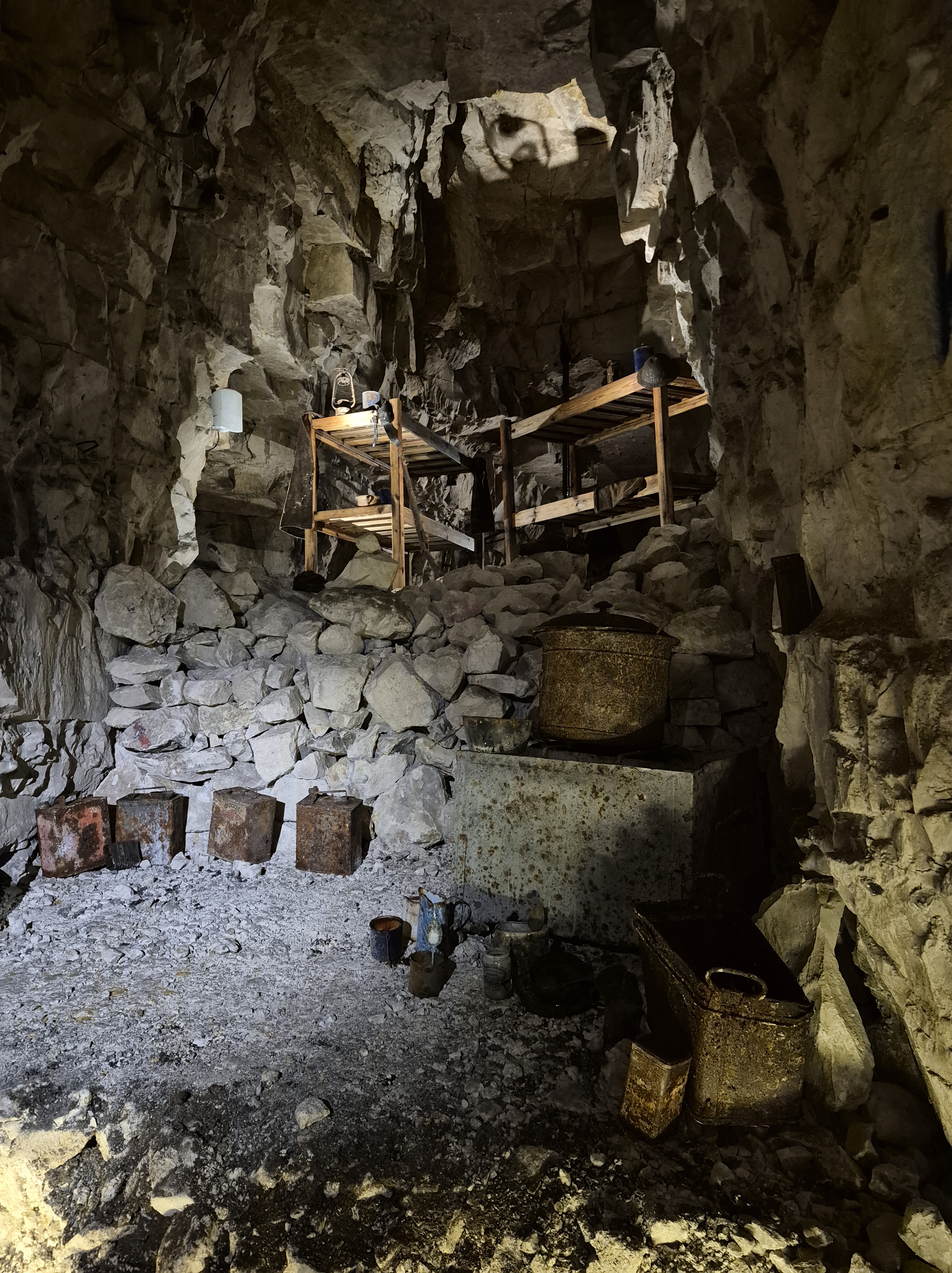
We had planned to visit the Wellington tunnels in Arras, but they were sold out so, knowing we’d be back in the area Wednesday, we bought tickets for then. It was well worth the admission price of €8. Kind of fun to wear a “Brodie” helmet hard hat. The tour was atmospheric, with a guide, videos projected on the walls and background sound track. I was a bit worried about being claustrophobic, but the caverns under there are huge!
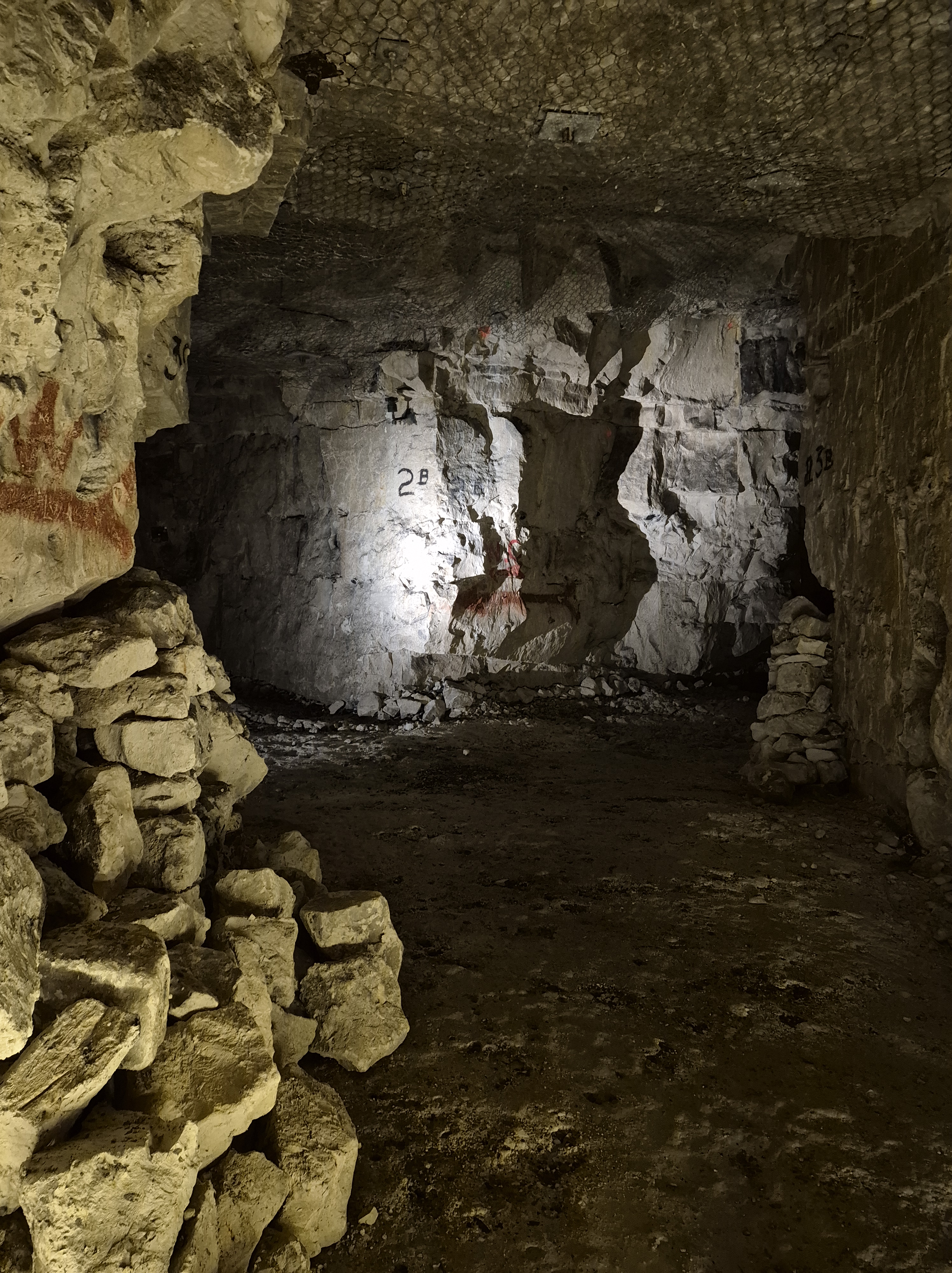
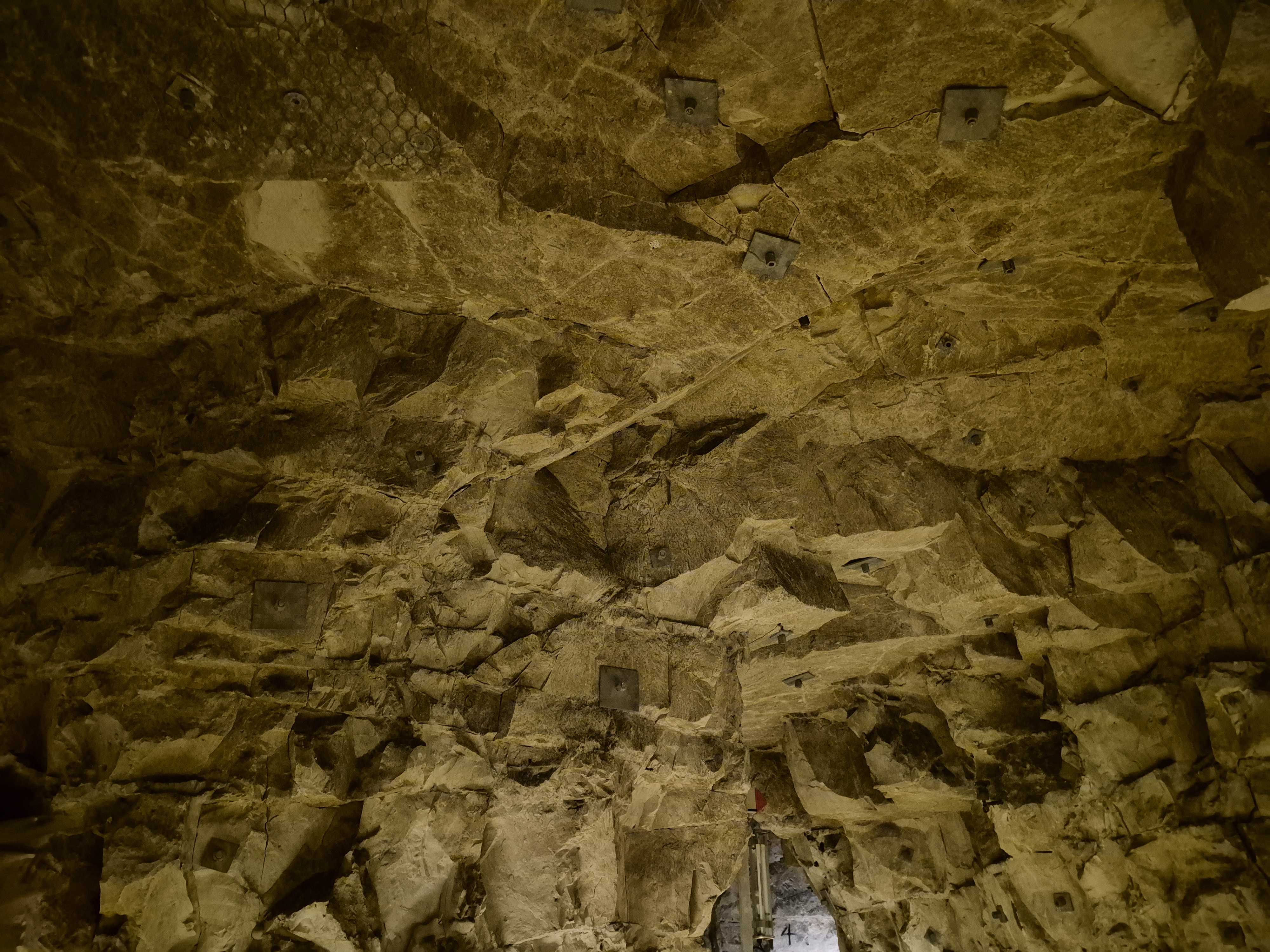

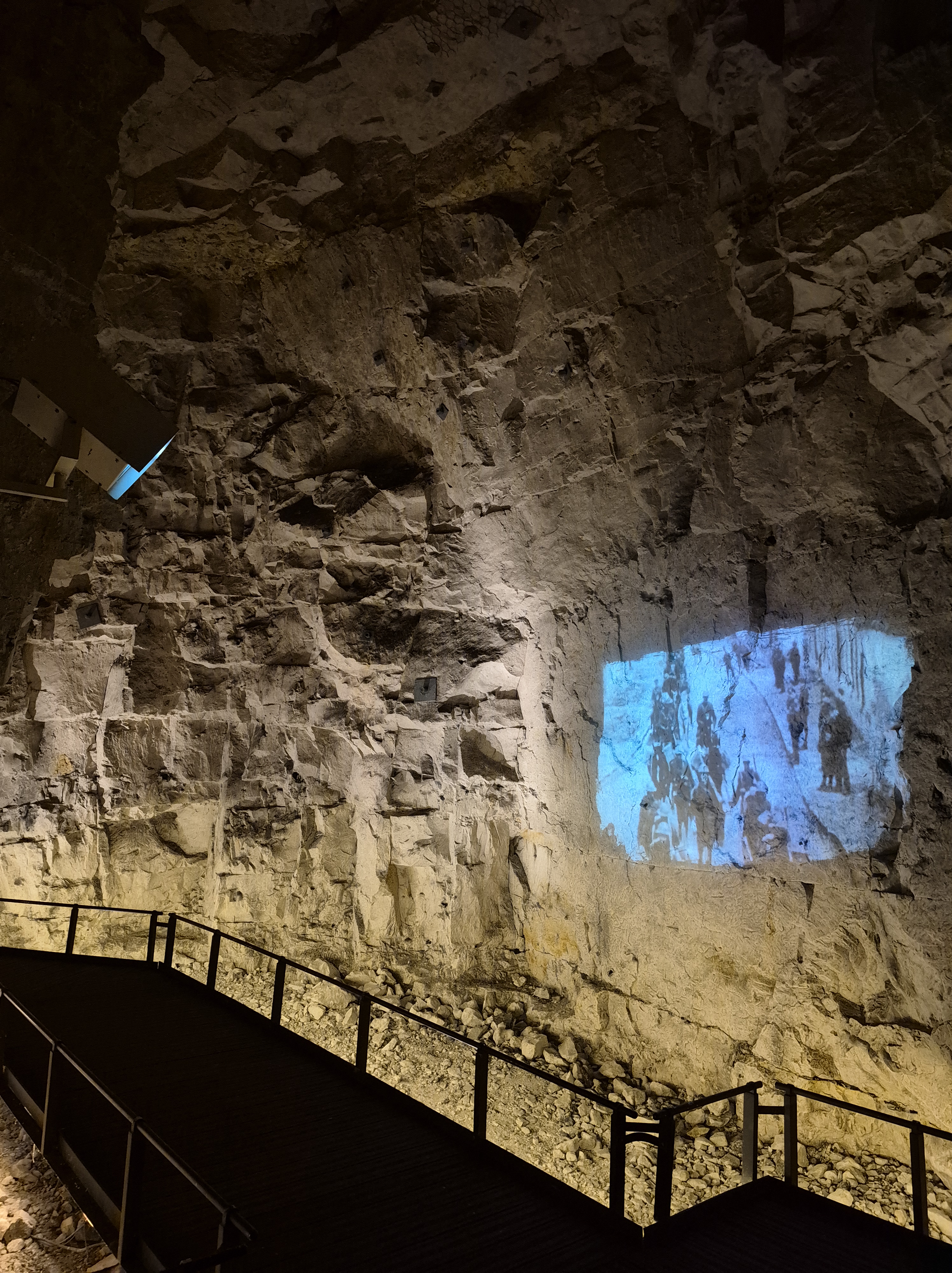
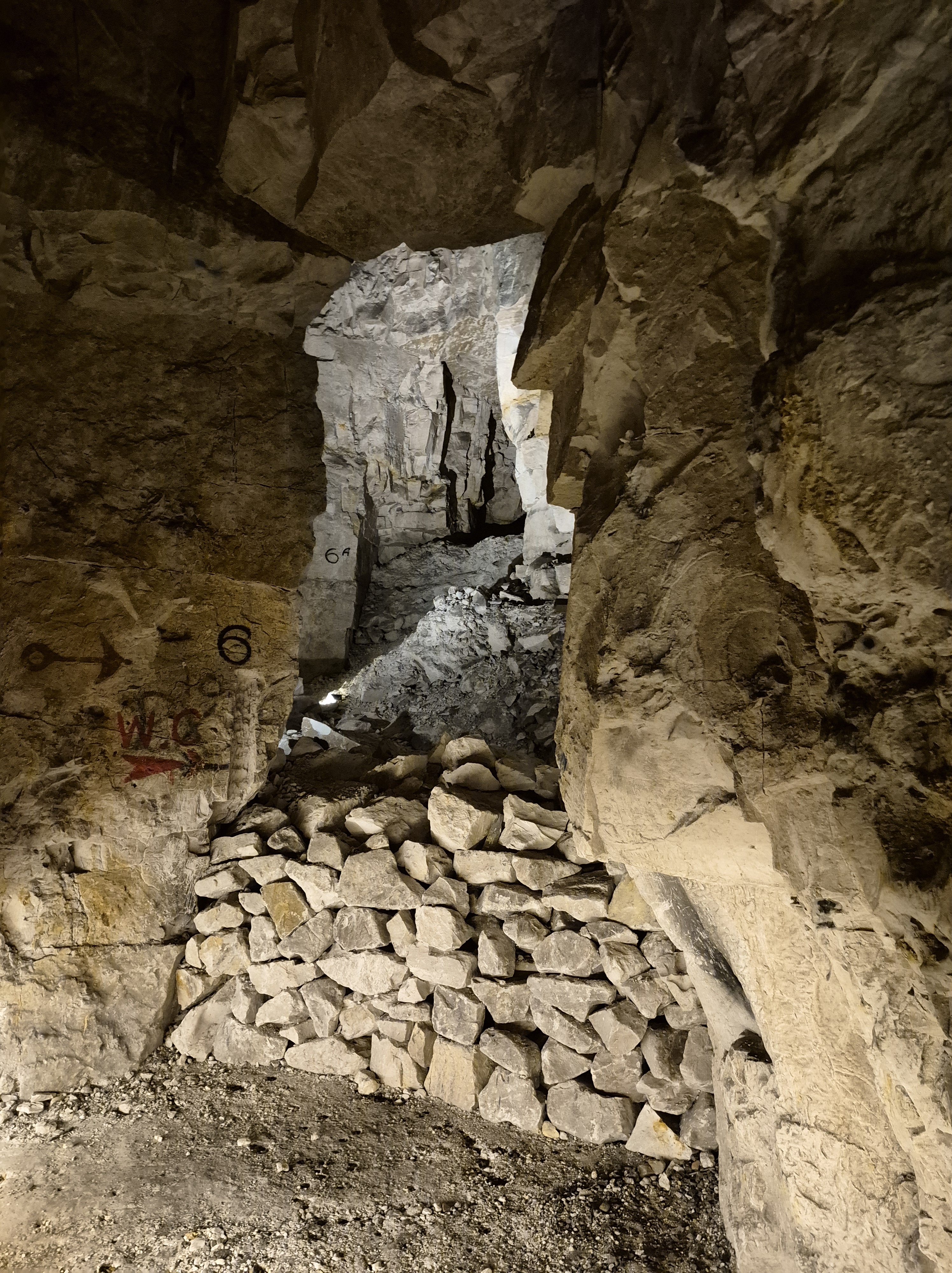

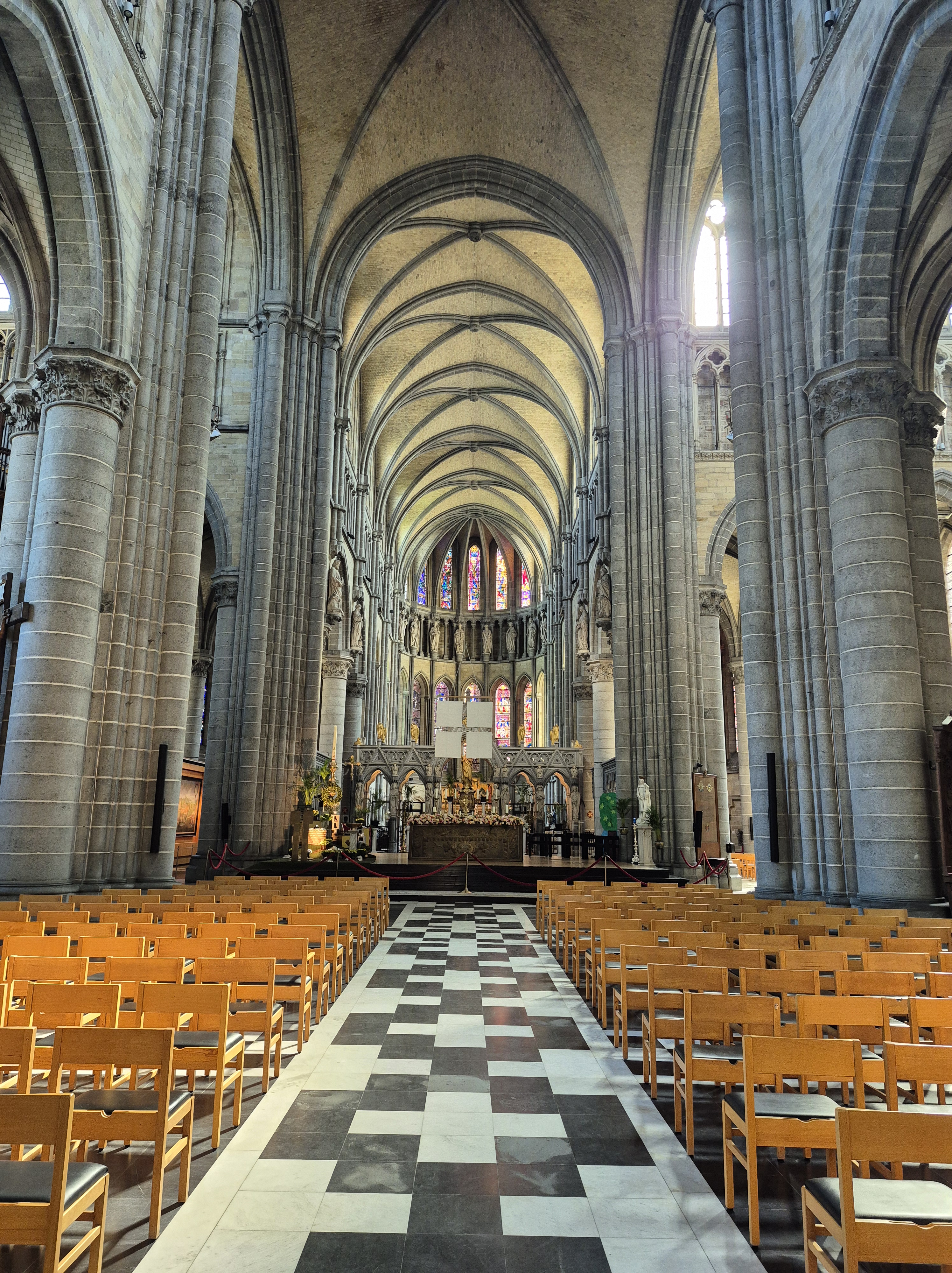
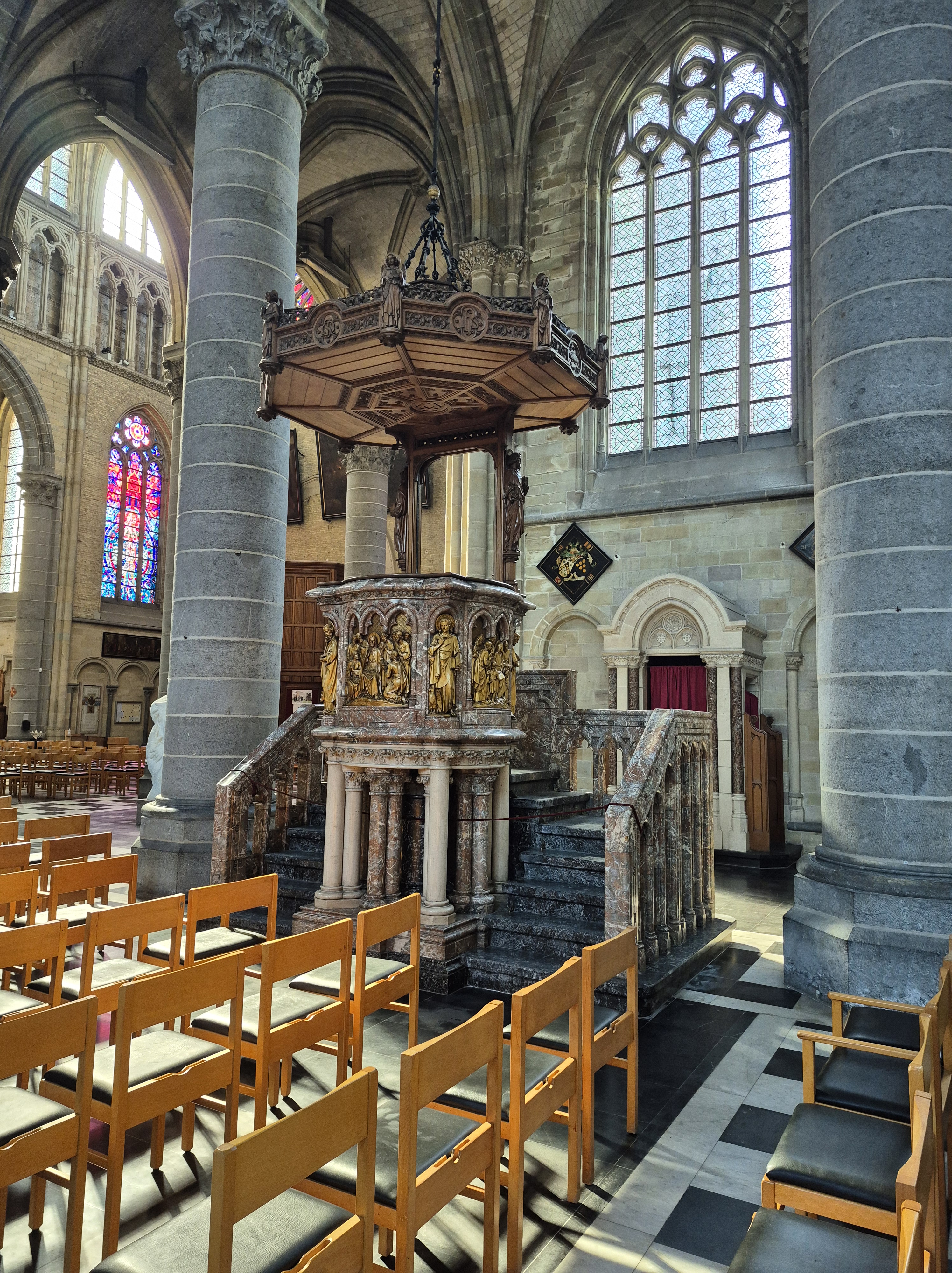
Our last day, we stuck a little closer to Ypres. We visited St. Martin’s cathedral in Ypres. It was stunning! Every November they have a massive concert to commemorate the end of the war which we didn’t get to on our last visit. We then dropped into St. George’s chapel, built to commemorate Commonwealth fallen.
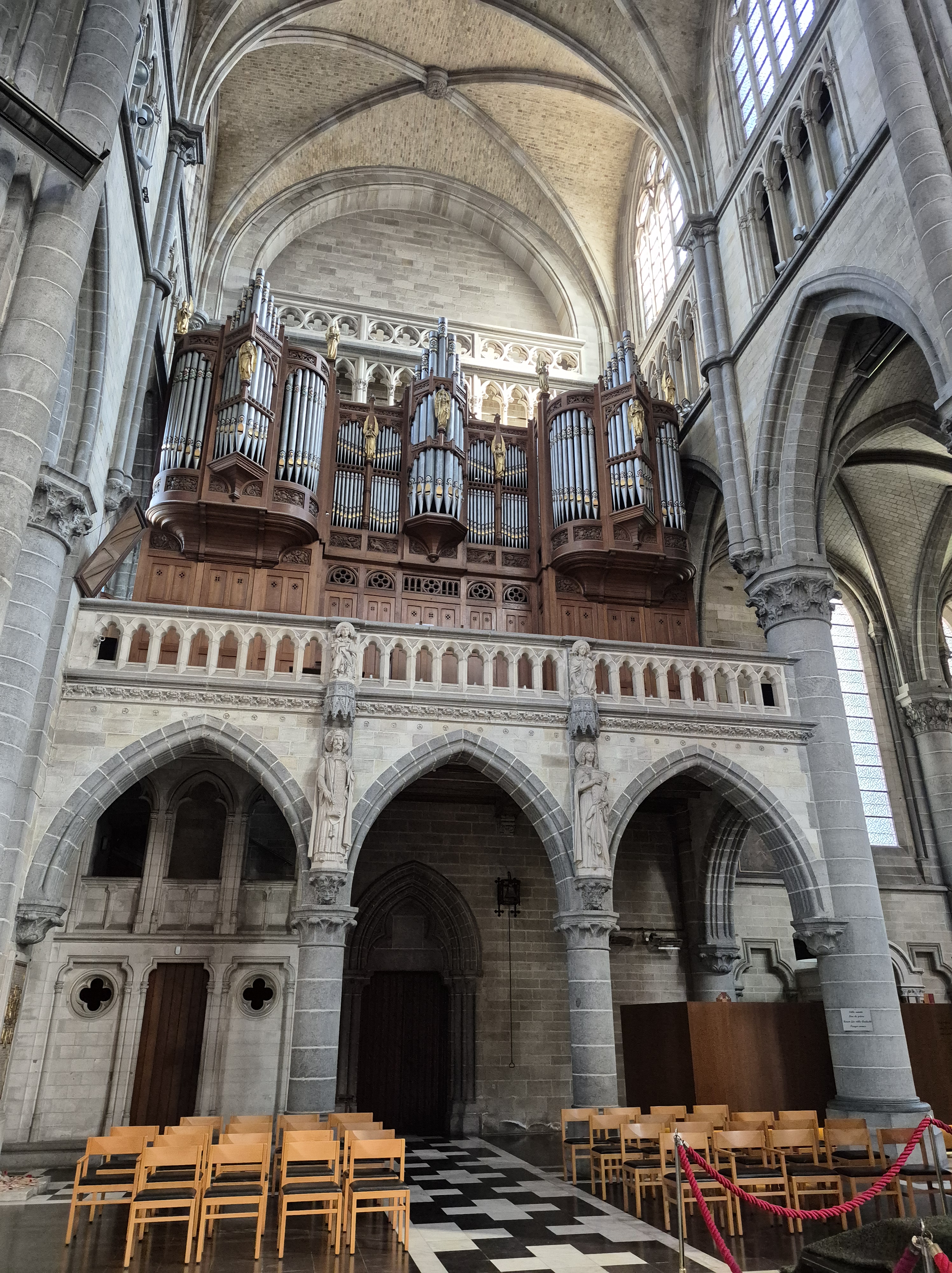
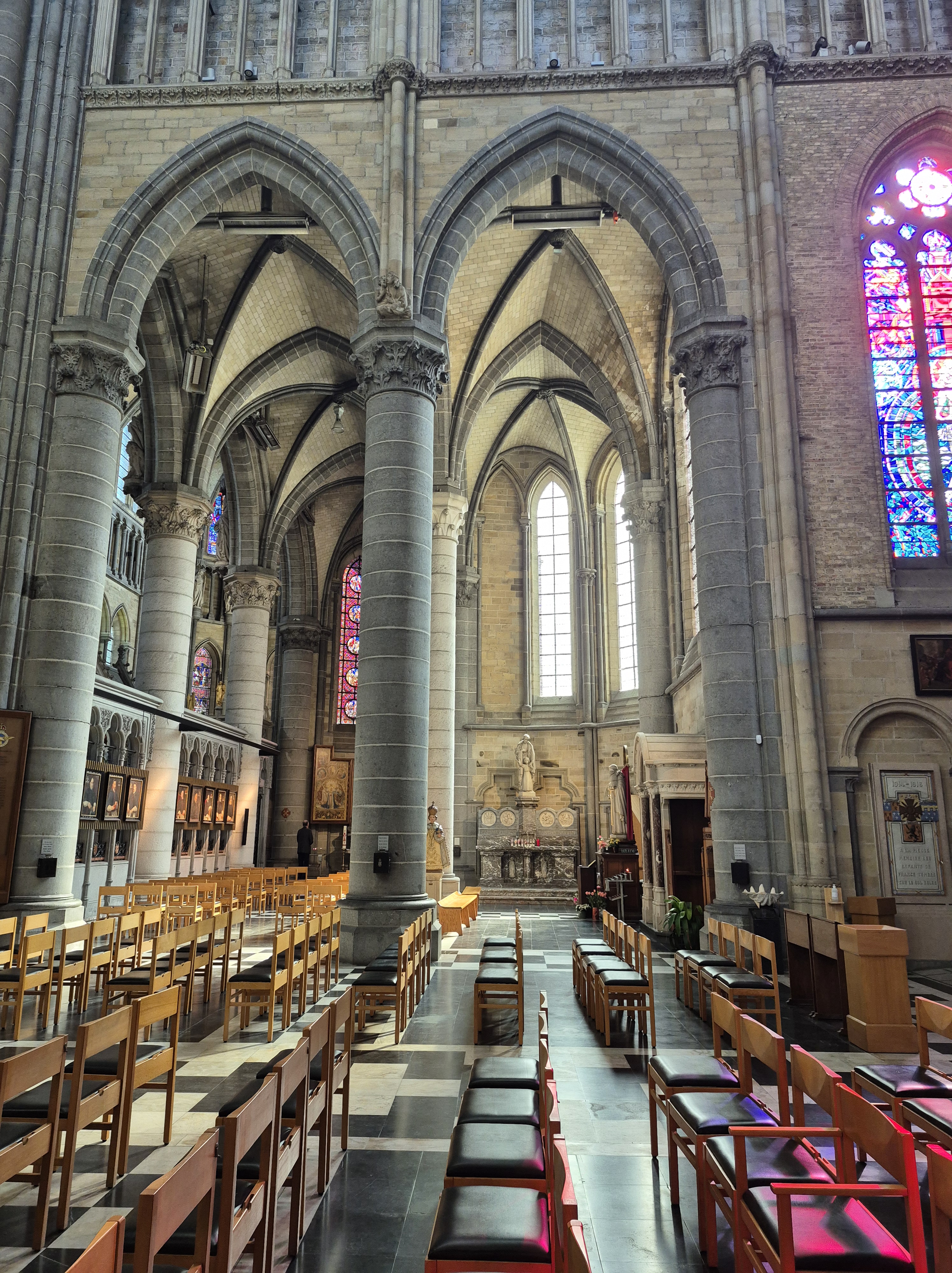
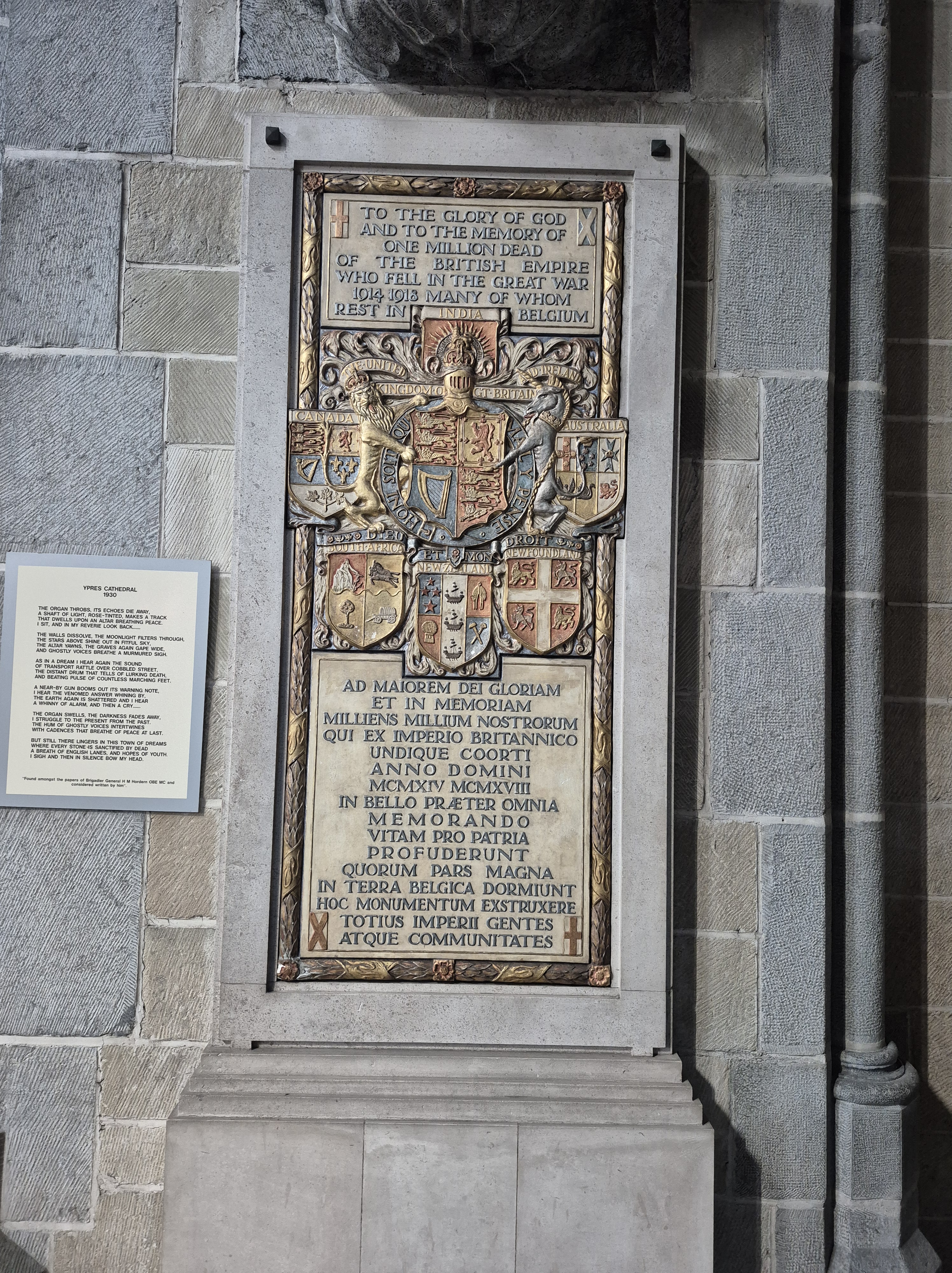
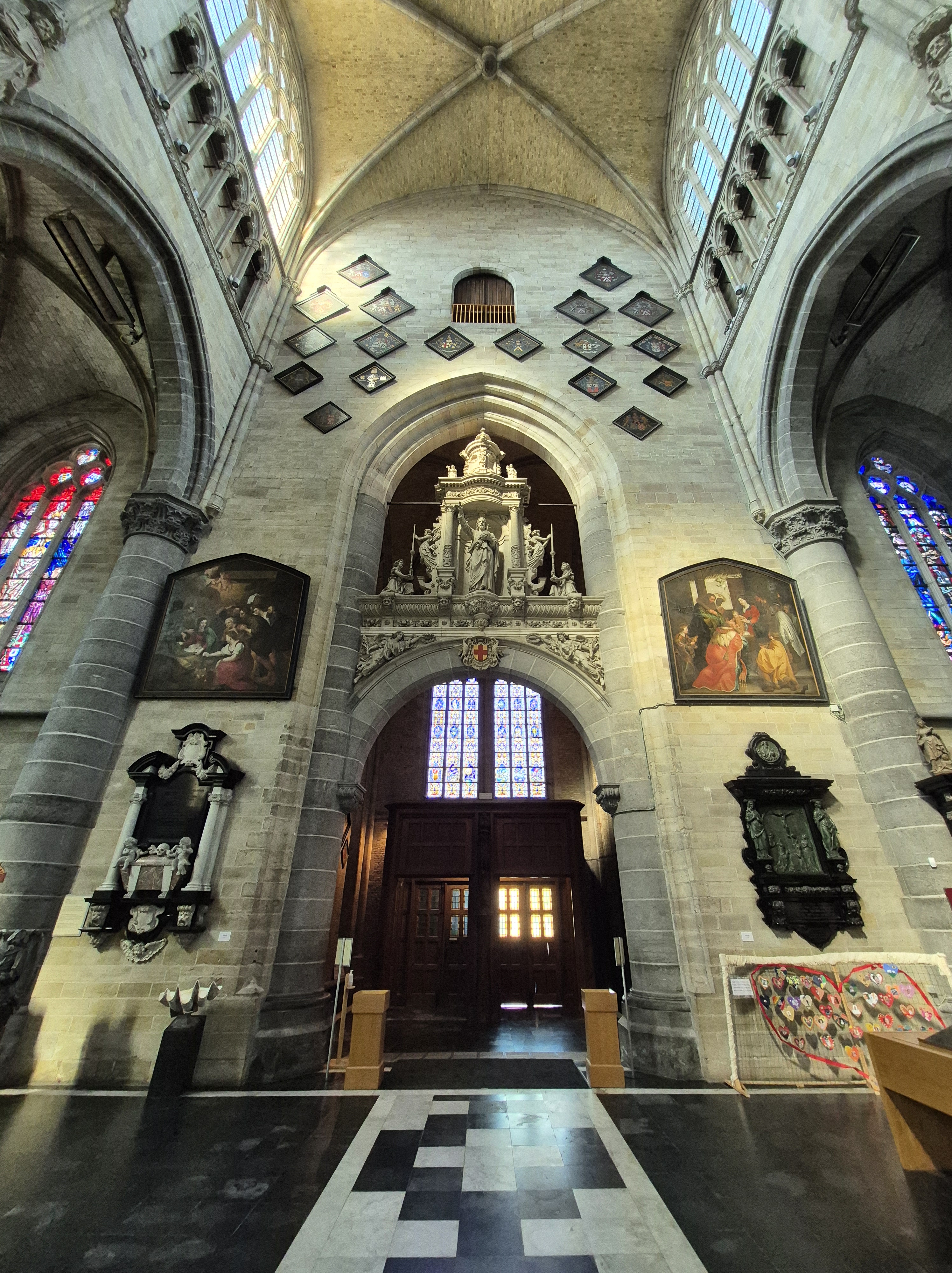
In the afternoon, we went to Mount Sorrel, near Sanctuary Wood, and to Mt. Kemmel. It is no wonder these places were sought after as they offered great vantage points over Ypres and the Messine Ridge respectively.
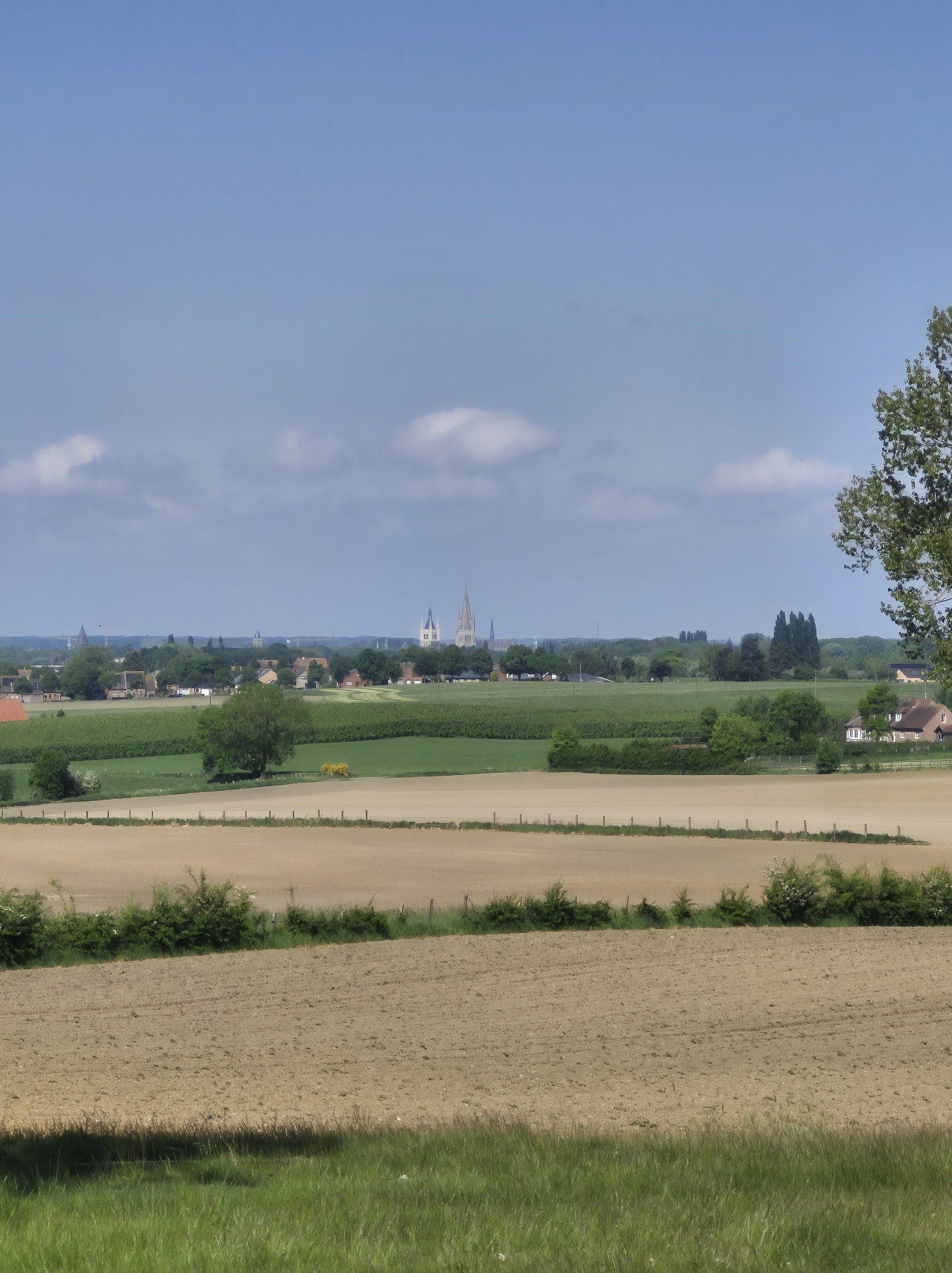
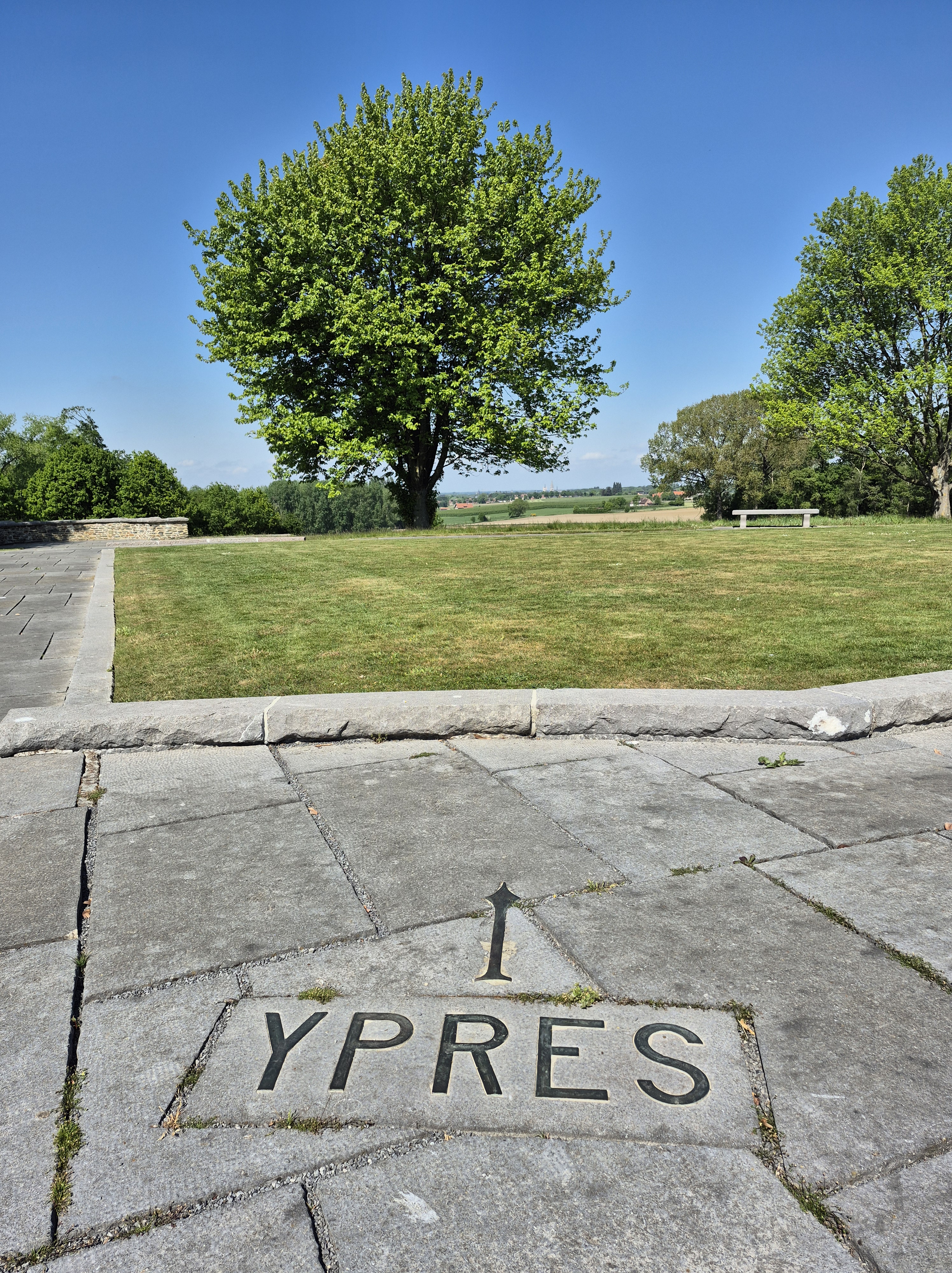
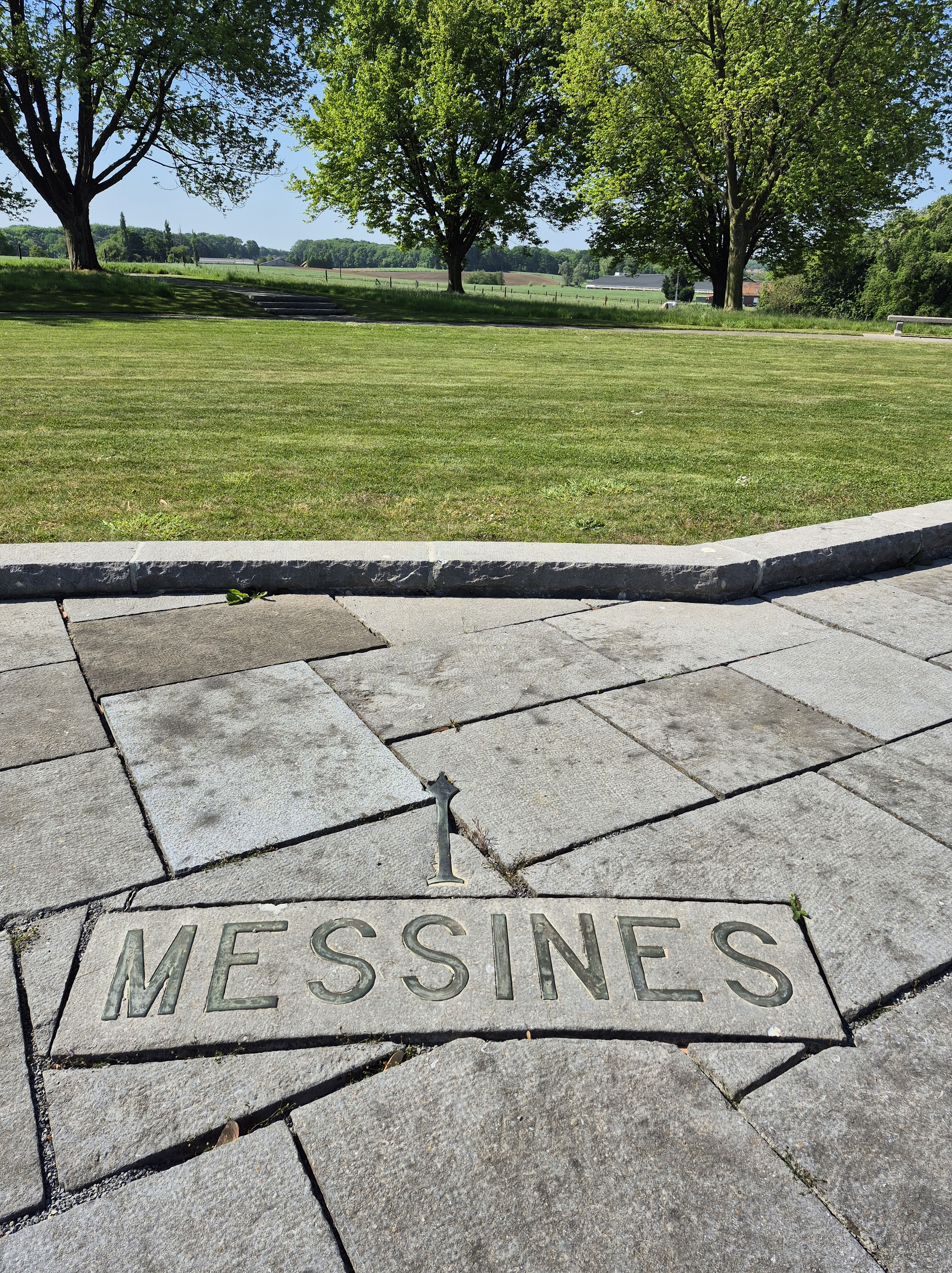
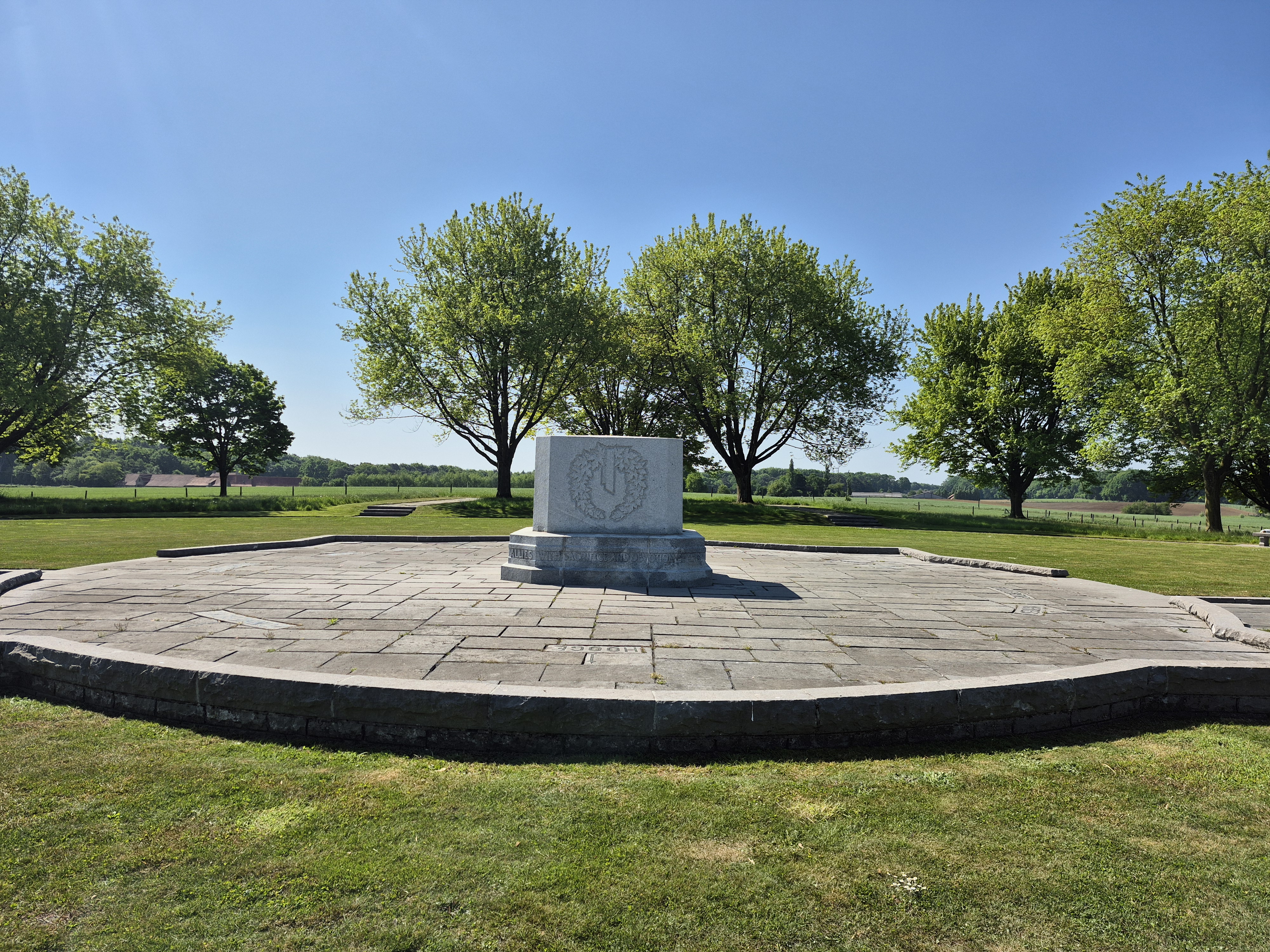
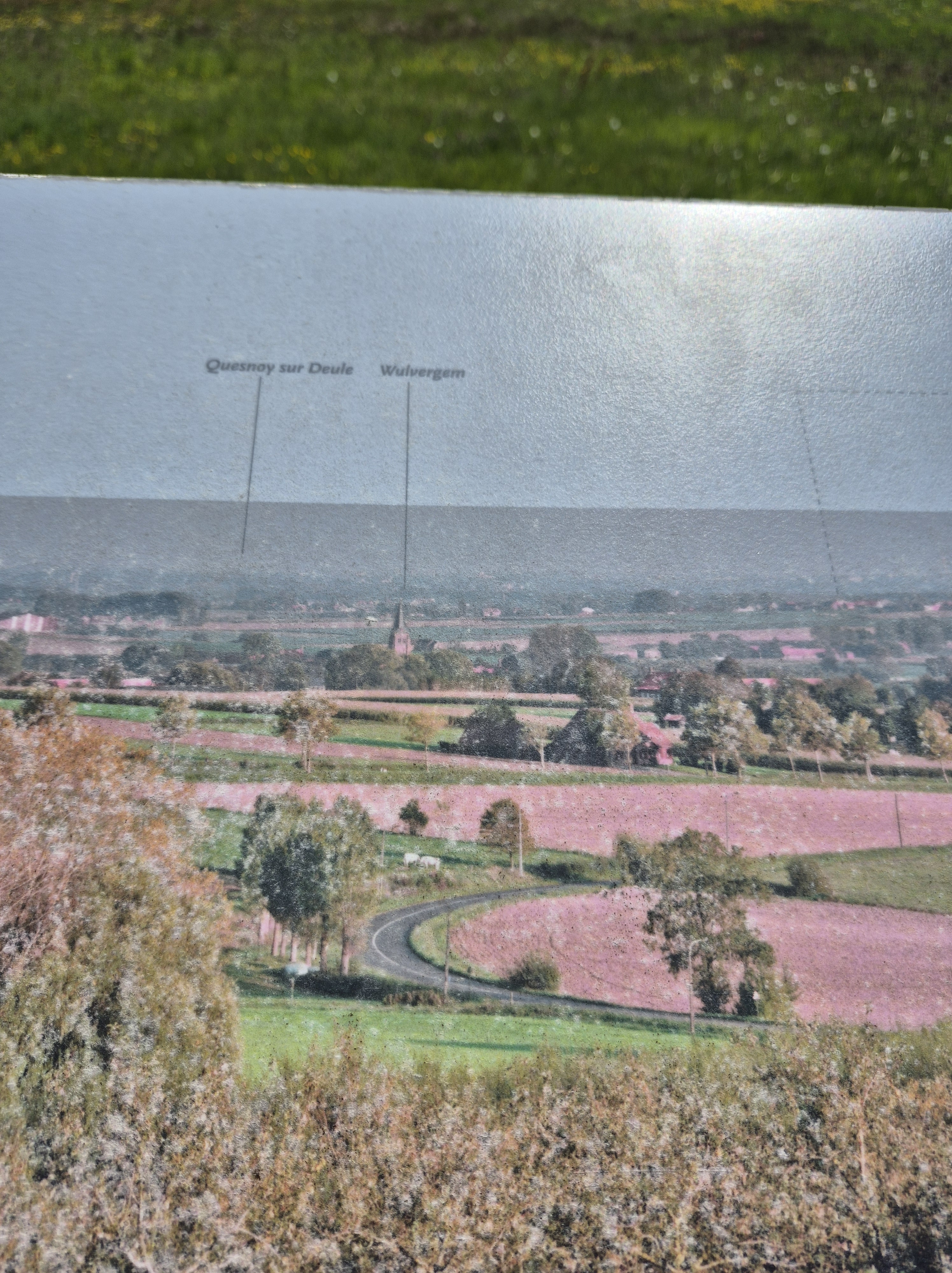

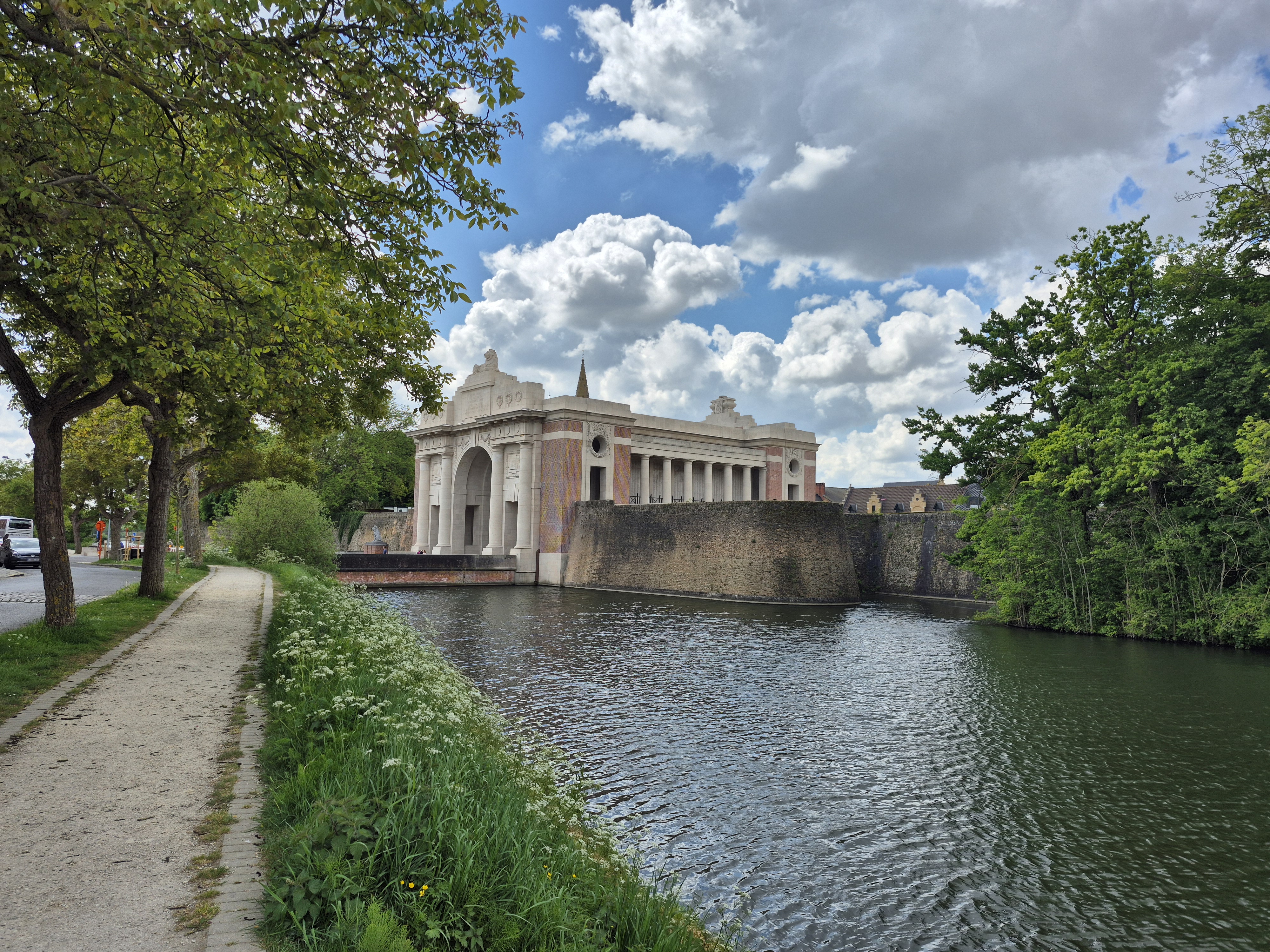
In the afternoon, we attended the reburial service for British soldier, Private John Tames. The third of three brothers to enlist, John was also the third brother to go missing in action, his older brothers in 1915, himself in 1917. What a terrible blow to his family! In 2018, during road building in Zonnebeke, John’s remains were unearthed and through DNA testing, were identified. He was laid to rest by members of his own regiment, watched over by his great-nephew, in the Irish New Cemetery near Ypres.
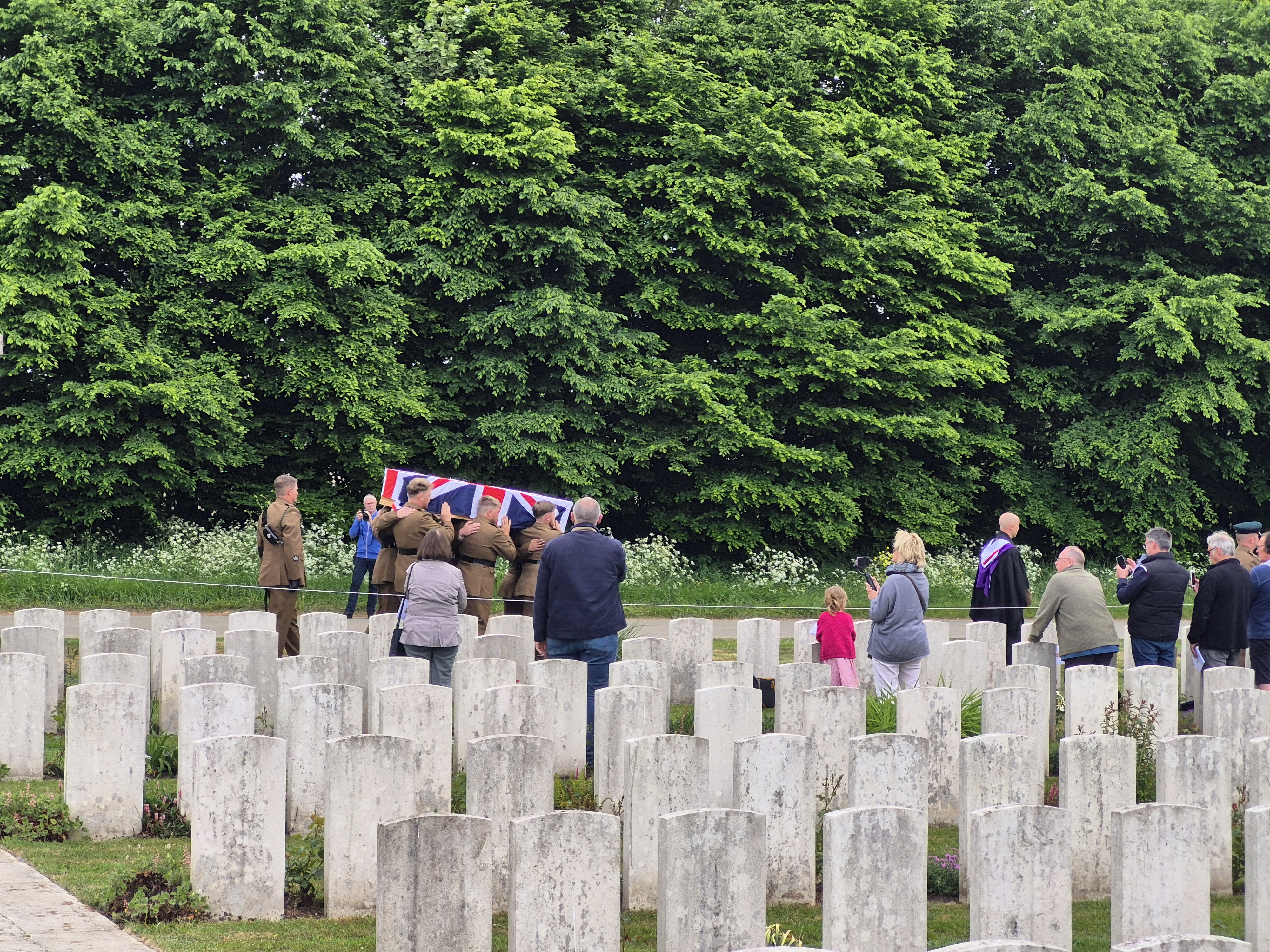
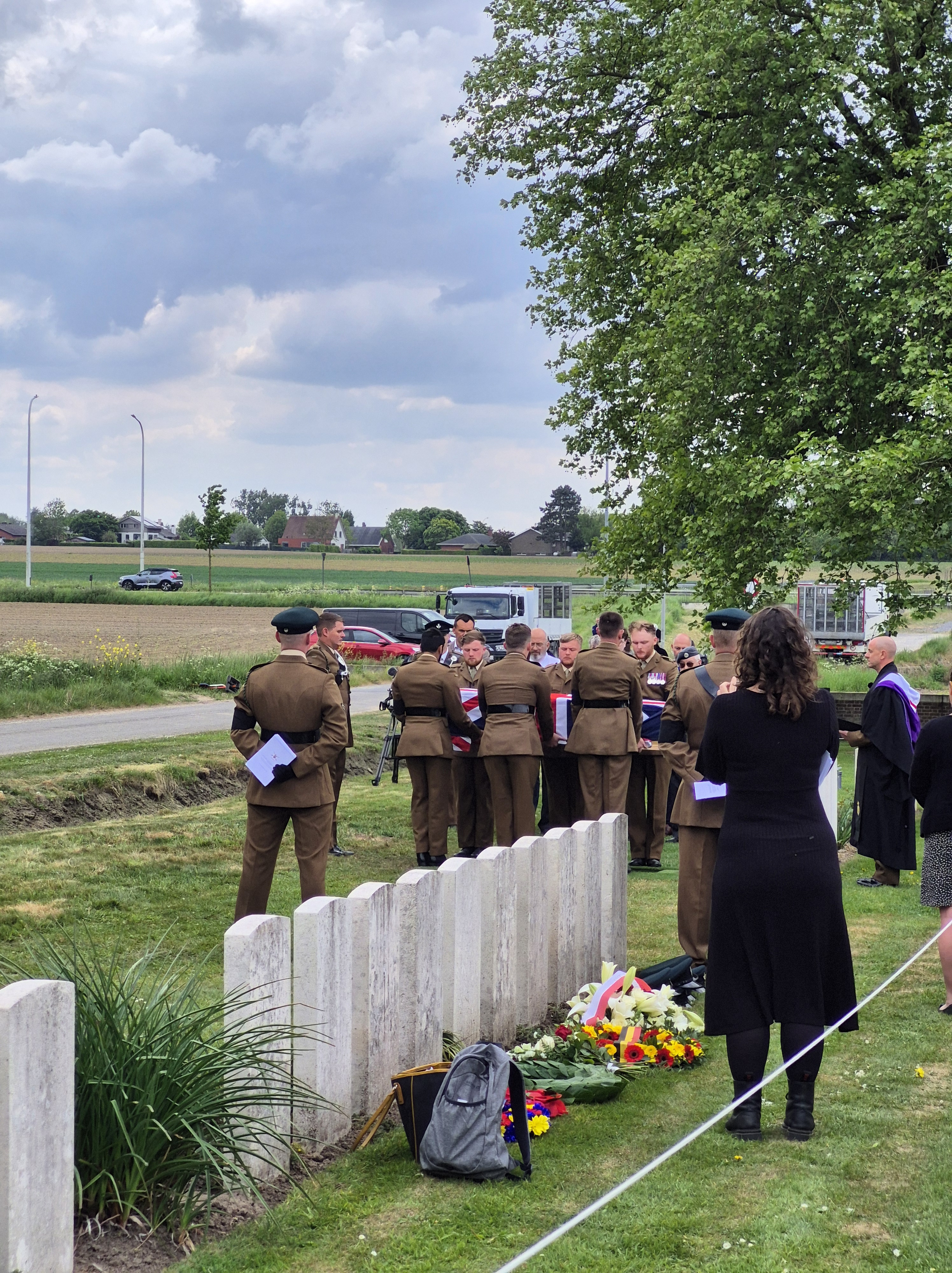
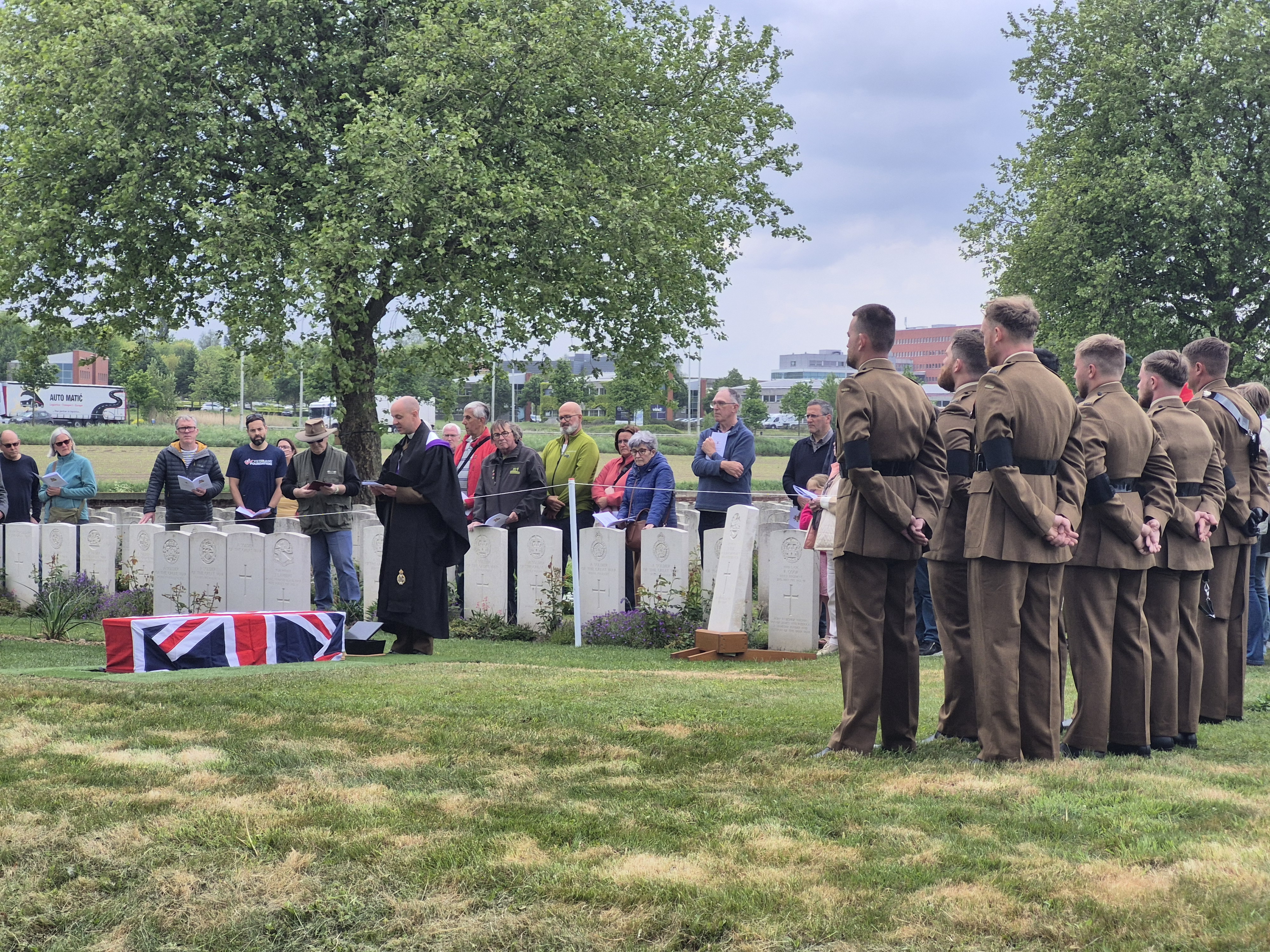
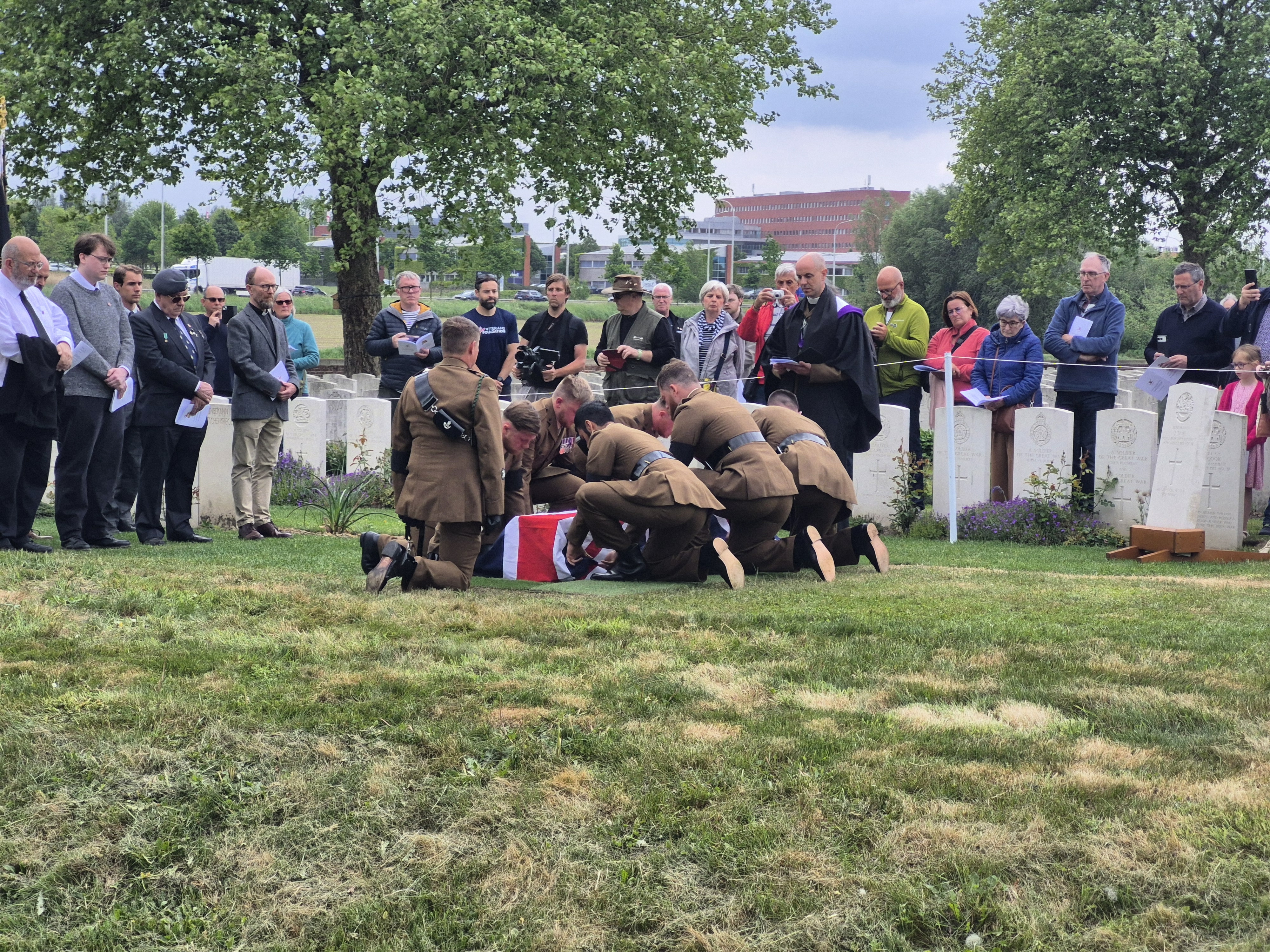
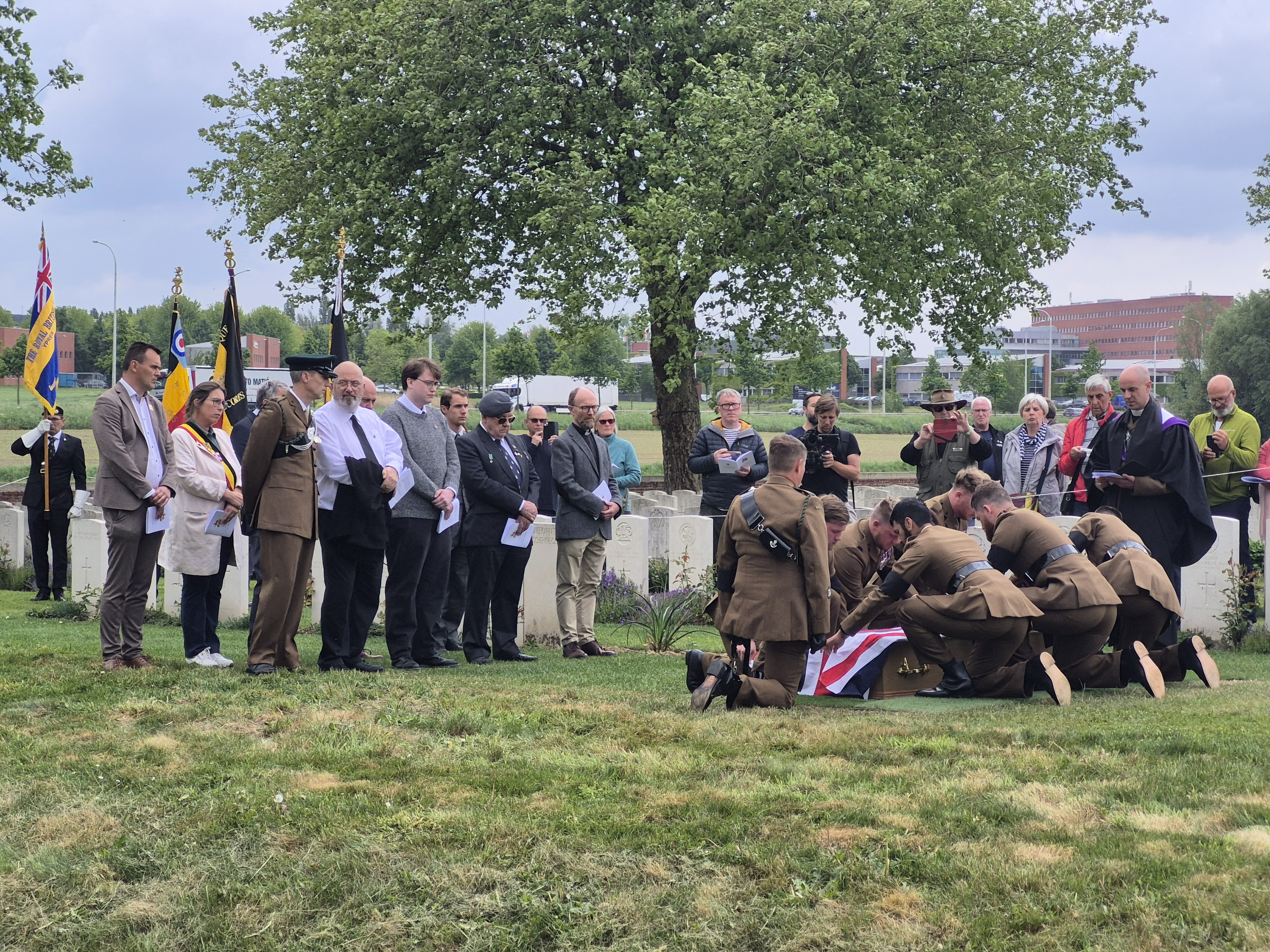
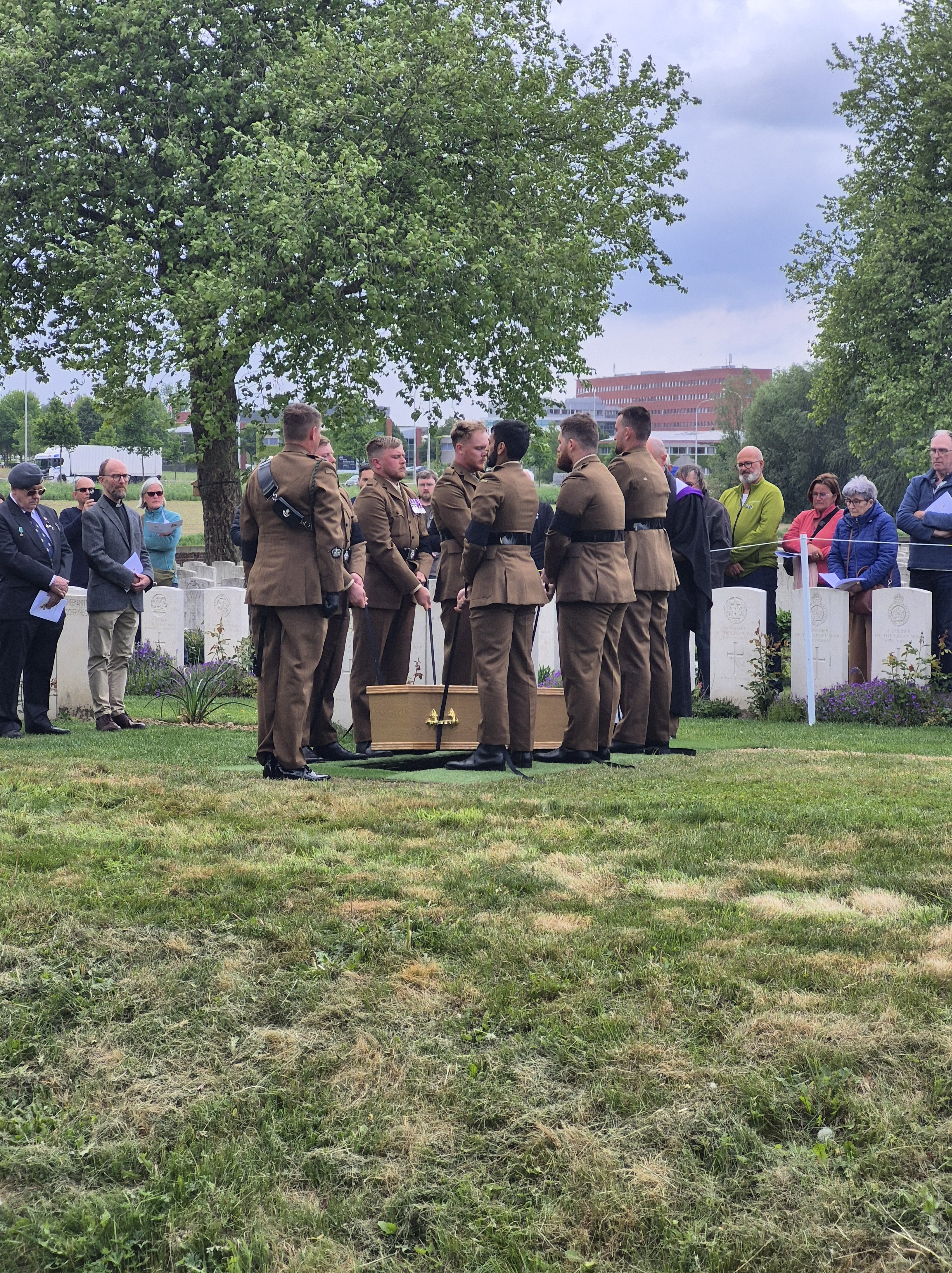
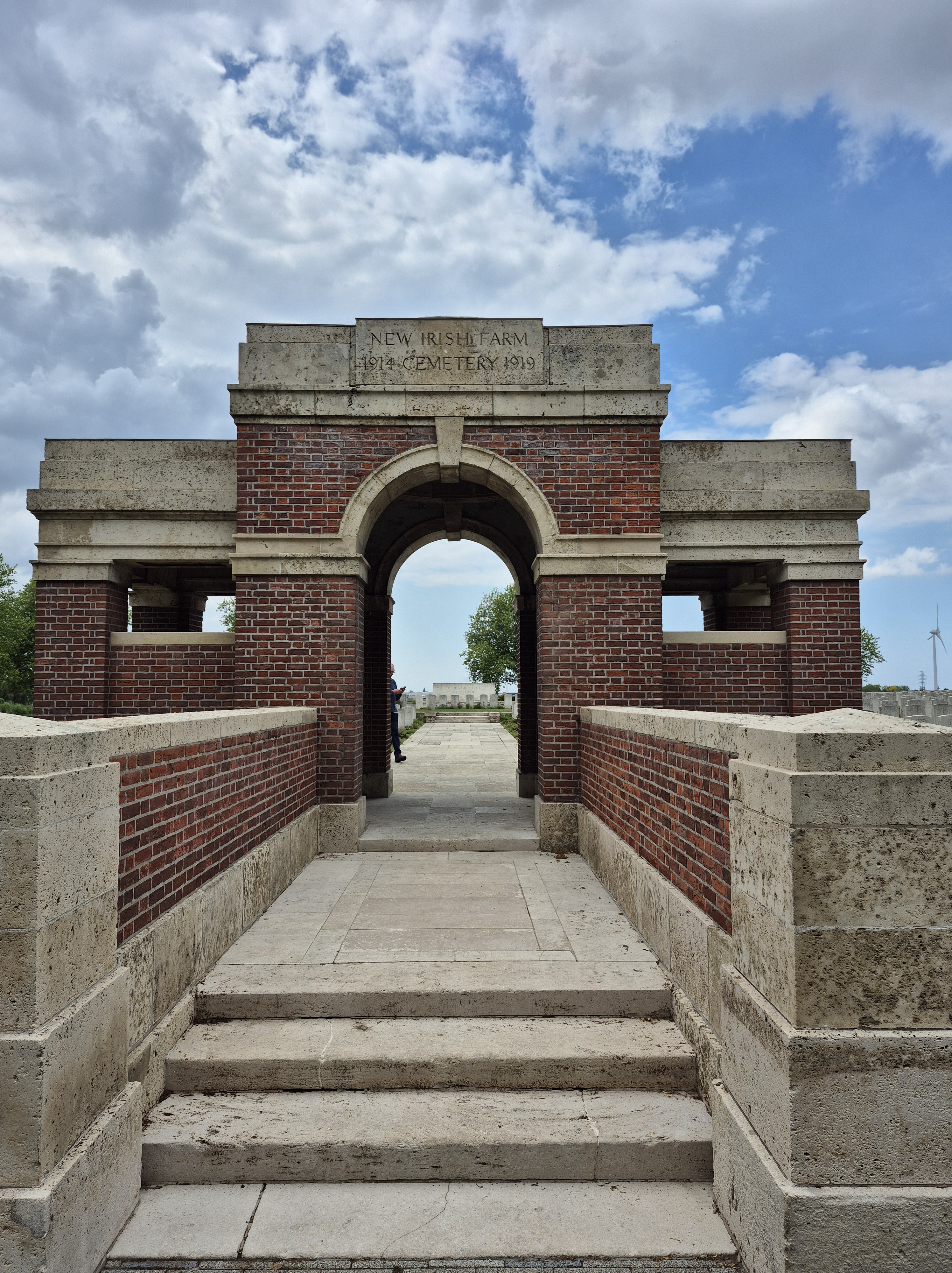
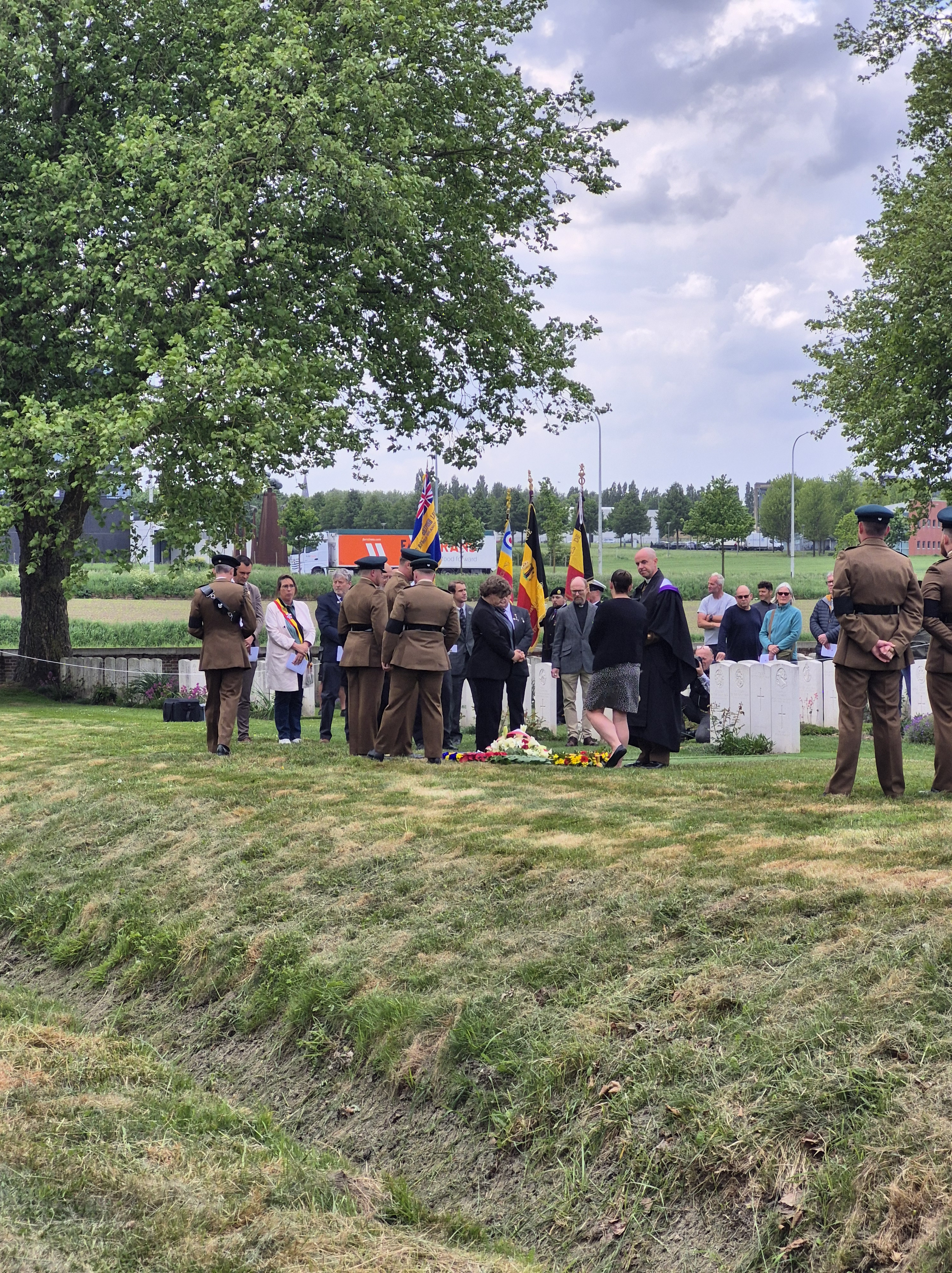
It was a special service at Menin Gate, being V.E. Day, and so the place was crowded with dignitaries and had two bands play, a fitting night for our last in Belgium.
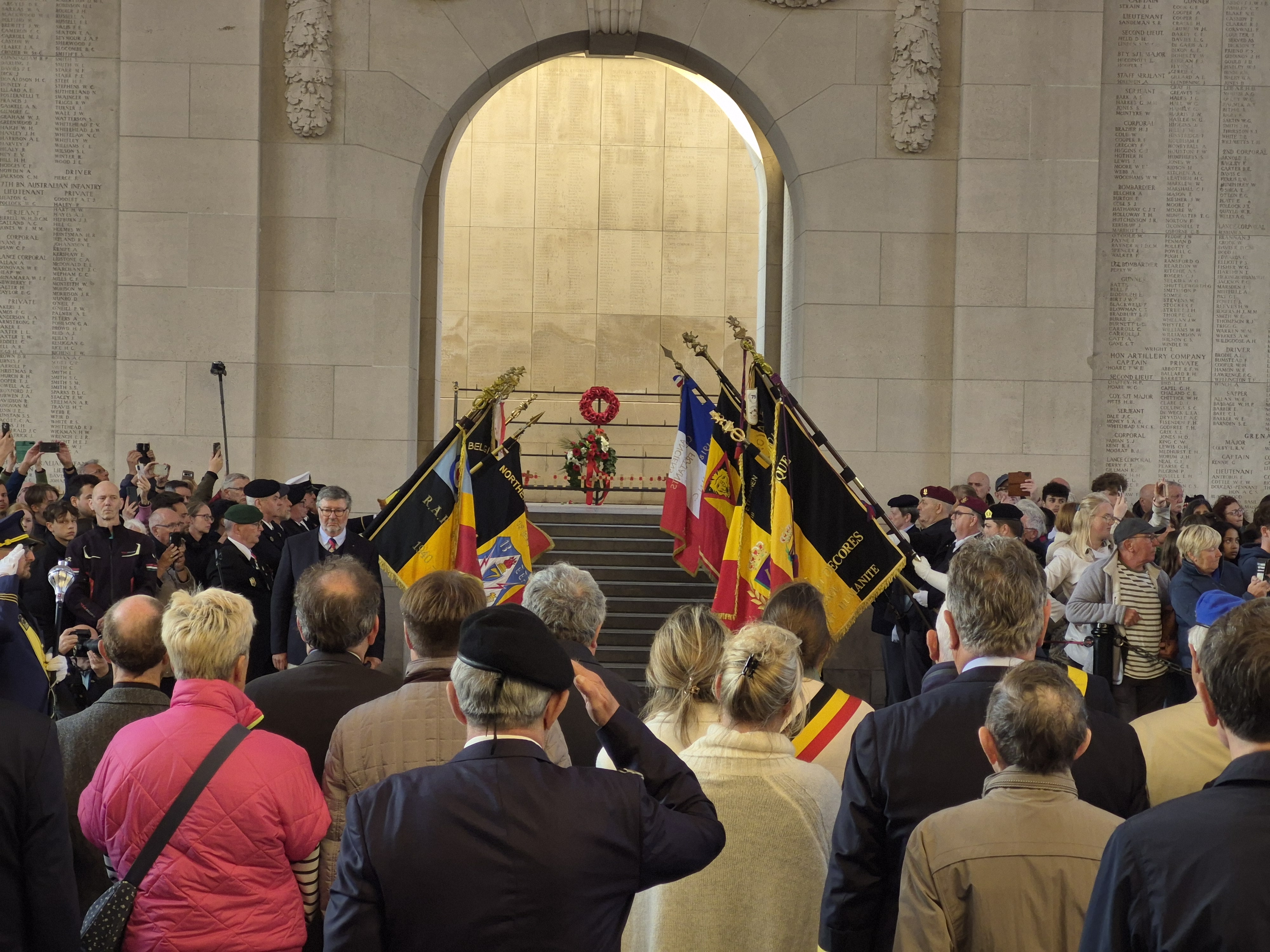
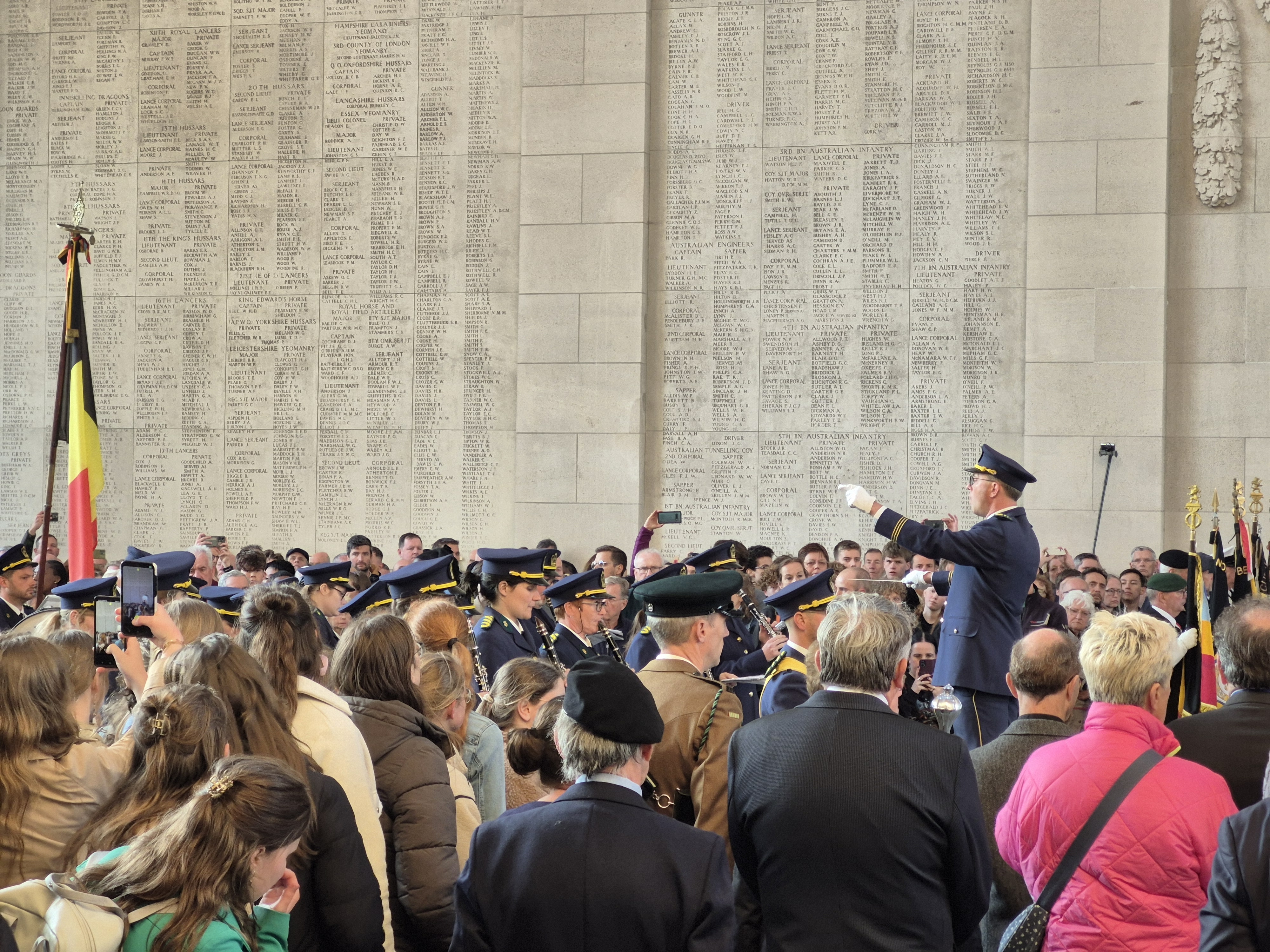
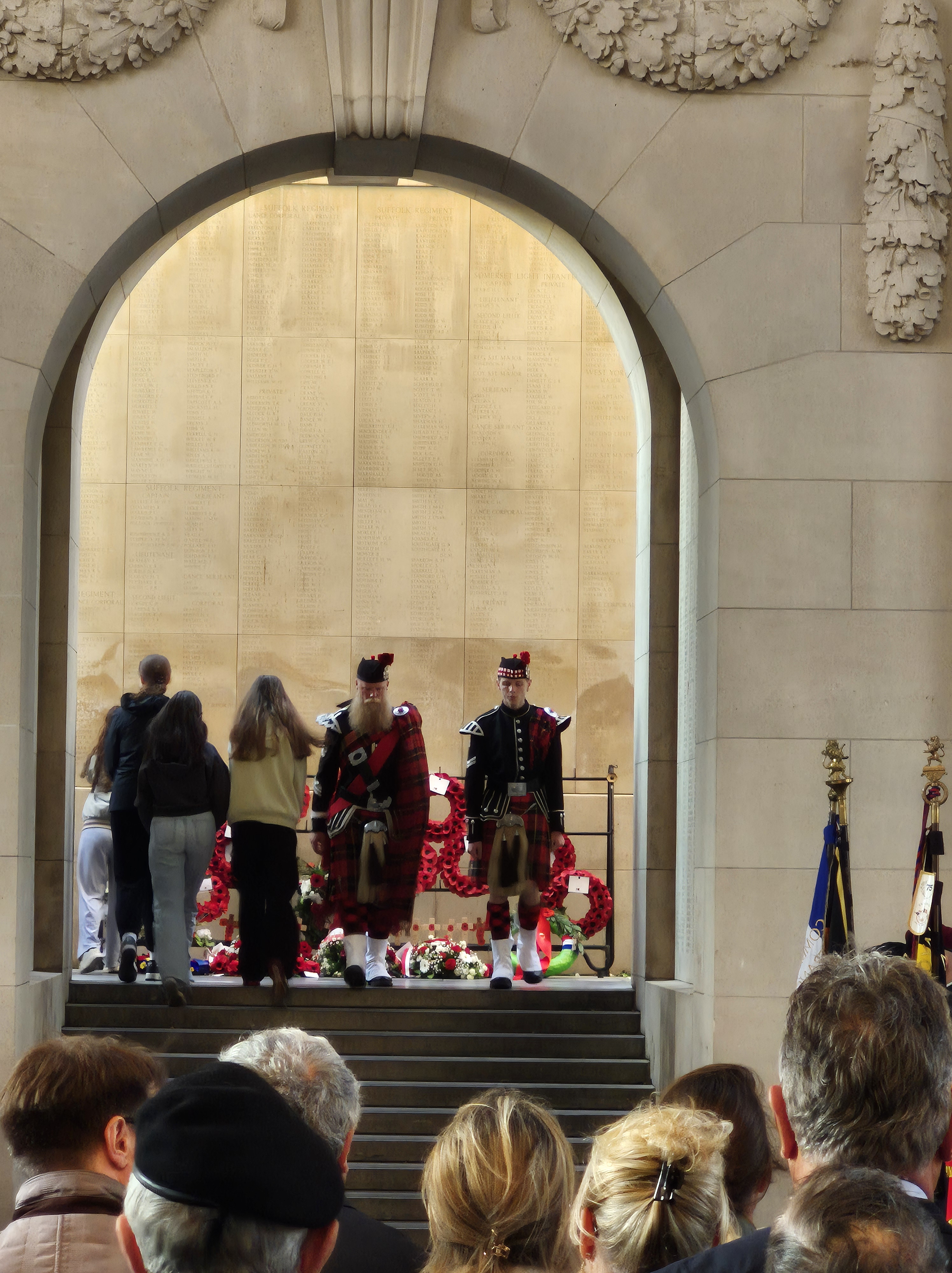
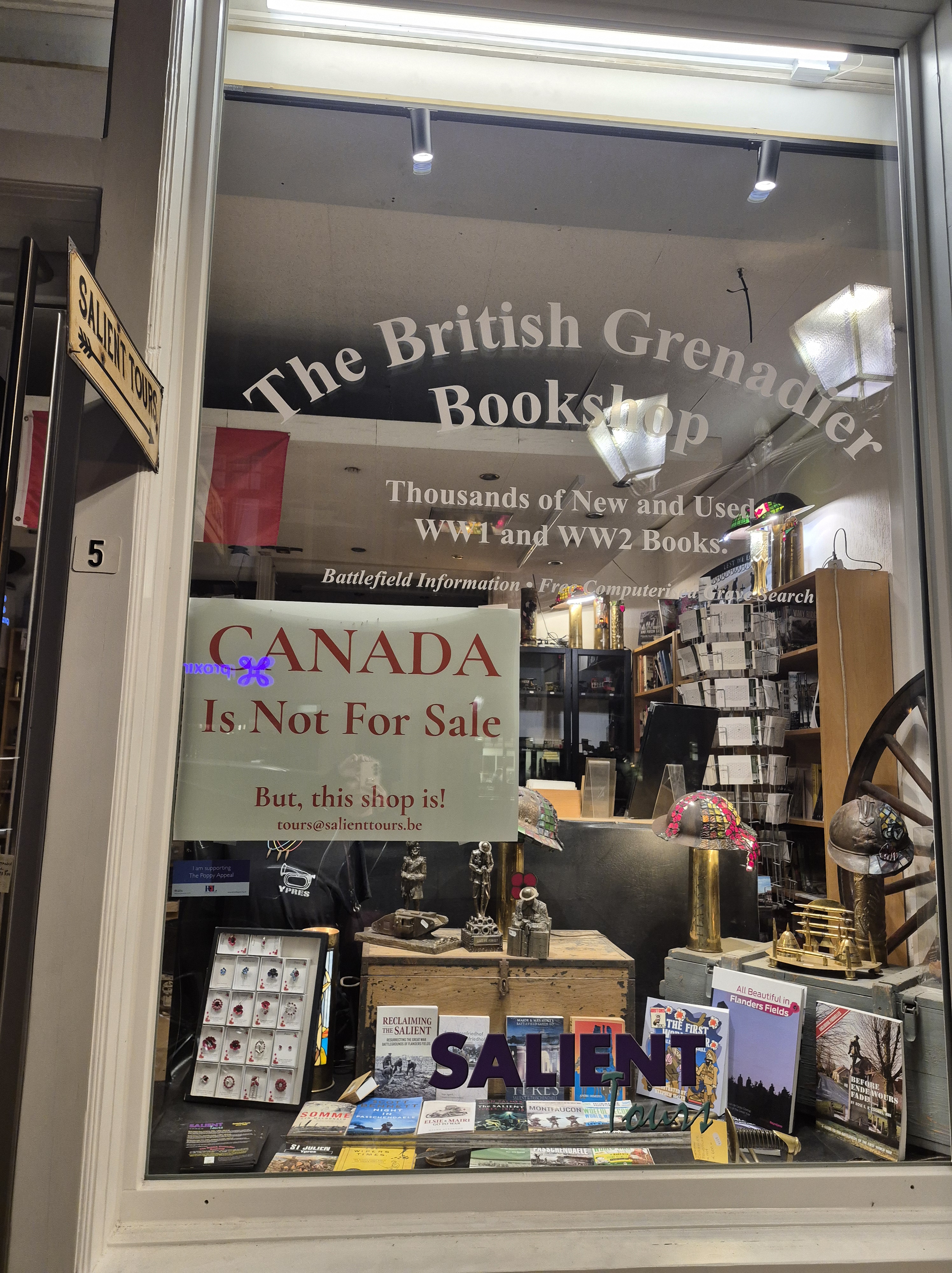
If anyone wants to move to Ypres, there is a book shop/tour business for sale. Steve is a Canadian who has run it for 25 years. I am tempted…
A Service to Honour Jim Johnstone
20 May 2025
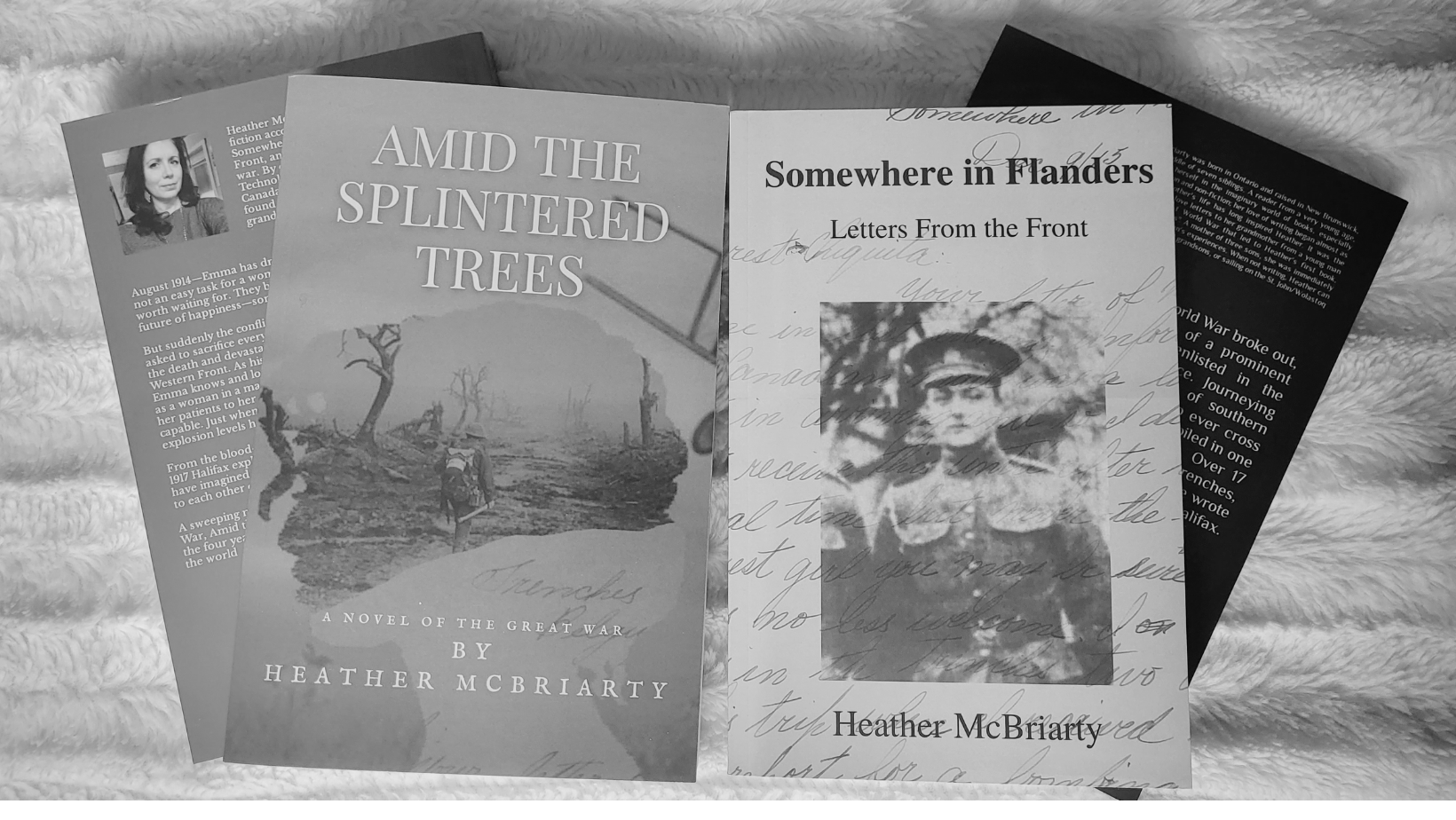
Here is where I come to the story of how my travel plans changed. Earlier this year a police officer reached out to me from Ontario. He and his pipe band were going to be in Ypres and Vimy and they wanted to do a ceremony at Jim’s grave. At first, I was a little skeptical. Was this legit or some elaborate scam? Over the course of a few messages, then email, I consented to call the officer, Special Constable John Guy of the Halton Regional Police Services. He had read my book a few years ago, and Jim’s story affected him deeply. He and his family had been to Belgium in 2023 and visited Jim’s grave. When he knew his pipe band was to go to Europe, he immediately reached out to me to see if I was okay with the idea – heck, yes! It was then he met with the rest of the band members, got permission from his Chief and it all fell into place. The entire band got copies of Somewhere in Flanders so they could “meet” Jim as well, and I made my travel plans to meet them there. It was all SO much more than I had anticipated. The entire band paraded down the lane that Jim would have been carried to his final resting place. They had a piper, a singer, a bugler, speeches and a wreath laying. It was emotional, beautiful, a loving tribute to Jim and his fallen comrades at RE Farm. It will be one of my most treasured moment!
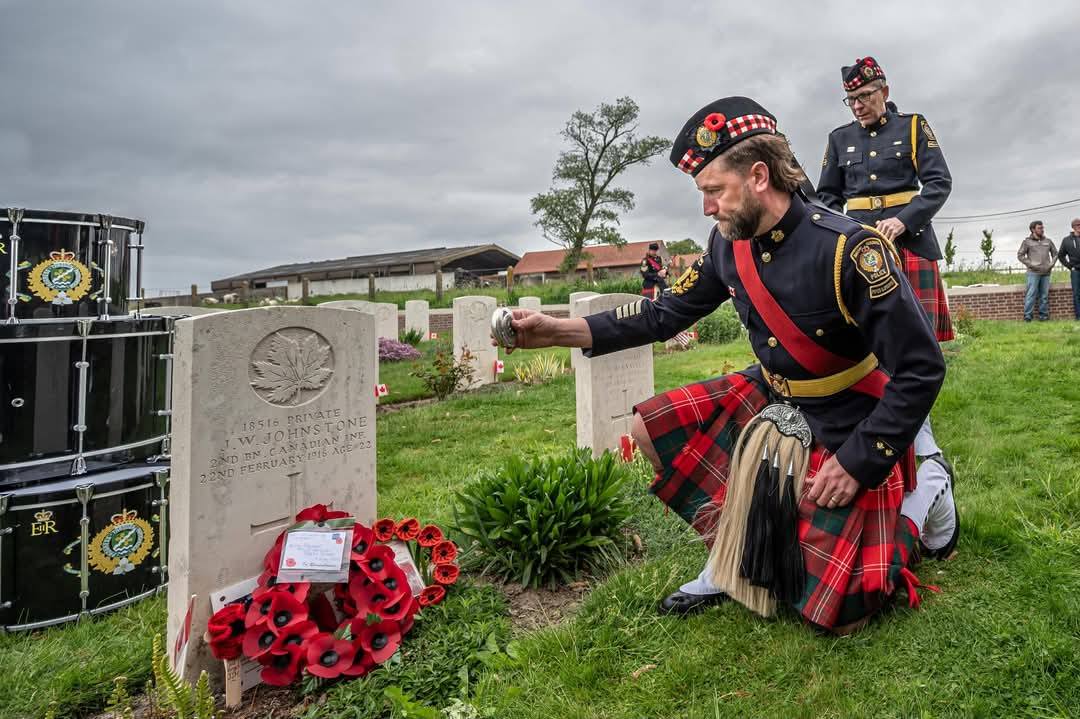
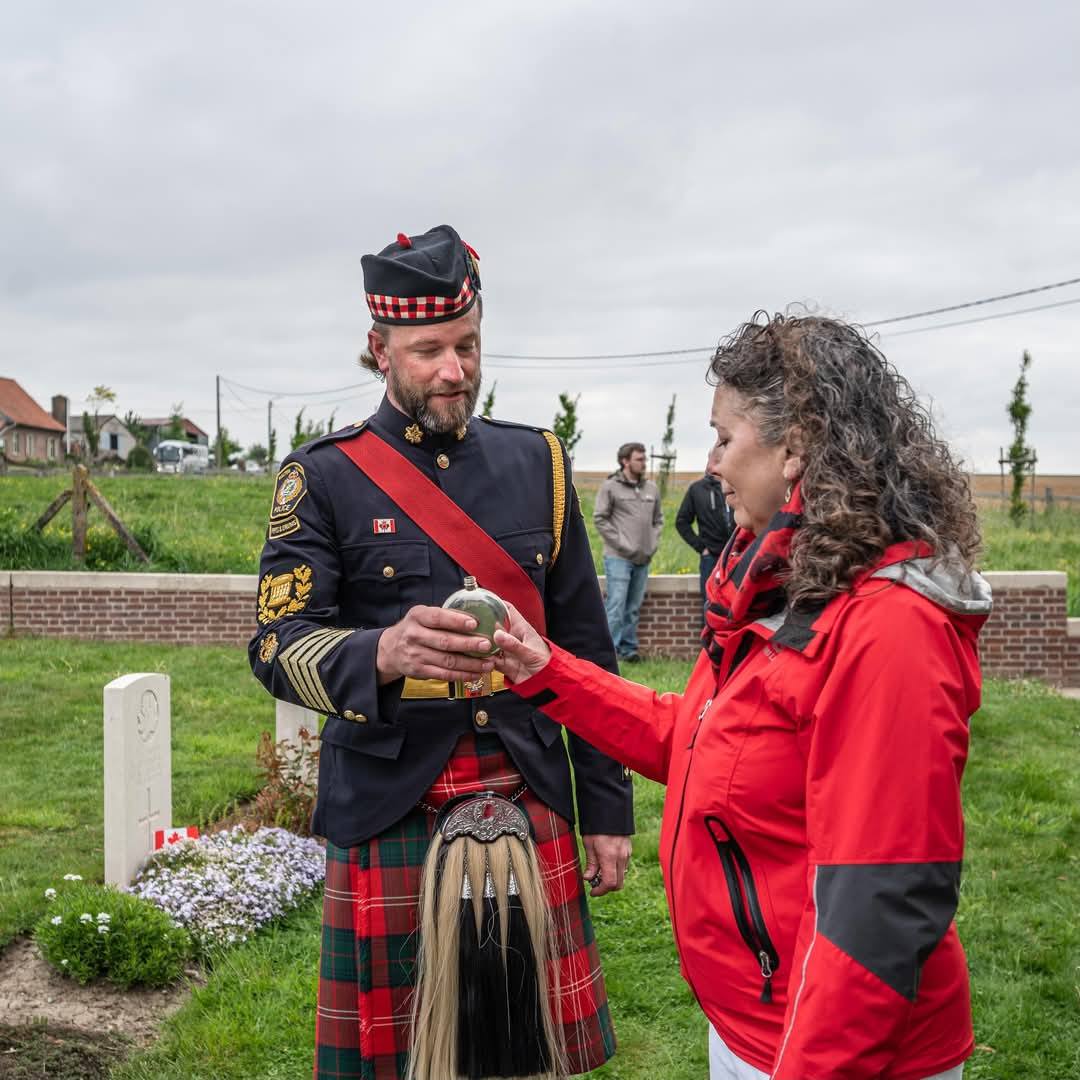
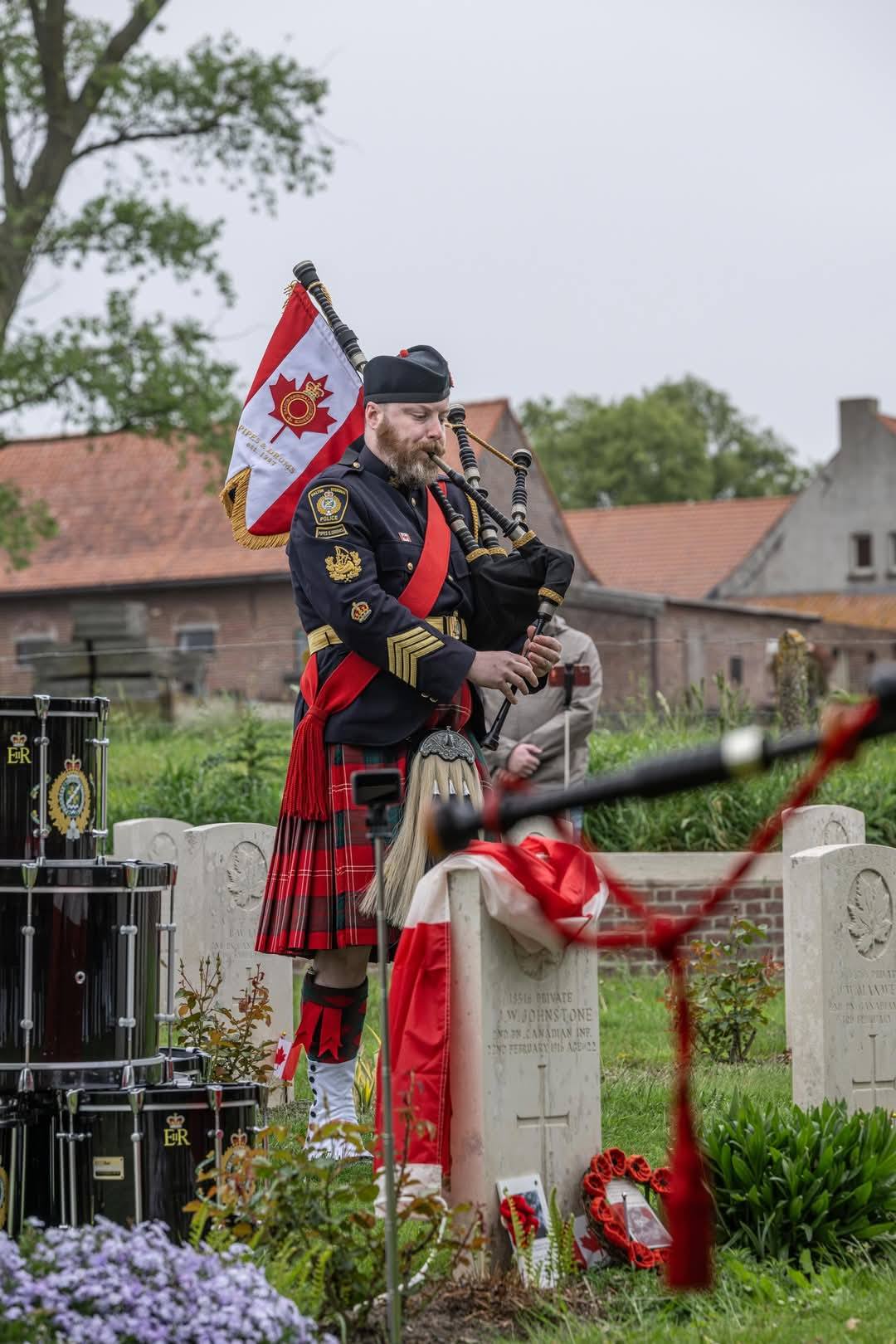
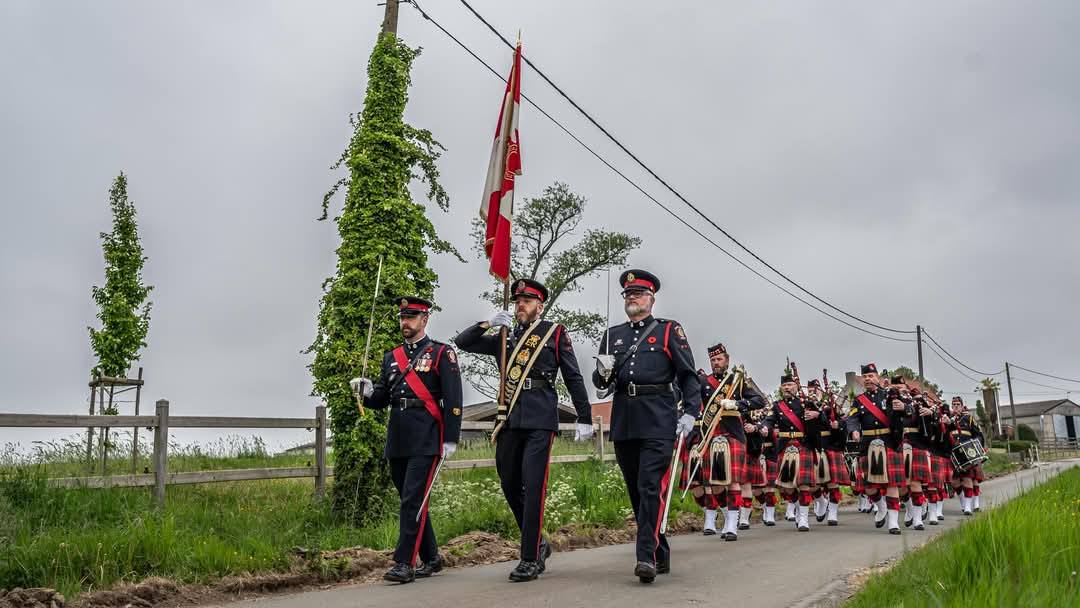
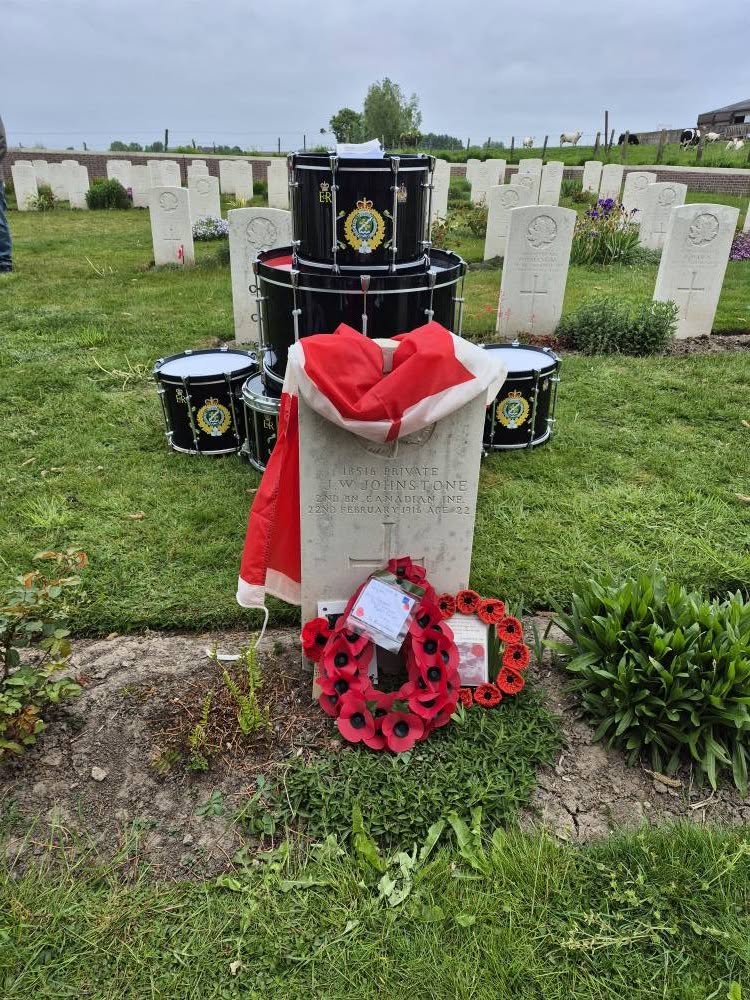
Photo Credit: Eric Compernolle
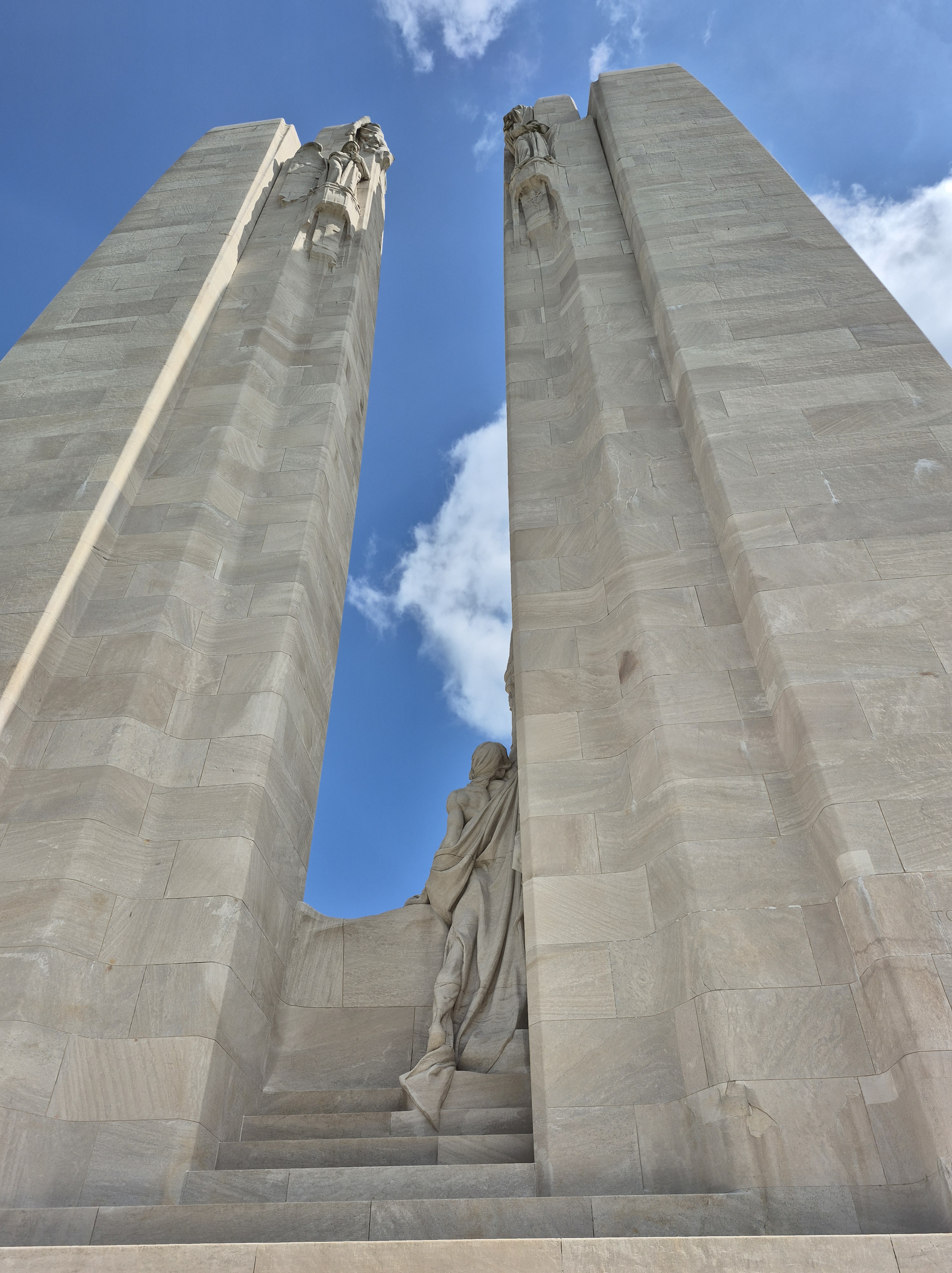
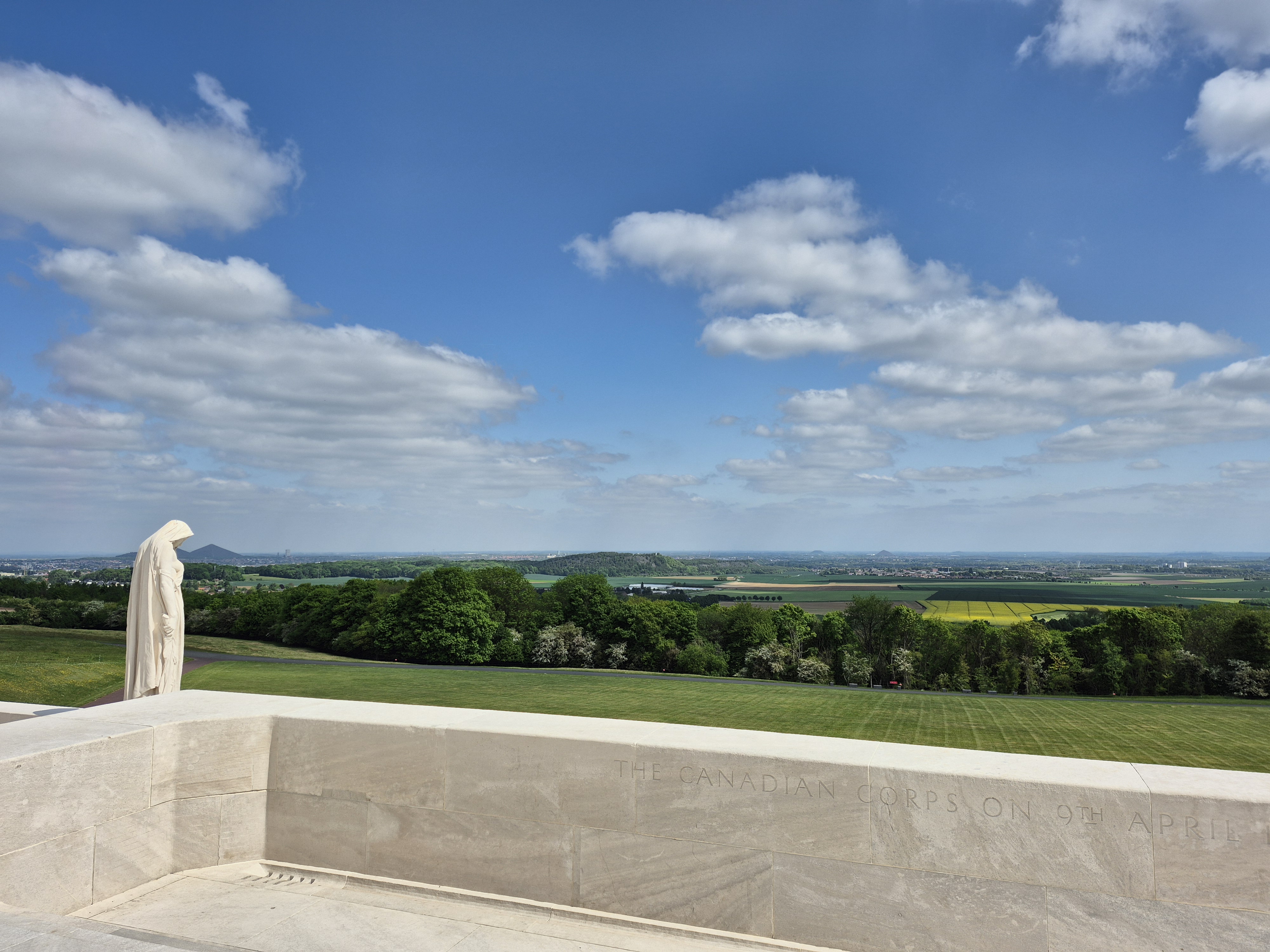
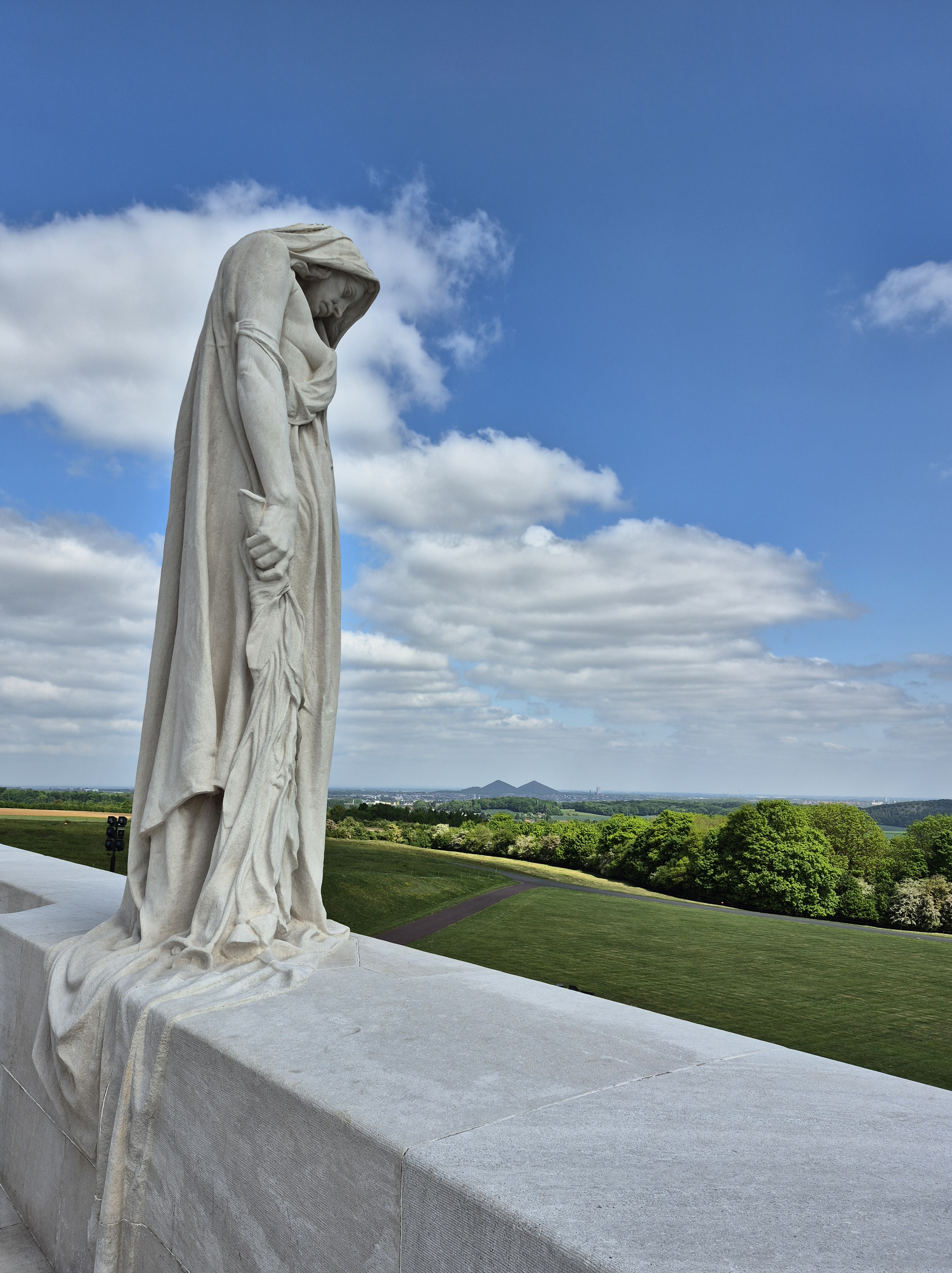
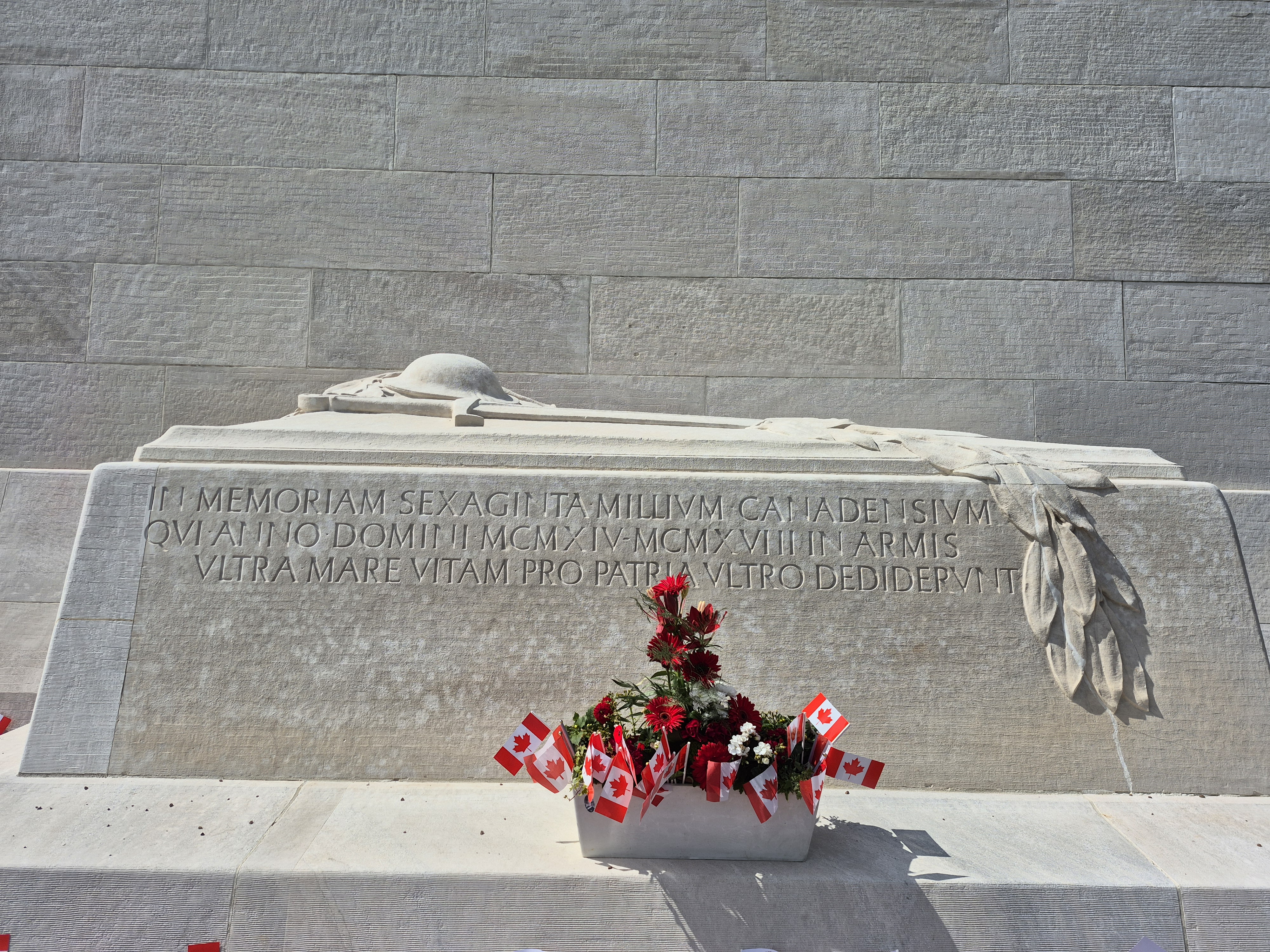
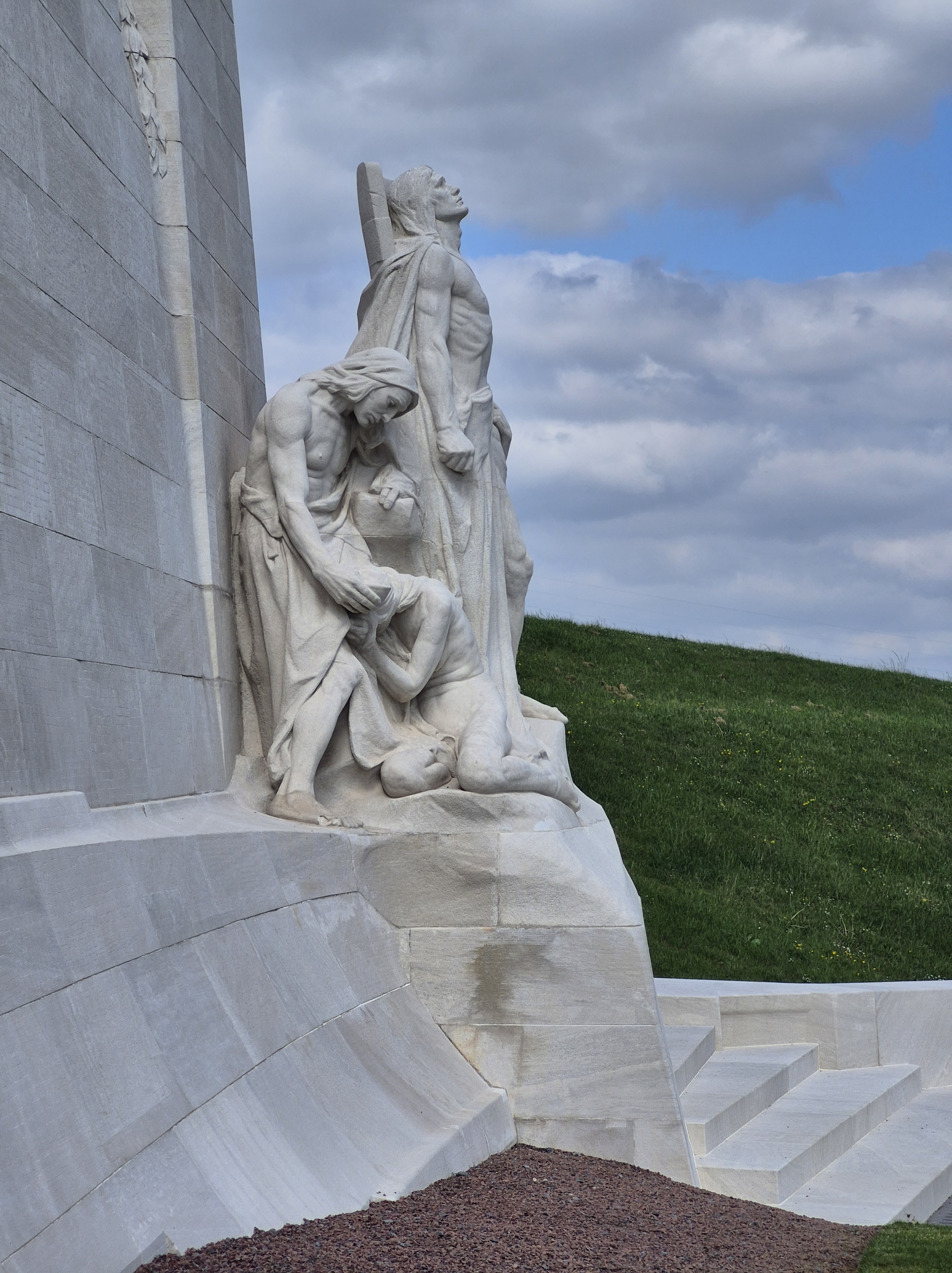

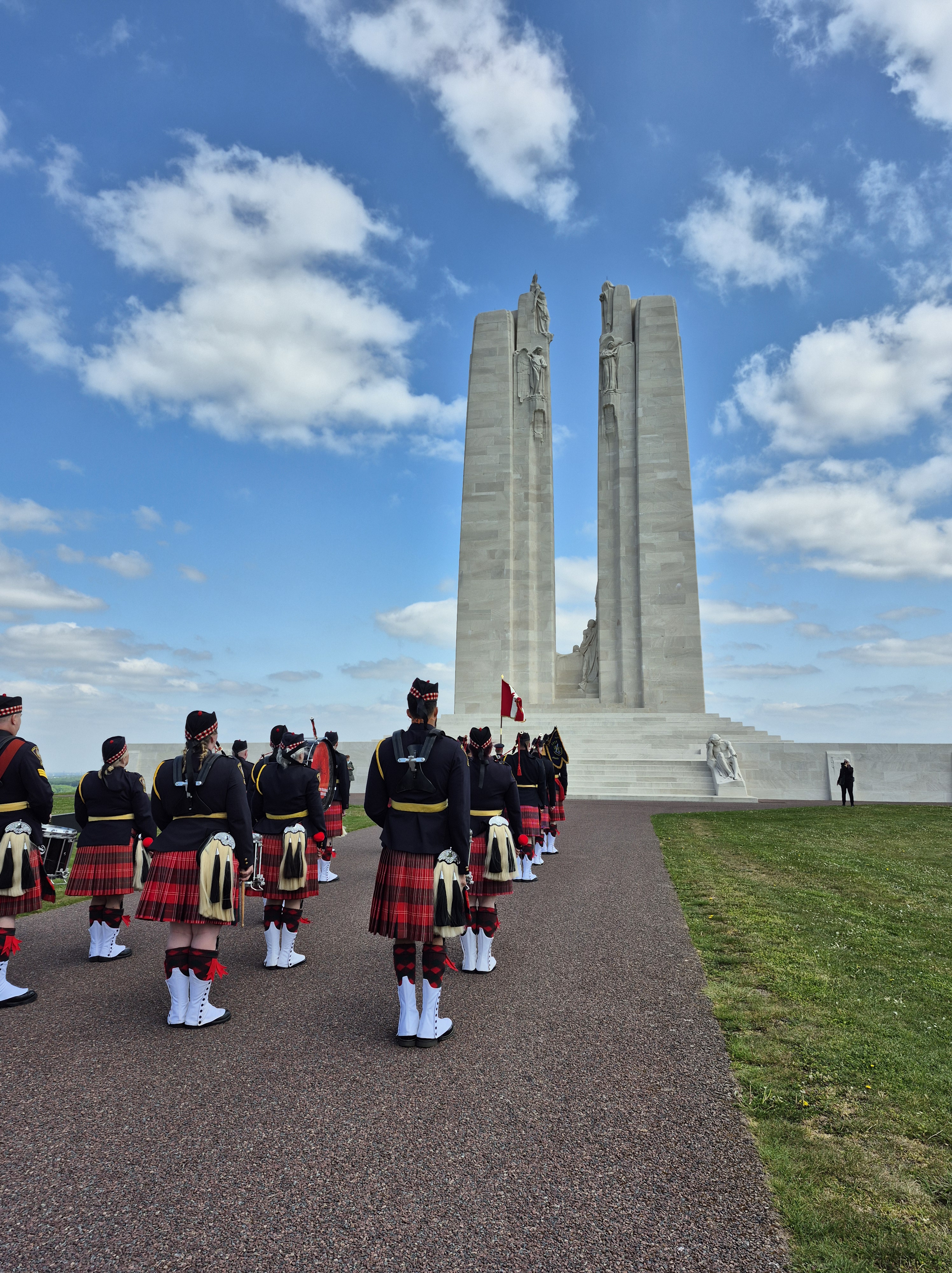
We then joined the band at Vimy.
Travel Part Two
20 May 2025
Days four, we took a look north and west of Ypres, visiting the Dodengang, a series of restored Belgian trenches along the Iser Canal. Here the Belgians held off the Germans who were mostly lined up on the opposite bank of the canal, except for one small part. There is a lovely little museum and not expensive, that includes access to the trenches. With so much focus for me usually being on the commonwealth sites, this was interesting. In October 1914, the Belgians opened the dykes and flooded the countryside between Nieuwpoort and Diksmuide, halting the Germans from taking this last strip of Belgium.
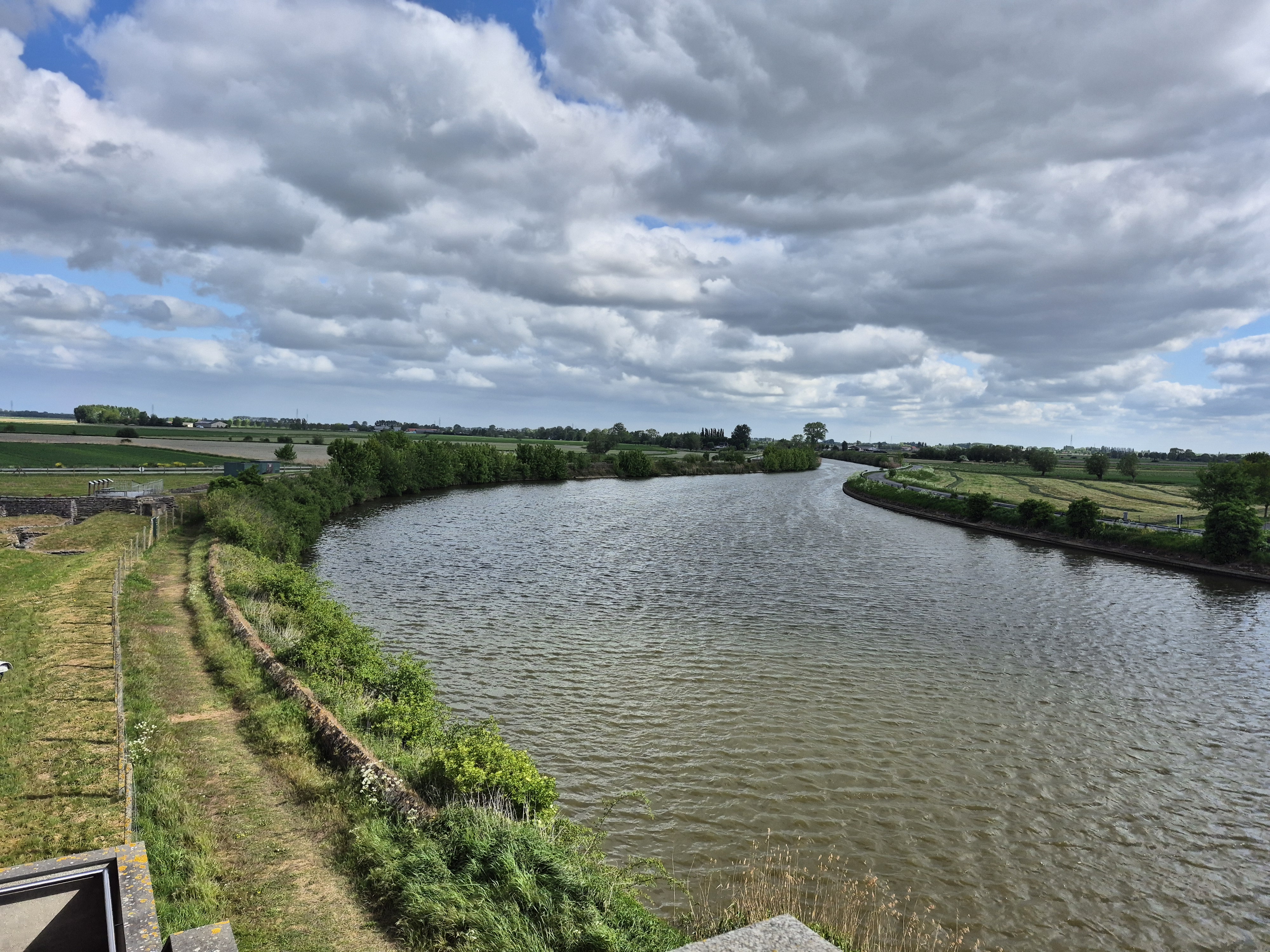
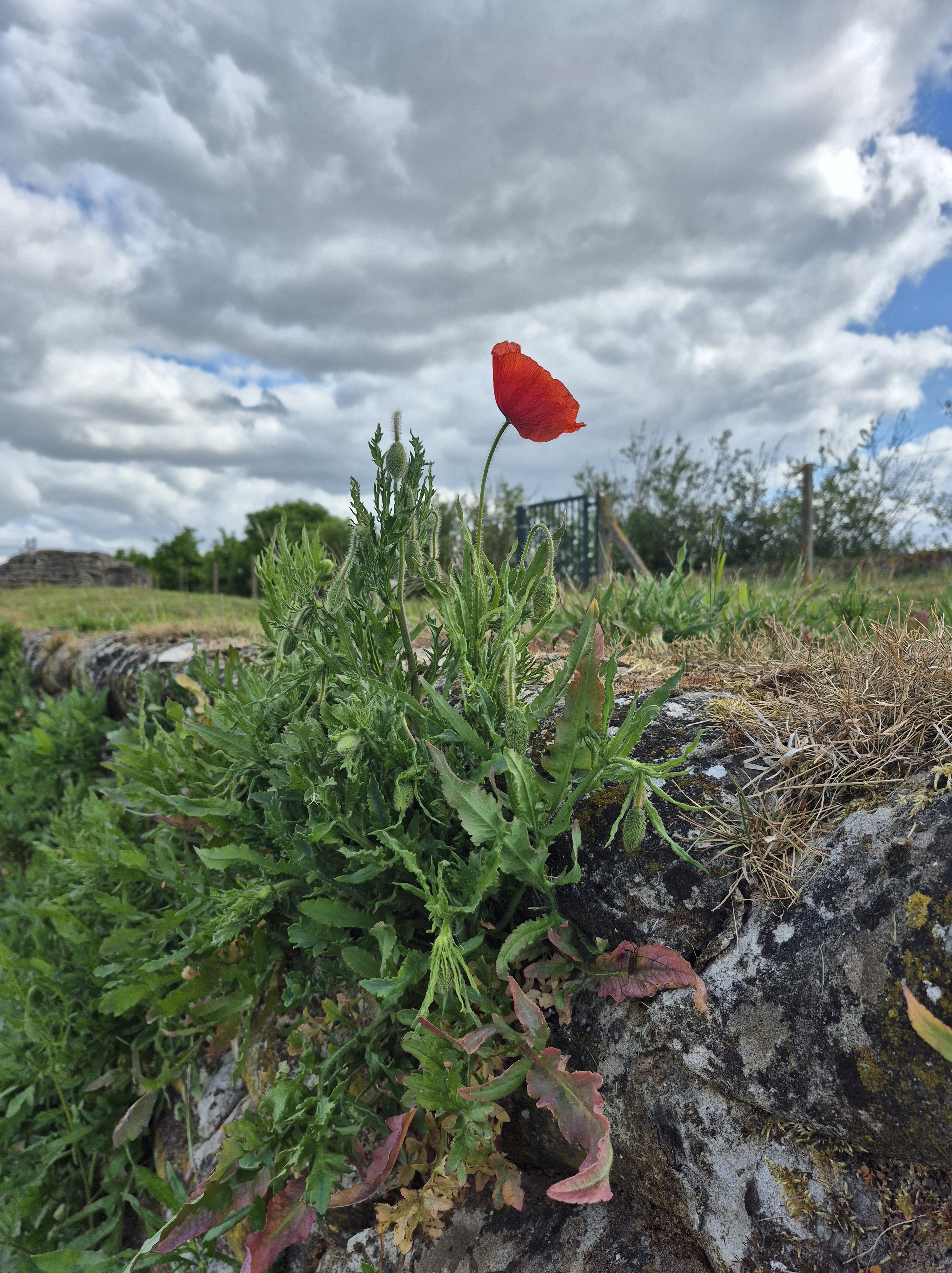
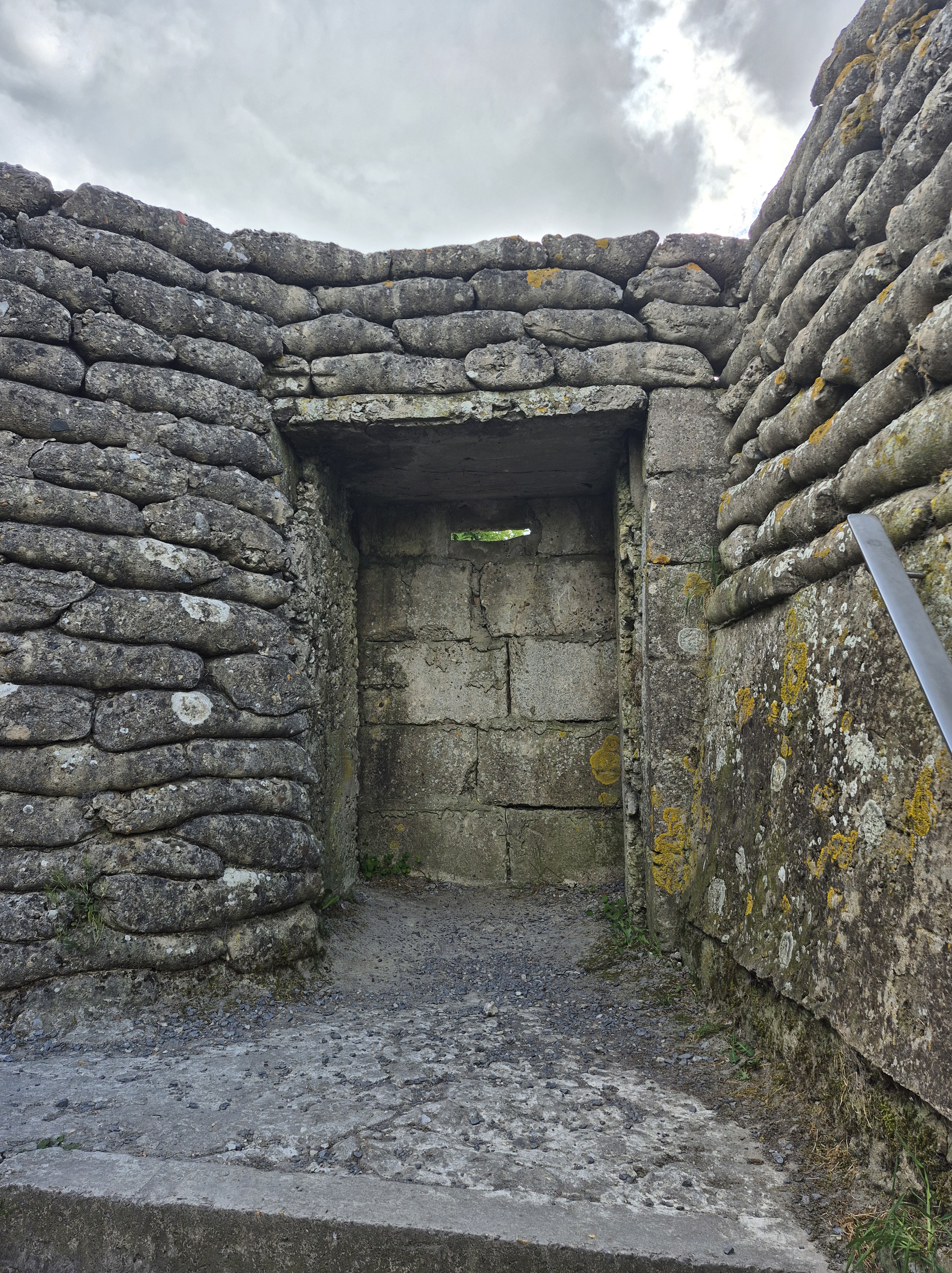
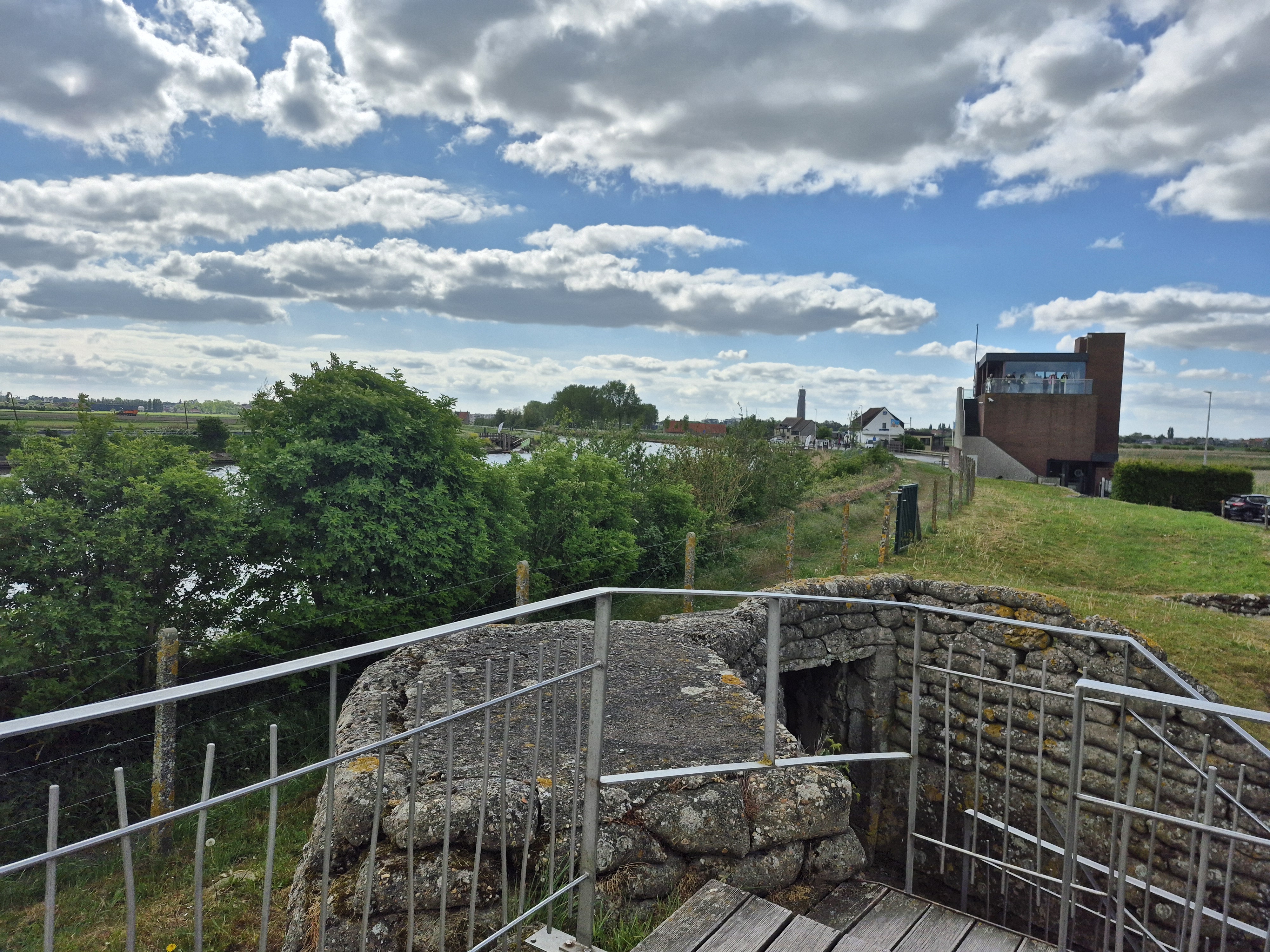
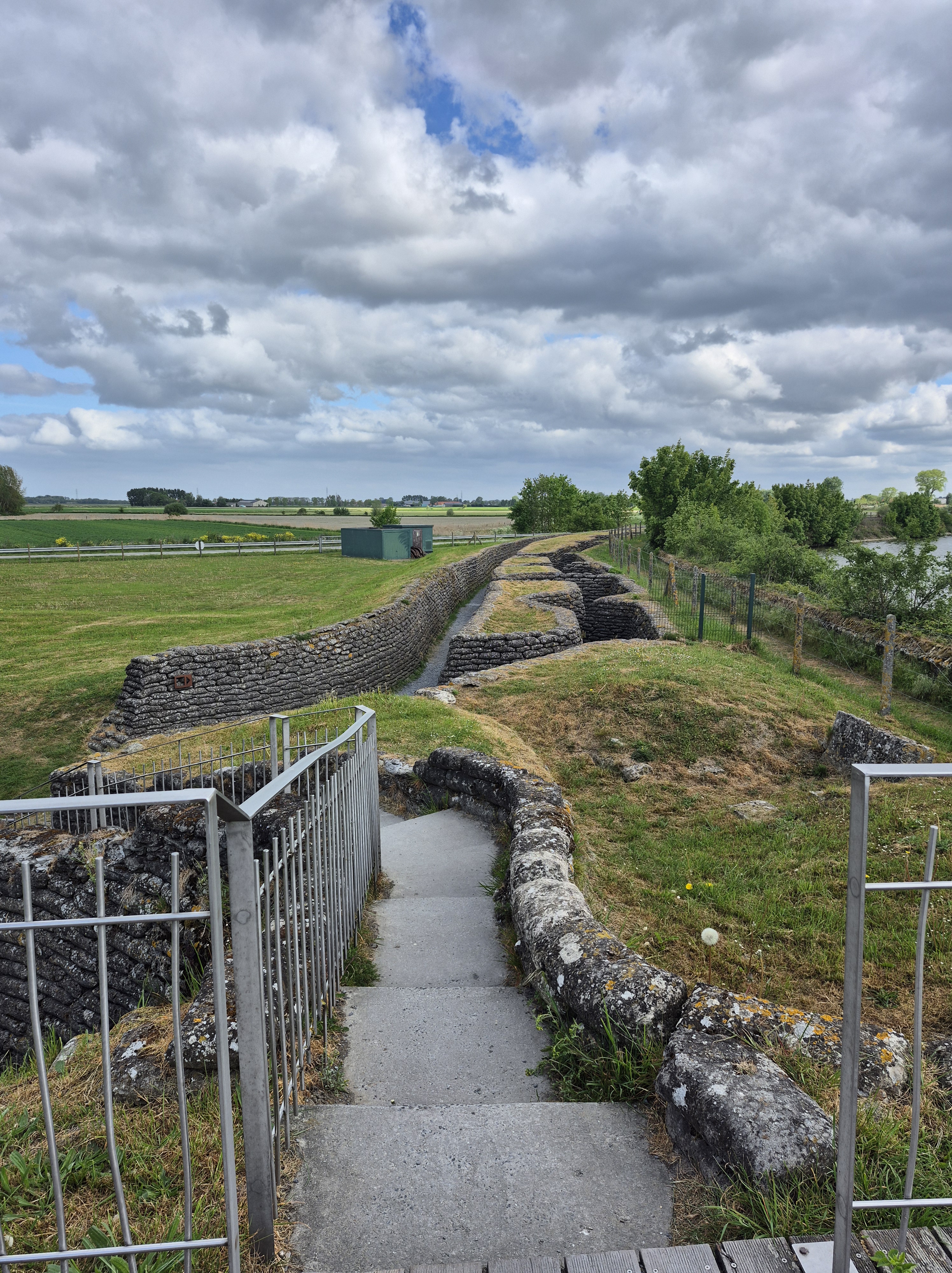
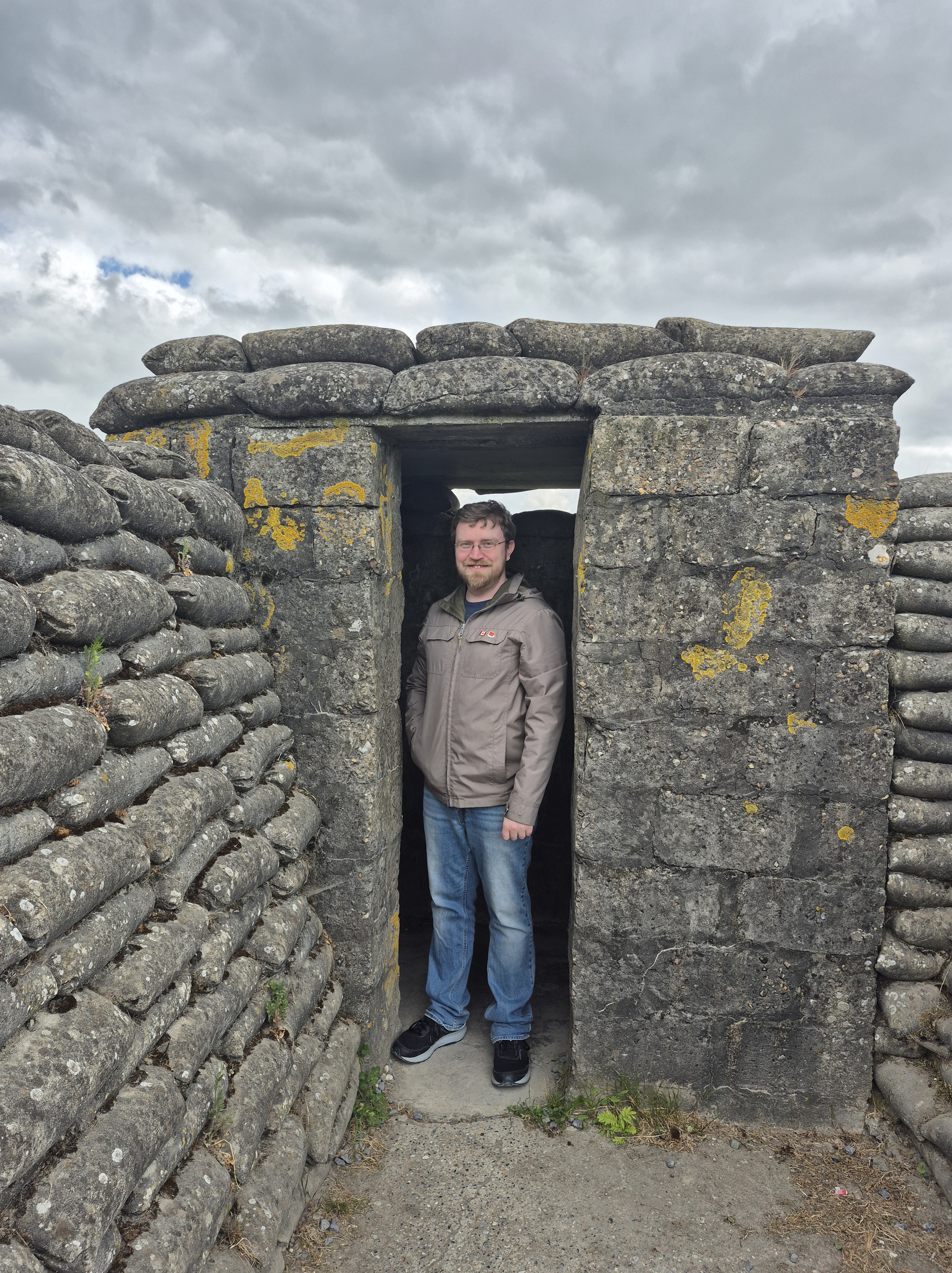

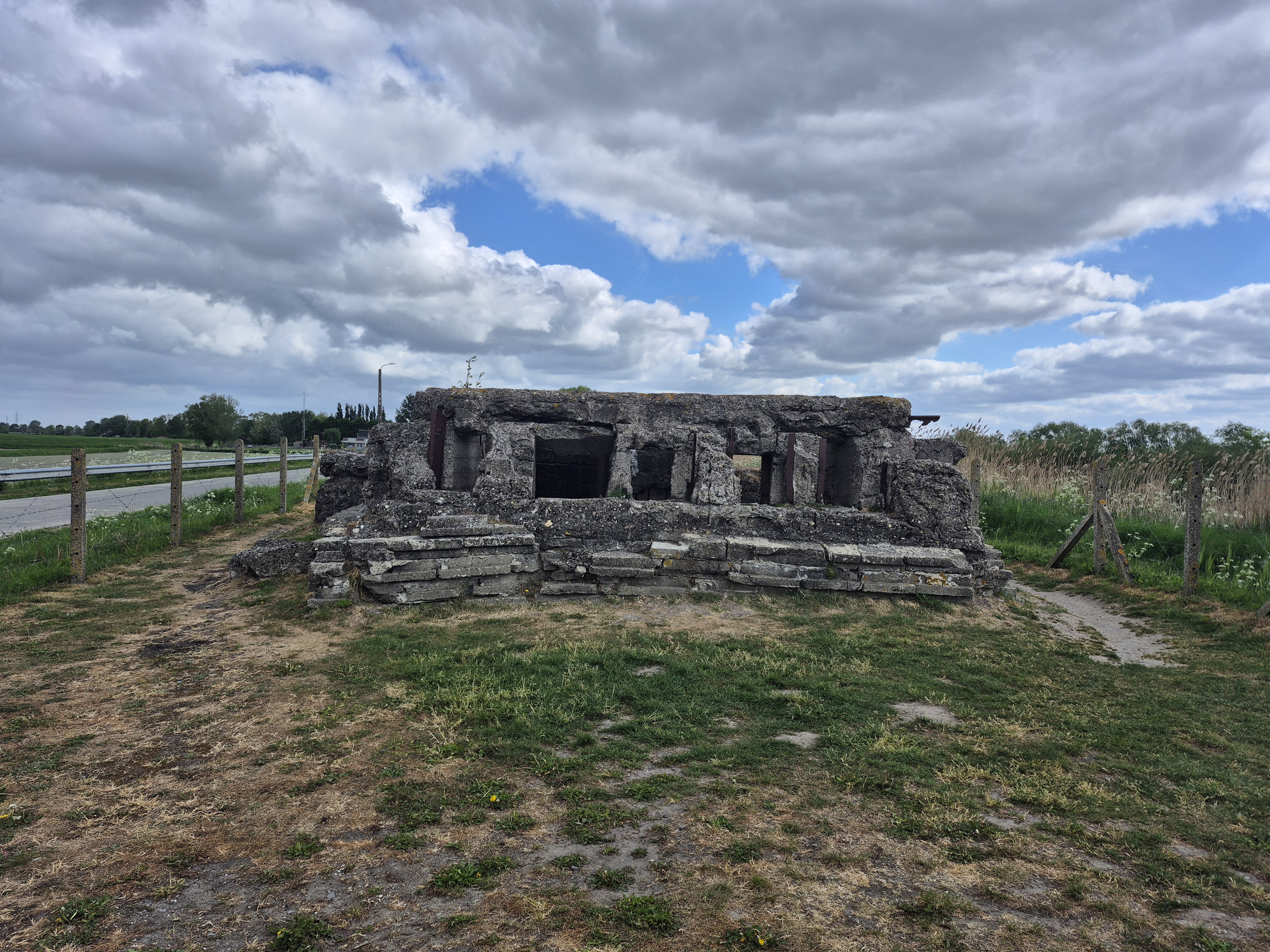

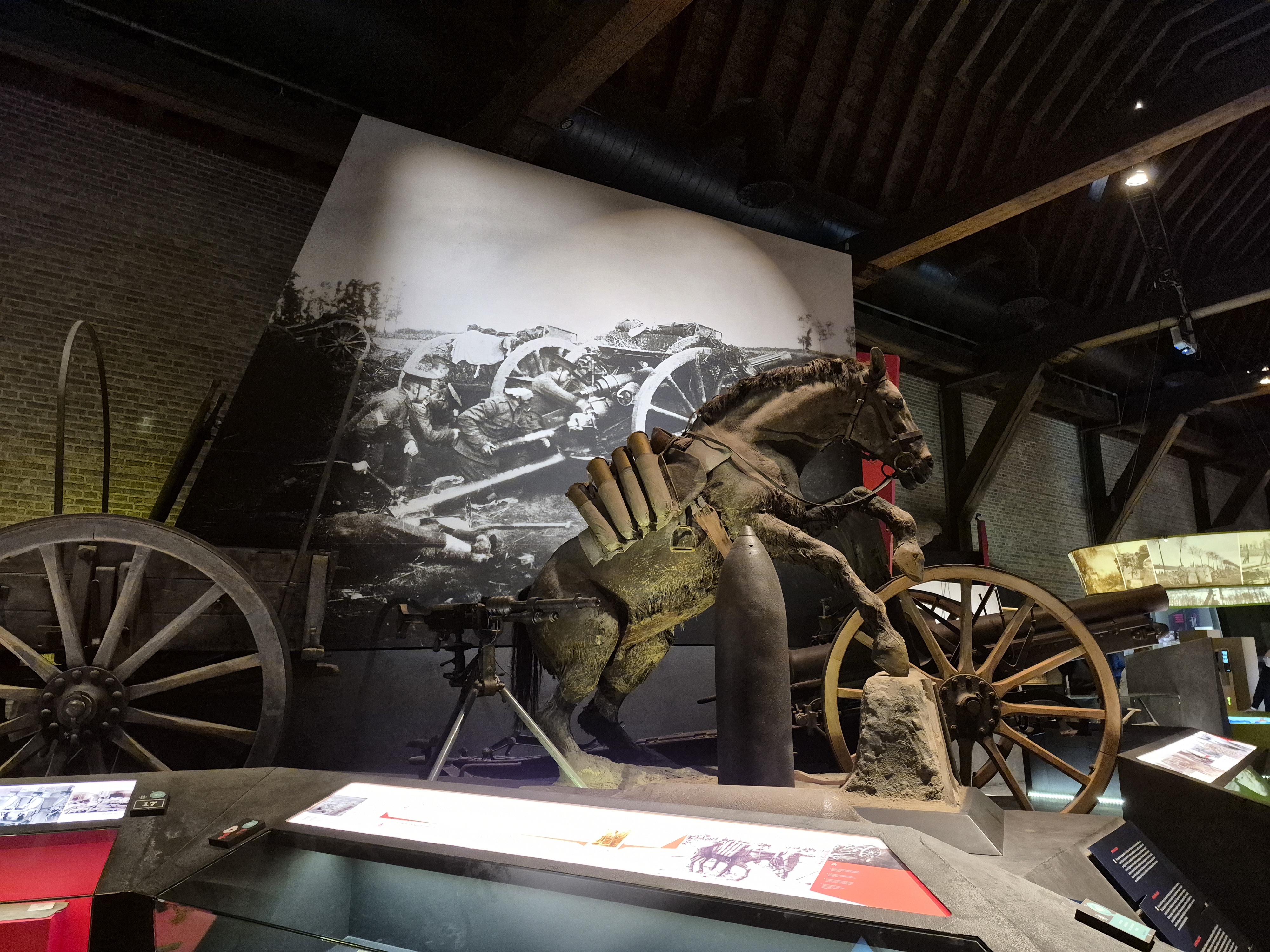
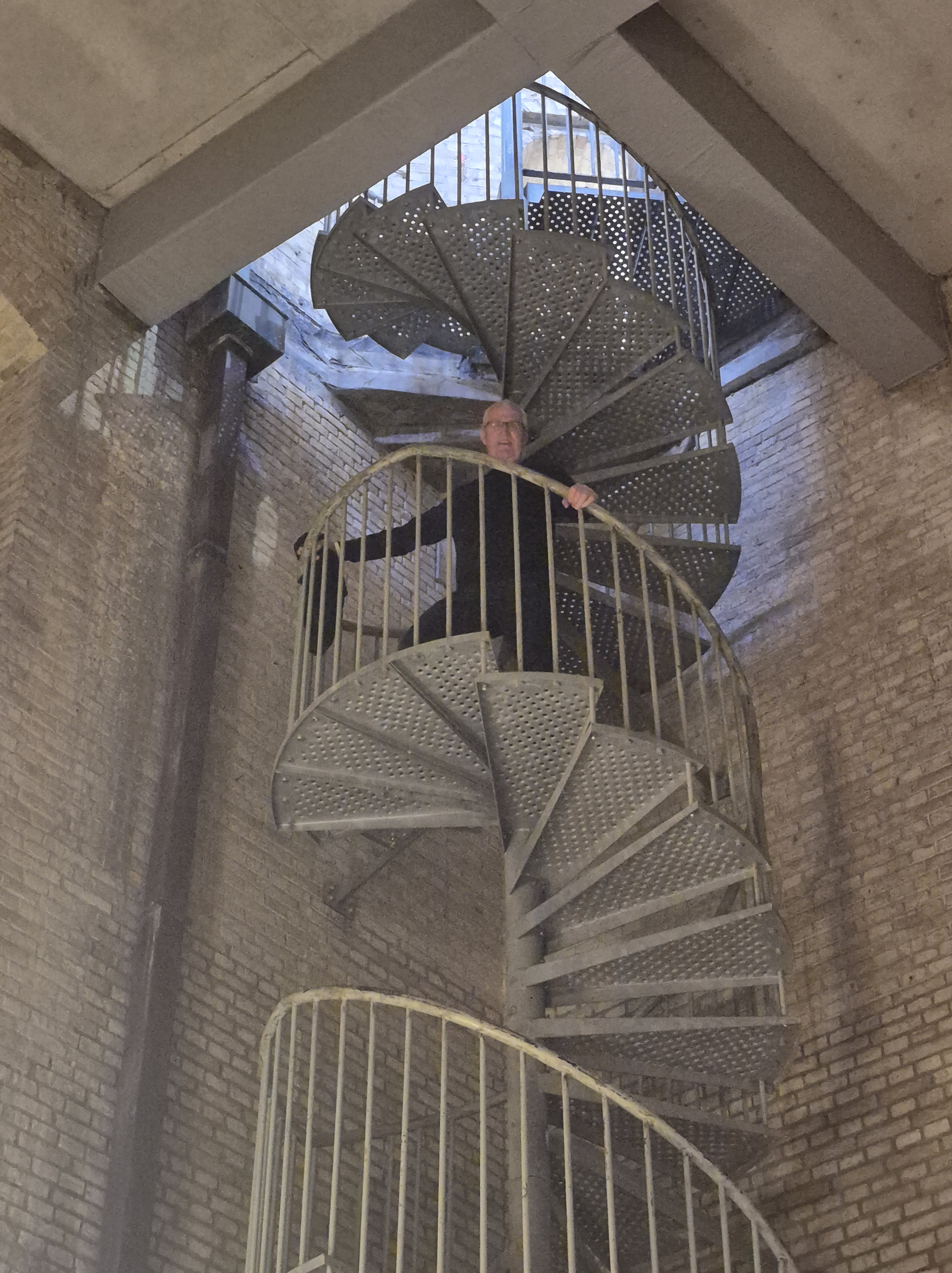
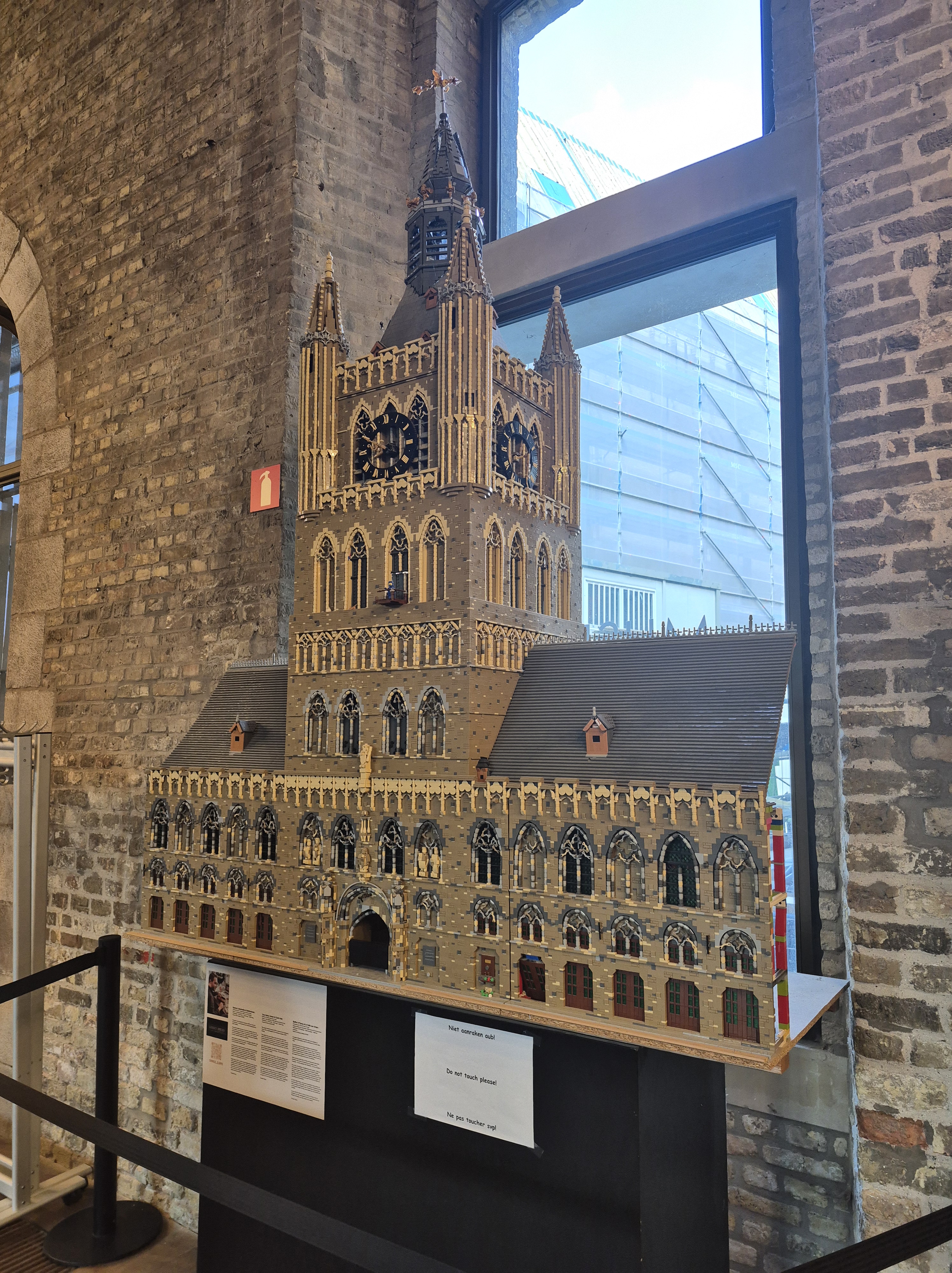
We then needed a little salty sea air so headed to the beach at Nieuwpoort. It was cool and windy so not great for a beach day. These are gorgeous sandy beaches that stretch for miles; no wonder people flock there in summer! We then drove down to Dunkirk and back around to Ypres to visit the In Flanders Field museum. I highly recommend this museum and a climb to the top of the clock tower.

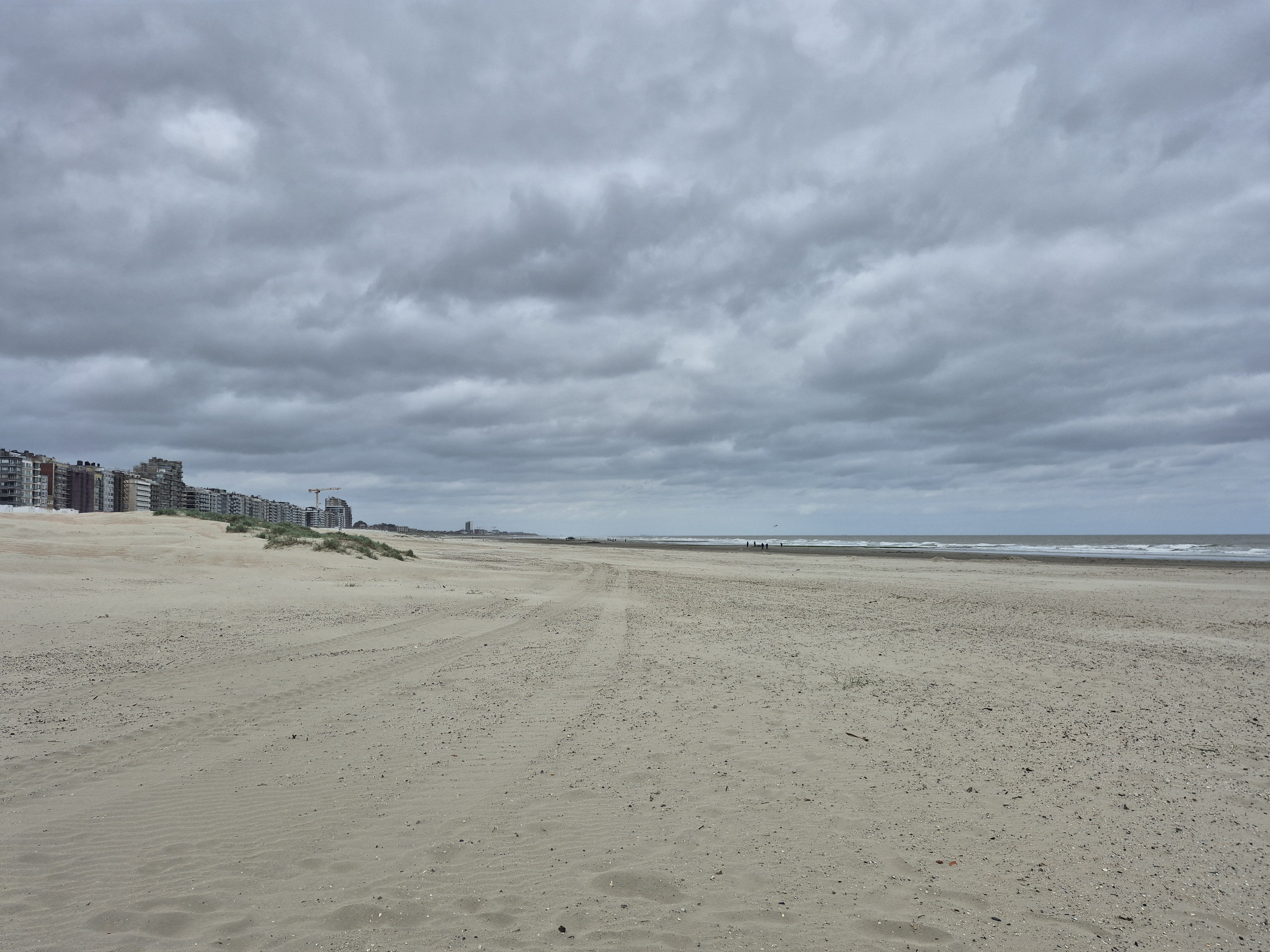
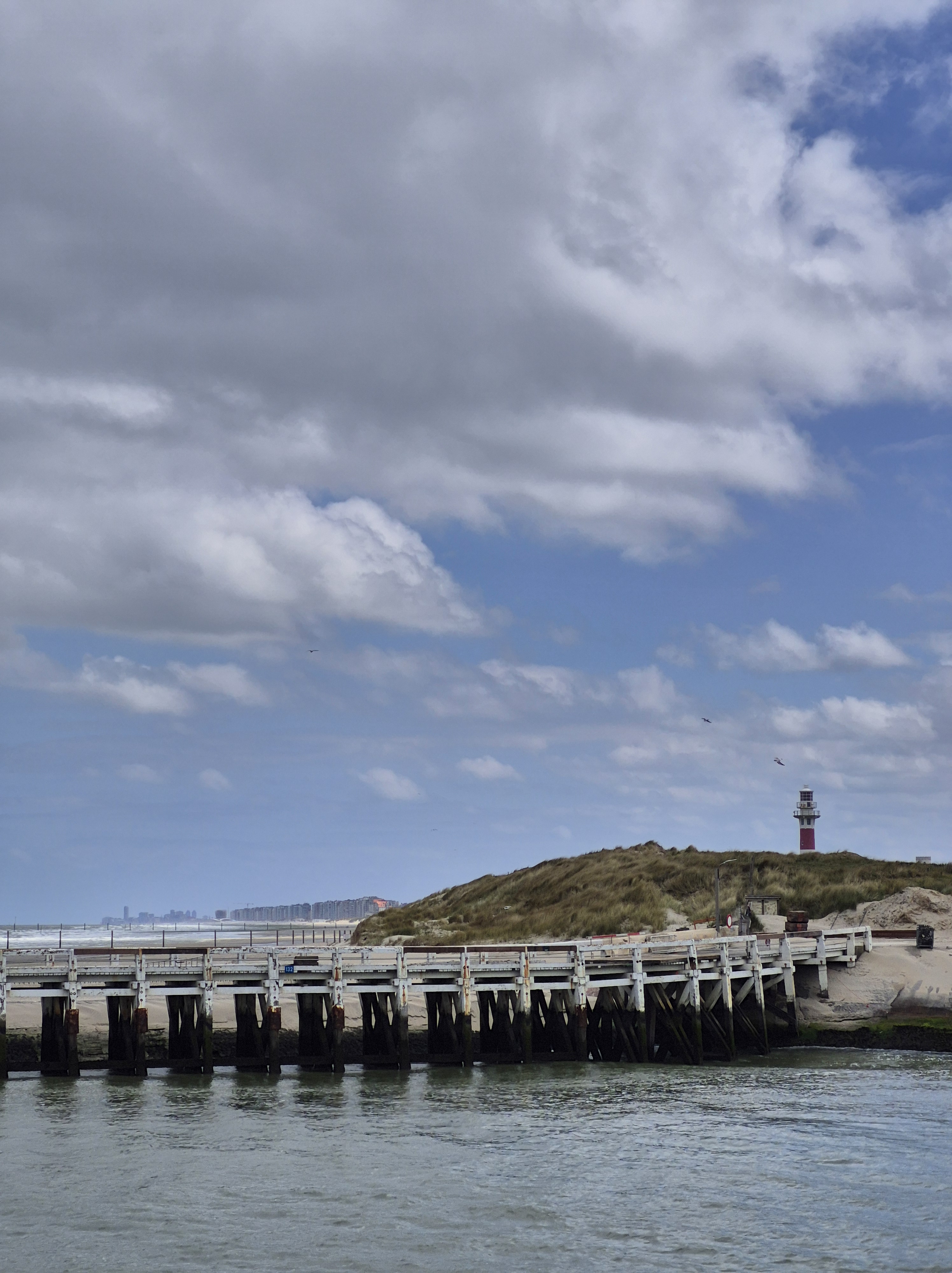
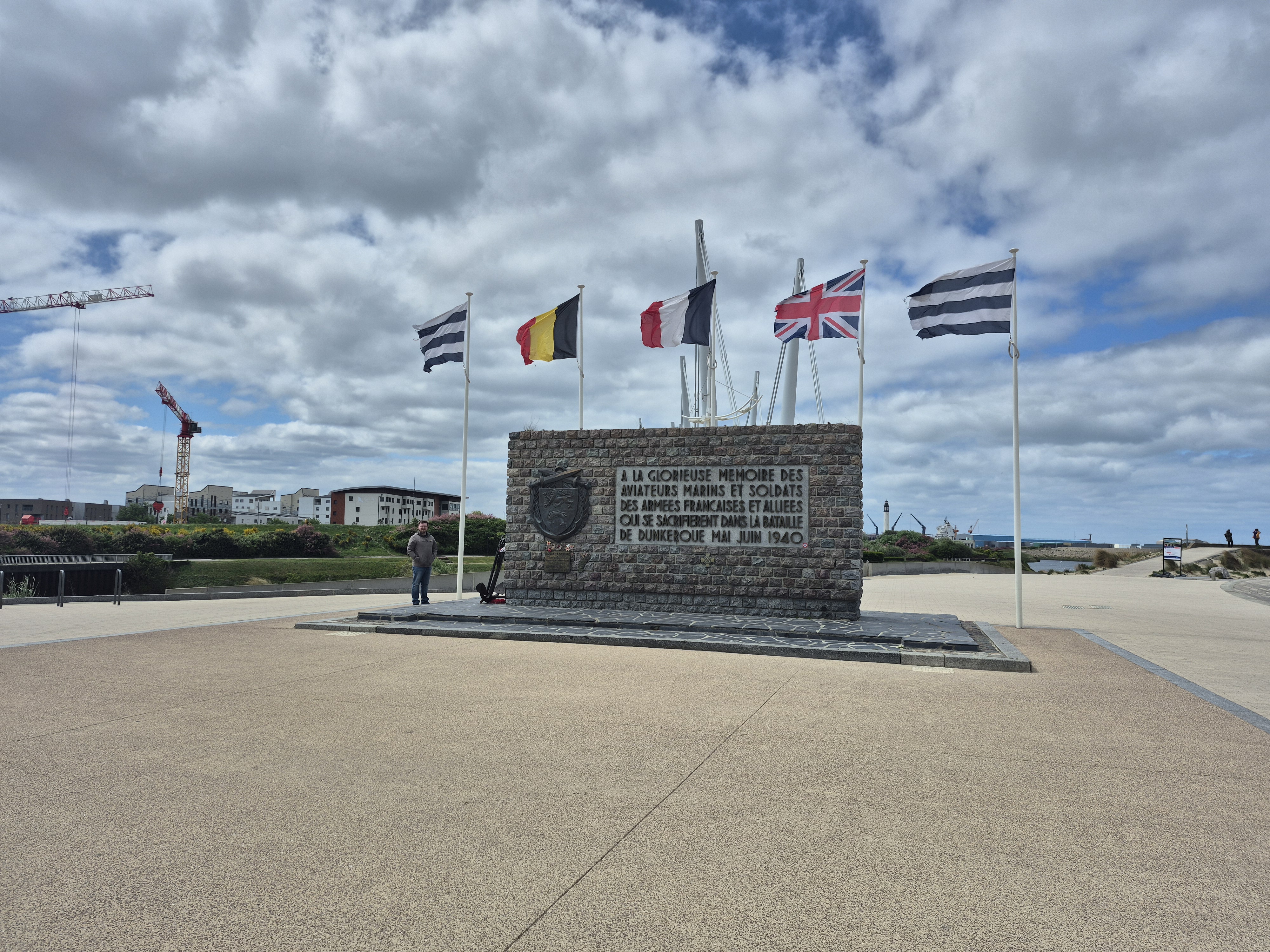
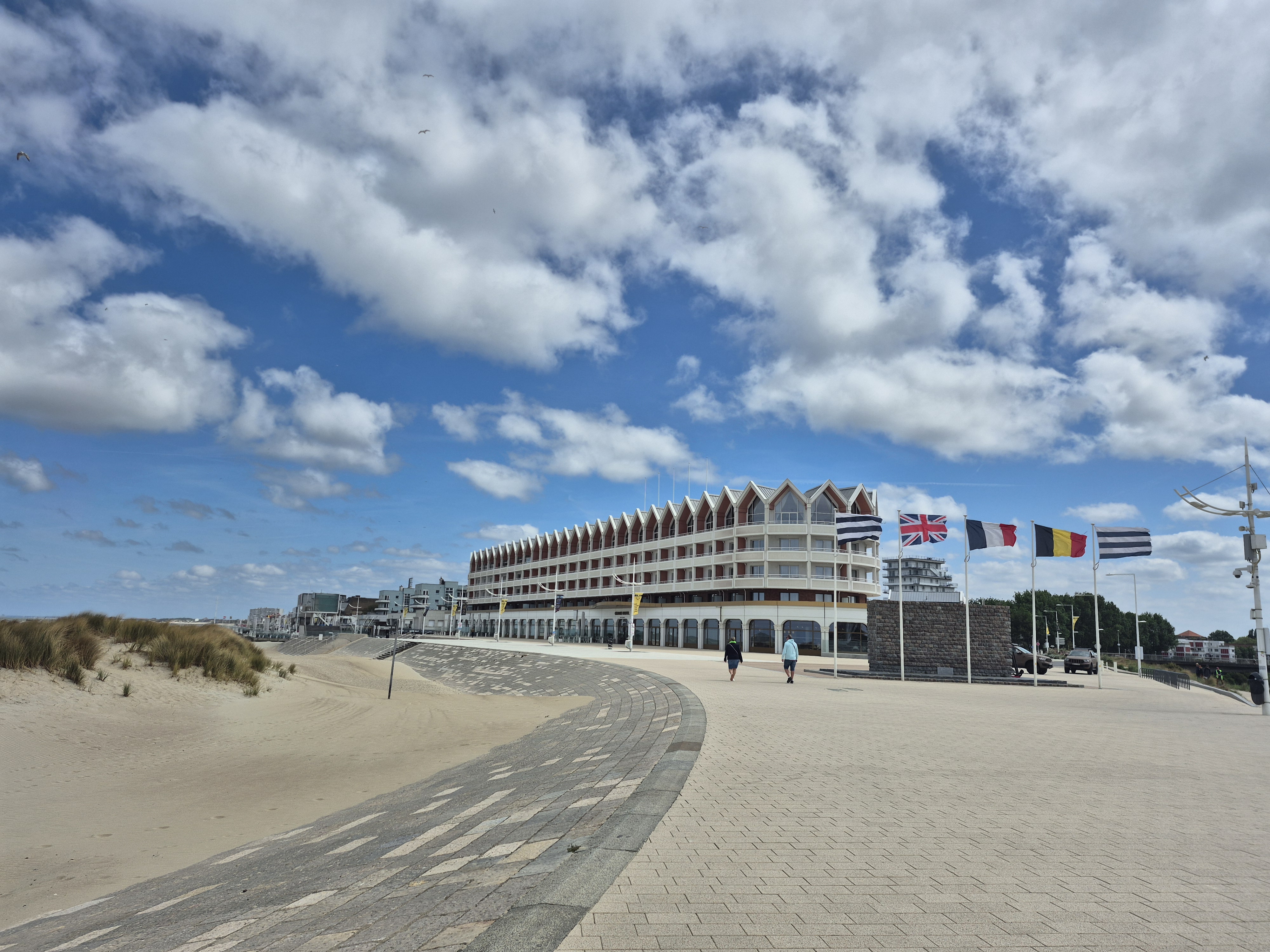

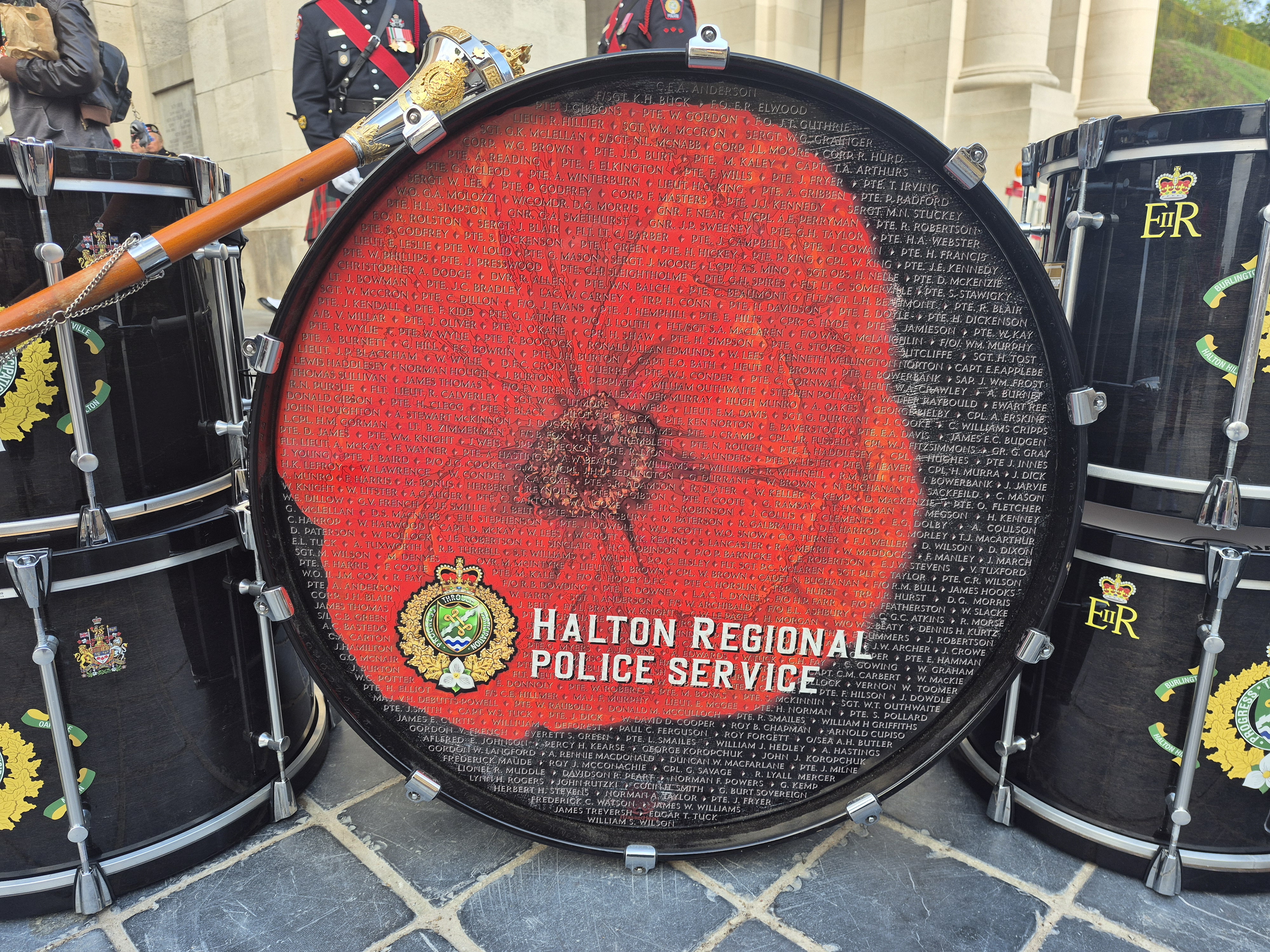
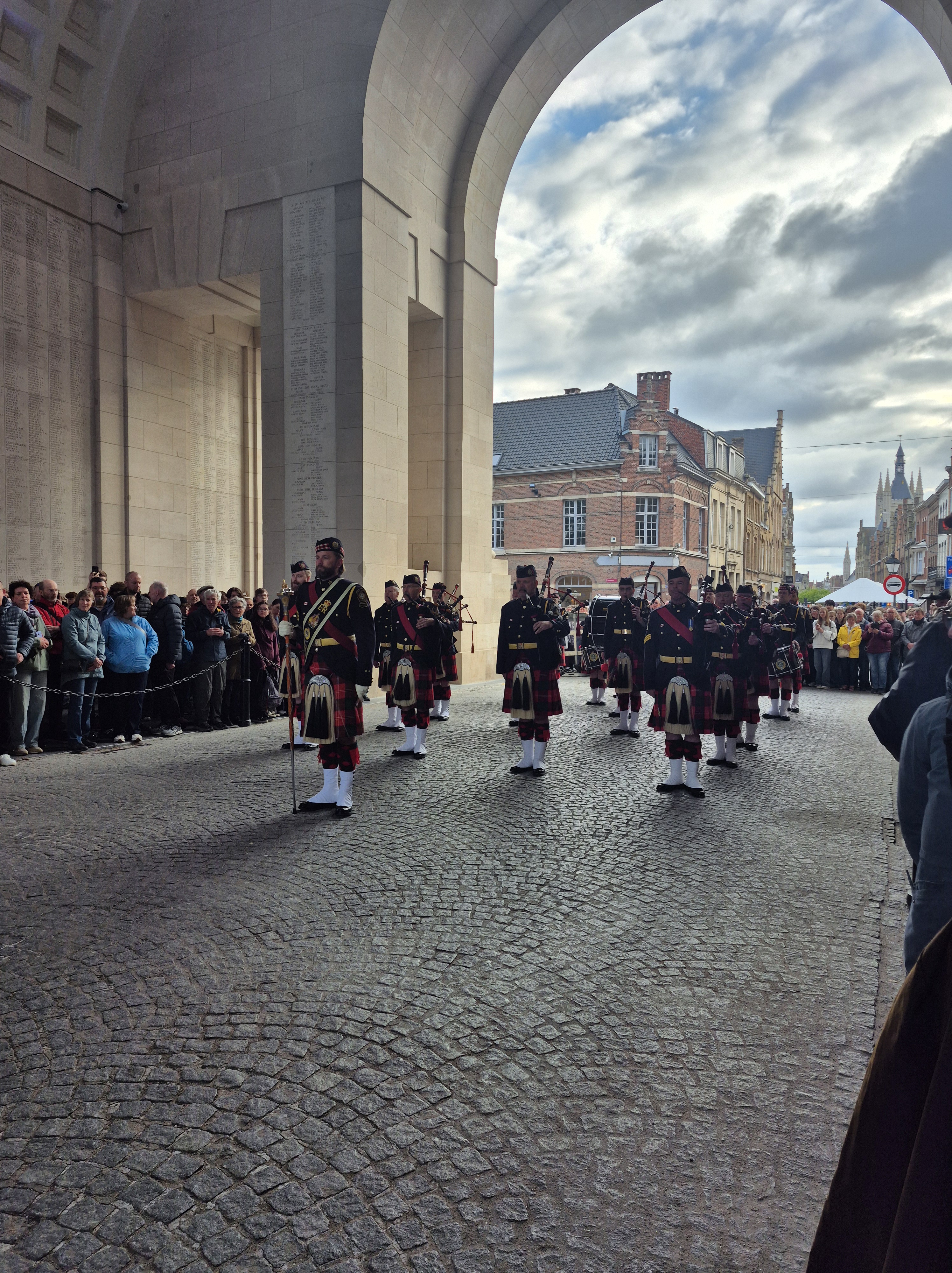
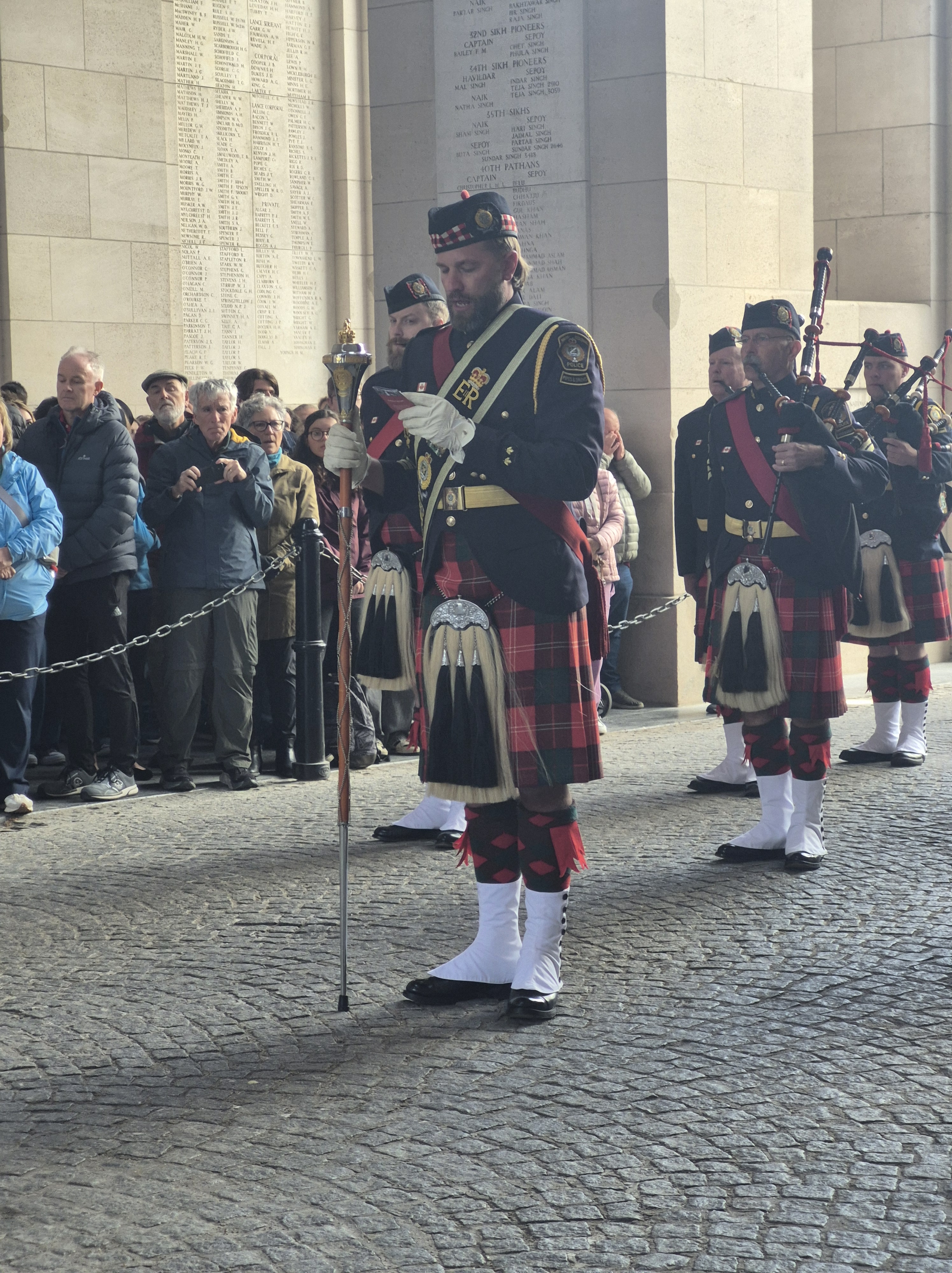
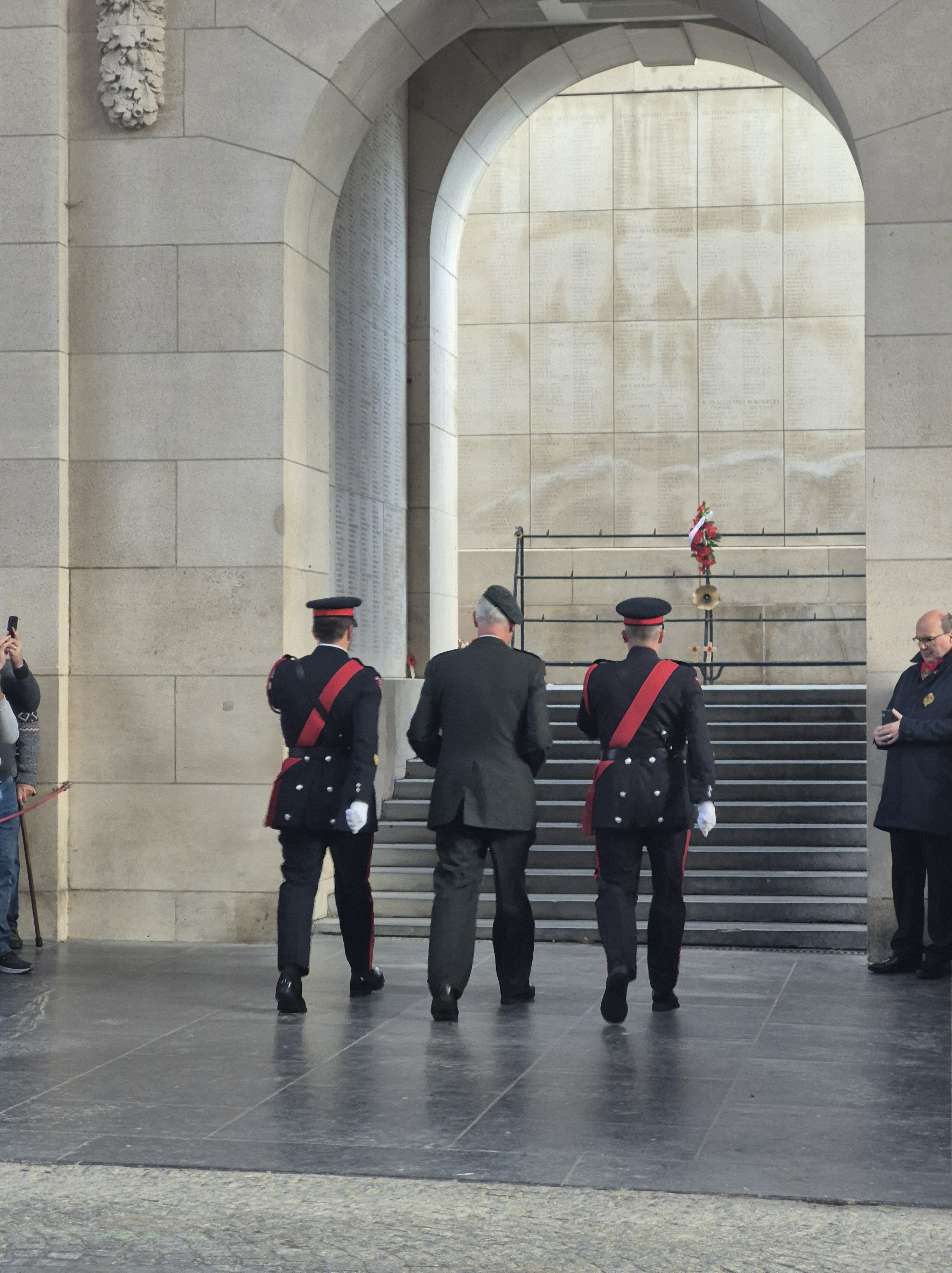
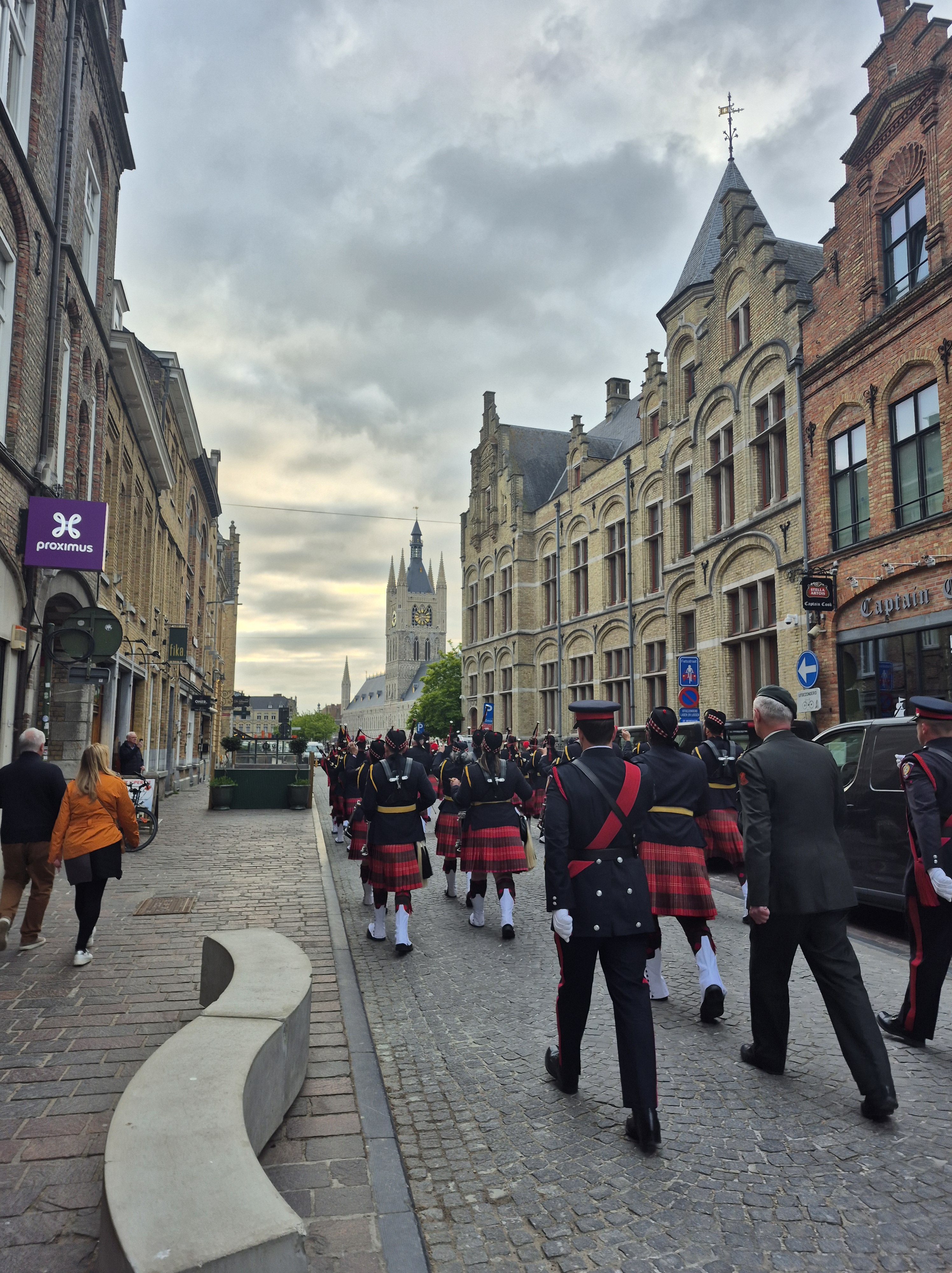
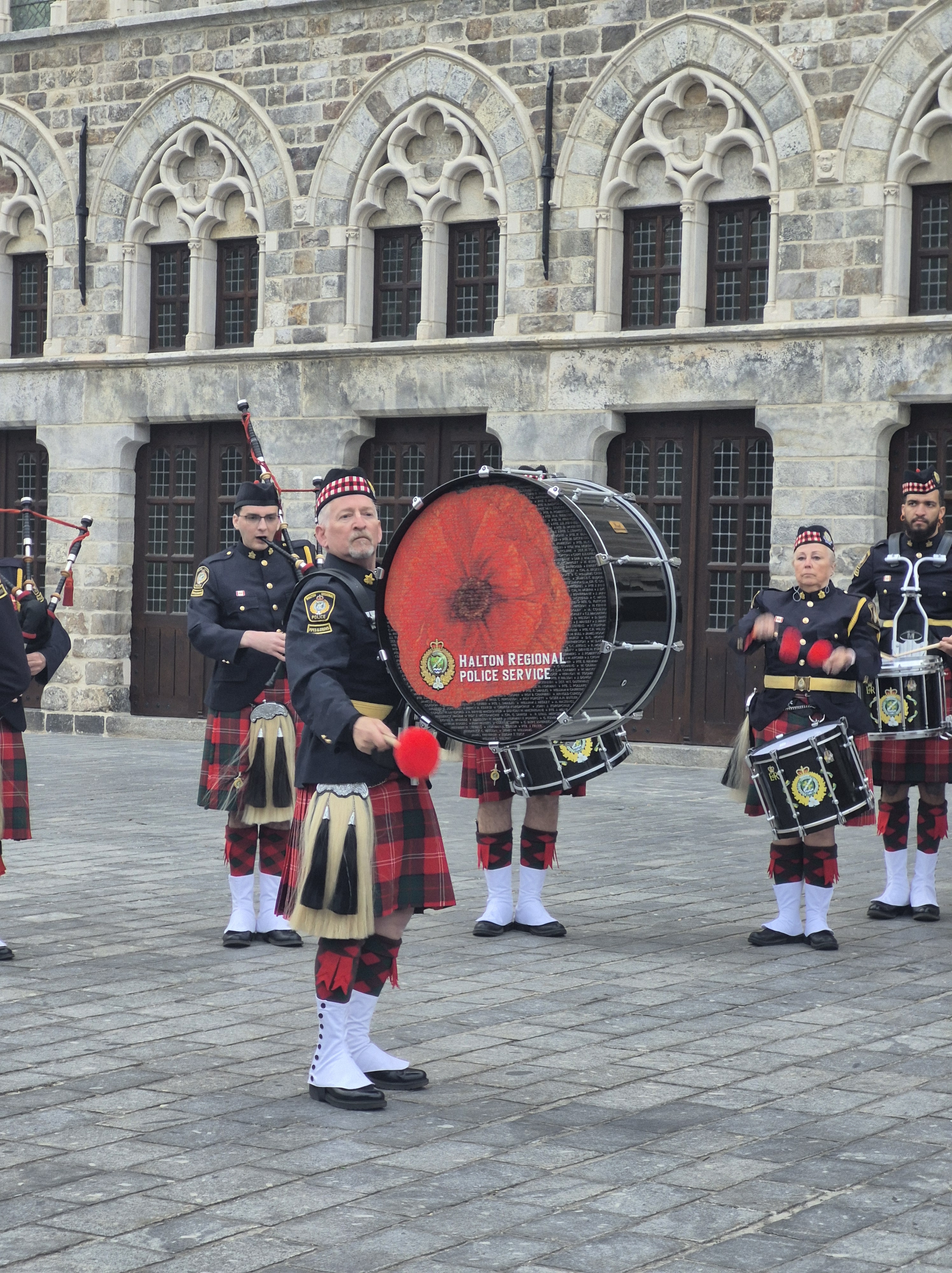
The day ended with the Menin Gate ceremony at which the Halton regional Police Services pipe and drum band played. Their drum lists all the fallen of both world wars from the Halton Region of Ontario, Canada. They had been at the VE ceremonies in the Netherlands earlier, and came to Ypres and Vimy.

Travels to the Sacred Lands
12 May 2025
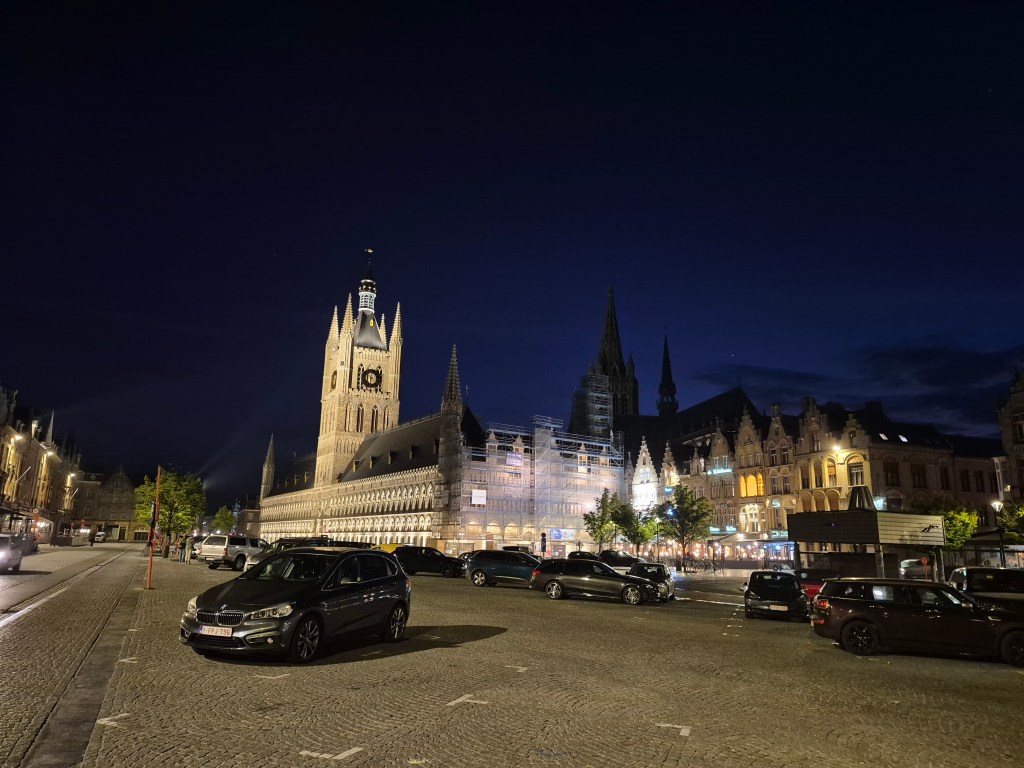
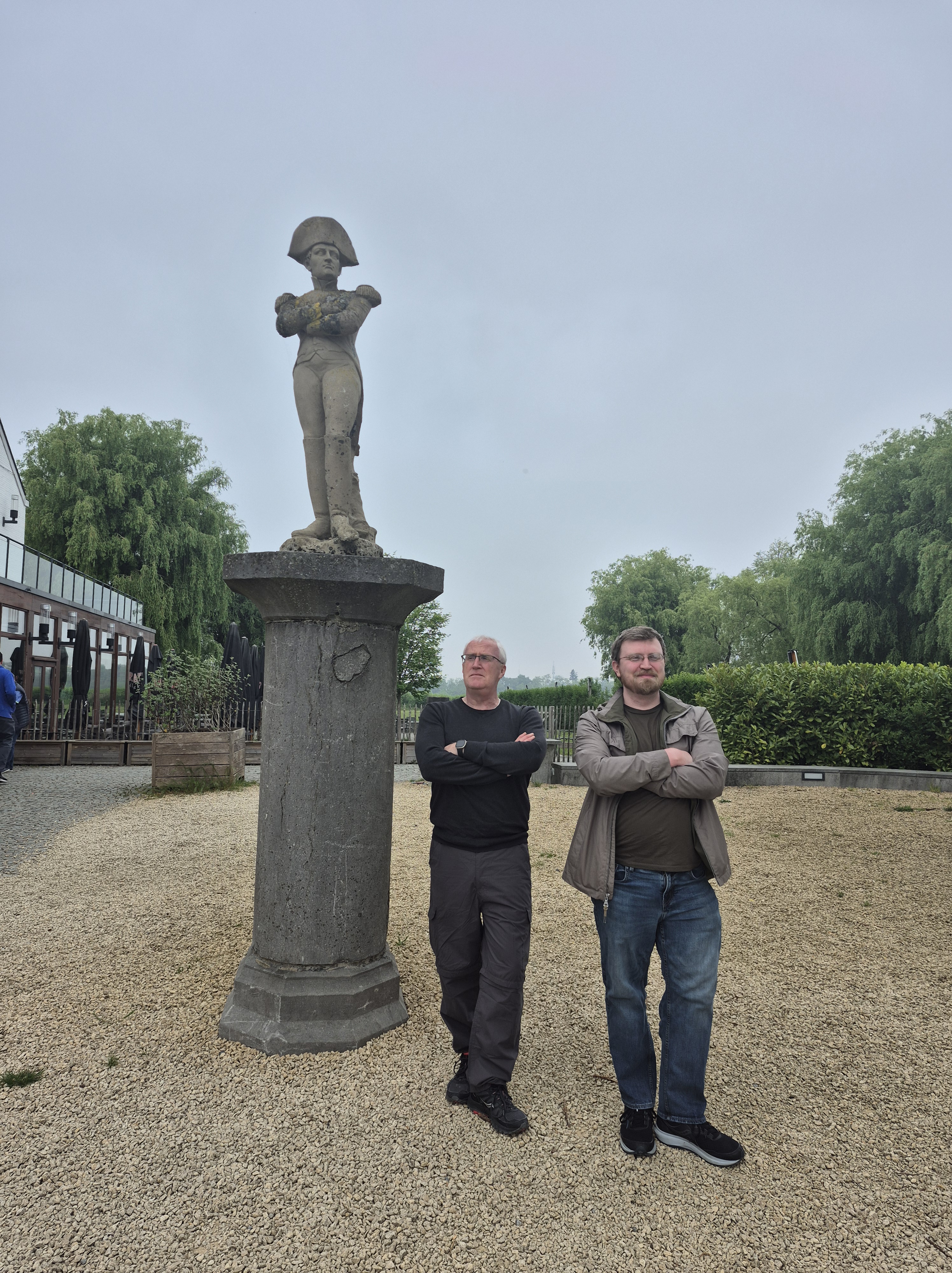
I’m doing a little different blog posting for the next few, before returning to the fallen of R.E. Farm: documenting my recent trip to Belgium. I had hoped to go in April – either for Vimy Ridge Day or to mark the Second Battle of Ypres – but a message out of the blue changed those plans, and I’ll explain that in a later post. My husband, son and I flew over to Brussels on May 2, with only six days to pack in as much as possible. Landing at 8am, we hopped in a rental car and dove right in with a stop at Waterloo, a side trip to Bastogne and a visit to the St. Symphorien cemetery in Mons.

I didn’t get any pictures in Bastogne. We dropped by Bois Jacques, where the Easy Company fox holes are, only to find out they are fenced off and you have to purchase a ticket at the Bastogne War Museum to get in. Off we went to the museum about 5km away. Admission for three of us was $130 CDN (yoiks!!) but that gave access to the museum, the fox holes and the HQ building in Bastogne. The museum was a huge disappointment; a few tanks, not a lot of artifacts and walls and walls of tiny print reading. We skipped going back to the fox holes and the HQ, but even if we’d gone, it was – in my opinion – not worth the horrific price. For example, the In Flanders Field museum in Ypres is twice the size, 10 times the artifacts, and only 8 Euros per person not 27! Unless you’re a diehard fan, skip it.
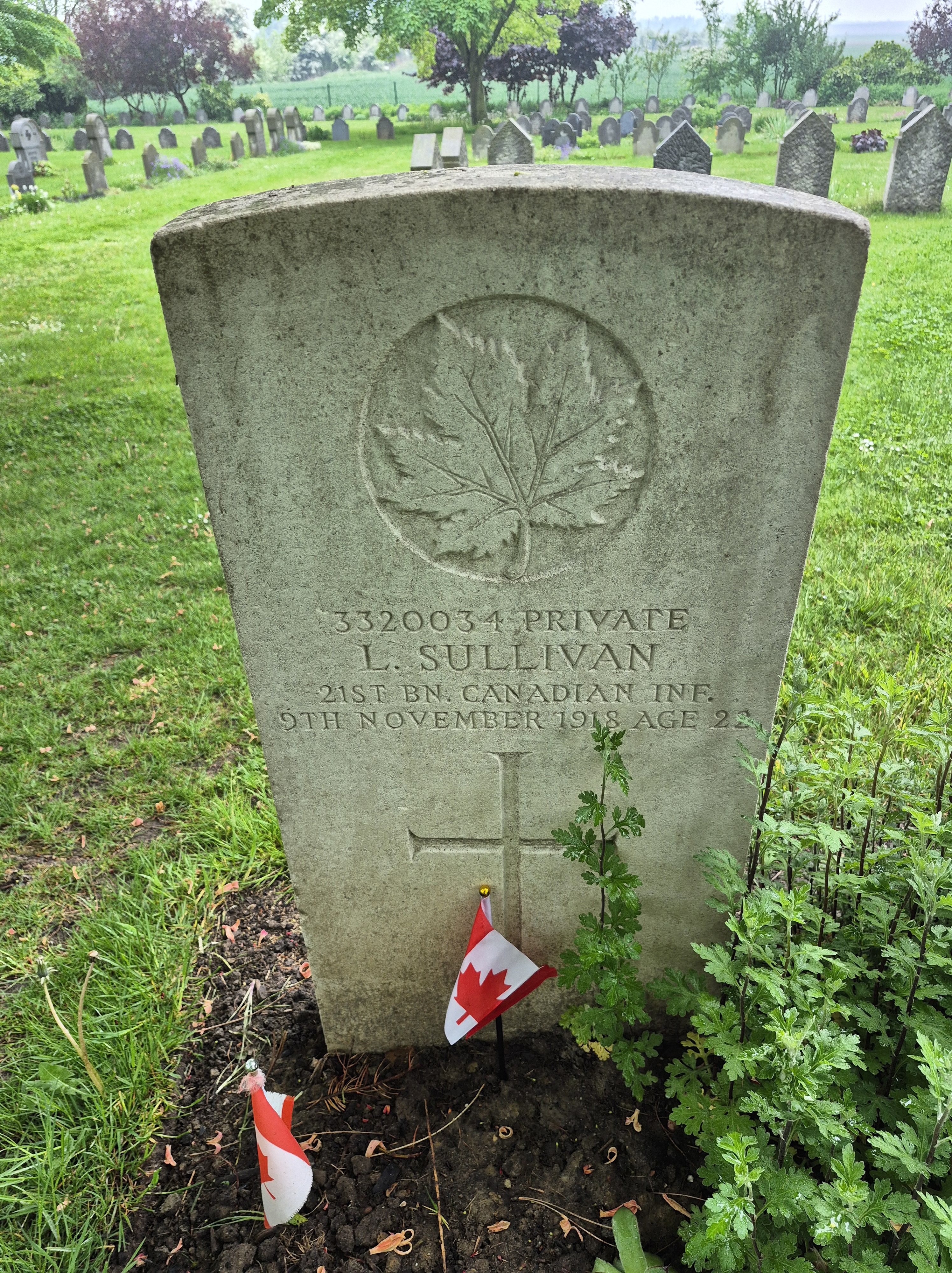
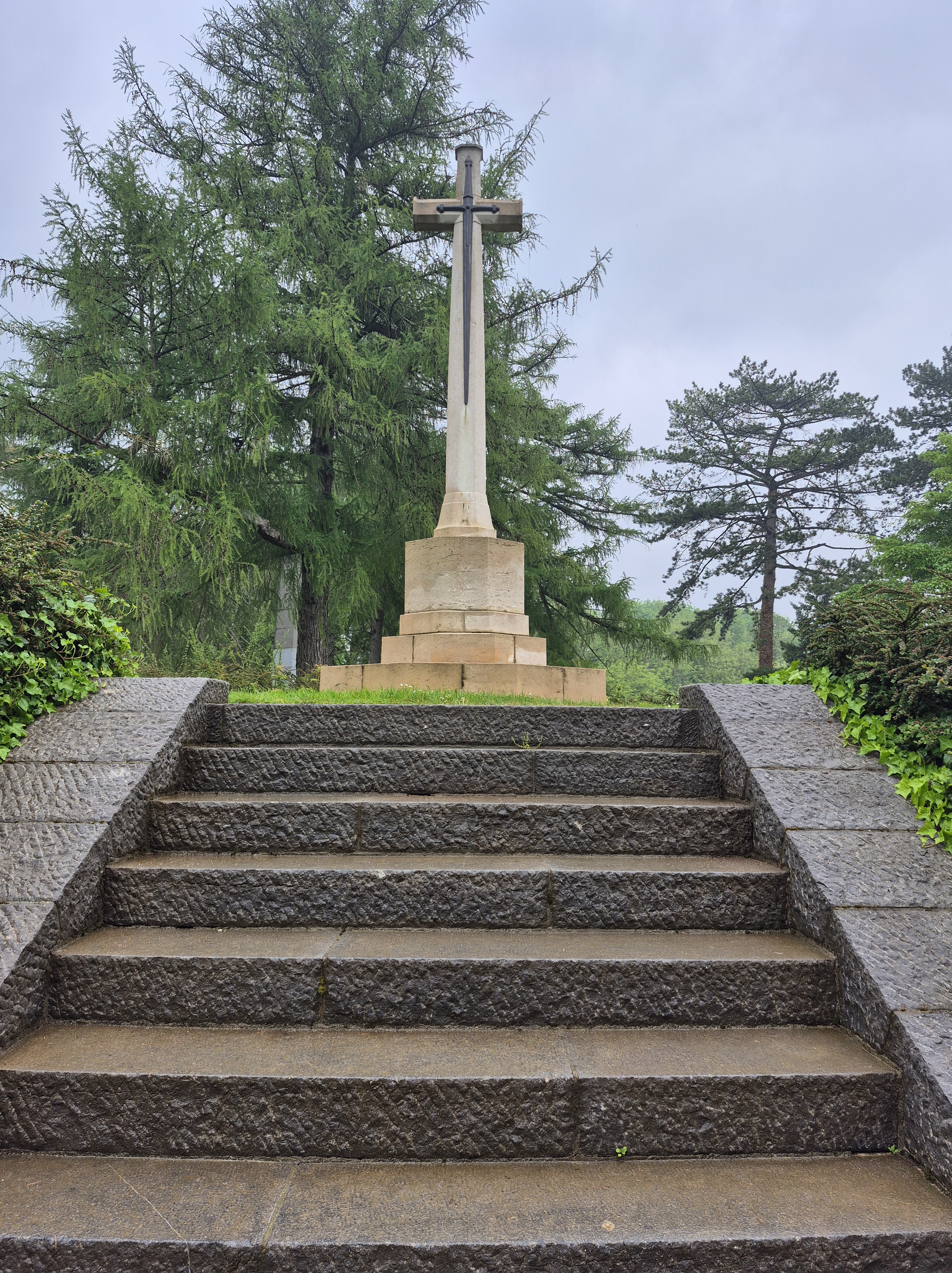
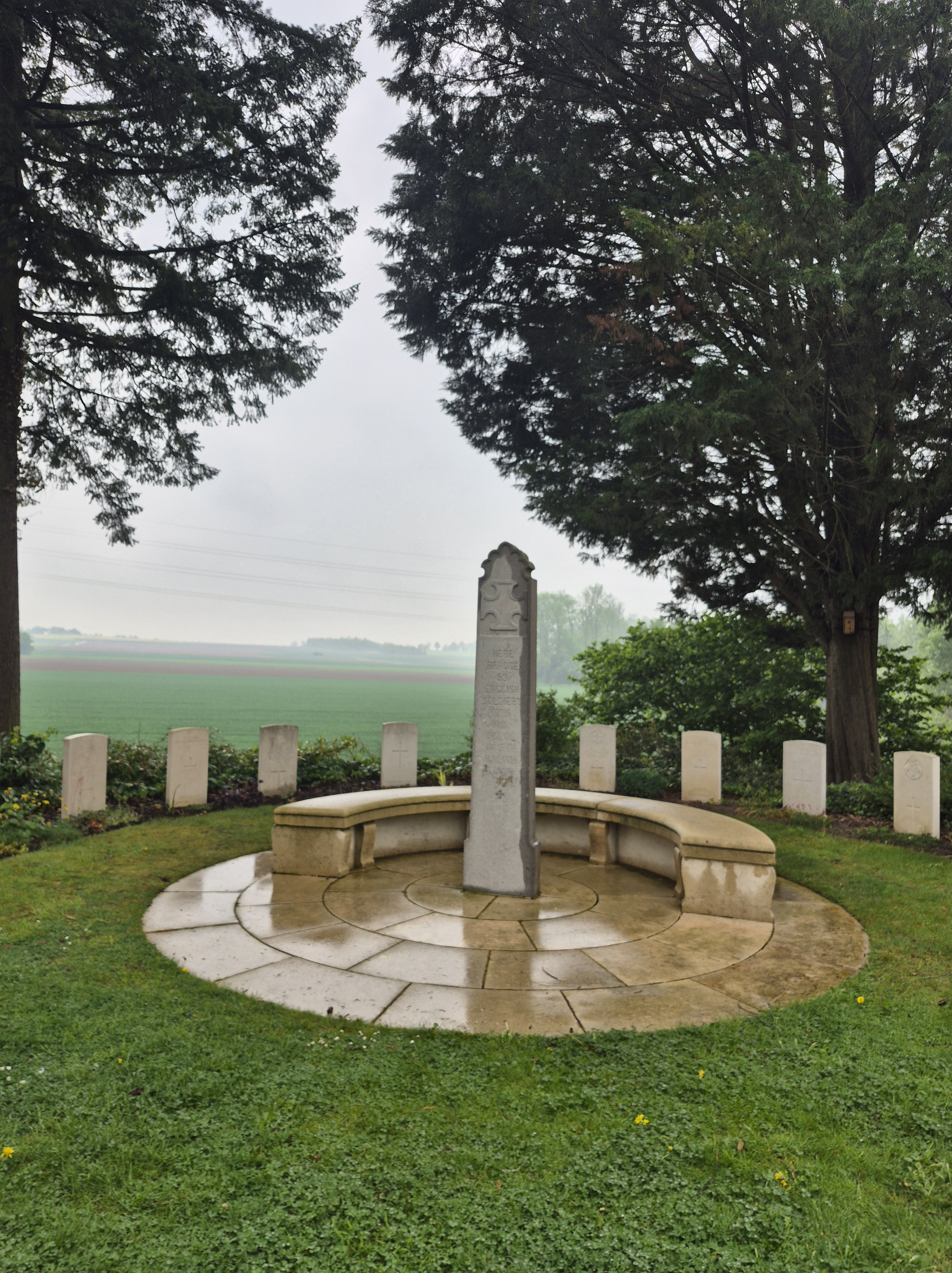
St Symphorien cemetery, Mons was beautiful and very different than CWGC cemeteries. It is the resting place for an equal number of German and Allied soldiers, including the first casualty of the war and the last Canadian casualty, George Price. The graves are not all laid out in neat lines (though most are) and it has numerous terraces, paths winding through the trees and feels like a formal garden. Definitely worth a visit.
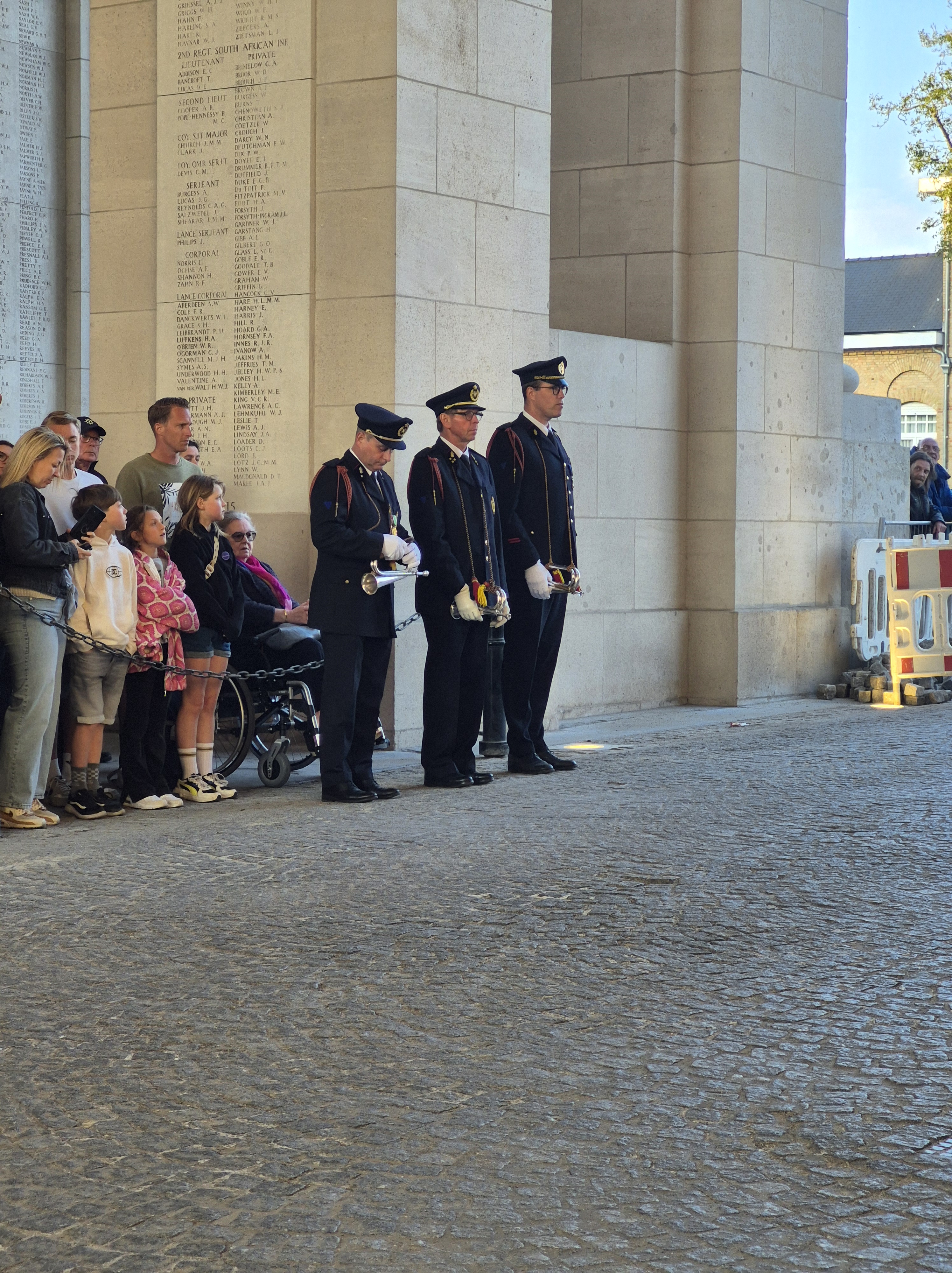
To end our very long day, we attended the 8pm ceremony at Menin Gate, an observance we’d repeat every night we were there.

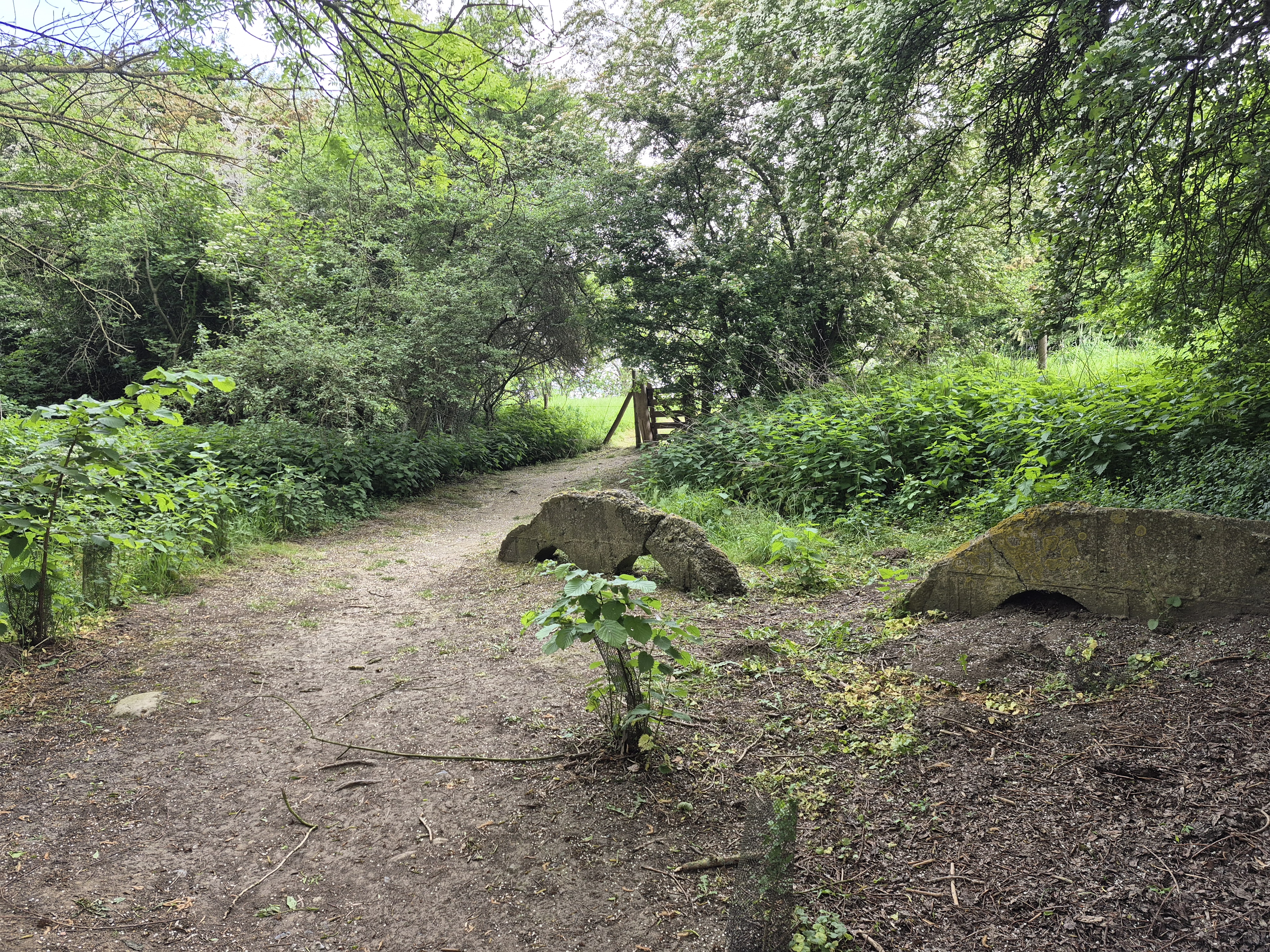
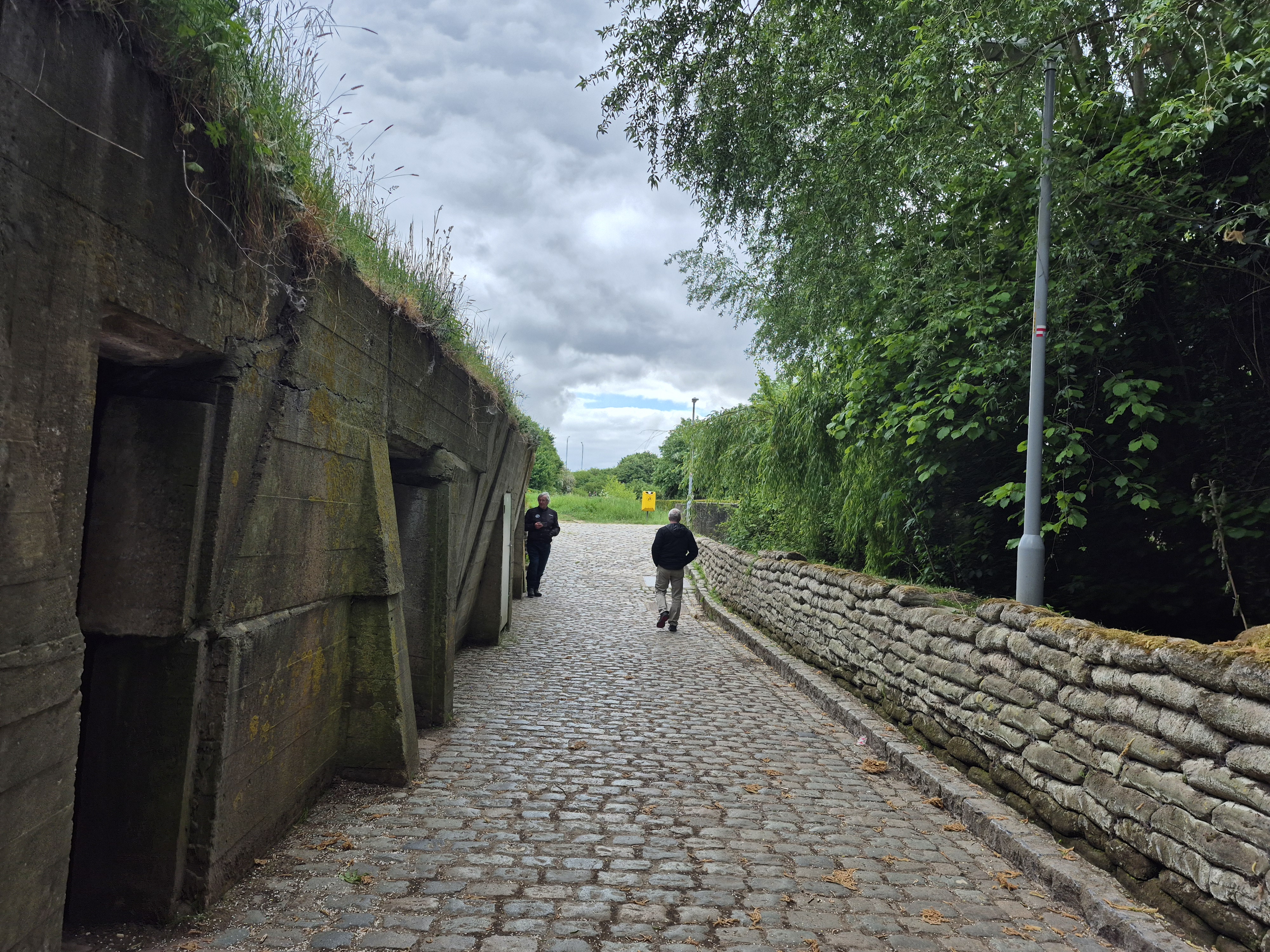
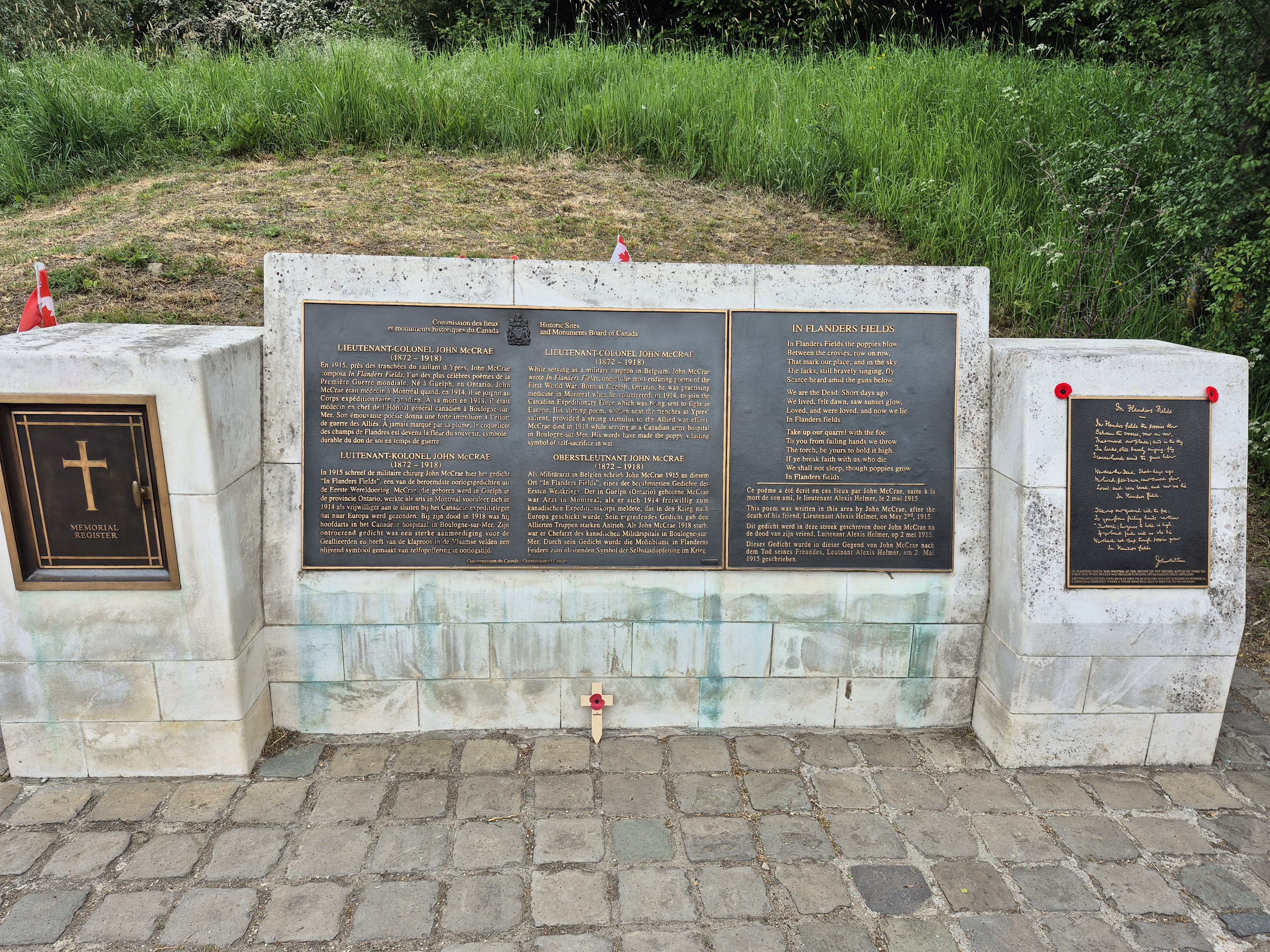

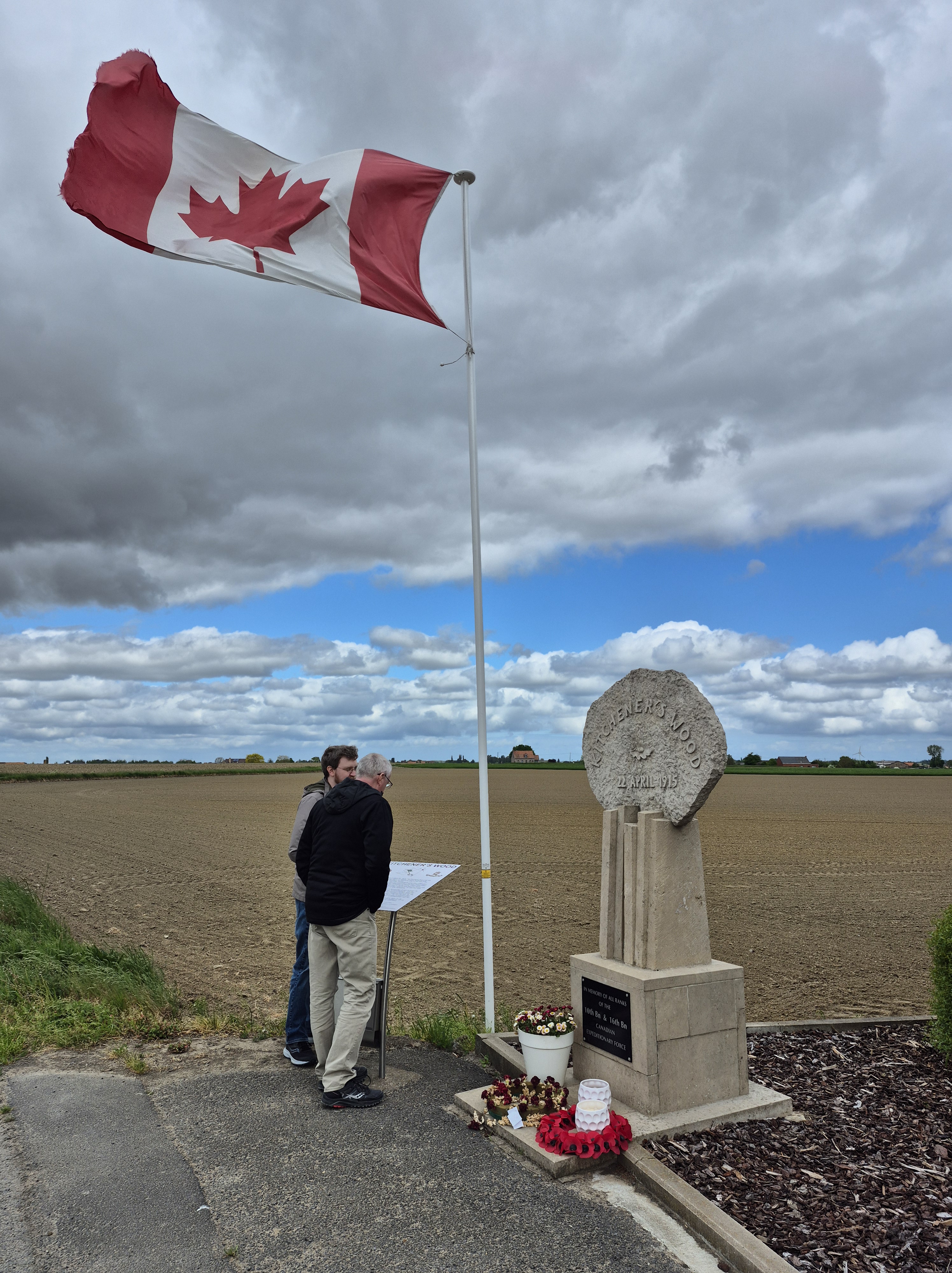

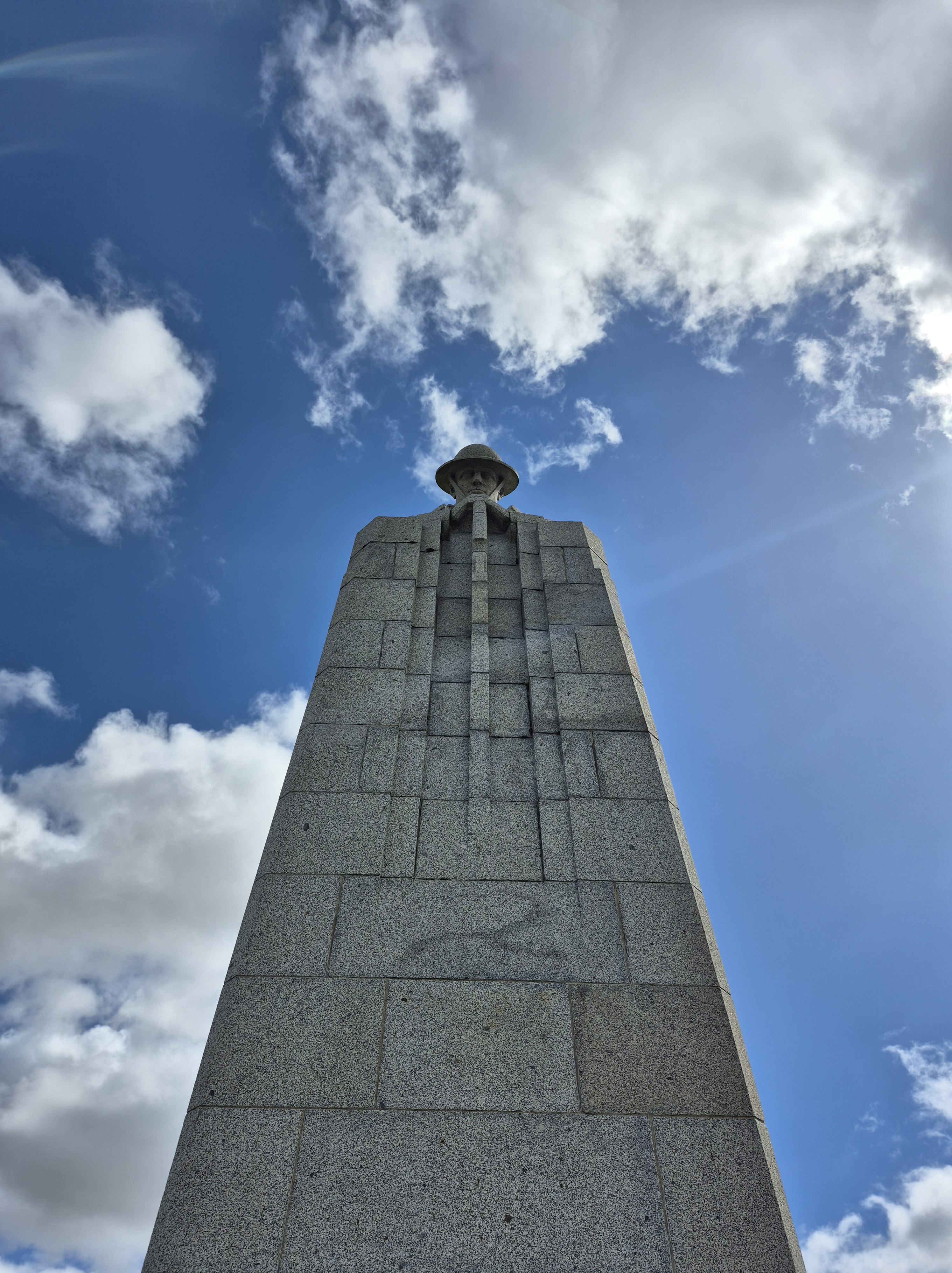
Day two was a chance for waffles! We then toured around close to Ypres/Ieper visiting Essex Farm cemetery, Kitcheners Wood and the Brooding Soldier at Vancouver Corner, St. Julien.
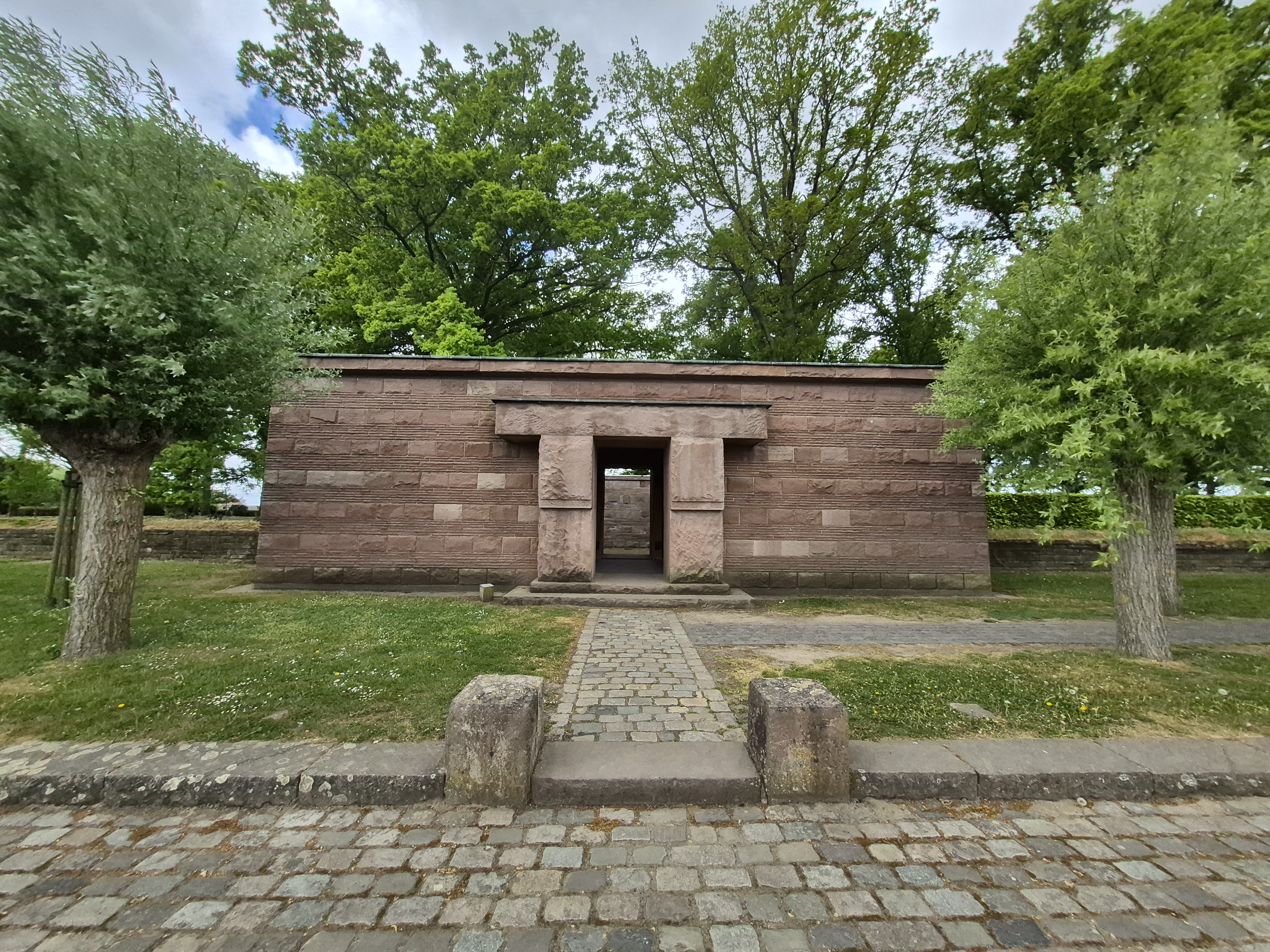

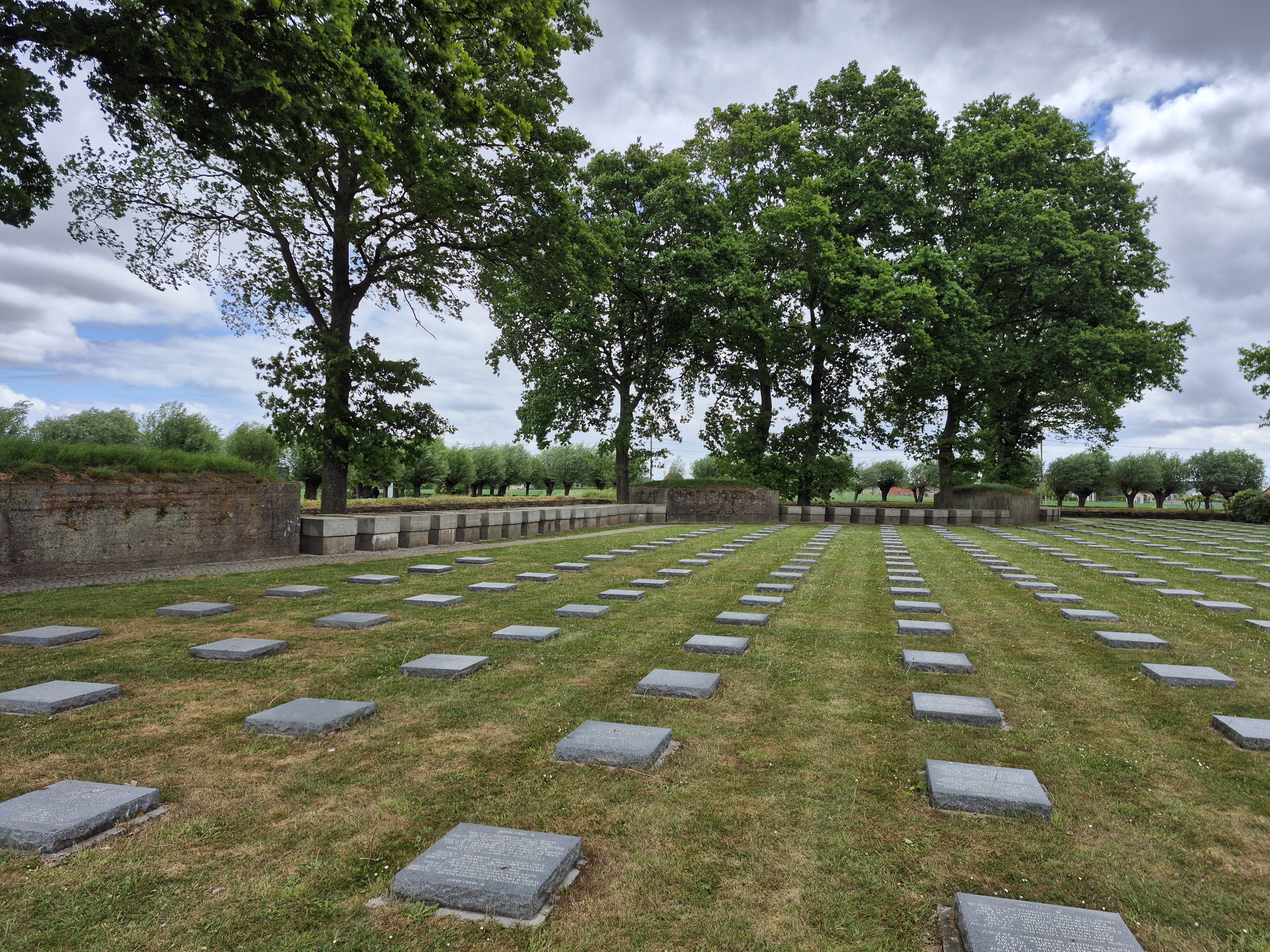
The Langemarck German cemetery, one of only nineteen German cemeteries in Belgium (consolidated down from 155) is a far more dark and somber place compared to the peace and lightness of the CWGC ones. Langemarck holds 44,000 men of whom more than 20,000 lie in a mass grave. Most of the individual stones are engraved with up to sixteen names.
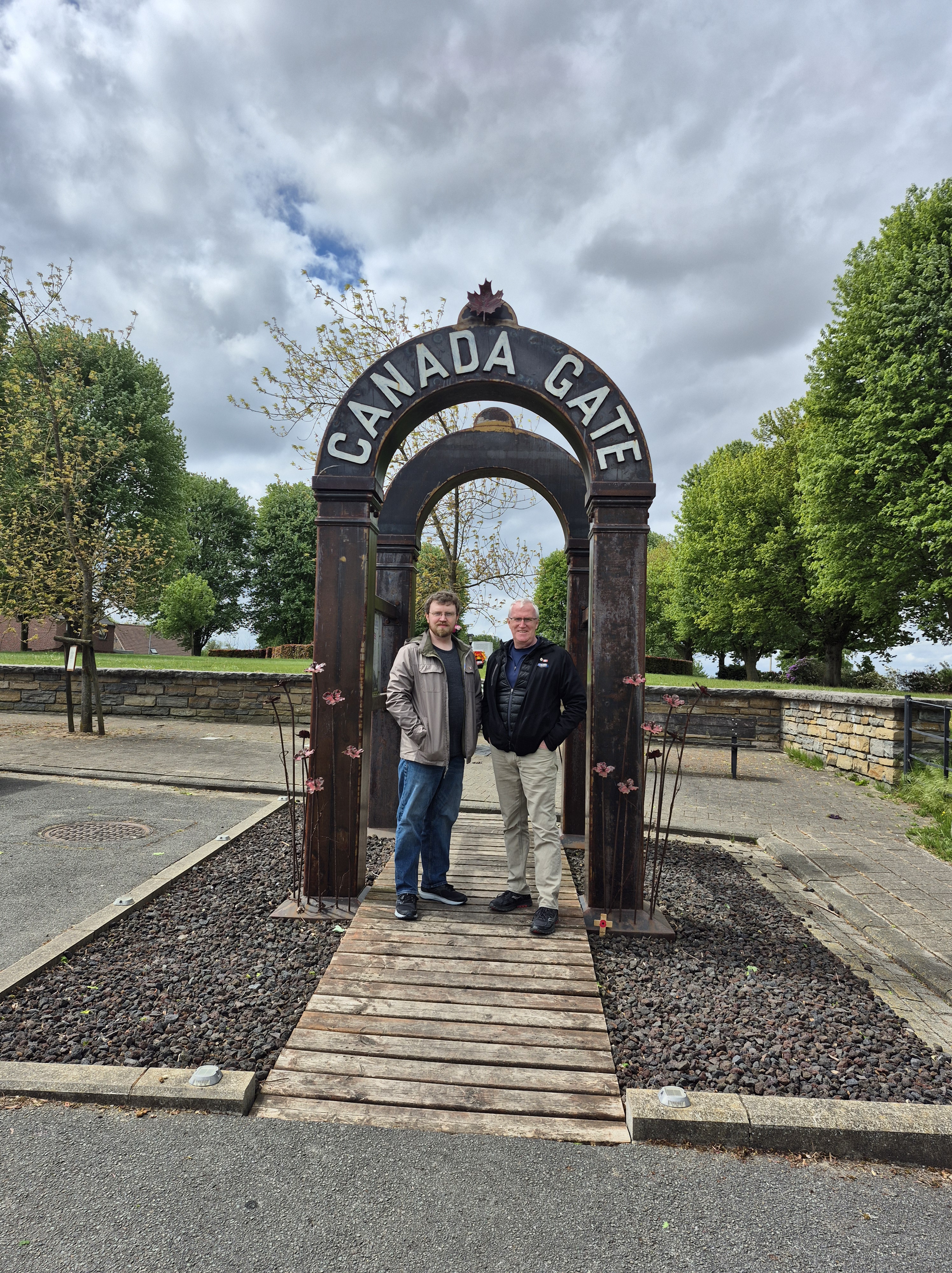
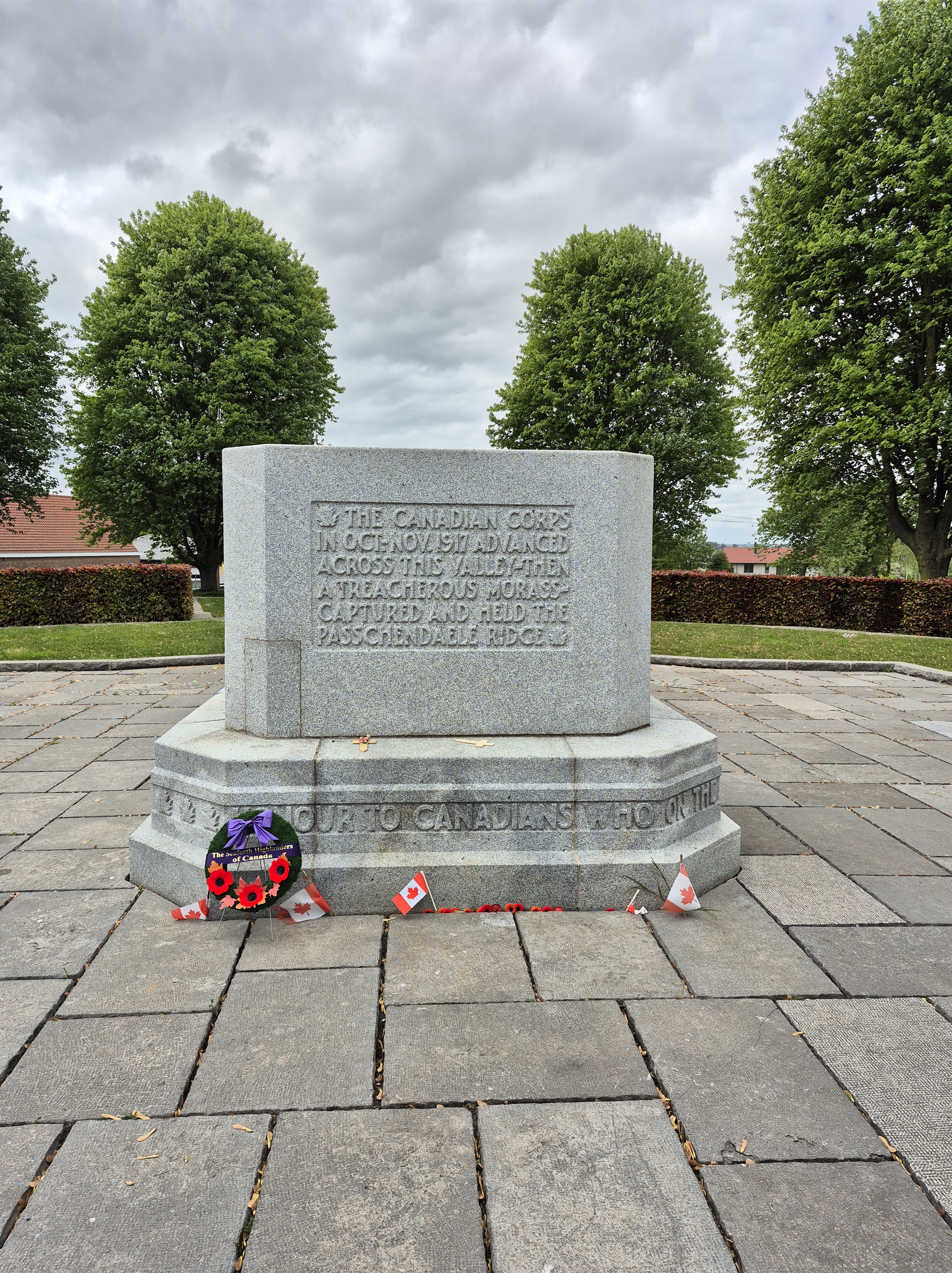
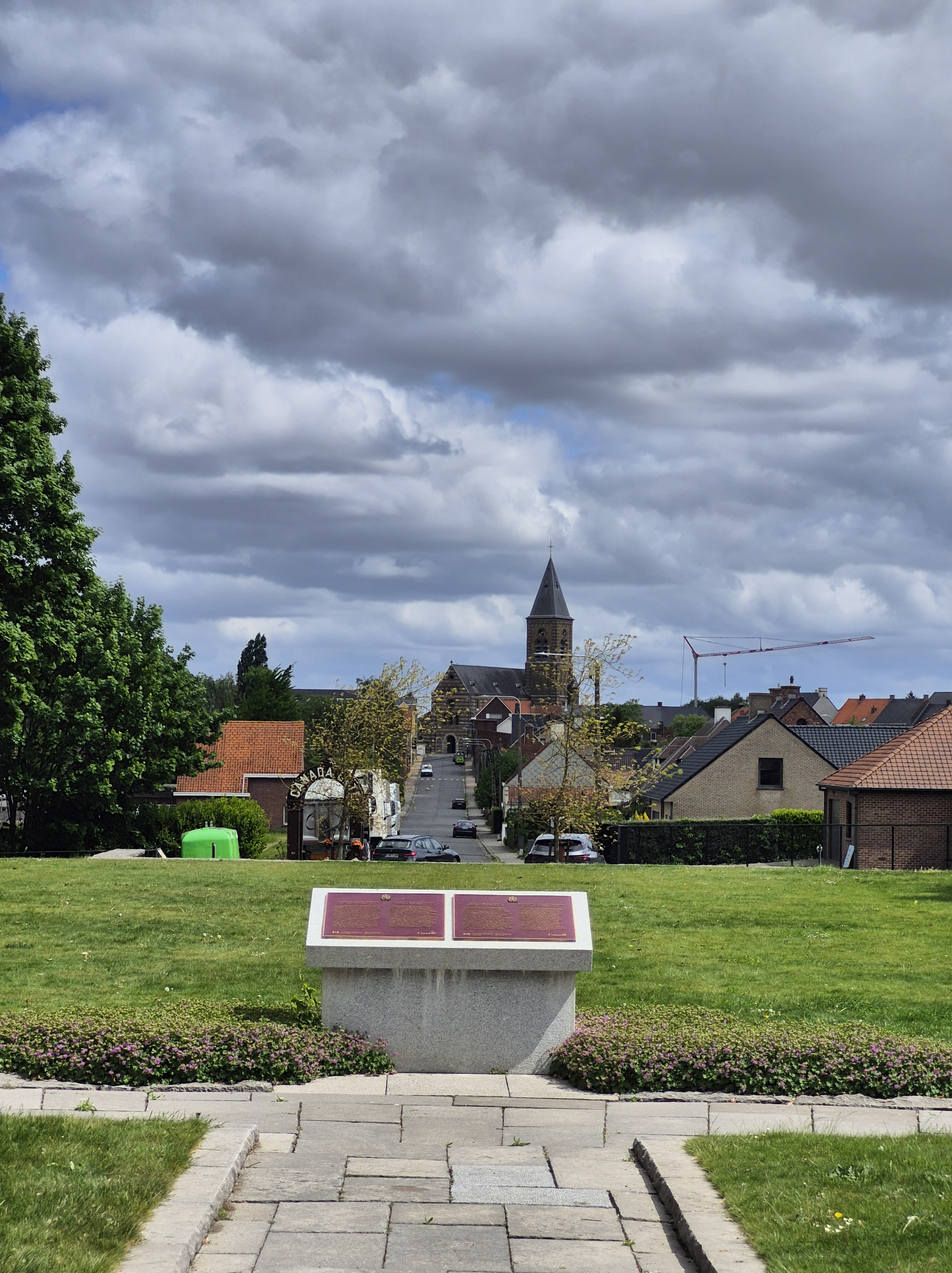
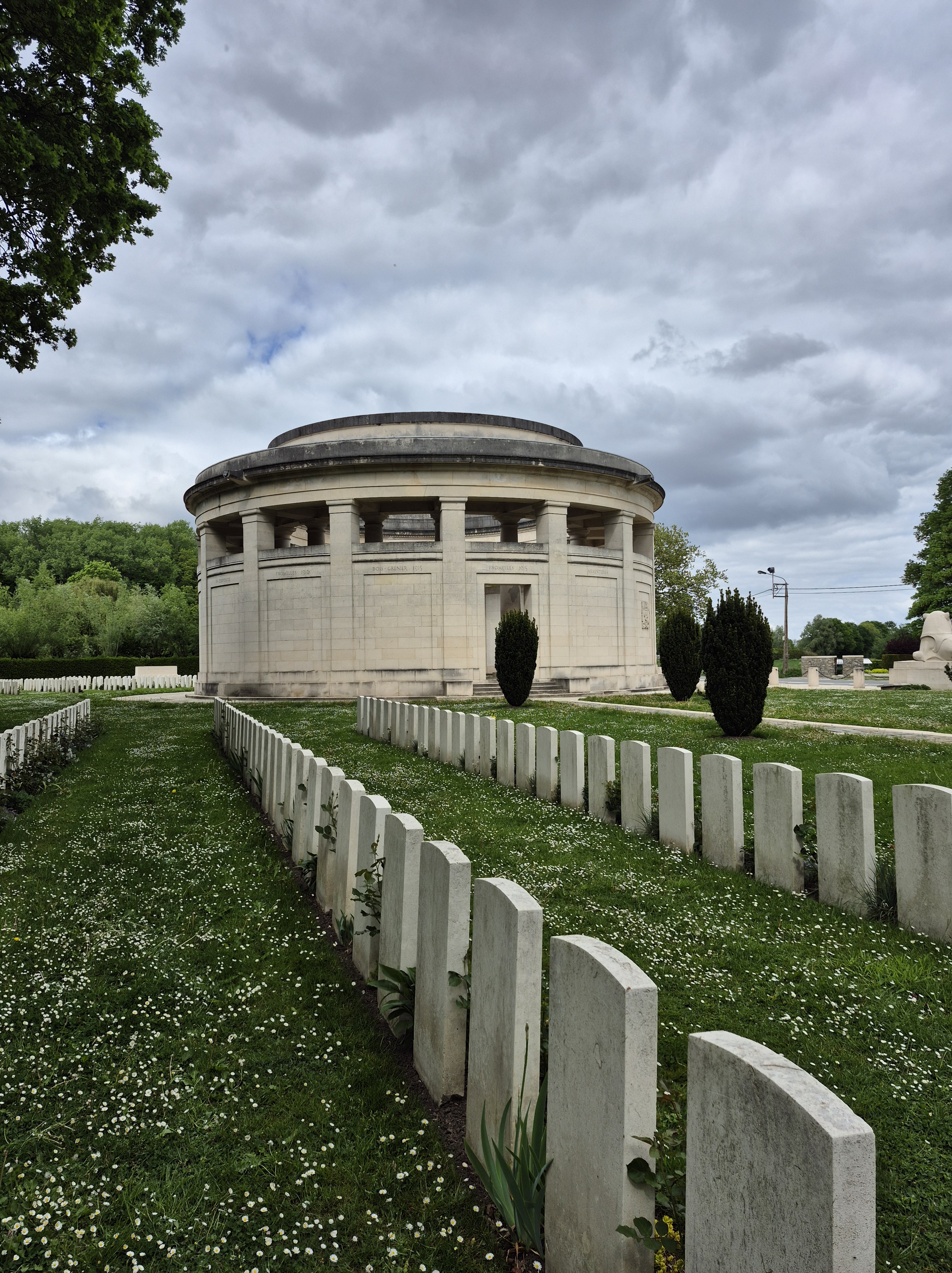
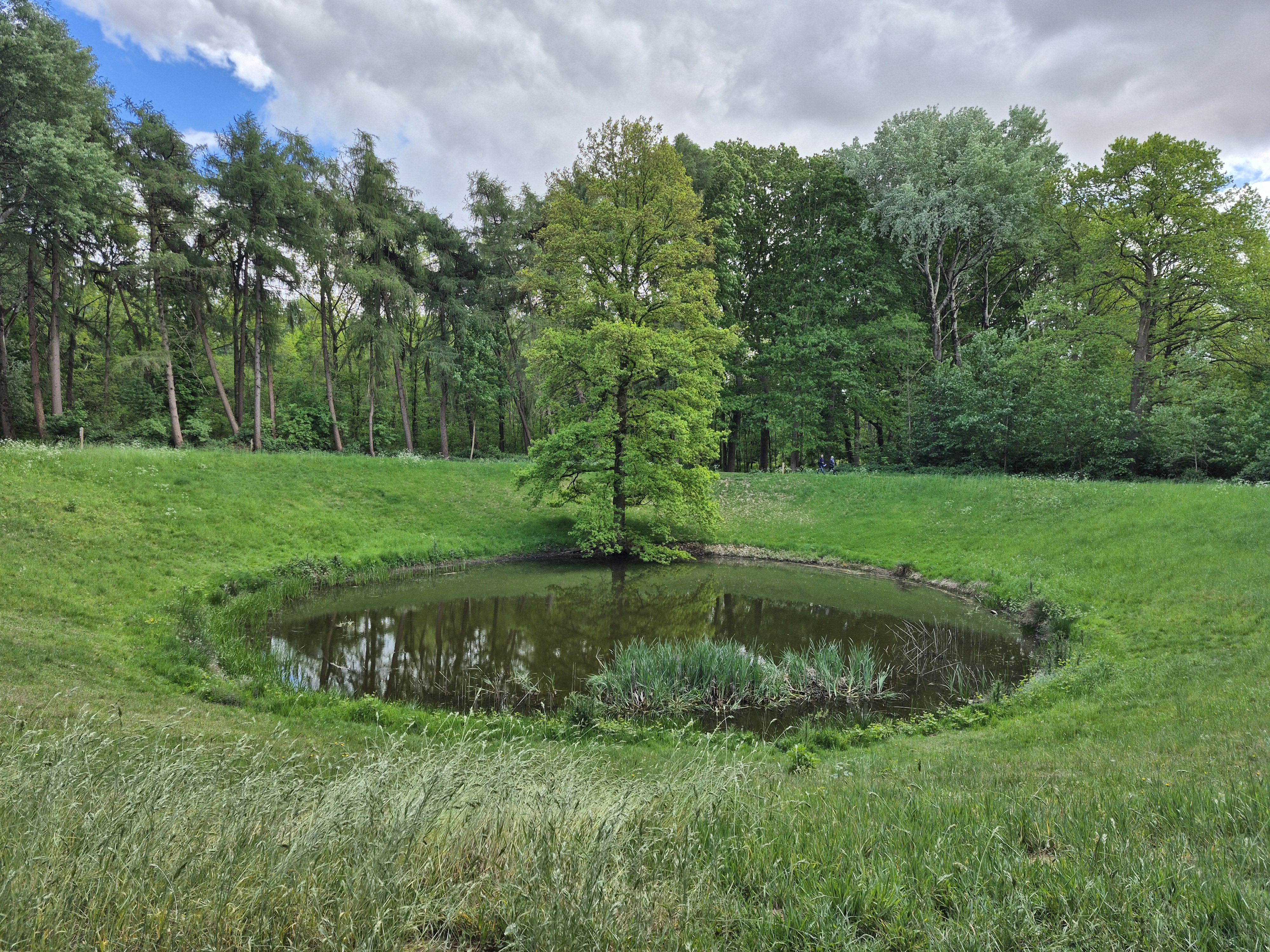
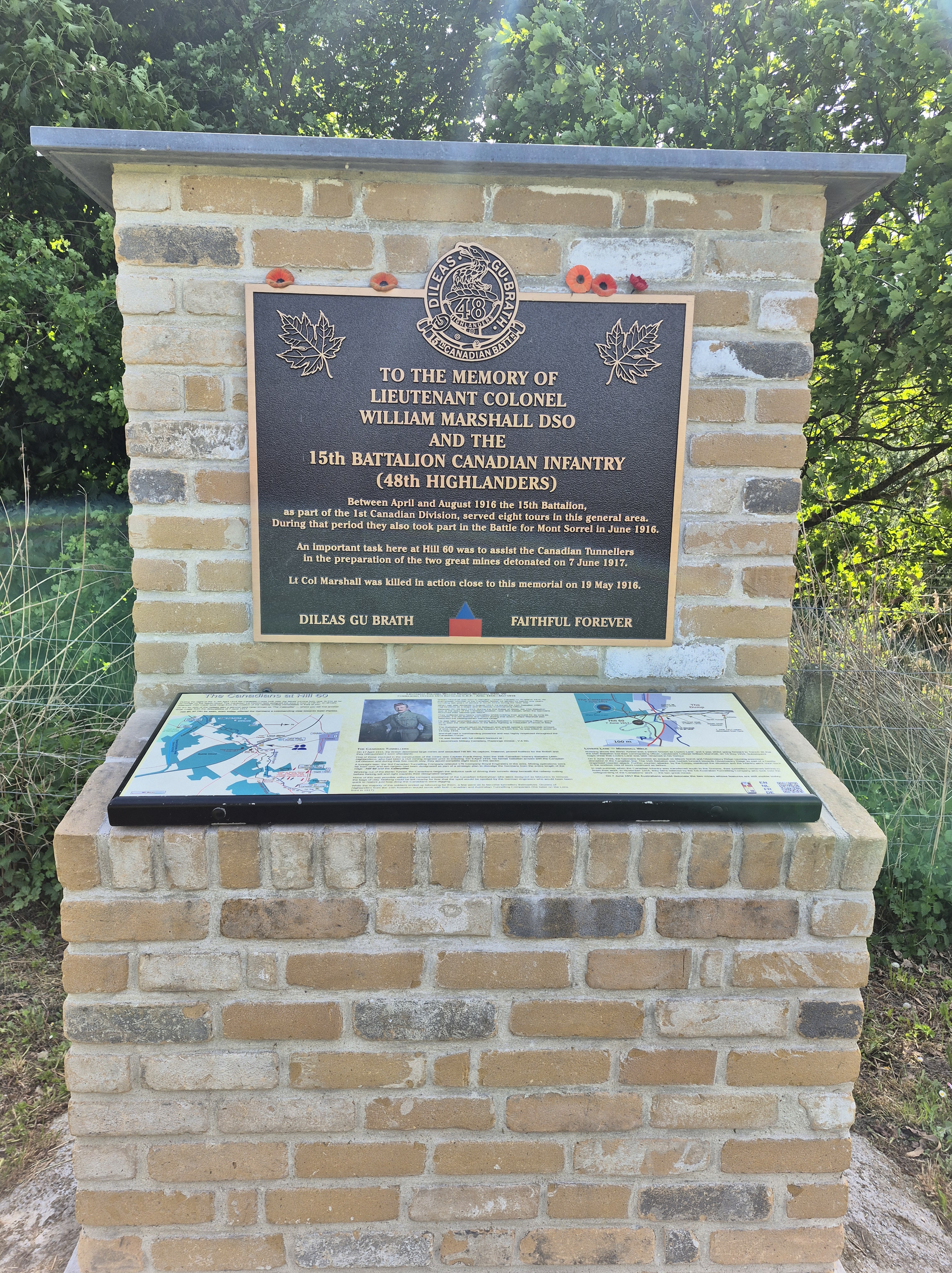
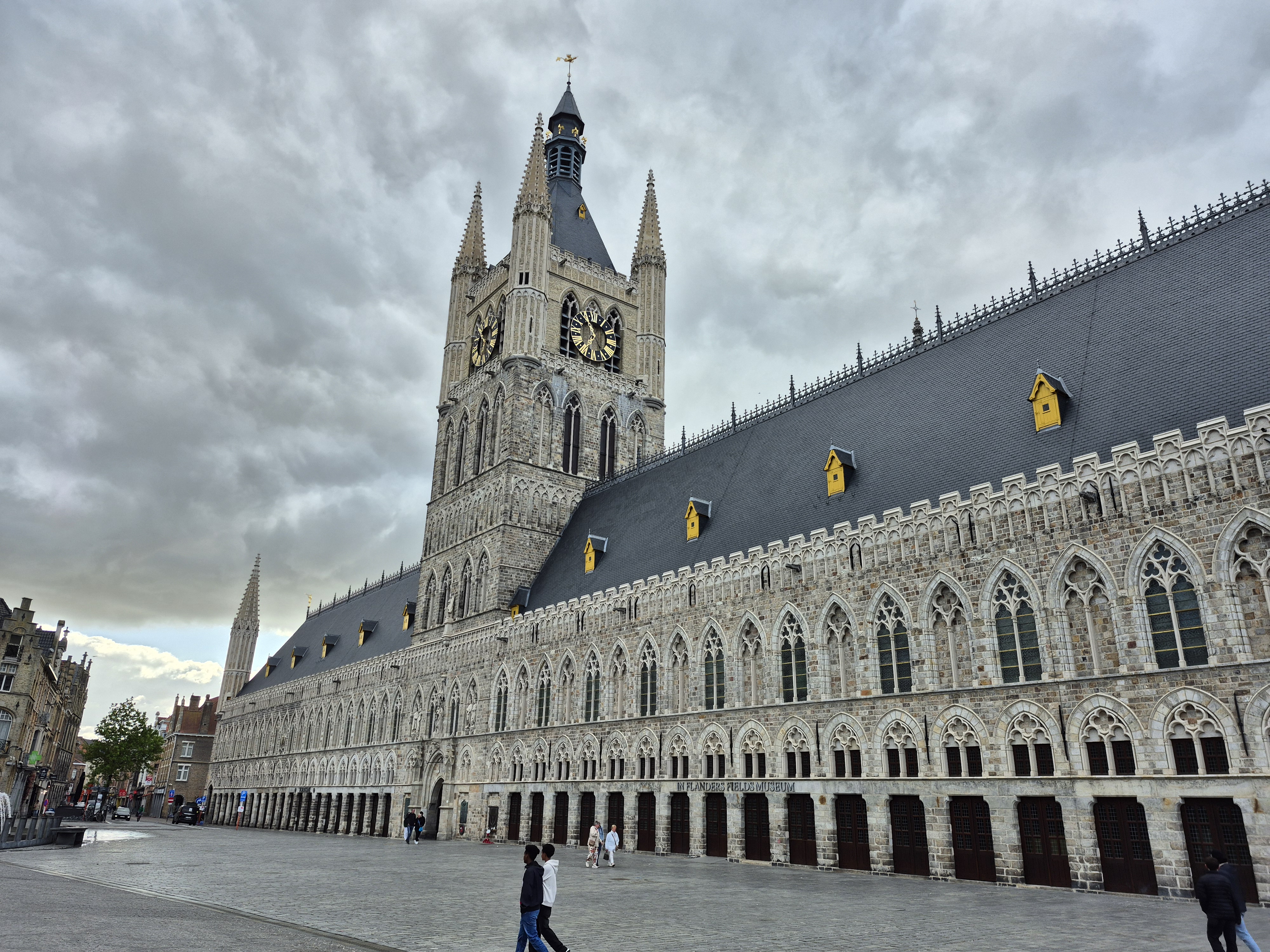
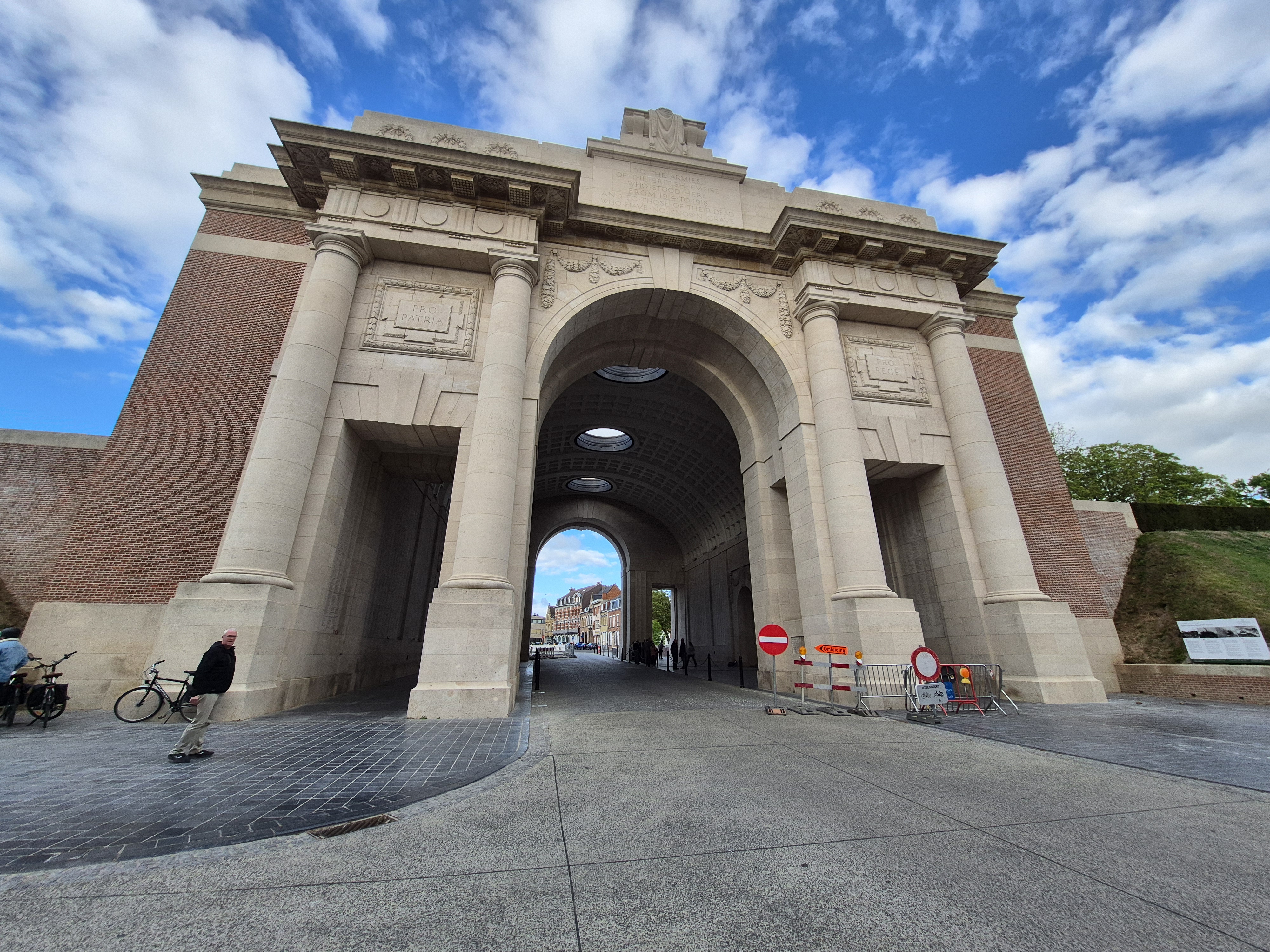
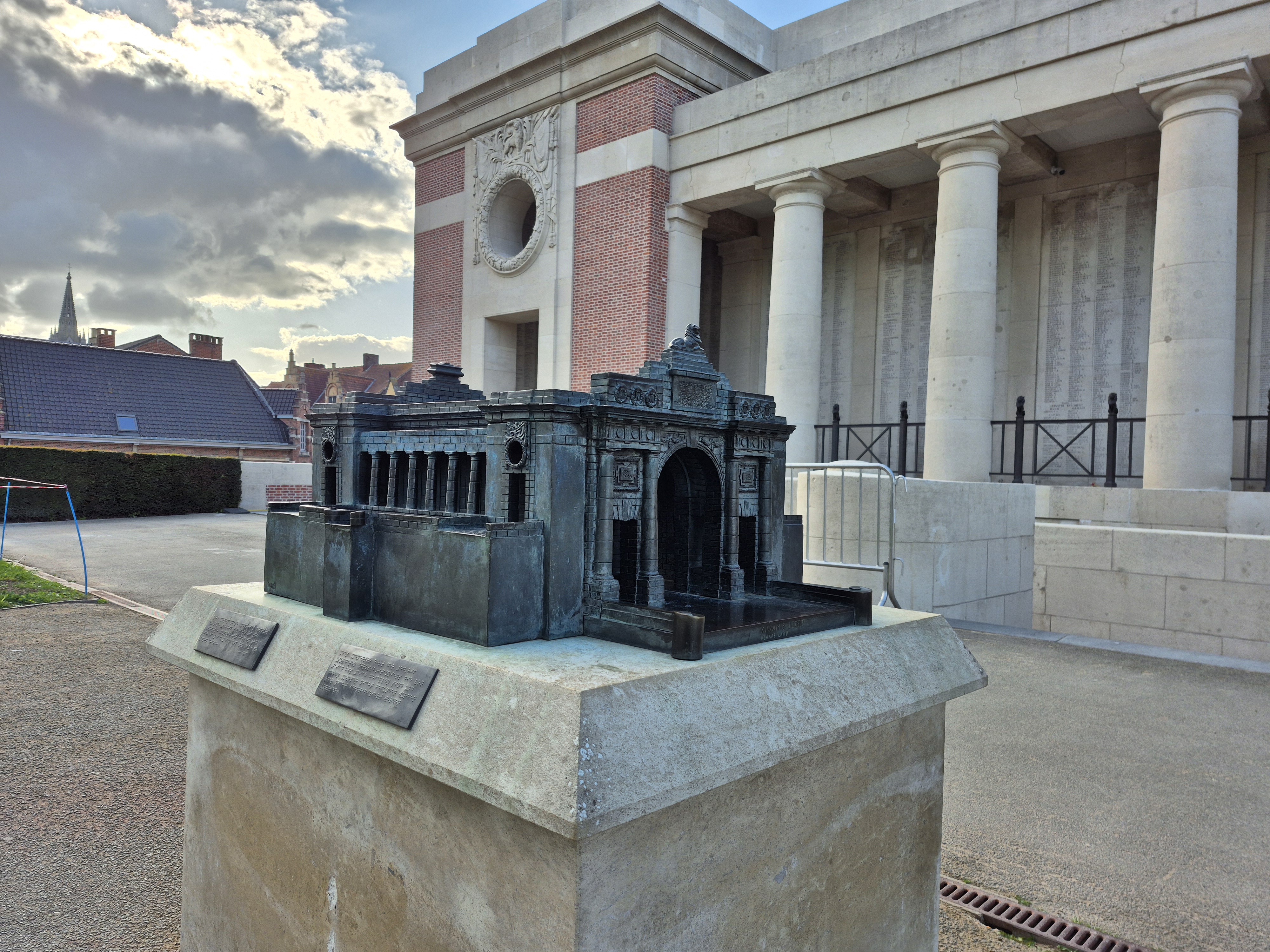
We then went to Crest Farm where there is a monument marking the Canadian capture of Passchendaele Ridge, down to Hill 60 to see the Caterpillar Mine Crater, to the Ploegsteert Memorial to the missing (British) and wandered around Ypres.
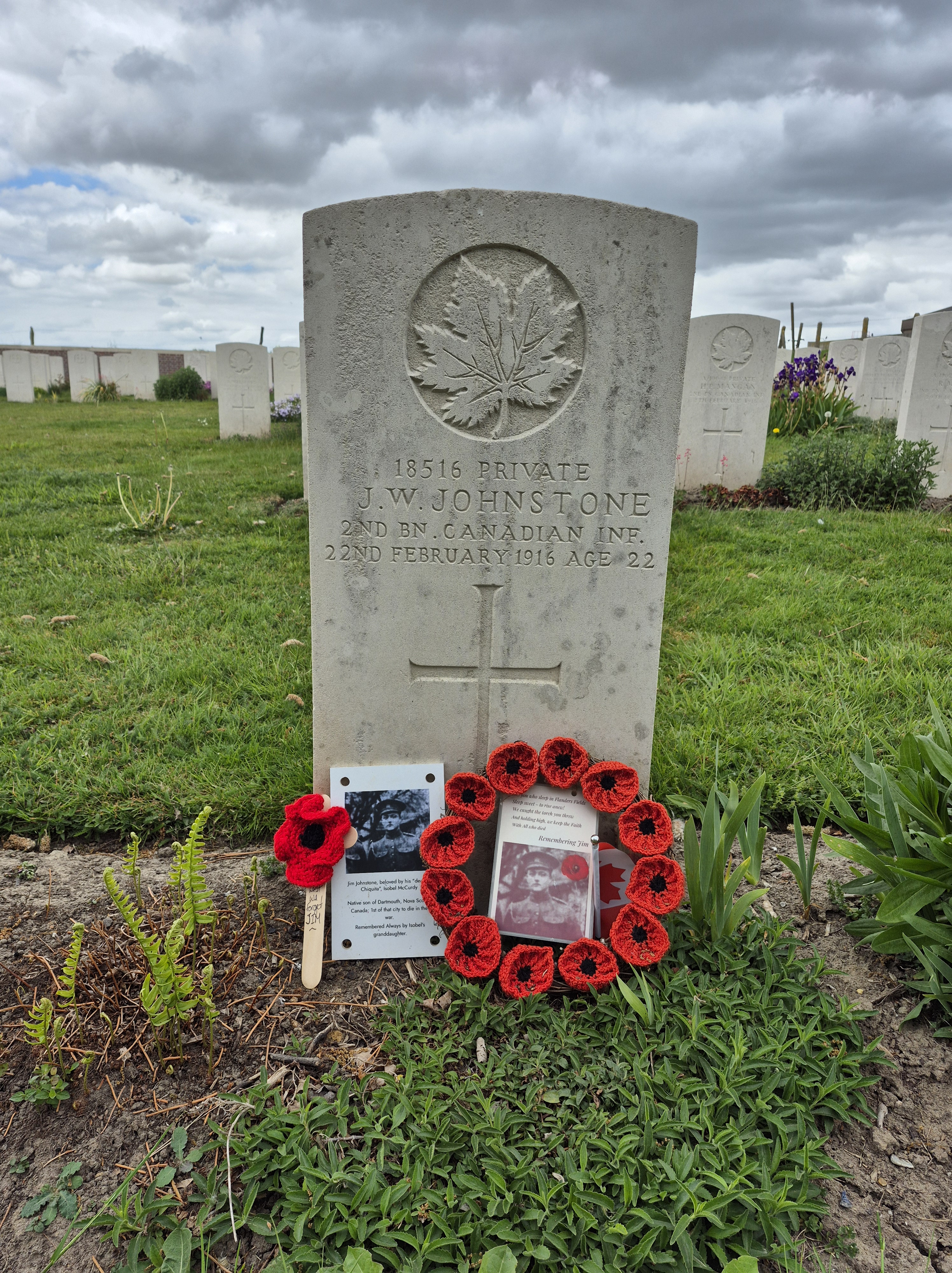
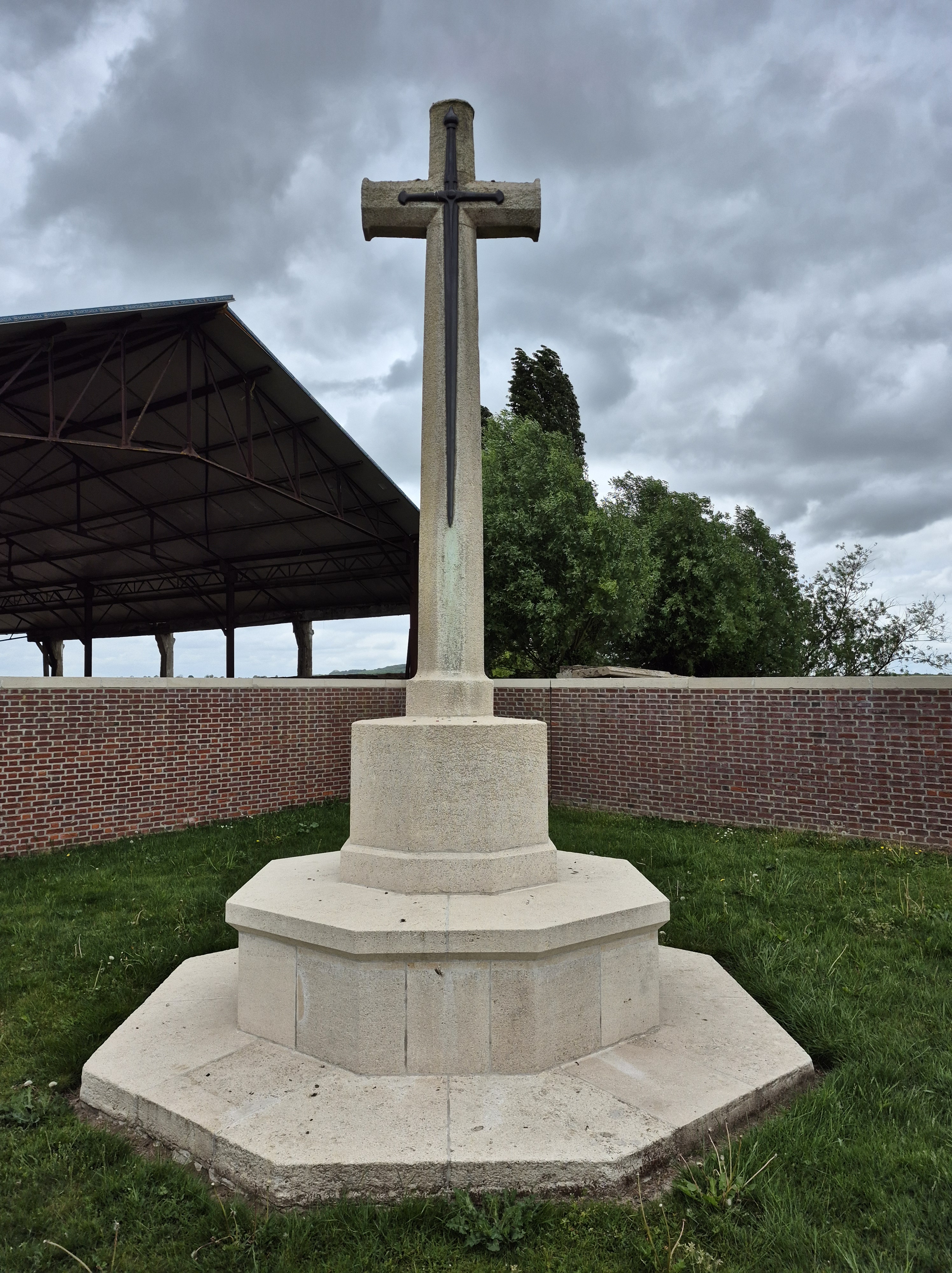
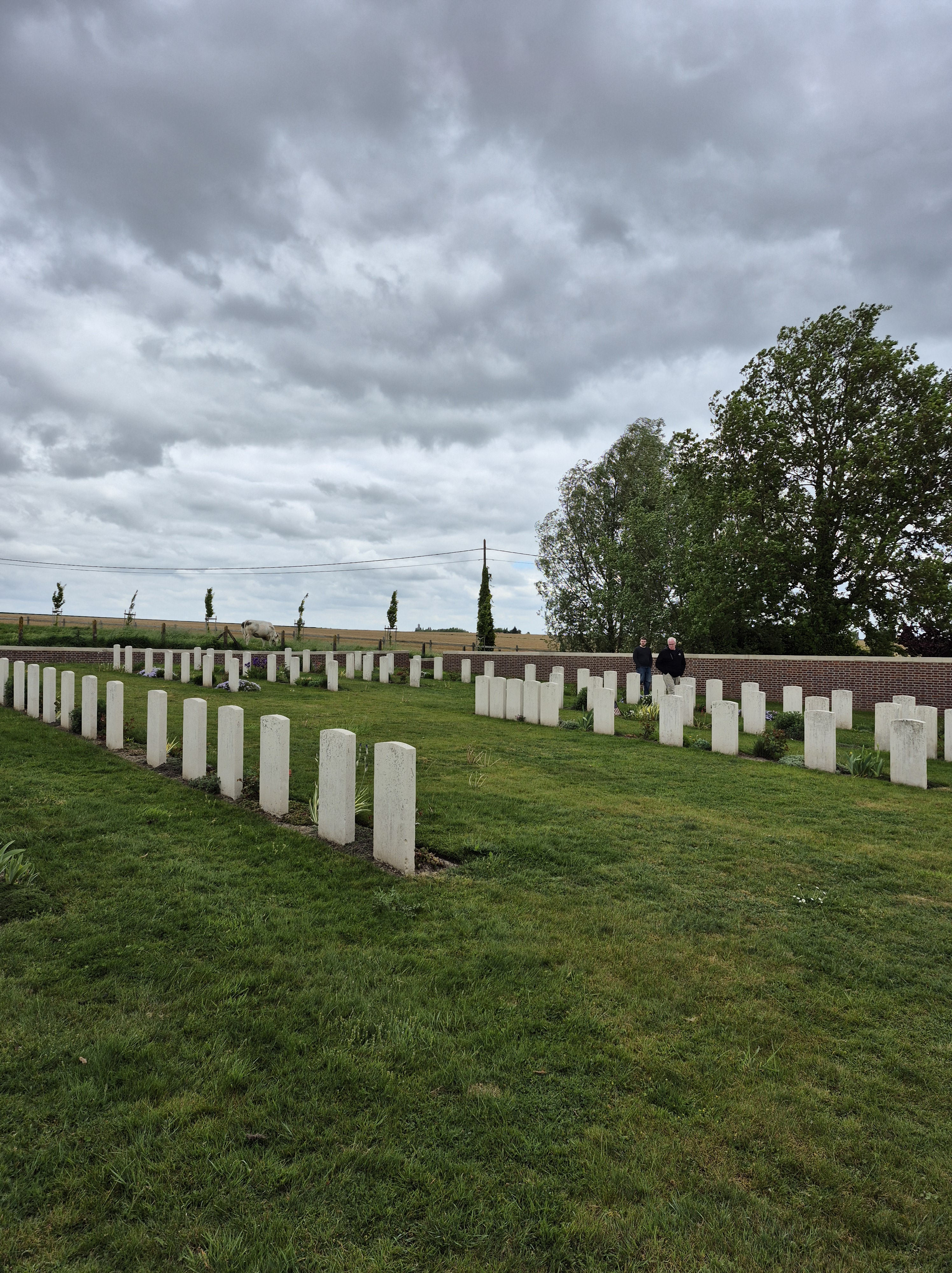
Of course, there was a visit to the young man who began this, Jim Johnstone!
Brotherhood and Friendship
30 April 2025
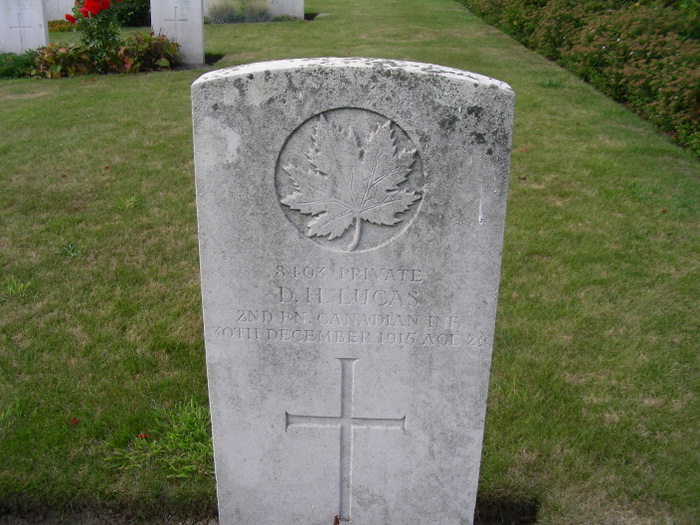
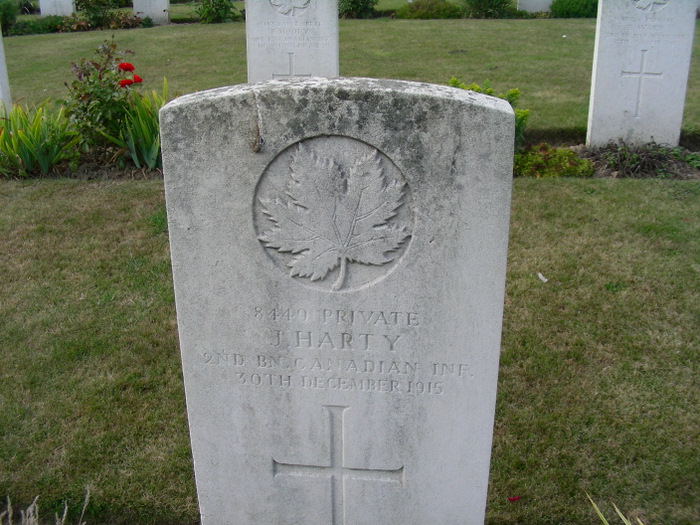
The men hunkered down in a dug out, the air thick with the fug of unwashed bodies, scratching at the welts left by lice. The air was cold and damp, mud frozen in crusts on their boots, their furred vests. Outside, shells from trench mortars and rifle grenades screamed and the shockwave of explosions rattled dirt down on their heads. A figure tumbled through the curtained doorway, moaning in pain as he slumped to the floor, his ghostly pale face a contrast to a river of shockingly bright blood soaking his uniform.
“We need a stretcher!”
James Hardy leaped to his feet. “I’ll go!”
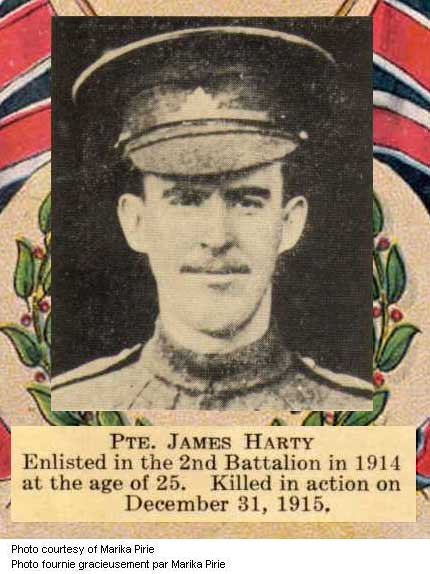
Private James Hardy had been described as the life of the party, light-hearted, fun-loving. Perhaps that came from being the baby of his family. James, who went by Jim, was born on 8 May 1888 in Renfrew, Ontario to Rodger, a farmer, and Mary Harty, a couple who had moved from Ireland to Canada in 1871. A good Catholic family, the couples’ ten children included Michael, Maggie, Mary, Thomas, Hanna, Johannah, Teressia, John, Kattie and James, all born in Canada.
Jim, unmarried, attested in Valcartier in September 1914, an original member of the 2nd Battalion and one of a group of “Renfrew boys” who’d enlisted together. Jim wasn’t tall at 5’ 6” but the brown-haired, brown-eyed young man was probably strong from working as a butcher. After training in Valcartier that fall, and travelling to Salisbury Plain for the winter of 1914/1915, Jim fought at Ypres in April 1915, Givenchy and Festubert in May and June 1915. Early that fall, the men got word that they would be getting some extended leave (8 days) out of the line to travel to England, but German submarine activity in the English Channel, along with typical military red tape, delayed leave over and over again. On 7 December 1915, Jim finally got his much-anticipated leave. Advanced notice was rare, so Jim probably got told to pack up and be ready to board the train to the coast with barely time to brush the dried mud off his uniform. Where exactly he went is hard to say but most men took in the sites of London. No doubt he enjoyed a hot bath, some good food, and a more comfortable bed than he’d seen in a very long time. Perhaps there was bad weather on his return or train delays, but Jim Harty didn’t get back in the line until 19 December, just in time to go back in the fighting line on the 20th. Five days in the front line was followed by five days out, a normal rotation. The 29th it was back to the front line. On the 30th, things got a bit “hot”. As well as trench mortars, the Germans got busy in the afternoon with rifle grenades. A number of the men got injured, including one of Jim’s platoon, who was seriously injured. Jim had been taking shelter in a dugout. He didn’t have to but the big-hearted man knew his friend’s only chance was to be rushed by stretcher to the aid station. Without a thought for his own safety, he left his safe place and rushed down the trench line to fetch help, right into the path of a rifle grenade. Instead of getting help for his friend, Jim was now in need of the stretcher bearers. Evacuated to the field ambulance, likely at R.E. Farm, Jim died of his wounds an hour later. But who was his seriously injured friend? There were nine other injuries that day, but only one other man also died, and perhaps David Lucas was who James Harty tried to save.
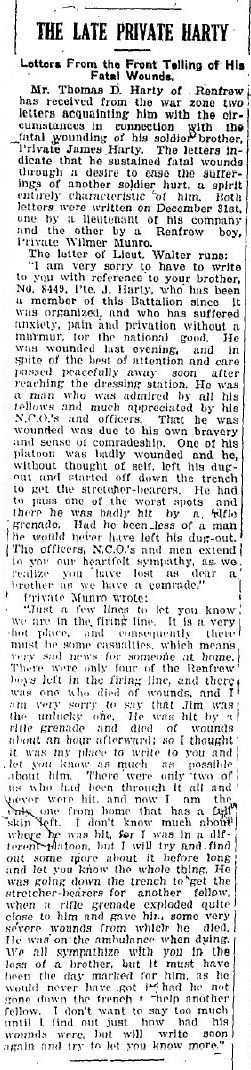
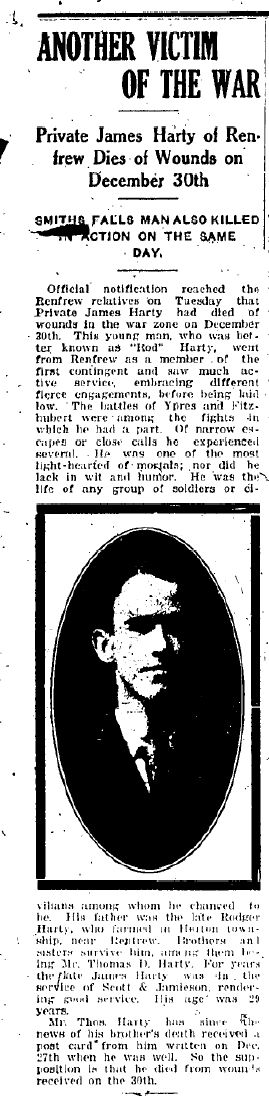
Private David Henry Lucas had enlisted at almost the exact same time as Jim. Their regimental numbers are separated by only 46 others. David was working at the time as a moulder in an iron works and had a more turbulent life than his friend. Born on 29 May 1890 in Smith Falls, Ontario, David was the fourth of nine children of David A. and Martha Lucas. David Sr. was a farm labourer from England originally. Martha was from Ireland and three years older than her husband. In fact, he was her second husband, the first having been murdered in Ireland. In 1900, the Lucas’s marriage was not a happy one, and 39-year-old Martha ran off, apparently with a couple of boarders. Although a newspaper reported that she took some of her children with her, they all were reported as living with their father in the census of 1901: Lorne, Emma, Amy, David, Maggie, twins Mabel and Albert and Herbert; 2-year-old Irene had died in 1889. Despite a newspaper report about 4 of David Sr’s sons in uniform published in 1916, there does not seem to be any record of one with the initial J, nor any military record that can be traced to another son of David Lucas. It is possible he was a brother or nephew.
David Henry he enlisted on 22 September 1914 with the 2nb Battalion. His witness on his attestation papers is his brother Albert who also enlisted. Brown-haired, grey-eyed David was a solid man, at 5’ 7 1/1” with a 39” deflated chest measurement equal to most others at full inspiration. He was also a handsome young man from his picture, but that proud visage would not remain unmarred for long.
The battalions first real action was at the Second Battle of Ypres in April 1915. Creeping in toward Kitcheners Wood, the battalion faced severe fighting the night of the 22nd, continuing until noon on the 24th, when, under heavy machine gun fire, the battalion was withdrawn to HQ. It is likely during this retreat that David sustained a gun shot wound to his nose and was evacuated to hospital in Rouen. He was discharged to recovery on the 28th and to the base on 6 May, finally rejoining the unit on 9 May. It would be his first wound stripe received.
During the battle at Givenchy in June 1915, David again received a gun shot wound to the head. This was the period before metal helmets had been issued and all the soldiers had were soft field caps. Fortunately for David, it must have been a grazing type of injury. He was treated at hospital in St Omer and rejoined his unit 6 days later. Another wound stripe for his sleeve.
Sadly, the third time was not the charm for David. In the heat of the rifle grenade attack on 30 December 1915, David was also severely injured and like Jim, did not survive. James Harty was laid to rest in plot III.C.8 beside George Welsford, and David Lucas in plot III.D.7 beside Samuel Dempsey.
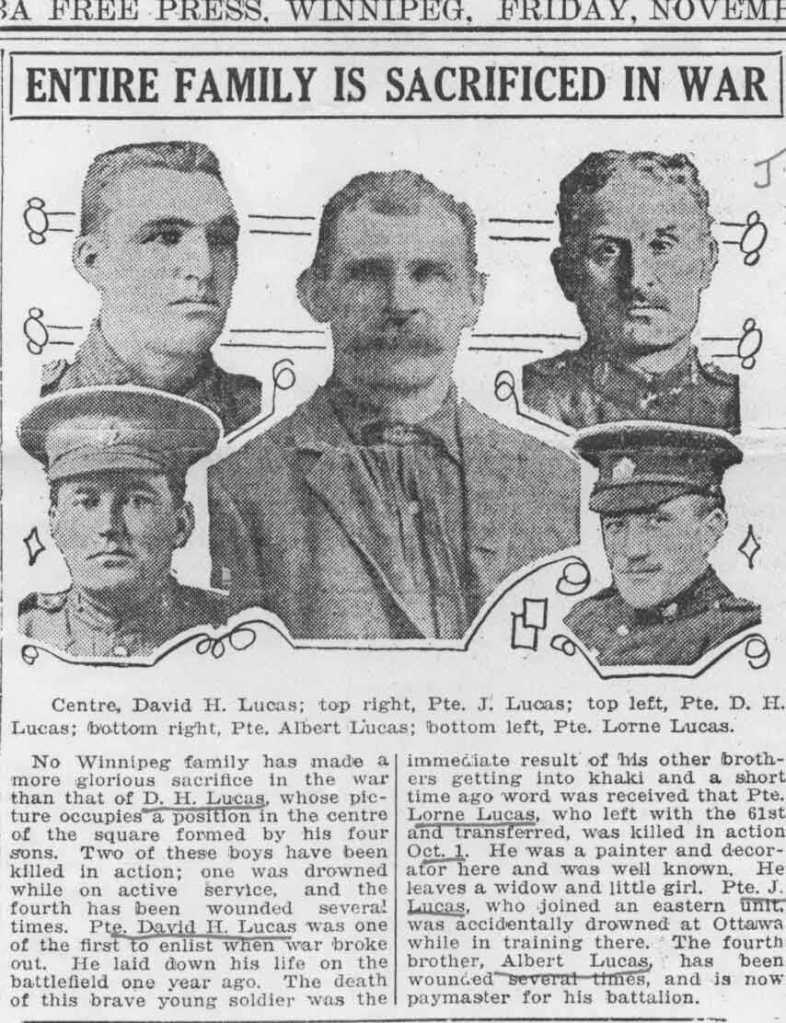
I can find no corroborating evidence of J. Lucas being David’s brother.
A Troubled Soul
15 April 2025
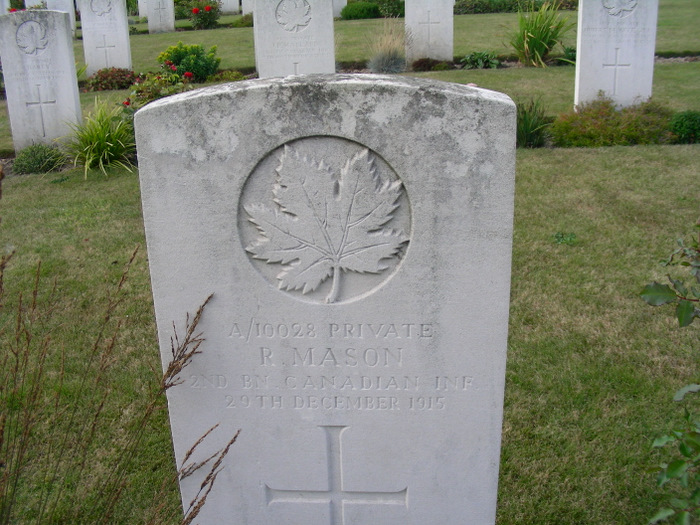
Private Robert Mason
Sometimes one must withhold judgement, must look with grace and compassion on the men whose records can seem so cold and whose deeds appear less than heroic. There are always back stories, even if we can find only traces of them sometimes, circumstances of which we have only the smallest understanding. That these men signed away their lives, stepped forward into a horrific war makes them heroes despite a few missteps along the way.
The 2nd Battalion was fortunate to spend Christmas out of the trenches. After vacating the front lines on the morning of the 25th, they marched into Bailleul for a lovely dinner at the church hall, its walls hung with flags and bunting and paper wreaths in an effort to bring some holiday cheer to the men. Once the meal and the speeches were done, they marched the 6km back to Dranoutre, itself about 8km behind the lines, out of reach of the shells if not the sound of the guns. On the 29th, the men of the 2nd headed back to the cold mud of the front lines to be met with a hail of German rifle grenades.
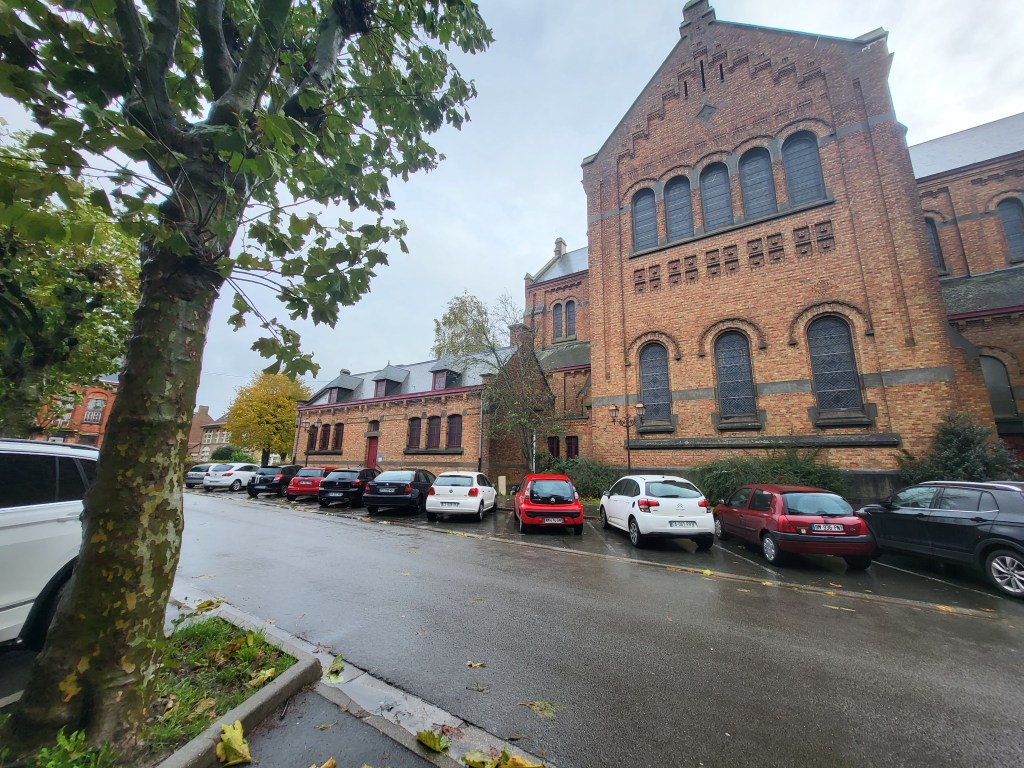
The church hall in Bailleul, France. Author’s collection
Private Robert Mason is one of those men it is very difficult to find any information on. He was born in Scotland on 29 November 1893, and unfortunately his is a common name there. A 14-year-old Robert B. Mason arrived in Ottawa with (presumably) his mother, Mrs. Agnes Mason, in 1907 from Scotland on the S.S. Numidian. The age and location fit for our Robert but there is no further evidence linking them. Robert attested in Carleton (near Ottawa) in the 38th Battalion on 26 February 1915 and listed his 16-year-old sister Jean Mason as his next of kin. Jean was living in Aukland, New Zealand in the home of Thomas Knox (possibly her uncle) with their younger brother, Alexander, also listed in Robert’s papers. I found a Jean Mason Knox, “daughter of” Thomas Knox living in the same city as Robert’s sister, and assume they are the same person. What this hints at is a family torn apart, emigrating to different countries at opposite ends of the earth. Who their father was is lost. What happened to Robert’s mother is also a mystery, as she was evidently not in the picture by 1915. I doubt Robert ever saw his siblings again but thought fondly enough of them to name Jean as his next of kin; Alex received Robert’s plaque and scroll, his so-called “death penny”.
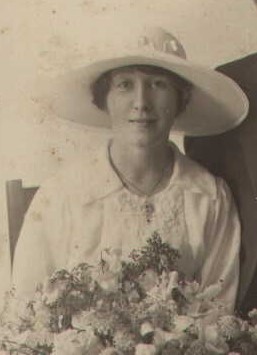
Jean Mason, born 1899 in Edinburgh, in 1921, about the same age as Robert when he was killed. She would have been 8 years old or younger when she last saw her brother. Perhaps Robert looked like his sister? We’ll never know.
Robert was a good-sized young man, 5’ 8 ¾” with brown hair and grey eyes, working as a teamster when he enlisted. He sailed from Montreal on 24 June 1915 on the S.S. Missanabie, recrossing the Atlantic eight years after his first voyage, but trouble seemed to follow him. In August 1915, while still in England, he was assessed 10 days detention for “misconduct”, a pretty stiff sentence. Shortly after, he was drafted to the 2nd Battalion and proceeded to France on 3 September 1915. Barely more than a month later, he was in hospital in Le Havre, diagnosed with gonorrhea, and again faced a stern reprimand: on 18 October he was assessed the forfeit of 50 cents per day while in hospital, post dated to the 9th – half his daily pay. Someone was fed up with his behaviour!
Venereal disease was a scourge that the Canadian and British authorities were deeply concerned about. Estimates run that 16 to 28% of Canadian soldiers contracted venereal disease, much higher rates of infection than British soldiers. Today, gonorrhea, a bacterial infection, is treated with a single dose of antibiotics. In the days before antibiotics, treatment was a much more distasteful, invasive, prolonged and mostly unsuccessful procedure. Robert did not return to the front lines until 27 November 1915. Sadly, the cut in pay would have no real impact; Robert had only a month to live.
On 29 December 1915, possibly due to the rifle grenade attacks as the battalion returned to the front line, Robert was killed. I cannot fault him for finding whatever comfort he needed in the arms of a woman.
Faceless, but not forgotten
27 March 2025
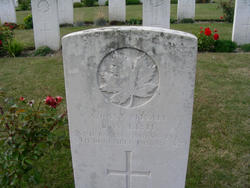
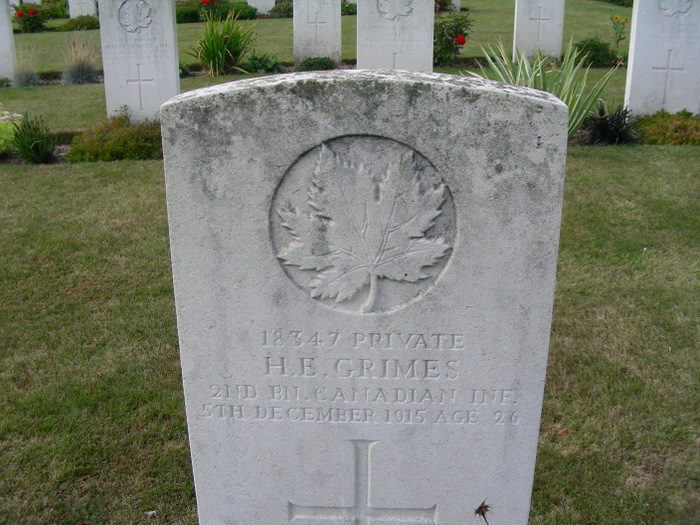
Private Henry Edwin Grimes and Private Bert William Kish
Sometimes these searches are a combination of heartbreaking and frustrating. Of course, it is always sad looking into the histories of these very young men who died needlessly and without experiencing many of the joys of life: falling in love, finding satisfaction in a career, watching their children grown up. Specifically, what I mean by heartbreaking is the utter lack of any evidence of their lives beyond a military record and a barebones listing of parents or siblings. When I struggle to find a picture, or any meaningful information, I’m both sad that their faces and their impact on the world has been almost lost. Its doubly sad when they are laid to rest in a small cemetery that gets few visitors. Apart from the dedicated Commonwealth War Graves Commission gardeners, and the cows in the field next door, R.E. Farm cemetery is rarely visited, maybe a dozen or so people pass through each year. It means it is even more important for me to at least present what I can about these lost men, to make sure their sacrifice is NOT forgotten. Private Henry Edwin Grimes is one of these boys.
Henry was born in Gosport, Hampshire, on 20 January 1888 to William, a shipwright, and Annie Grimes. In 1901, Henry’s older brothers William and Charles were working alongside their father as apprentice shipwrights, while Henry and his younger sisters Annie and Kathleen were still in school (presumably). Portsmouth, just across the harbour from Gosport, had been a centre of shipbuilding for centuries and by the 18th century had the largest drydock in the world. Henry might have followed his father and brothers into the trade, but it is evident he had other ideas. He joined the military, serving more than four and a half years with the Royal Engineers, though this possibly was as a volunteer in the militia. In 1911, wanderlust seized him, as it did many young men in those days. A brand-new country seemed like a place to begin anew. In March, Henry hopped on the S.S. Grampian and emigrated to Canada, arriving in Halifax, NS. His profession was that of a painter and it appears he ended up in Alberta, about as far as you can get from a life by the sea.
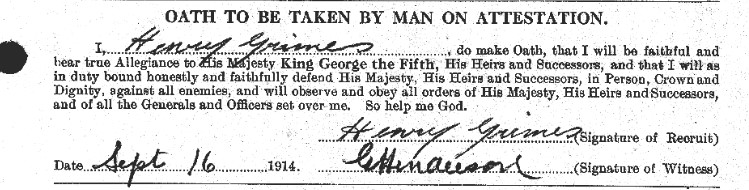
With the declaration of war in August 1914, Henry immediately enlisted in the 101st Edmonton Fusiliers, which would become the 9th Battalion, attesting in Valcartier on 16 September 1914. It is entirely possible he and Jim knew of each other, having followed the same path to the 2nd Battalion. Landing in Portsmouth in October 1914 would have been a homecoming for Henry, and it is highly likely his family would have been in the cheering crowds that greeted the First Canadian Contingent – all but his mother who had died in 1907.

The 9th Battalion in Plymouth, England, shortly after landing in October 1914. Is one of these faces Henry’s?
When the 9th Battalion went to France, Henry, like Jim, was left behind as part of a reserve battalion. However, he would have had plenty of opportunity to visit with his family over the winter and early spring. On 1 May 1915, he finally got his chance to see action when sent as reinforcement to the 2nd Battalion following the huge losses at Ypres in April. In August, Henry got into a bit of trouble. Missing “parade” – a practise of marching and drilling in formation – he was assessed a forfeit of a day’s pay and punished with five hours of drill wearing his full pack – upwards of 75 pounds!
On a rainy 4 December 1915, the 2nd Battalion returned to duty in the trenches marked D3 to E4 along the ridge above Wulverghem. It had been a quiet day, but the next was a different story. December 5th saw the Germans active with rifle grenades, and they dropped 85 to 90 high explosive shells on the 2nd’s support trenches. It must have been truly awful to be under that heavy of a bombardment, and nine men were injured. Henry, sadly, was killed. He lies in plot III.B.11 beside Rexford Hurlbert. The next day saw more high explosive shells rain down and another casualty killed. This time it was Bert Kish.
Sometimes, interesting stories come out of my research, tangled webs of family history. Bert’s is one such. A letter came to the family that Private Bert William Kish had died of his wounds, sent by Bert’s brother-in-law, Captain William Kruger. William was married to Bert’s older half-sister, Nellie… who was also – technically – Bert’s cousin.
Bert Kish was born in Frontenac, Ontario to Benjamin and Henrietta Jane “Jennie” (Peters) Kish on 7 October 1888. He had an older sister, Ida two years his senior, but also a half-sister Nellie, his mother’s child from her first marriage to Benjamin’s late brother William, making her also a cousin. A bit of a cozy family situation! Nellie had married William Kruger, a member of Canada’s Permanent Corps since 1896 and a South African veteran. Perhaps it is due to Kruger’s influence that Bert spent 6 years with the 4th Hussars militia in Kingston, Ontario.
In May of 1912, Bert married Edith Payne a young woman who’d emigrated from Birmingham, England. Their daughter Doris Jane was born on 19 June 1914 at Dr Hagar’s private hospital. At the time Bert was working as a fireman on a boat to support his growing family. As a married father, he likely was turned away as a volunteer, despite his military experience. I make a big assumption that he would have tried to get in the summer of 1914, based on his service in the militia as those men were the most likely to enlist early on. Bert did finally attest in Ottawa in the 38th Battalion on 24 February 1915. At 5’7”, the brown-haired, hazel-eyed 26-year-old was considered fit and was accepted. When the battalion shipped out to England, Edith and baby Doris followed Bert across the Atlantic, back to Edith’s hometown of Birmingham, to live with family, I would assume. Perhaps they had plenty of time to visit, for Bert to bond with his small daughter, celebrate her first birthday perhaps, before he finally was taken on the strength of the 2nd Battalion and headed over to France in late August 1915.
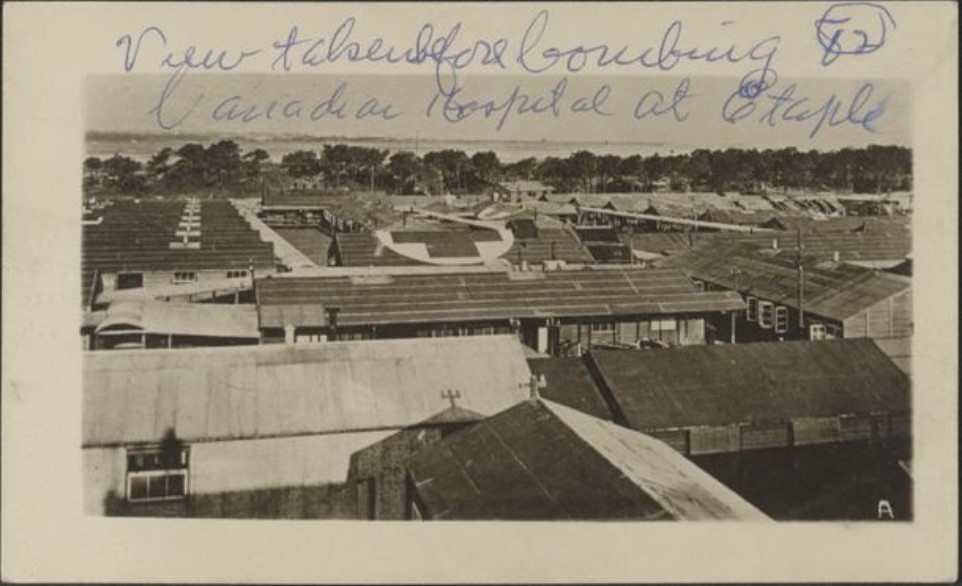
University Archives, Northwestern University Libraries. (Thu Mar 27 2025). Canadian hospital in Etaples, France, Retrieved from https://dc.library.northwestern.edu/items/d98d3147-8b6c-4bb7-a286-b4c94b041c4b
The 14th of October 1915 was a quiet day in those trenches above Wulverghem, and the battalion was relieved to go to General Reserve in Dranoutre, well behind the lines. It was an uneventful day for all, except for Bert who managed to get wounded by shrapnel across the back of his hand. It was only 3 to 4 “small wounds”, mere “abrasions” which he claimed were not painful but Bert was declared unfit for duty. From the Field Ambulance, he was sent to the No.1 Canadian General hospital in Etaples, France. I’m sure he wrote to Edith to reassure her he was, for the moment, safe and sound. (This same hospital would be bombed by the Germans in May 1918, killing 66, including 3 nursing sisters.)
After what must have been a lovely rest – Jim described how delightful being away from the fighting and in a clean bed at the coast was – Bert returned for duty on 2 November. A month later, Bert was not so fortunate. On 6 December 1915, he was again wounded, this time more severely and died of his wounds at the Field Ambulance. He was buried beside Henry in plot III.B.10.
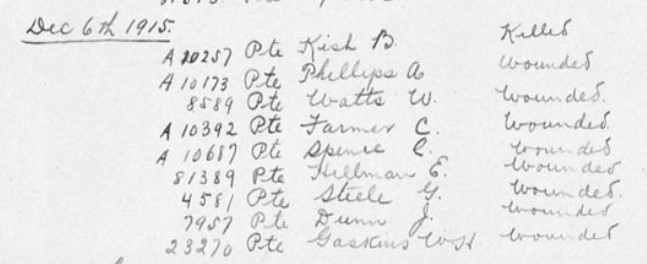
I found Bert’s widow Edith in Buffalo, New York, having gone in 1917 to work in a munitions factory. I wondered how a single woman, with no family could work and take care of a small child. Then I found the answer: less than a month after losing her husband, Edith lost her 18-month-old daughter Doris to illness. How tough and heartbreaking life was not so long ago! Any legacy of Bert’s was snuffed out.
Lads of the 38th
7 March 2025
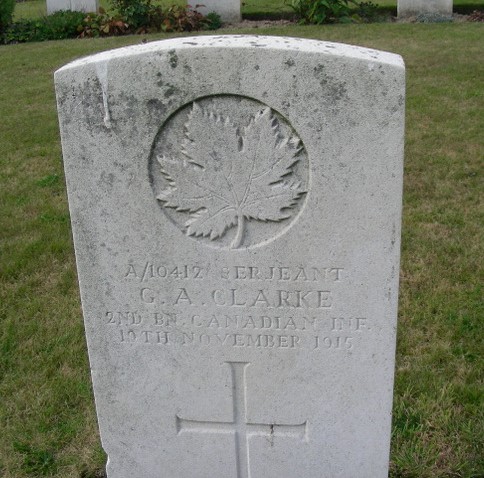
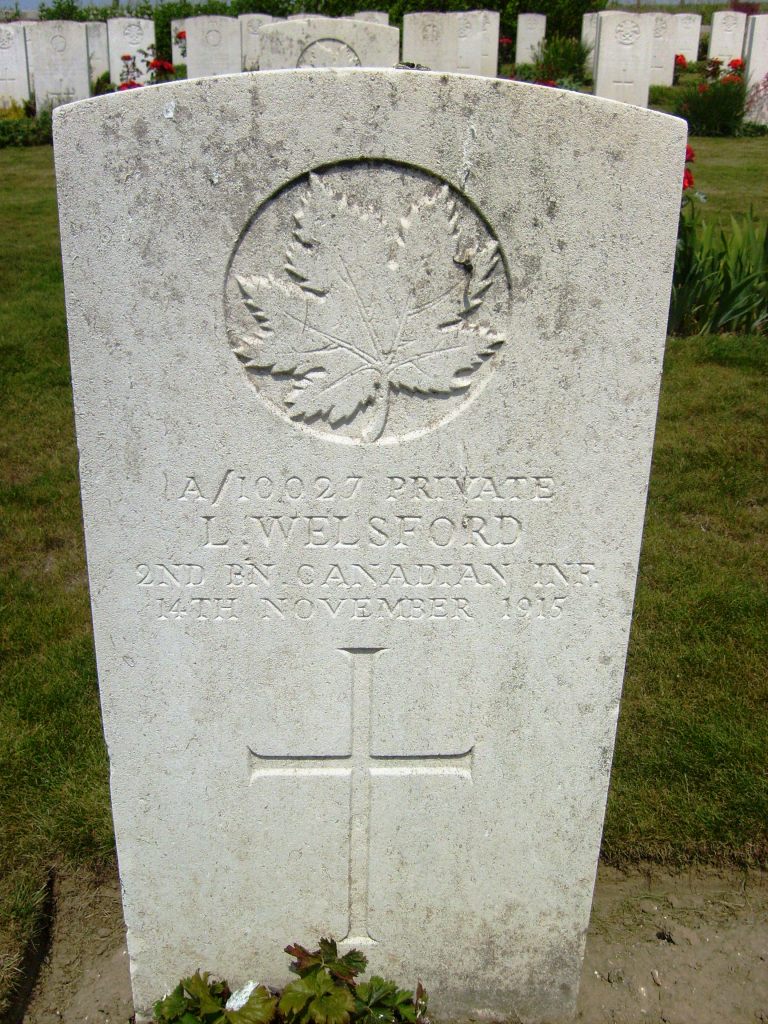
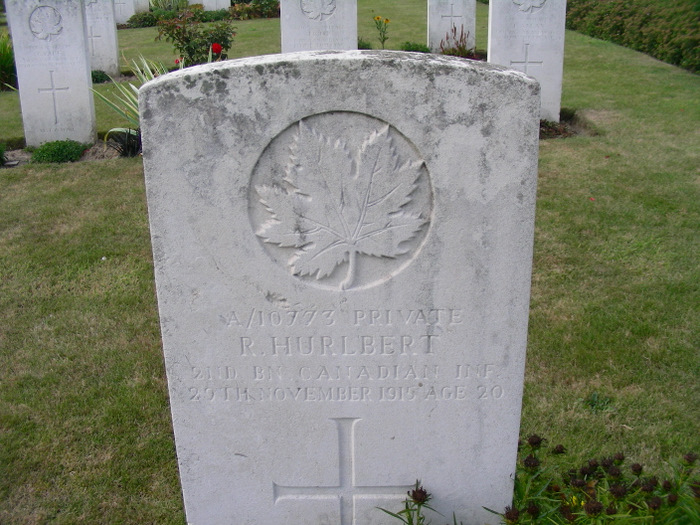
Sergeant George Clarke, Private George Welsford and Private Rexford Hurlbert
These three young men all followed the identical path to the trenches near Wulverghem, and there is little doubt in my mind they would have worked together and known each other. All came from Ontario and all enlisted in the 38th Battalion within weeks of each other. This is their story.
The 38th Battalion was authorized in the Ottawa region on 28 December 1914, although some recruiting had begun as early as November. Training proceeded in Ottawa through the spring of 1915, until requests came in for reinforcing drafts, likely in consequence of the losses at Ypres in April. The first draft went overseas in May, followed by a second, consisting of five officers and 250 other ranks. On 24 June 1915, the second draft, including Clarke, Welsford and Hurlbert, boarded the S.S. Missanabie in Montreal, bound for England. While the rest of the 38th Battalion were shipped to Bermuda and eventually served under their designation through the rest of the war, this second draft was merged into the 12th Reserve Battalion and parted out where needed. Clarke, Welsford and Hurlbert were all drafted to the 2nd Battalion on 24 August 1915, sailed across the Channel and joined their new unit – already ensconced in the Ploegsteert trenches – four days later. Their brief foray into warfare had begun.
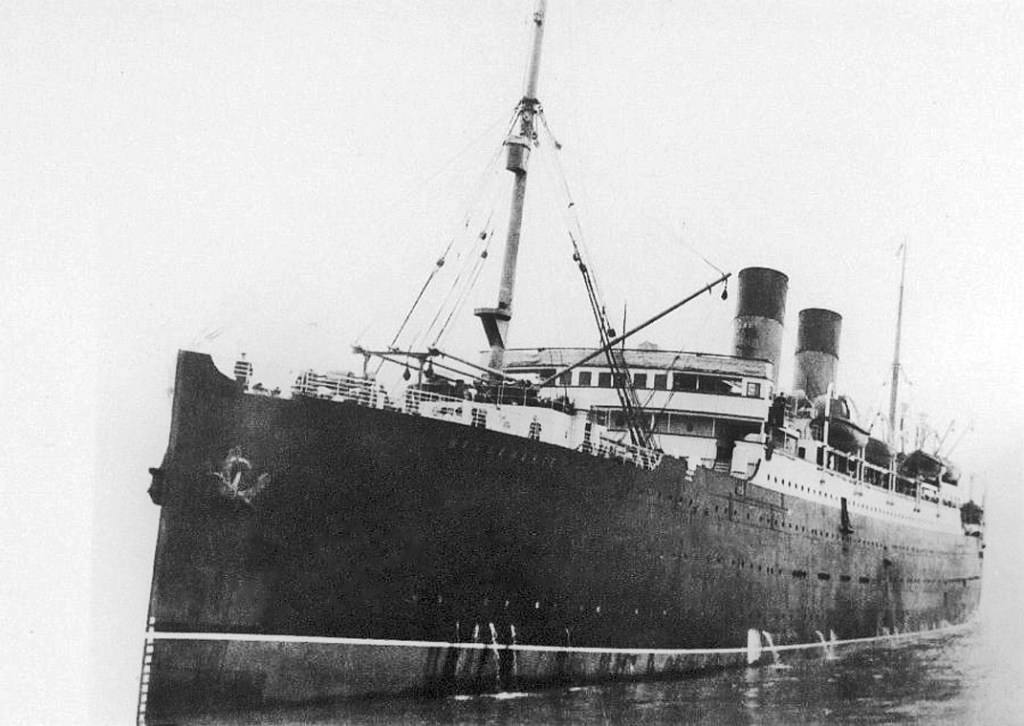
S.S. Missanabie
George Lindsay/Lyndsay Welsford was born in Guelph, Ontario, on 23 April 1896 to labourer Robert Welsford and his wife Emma (Kee). Preceded by sister Emma (who died shortly after birth) and brothers Roy, Albert and James, and followed by younger sister Alice, George was delivered by Dr. Lyndsay, hence his middle name. Despite his Irish ancestry, 5’ 6” George was dark haired, dark eyed and “swarthy”, according to the medical examiner. By the time he’d enlisted at age 18, George was working as a labourer as well, and the family was living in Buckingham, Quebec, now a neighbourhood of Gatineau, just across the river from Ottawa.
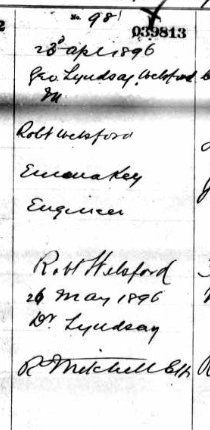
On 14 October 1915, George had been with the 2nd Battalion for less than 2 months. The day dawned fine and bright after heavy rain the previous day. It was a quiet morning, and the battalion looked forward to being relieved by the 3rd in the afternoon and heading to Brigade Reserve, one company to Souvenir Farm, one to R.E. Farm and two to Wood Camp. Something went wrong. In the absence of any mention of shelling or any other injuries, I would guess George got careless and a sniper hit his mark. 19-year-old George went to R.E. Farm, laid to rest close to James Mallard in plot III.C.7. His headstone is marked L. Welsford, but clearly from his signature, he went by George. I have contacted the Commonwealth War Graves Commission to fill in the missing details of his identity.
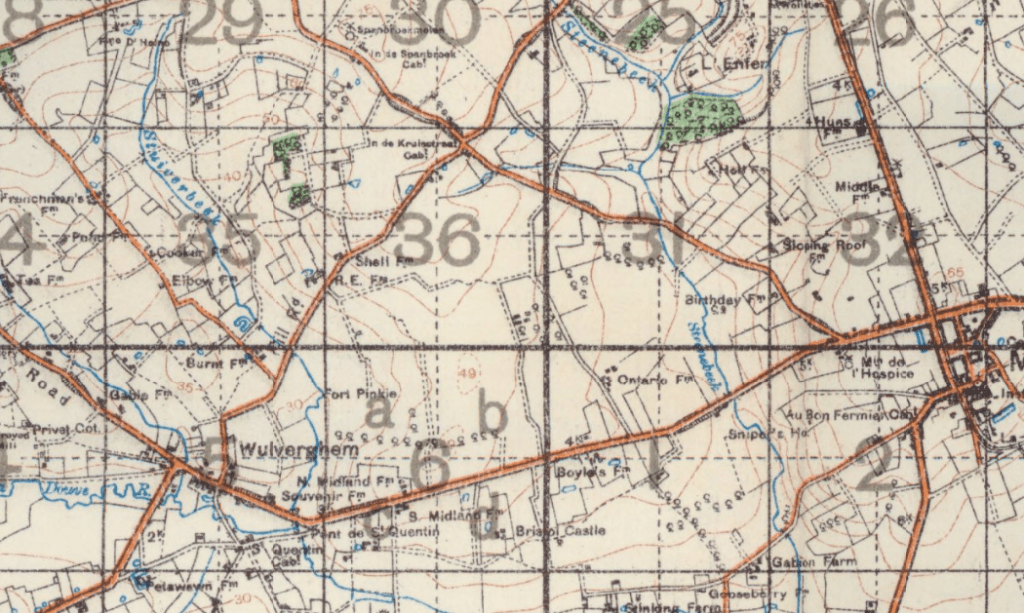
RE Farm in box 36.c; Souvenir Farm in box5.d/6.c
George Arthur Clarke was different from his comrades in this blog post. A Londoner, 33 years old and married, a sergeant, this George had spent twelve years with the British army and so was a highly experienced soldier. He was born on 21 February 1882, and I can find no mention of parents. It is possible he spent time in a London workhouse, but that can’t be confirmed. At 18 years of age, George joined the Royal Scots Regiment and spent the next twelve years roaming the globe. From 1900 to 1903, he was in South Africa, earning the King’s and Queen’s SA medals. He then spent four years in India. In 1907, he returned to England, and in 1911 was discharged from duty. That same year, George married Mary May Houssart, a widow four years his senior and took on the responsibility of her two daughters, 10-year-old Lilian and 7-year-old Dorothy. Two years later, he took his new family to Canada, arriving in Toronto, via Portland, Maine on the Ascania from Southampton.
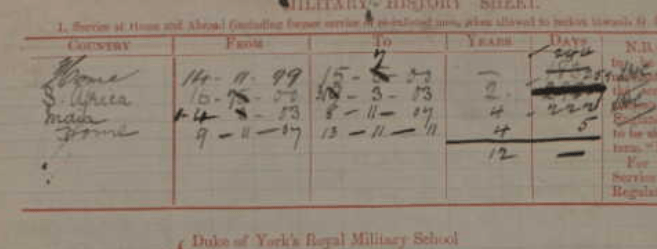
In February 1915, when George enlisted, they were living in the Ottawa area where George worked as a labourer. At 5’ 11” and 170lbs, he’d grown three inches since enlisting in the Royal Scot’s and his brown hair was now “light”, probably greying. When he traveled overseas, Mary and the children went too, possibly to stay with family for the duration, likely in hopes of seeing George on leave.
George’s years of experience undoubtedly played a role in his promotion to sergeant but also may have given him an attitude toward the younger, far less experienced officers above him. In October 1915, he was “severely reprimanded” for not complying with an order. His grievous sin was being found without his boots while in the trenches and he probably refused to put them on again.
On 18 November 1915, the 2nd Battalion moved back into the trench line just above R.E. Farm after a rest in the “Piggaries”. It seems the weather had been miserable as the 19th was spent bailing out the accumulation of water. The Germans threw over thirty HE shells, but the war diary says “they did no damage…” Yet at this time, George was seriously injured. He cleared the dressing station and was forwarded to the No. 2 Canadian Field Ambulance but there died of his wounds. George was buried in plot III.D.1. Mary, Lilian and Dorothy returned to Canada, Mary once again a widow with young children. Dorothy returned to England and lived out her days there, never married but having taken Clarke as her last name. It indicates the affection George must have had for his stepdaughters.
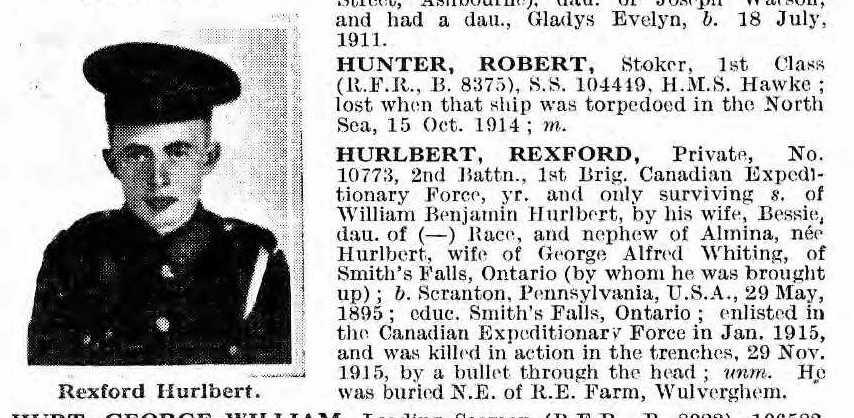
Rexford B. Hurlbert was an American, born in Scranton, Pennsylvania on 29 May 1895. His mother, Mary Elizabeth “Lizzie” died at age 26 of “heart trouble”, his father William Benjamin not long after, and Rexford was raised and educated by his father’s sister, Almina (Hurlbert) Whiting in Smith’s Falls, Ontario. In 1914, 18-year-old Rexford was working as a fireman. His brother had just died, his heart troubles making him too weak for surgery when struck with appendicitis.
Rexford was a heavy smoker – one and a half “boxes” a day – which would come to haunt him. He’d passed his medical in Canada, but while training in England, he complained of weakness, blurry vision and chest pain. He found himself short of breath during marches. Admitted to Moores Barracks Canadian Hospital on 17 August 1915, he described having “heart issues” at 16. His tests came up normal except an occasional irregular heartbeat. After being given an exercise regimen, Rexford was found “cured” and sent back to duty on the 22nd. Four days later, he was in Ploegsteert.
The last week in October was quiet. The battalion returned from Dranoutre to the trenches on the 26th. The weather had been cooperative but there was rain and it was freezing on the 29th. The enemy had thrown a few, small HE shells and some rifle grenades, but that didn’t stop the trench work. The night would have been dark as it was six days past the full moon. Rexford might have been lulled into a false sense of security. At 4am, he raised his head too high. A single shot to the head from a German rifle ended his war. Rexford was buried in plot III.B.12
“November’s sky is chill and drear, November’s life is red and sear.”
25 February 2025
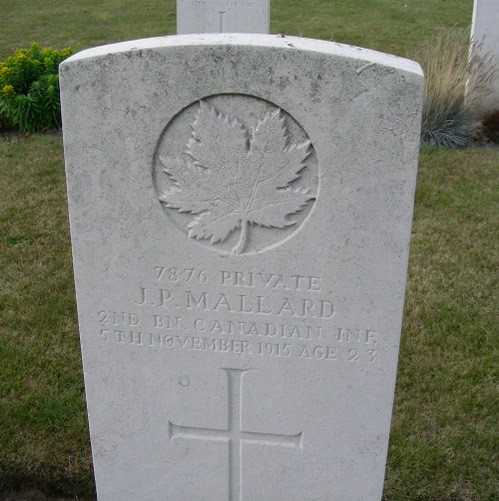

Private James P. Mallard and Lance Sergeant Edward Moody
Enemy’s artillery active.
- 2nd Battalion war diary for 5 November 1915
Lance Sergeant Edward Moody wasn’t a Canadian and neither was Private James Patrick Mallard, but they both wore the maple leaf…and are buried under one.
Edward Moody was born in Romsey, Hampshire, England, a town north of Southampton and on the edge of the New Forest, on 10 September 1885 to Stephen and Phoebe Moody. Stephen was a brewery labourer. In 1901, the family included the couple and their nine children – Florence, Walter, Henry, Edward, Alfred, Louisa, Frederick, Herbert, and Ernest – who ranged in age from 22 years to 9 months. While his older brothers worked in the brewery with their father, 15-year-old Edward and Henry worked as stable boys. Ten years later, only 25-year-old Edward, who was now working as a carter, and his three youngest brothers still lived at home, but that was not to last. On 3 July 1913, Edward finally made a big move. He boarded the Ausonia in Southampton and departed for an ocean voyage to Canada. While no family went with him, no wife or children, he may have been travelling with a small group of other men – E.A. Cripps, H.J.J. Garden and H. George Snelgrove – all listed together and all farmers by occupation.

Just over a year later, at the outbreak of the war, Edward immediately enlisted, attesting in Valcartier on 23 September 1914. At 5’6” with fair hair and blue eyes, Edward had served 3 years in the Colour Rifle Brigade, so had some experience in shooting and drilling, no doubt. He was one of the original 2nd Battalion, and shipped out in October 1914 back home to England, training very close to home. He must have spent time visiting his family during that winter and they would have been very proud in December when he was appointed to Lance Corporal.
In February 1915, the battalion embarked for France to the fighting at Neuve Chapelle and Ypres. In May 1915, Edward was appointed to the rank of Corporal and by December, Lance Sergeant.
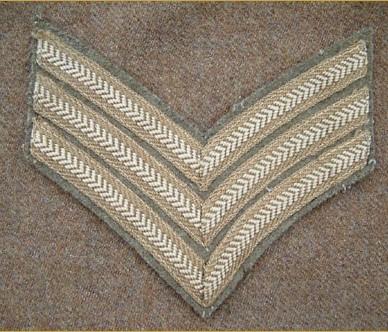
The three sleeve chevrons of a sergeant.
There is some confusion around ranks and appointments. As a Lance Corporal, Edward was still ranked as a private, but paid at a higher rate with addition responsibilities, $1.05/day versus $1/day. Likewise, as a Lance Sergeant, Edward was ranked as a Corporal, but paid as – and wore the chevrons of – a Sergeant, $1.15/day.
In morning threw a few small HE shells around RE Farm.
- 2nd Battalion war diary for 5 November 1915
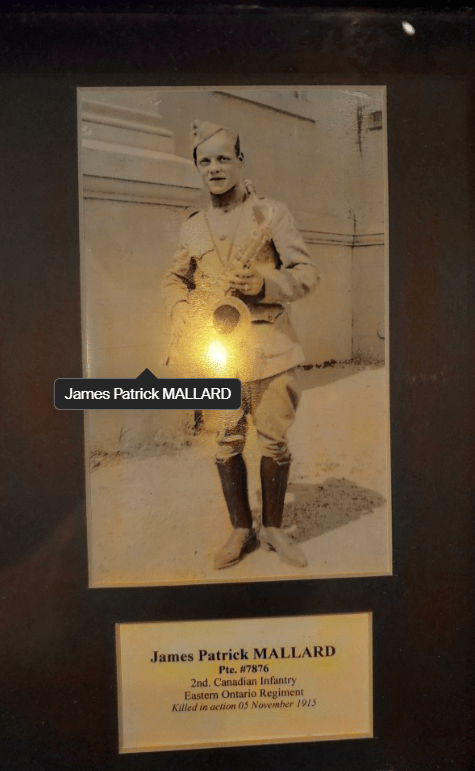
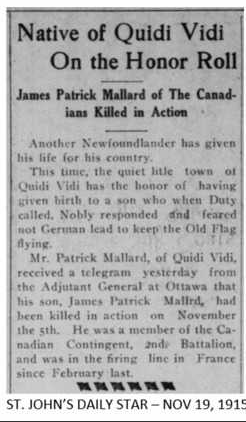
James Patrick Mallard was neither a Canadian nor a British ex-pat. James was a Newfoundlander, then part of Britain’s Commonwealth on its own and not due to join Canadian confederation for nearly another 30 years. He was born in Quidi Vidi, a neighbourhood in St. John’s, NFLD on 18 August 1890 to Patrick and Mary Ann (Skiffington) Mallard, the eldest of their eight children. Along with sisters Susan and Sarah, and brothers John and George, there were James Patrick, James Francis and Patrick Francis, so which of his names he went by is difficult to tell. I have picked James.
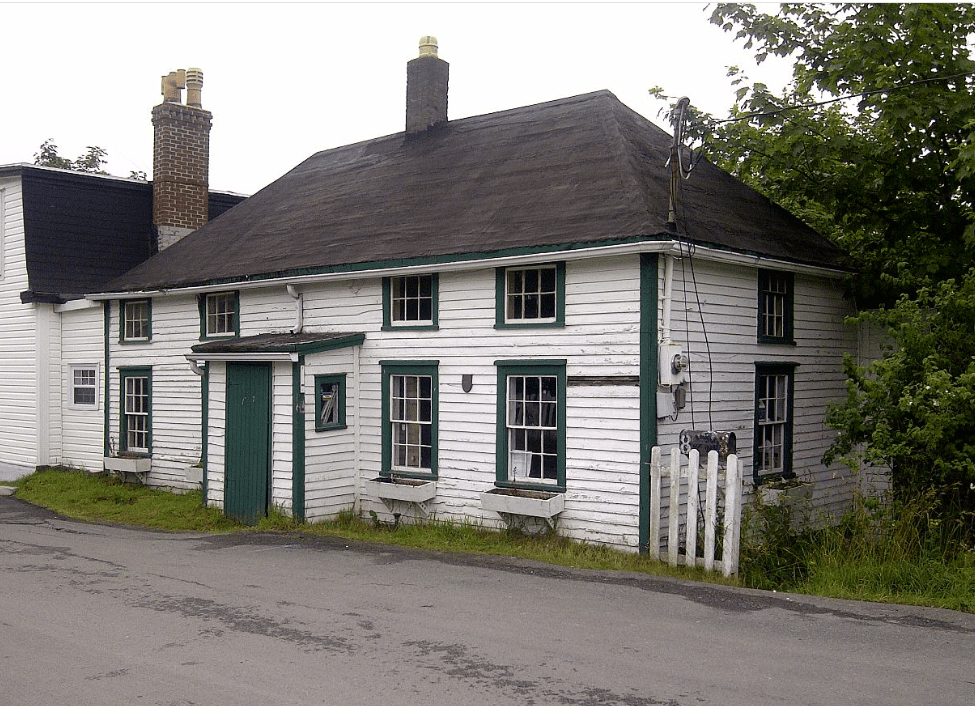
The Mallard family had arrived in Newfoundland sometime around 1800, with the immigration of William Mallard, James’ great-great-grandfather. A family home was built between 1820 and 1840 and was occupied by the Mallards until the 1980s. As a fourth-generation Newfoundlander, James’ roots were deep which makes it a bit surprising that he enlisted in the Canadian Expeditionary Force rather than the Newfoundland Regiment, affectionately named the Blue Puttees. Perhaps, like many today from Newfoundland, James had gone to the mainland to find work. According to a cousin in Newfoundland, James had won a trophy in the Governor General’s Foot Guards (GGFG), an Ottawa based reserve regiment, which would place James in that area in 1914. Indeed, the GGFG perpetuates the 2nd Battalion to this day.
James was, like Edward an original member of the 2nd Battalion, attesting in Valcartier on 22 September 1914. An ironworker by profession James was 5’7” with brown hair and eyes. He sailed from Quebec on the S.S. Cassandra in October 1914. I’m sure he would have been thrilled to see the Newfoundland ships bearing Blue Puttees join their convoy that fall. James fought with Edward at Ypres, Festubert and Givenchy that spring and summer of 1915. In September, it was – of all things -a sprained ankle that kept him out of the lines and at a Casualty Clearing Station (CCS) for nearly two weeks. CCS were far more sophisticated than the name implies, more in line with the units made famous by the TV show MASH, than a mere passing through point for the injured, with OR suites, x-ray equipment and a full nursing staff (as close as female nurses could get to the front lines). By the 29th of September, James was back in the fighting. But it was a quiet part of the lines…
In afternoon enemy bombarded our front lines and support lines with about 30 large (8.2) calibre shells, also about 50 smaller shells 7.7 and 4.1 shells…
- 2nd Battalion war diary for 5 November 1915
The 4.1s were nicknamed Hissing Jennies; they could be shrapnel (discharging small round lead balls after exploding in air), high explosive (detonating on impact and spreading a deadly swath of shredded metal) or gas. The 8” calibre, which could punch out a twenty-foot-wide crater and send up greasy black smoke, were named after the 1914 American heavyweight boxing champion, Jack Johnson. None were funny despite the light-hearted names. They also proved deadly to Edward and James. After a couple of weeks free of casualties, it was Captain Gordon’s unfortunate duty to serve at another 2nd battalion funeral service at R.E. Farm. James is buried beside Hubert Gill in III.C.9. Edward is right behind him, next to Edgar Ward in III. D.2.
A Fake Attack
28 January 2025
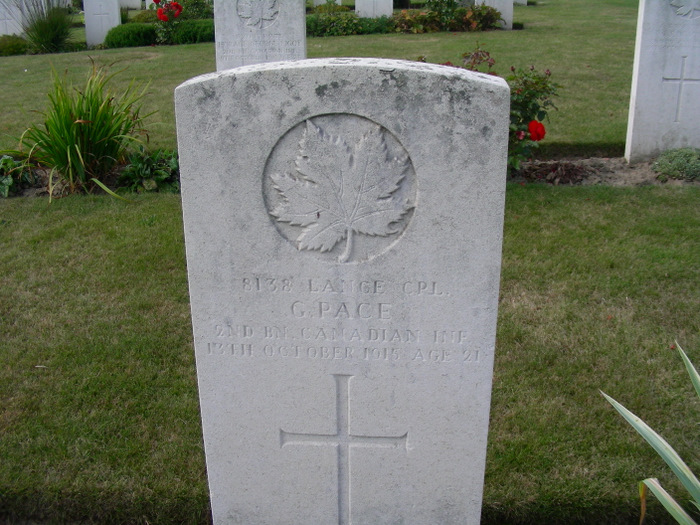
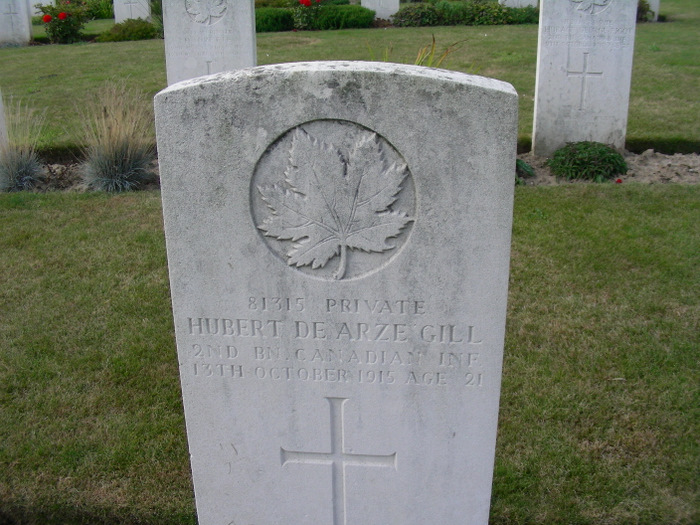

Private John Burr, Private Hubert Gill and Lance Corporal George Pace
The First World War was, some claim, an “artillery war”. An estimated 900,000,000 to 1.2 billion shells were used by all sides. Canadians fired one million shells just to soften up German defenses in the week before the attack on Vimy ridge in April 1917. Shelling was the leading cause of death in this conflict, caused intense strain on troops, and left men suffering for years after. In defiance, the troops began giving various shells silly names – Wyper’s express, Jack Johnsons, coal boxes, hissing jennies, rum jars – in an attempt to lighten the fear. They took the attitude that if the shell “had your name on it” your fate was unavoidable. Our next three men all fell victim to German artillery shells, and all on the same day, 13 October 1915.
Private John Burr was older than many of the men at the front, married with four children. He was also a recent transplant to Canada. John had been born on 19 February 1877 in Aberdeenshire in Scotland. At age 25, in 1903, he married Margaret Fraser, a 36-year-old widow with five children. The couple soon had four children of their own – Alexander (1904), John (1906), Mary (1909) and James (1910). In 1912, John, a farm labourer, and Margaret emigrated to Canada, leaving Margaret’s now grown children from her first married in Scotland. They arrived in Quebec in June and John took work as a railroader. A year into their new lives Margaret died, as possibly did 3-year-old James. John, now 37 years old and a single father, would not have been able to enlist in the Canadian Expeditionary Force, but he would solve that issue. On 2 March 1915, he married 26-year-old Annie Walker and on 19 March 1915, he attested in Ottawa, joining the 38th Battalion, leaving his new bride with his 11-, 9-, and 5-year-old children.
John was a relatively big man for the day at 5’8” and 160 pounds, but with his “iron grey” hair, he must have seemed an old man to the young troops. On arriving in England, he was assigned to the 12th Reserve Battalion, but the heavy fighting at Givenchy and Festubert in June/July 1915 had left the 2nd Battalion short of men. John arrived to join the battalion on 28 August 1915.
Private Hubert De’Arze Gill might have been an officer. Certainly, the 22-year-old barrister-at-law from Winnipeg, Manitoba, had the education and standing to be one. The Manitoba Law Society memorialized the 57 barristers and law students who made the supreme sacrifice in 1914/1918, 50 of them officers, yet a private he was.
Hubert had been born 25 November 1892 to the Rev. Canon Edward Anthony Wharton and Agnes Ellen Gill, the fourth of their seven children: Evelyn (1887), Alfred (1888), Millicent (1890), Hubert (1892), Agnes (1897) and Ellen (1901). Hubert had followed in his mother’s footsteps; Agnes (who went by Ellen) was a barrister as well as a wife and mother. Hubert was also taller than average at 5’ 10 3/4”, with brown hair and grey eyes. In December 1914, Hubert enlisted, attesting in Winnipeg with the 32nd Battalion. On 23 February 1915, he sailed from Halifax aboard the S.S. Vaderland.
22 April 1915, the 2nd Battalion went into their first real fighting at Kitchener Wood, 5km NW of Ypres, in what would become known as the 2nd Battle of Ypres. On that day 1027 men of the 2nd marched into the Ypres Salient; four days later only 375 of them answered the roll call. The battalion was desperately short of men and so they withdrew to rest and reorganize. Part of the reorganizing was the influx of fresh recruits, Hubert being one, arriving on 5 May 1915.
Lance Corporal George Thomas Pace was another English ex-pat in the Canadian forces. He had been born to John and Kate Pace in Lewisham, London on 16 April 1894. In 1899, John died leaving Kate a widow and George and his siblings – William, Kate, Edith, Fred, Minnie and Ethel – fatherless. By 1911, the strapping 6’ tall blue-eyed, fair-haired George was living in Surrey with his mother, her new husband Fritz (“Frederick”) Wolters, siblings, including much younger half-brother, also Frederick, and five servants. At some point after this, George emigrated to Canada where he worked as an electrician.
George was single when he attested in Valcartier, Quebec, in September 1914, an original member of the 2nd Battalion. He proceeded overseas with the First Contingent in October 1914, then France in February 1915. Somewhere along the line, he acquired a wife, Jane, while back in England. Perhaps they had known each other before he emigrated; perhaps he had planned to marry her and bring her to Canada. Sadly, their time together was very, very short.

And this brings us to 13 October 1915 and the 2nd Battalion tucked in their quiet line on the edge of a slope rolling back toward the village of Wulverghem. The battalion was going to have a little “fun” with the Germans opposite them. In the morning, the Canadian artillery bombarded the German lines. Afterwards, the battalion staged a fake attack, lobbing smoke and gas “bombs” (aka grenades) toward the enemy. The Germans replied with a barrage of 6” and 8” shells. The 2nd Battalion’s front line and the communication trench leading back were both badly damaged. Seven of the “other ranks” were wounded. John, George and Hubert were killed by these falling shells, their lives snuffed out and their war over almost before it had begun. The three comrades in arms were all laid to rest by Captain Gordon of the 1st Brigade, side by side, immediately in front of their companions who had died in the preceding days, in plots III. C. 10, 11 and 12.
“Soldier of Christ Well Done”
10 January 2025
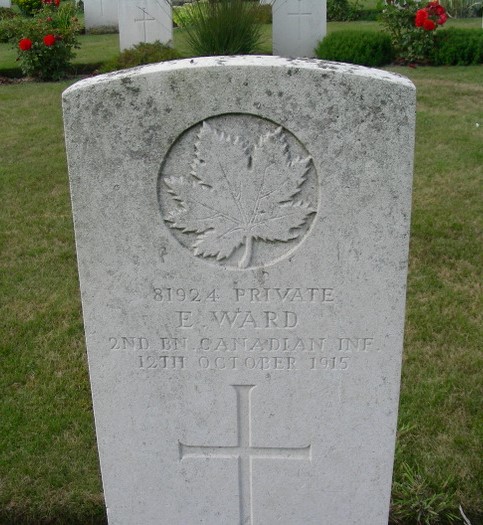
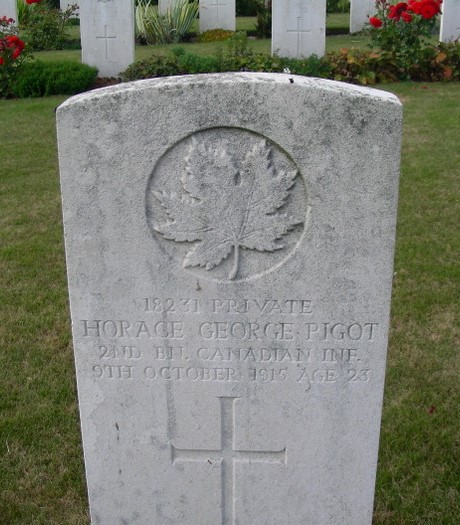
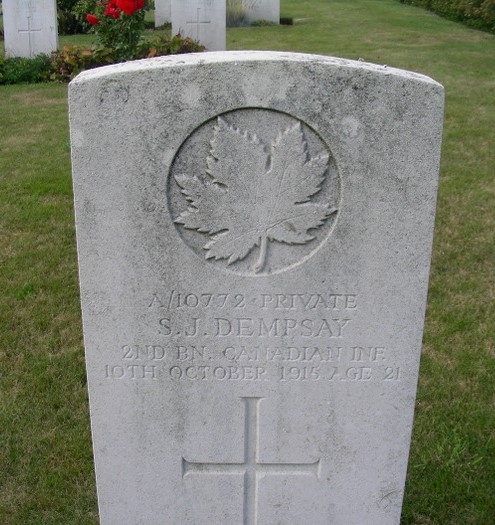
Privates Edgar Barnes Ward, Samuel John Dempsey and Horace George Pigot
Gun fire was only the second most common cause of death and injuries during the First World War, but for the following three young men, it was their demise. October 1915 was an easy month for the 2nd Battalion, CEF. They had been sent to what the men considered a quiet part of the lines, near the town of Wulverghem, north of Plogsteert. Facing them across no man’s land was Messine Ridge and on their left was Mount Kemmel. In that month, 30 men were injured – officers and other ranks – but there were only six deaths. The first three were all caused by rifle fire, two of them from sniper hits. Putting one’s head or even a hand above the parapet, even for a second, was very risky business. Even riskier was going over the top and into the wasteland that was no man’s land, as Private Horace George Pigot found out.
Private Horace Pigot was born in Woodford Green, Essex, England on 19 November 1891, the youngest son of John, a coal merchant, and his wife, Sarah. Horace was tall for the time, at 5’ 6.5”, with brown hair and brown eyes. At some point before the war, he immigrated to Canada, where he worked as a machinist. Horace, an unmarried 22-year-old, enlisted in August of 1914 in Edmonton, Alberta with the 9th Battalion and travelled to Valcartier, PQ with Jim Johnstone. They sailed together on the S.S. Zeeland in October 1914 to England, trained on the Salisbury Plain, and Horace eventually joined Jim in the 2nd Battalion on the 19 April 1915, just in time for the Second Battle of Ypres. I imagine they would have known each other.
On 25 April 1915, Horace was sent for training with the 1st Line Transport Drivers. The 2nd Battalion had not yet made it out of the Salient, so perhaps he did not arrive in time to move up with the rest on the night of the 22 April. In September 1915, he spent a week in hospital with tonsilitis, a serious disease in the days before antibiotics, arriving back with the battalion on the 22nd.
Since digging down deeply was impossible due to the high water table, front line trenches were reinforced facing the German lines and raised with sandbags. Constant shelling shook these fragile defenses and rifle fire broke open the bags. Repair was a constant effort. On the 9 October 1915, Horace was sent forward as part of a small team covering for the working party repairing the parapet. They had crawled forward to within one hundred yards of German trenches. It was on the way back that Horace was hit by a bullet, from a sniper perhaps, or just a lucky shot from the German line. He managed to groan out “My God Duncan, I have been hit” to his NCO before losing consciousness. He was hastily bandaged, and carried to safety, but Horace died on the way to the Aid Post at R.E. Farm, a mere 200m down the narrow country lane.
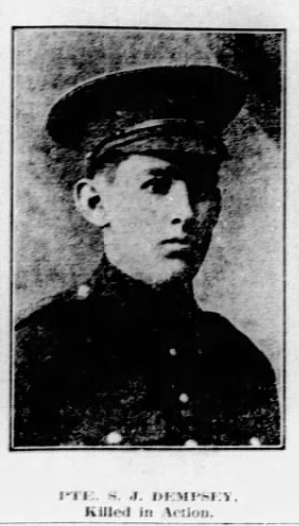
Private Samuel John Dempsey was hit within his own trench line. A native of Calabogie, Ontario, Samuel had been born on 31 March 1894 to Samuel Sr, Esquire, and Ida Dempsey. The slightly built young man – who stood at 5’ 7.5” with brown hair and hazel eyes – worked as a clerk. His family was large and Irish Catholic. His father, a merchant, had immigrated from Ireland in 1874. Samuel had 3 older half-siblings, Anna, Mable and William, from his father’s first marriage. Fourteen more children followed when his father married 17-year-old Ida. Emma, James, Ada, Lilian, Maggie, Samuel, Gibson, Clarebel, Gordon, Edwin, Vera, Elda, Bess and Wallace arrived between 1885 and 1912.
Samuel enlisted in Ottawa in March 1915. At 21 (almost) he would not have needed his parent’s permission. Originally with the 42nd Battalion, he went through the ranks of the 38th and the 12th Reserve Bn in Shorncliffe. On 24 August 1916, he was taken on strength with the 2nd Battalion, joining the unit in the field on the 28th. At this time, the 2nd Bn was in billets in Bulford Camp near Plogsteert. For the next month, as they were in and out of the trenches, the battalion war diary was filled with entries which began “Quiet” or “Very quiet”. Perhaps Samuel was lulled into over-confidence. Perhaps he just got a little careless. Or perhaps it was just inexperience.
On 10 October 1915, the day began, as it always did, with a “stand to”. At dawn and dusk, everyone was called to stand on the firing step, rifle at the ready, prepared for a potential German assault which the higher ups insisted was more likely during those hours. At 6am, when the sun was still below the horizon and the air probably chilly, Samuel raised his head just a fraction too high above the parapet. Maybe he wanted to see if any shapes were moving across no man’s land. It was all a German sniper needed to see, to squeeze the trigger from his hiding spot and Samuel’s war was over. He was carried down to the Aid Post where he died of his head wound. Captain Gordon, chaplain of the 1st Brigade performed Samuel’s burial service at R.E. Farm cemetery.
Private Edgar Barnes Ward was another English ex-pat. Born in Blackburn, England on 1 January 1891, he had come to Canada in 1904 with his parents, Mary Alice (Cross) and John Barnes Ward and settled in Moosomin, Saskatchewan. Edgar was a mechanic by trade and joined the 16th Light Horse militia. He was a good-sized lad, 5’ 7”, 165 pounds with a broad chest, brown hair and blue eyes. Edgar’s older half-sister, Mary Ellen, did not come with the family. Mary Alice had been a servant when she fell pregnant in 1881 and bore the child out of wedlock. However, she married John in 1886 and Edgar’s brother Wilfred (1889) and sisters, Muriel (1899) and Clara (1901), were on the journey.
Edgar enlisted in the 32nd Battalion on 29 December 1914 and sailed for England soon after on the S.S. Vaderland from Halifax on 13 February 1915. He was taken on strength of the 2nd Battalion on 2 May 1915, likely part of the reinforcements that followed the losses of the Second Battle of Ypres.
Edgar filled out his will, as all the men did, and it points out a precision and order he must have liked. He wrote, “In the event of my death I wish that my watch (the number of same is 4300530) and any other valuables to my mother.” I imagine it was a precious gift from his parents to take such care for its disposition.
All too soon, Mary Alice would receive that watch. On the 12 October 1915, two days after Samuel, Edgar was also felled by a “GSW” (gun shot wound) to the head. Another victim of the deadly aim of the German sniper.
Horace, Samuel and Edgar were the first three 2nd Battalion men to be buried in the tiny R.E. Farm cemetery; they lie in plots III.D.3, 5 and 6. Their only companions in this tiny cemetery were British casualties, if only temporarily. They would soon be joined by three more of their battalion, but that is for another post.
2025 – A new year, a new project
6 January 2025
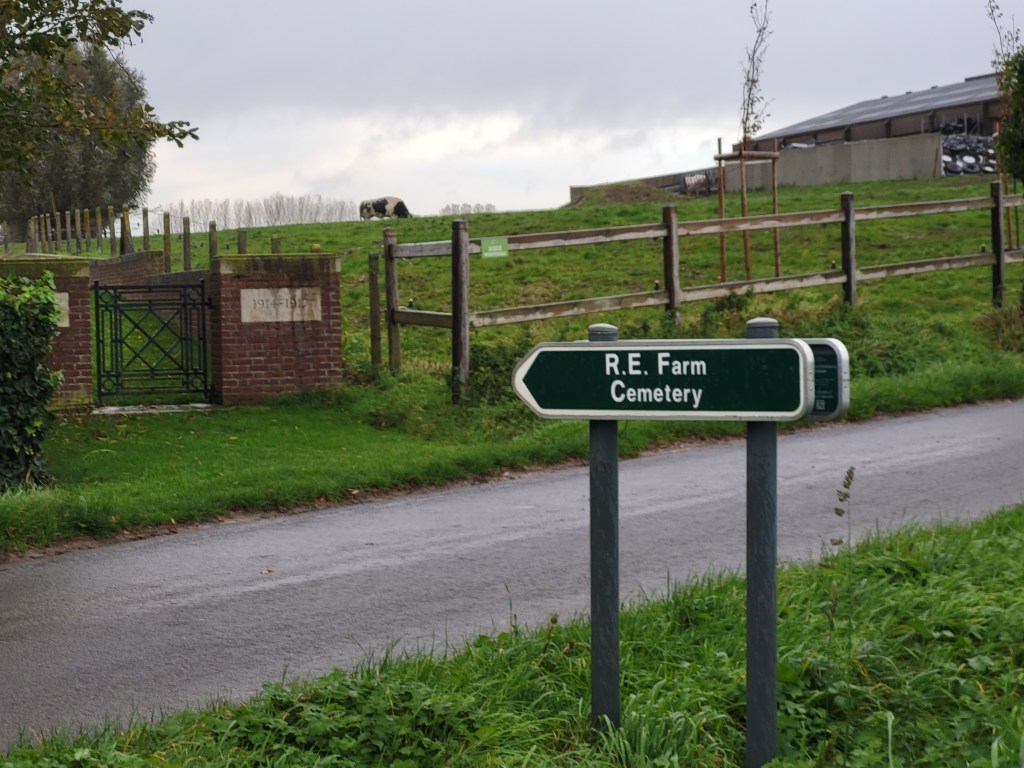
It had been my intention, soon after visiting R.E. Farm Cemetery in November 2023, to look into the stories of the 2nd Battalion Boys buried here with Jim. But I had long list of names and photos of graves from other cemetery visits that trip which took precedence. Now is the time to look into the histories of the men who Jim probably knew, whose deaths may have hit him personally, possibly whose graves he helped dig or funerals he might have attended. I do know he was deeply affected by the inevitable losses of his battalion. In his last letter to my grandmother, he said:
“…sometimes one gets a little bit lonely you know thinking about things and the war and about ones friends some of whom one will never see again. You know it is apt to make a person just a wee bit downhearted…”
A “wee bit downhearted”? I am sure it was more than that! As always, he tried to protect her from the realities of his war, yet a little of his mental trauma seeped out in this letter.
I already wrote about James Maxwell/Sibley, killed the day after Jim, and who lies immediately beside him. In the next few weeks, I will be looking at the twenty-five other 2nd Canadian Infantry Battalion men who died in the line of trenches just up a slight slope from the graveyard where they now lie in peace. All of them were killed in the short six months when they occupied a “quiet” part of the line, where no real battles were fought, from October 1915 to March 1916. Interestingly, none buried there died in January, although it is possible those, like Captain George Richardson who was mortally wounded in a raid in February 1916, made it to a near-by hospital and are buried elsewhere. These 25 men, like Jim, only made it as far as the Regimental Aid Station at the farm before succumbing to their wounds, if they were not killed outright. I will be beginning with Private Horace George Pigot, who was the first to be interred in early October 1915.
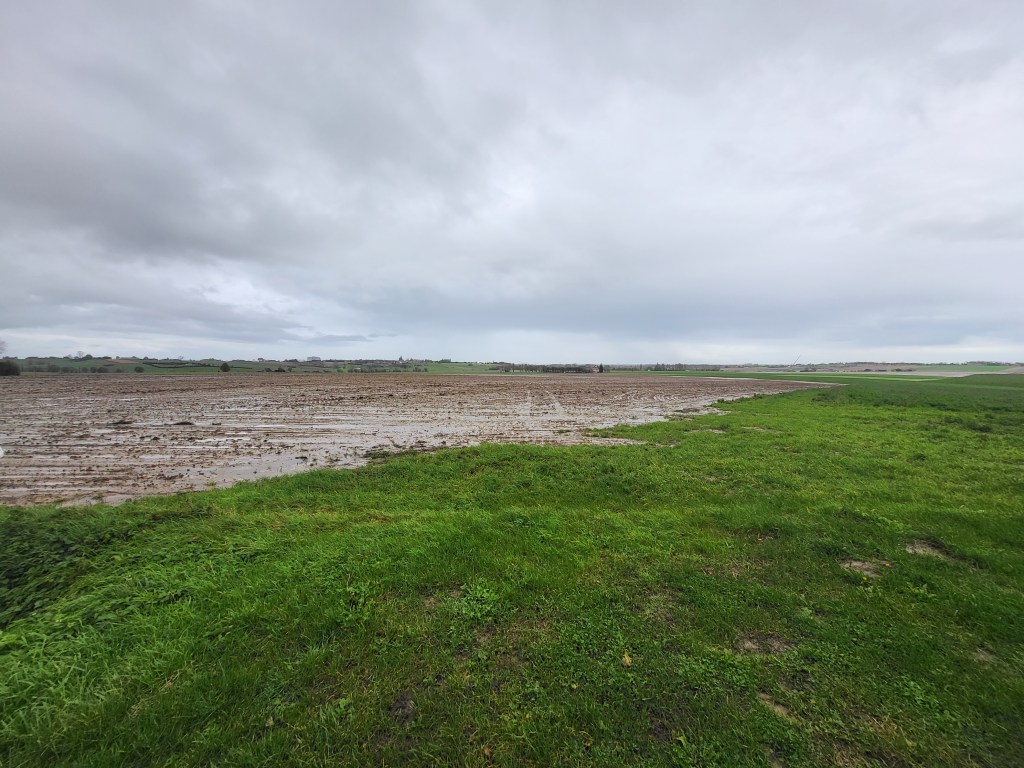
The field near Wulverghem, looking toward Messine Ridge (now Mesen). The 2nd Battalion occupied the front line which ran approximately along the divide between the mud and the grass in this photo.
A Kiltie
19 December 2024
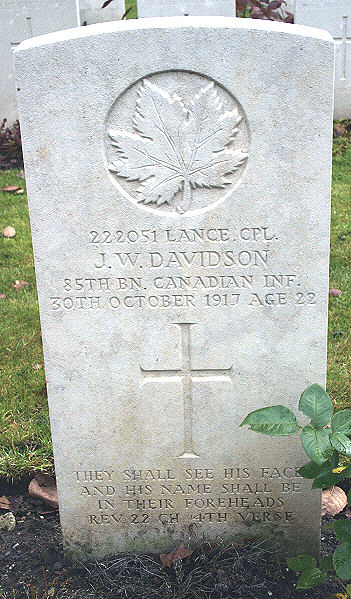
Lance-Corporal James Warren Davidson
His third great-grandfather had crossed the Atlantic in 1765 to give his family a new life in a new land that would not be called Canada for more than 100 years. One hundred and fifty years later, Warren crossed back to offer his life in service to this fledgling country and made the ultimate sacrifice.
James Warren Davidson – who went by Warren – was born in the small town of Newcastle, New Brunswick on the banks of the beautiful, salmon rich Miramichi River, on 2 December 1894. He was the third child and first son of James W Sr. and Mary Louise Davidson. His older sisters were Marjorie and Gertrude; younger brothers were W. Harold and John. He was the sixth generation of his proudly Scottish family to live there. His settler third great-grandfather had made his fortune as a lumberman and politician. His great-grandfather began a law firm in which Warren’ younger brother, Harold, would eventually practice after the war. Warren had found a respectable career as a bank clerk.
It is no surprise when Warren enlisted, he picked a kilted regiment, the 85th Battalion Nova Scotia Highlanders. Attesting in Halifax on 18 September 1915, warren was described as 5’10” which was very tall for the time, a slim 152 pounds with brown hair, hazel eyes, and a “fresh” complexion. One can picture the fair, unblemished skin and flushed cheeks this description evokes. The battalion had only just been raised four days before Warren signed on, so I suspect he had been working in Nova Scotia. It would be more than a year before this battalion left Canada – probably much to Mrs. Davidson’s relief – not leaving Halifax until 13 October 1916 on the S.S. Olympic and arriving in Liverpool five days later. By then, his younger brother Harold, who’d lied about his age, had been at the front with New Brunswick’s 26th Battalion for a year. By the time Warren and the 85th Battalion made it to France in February 1917, they were tasked as a labour battalion; there would be no fighting for them… or so they thought.
Of course, a huge event happened early that year: the battle of Vimy Ridge. All four Canadian Divisions were posed to take the impossible, however, the 85th Battalion, yet untested in battle, were again relegated as a reserve for the 12th Brigade. While the general impression is that the Canadian Divisions took Vimy Ridge in a matter of hours, that is not true for the entire length of the ridge. Hill 145, where Allward’s majestic monument now stands, was the highest and most vital feature, giving the Germans a commanding a view over the allies in the Souchez valley and which would give the allies an equally important view over the German-held Douai Plain. Attackers were under heavy fire from German fortifications on the Pimple (which only fell 3 days later), a high point just north of Hill 145, and their initial attack failed. It was into this killing field that the untested 85th Battalion was thrown, without supporting artillery barrage. The war diary describes the action.
“In spite of Machine Gun and rifle fire from the enemy, which immediately opened, the attack was pressed home, the Companies providing their own covering fire by Lewis Guns firing from hip and riflemen fire on the move. Many of the Germans finding themselves unable to stop the advance turned and ran but were soon put out of action by our fire. About 20 prisoners, including 3 Officers, were taken. Two Hun Officers and about 70 other ranks were killed. At least 3 machine guns were captured.”
The losses were heavy: 56 dead and nearly 300 wounded, many of whom died of their wounds. But Warren was not one of those numbers. He survived Vimy.
In May 1817, he was out with a case of influenza, and in June was appointed Lance-Corporal. In July, he went for a month’s training at Signalling School. In October, the battalion found itself in the hellish landscape of the Ypres Salient; the CEF was tasked to take Passchendaele.
In late October, the battalion had spent much of its time training and practicing for the attack scheme on Passchendaele. Vimy had taught an important lesson in that respect, of preparedness, and practice. On the 22nd, the 85th was inspected by HRH, the Duke of Connaught, son of Queen Victoria, bane of Sir Sam Hughes, recent Governor-General of Canada, and father of that Princess Patricia*. On the 28th, they moved up into the line near Potijze, a location designated I.10.a on the battle maps, just north of the infamous Hellfire Corner.
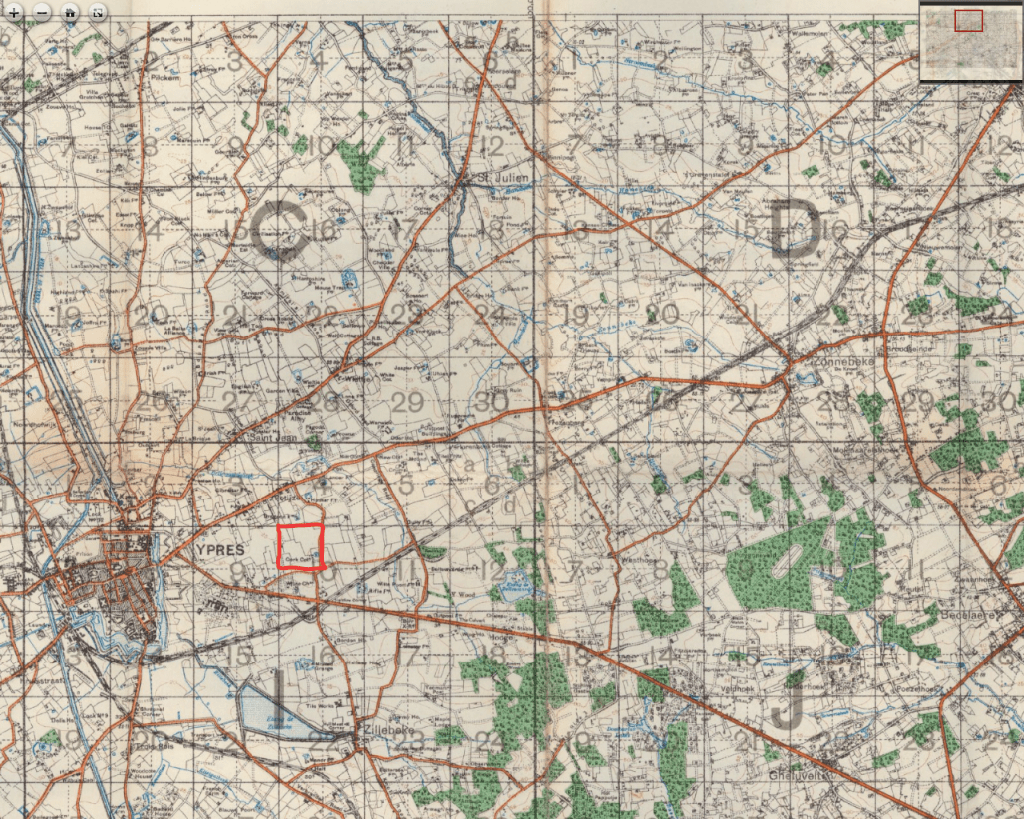
The red square marks quadrant of I.10.a east of Ypres. Hellfire Corner, so named because the Germans shelled it heavily, is the crossroad just below the bottom right corner of the red square.
On the night if the 29th, warren and the 85th Battalion were up near the jumping off lines for their planned attack, with HQ in D.17.b.30.25 near Hillside Farm. This was the second stage of the capture of Passchendaele, the first four days previously on the 26th. Hot tea and rations were served to the men on what was likely a cold, wet night. By 4:50am, they were at the tapes marking their jumping off lines. All was calm and quiet; the sniping and barrage had stopped. Their objective was Tiber and Vienna Cottage, with a company attacking along the railway.
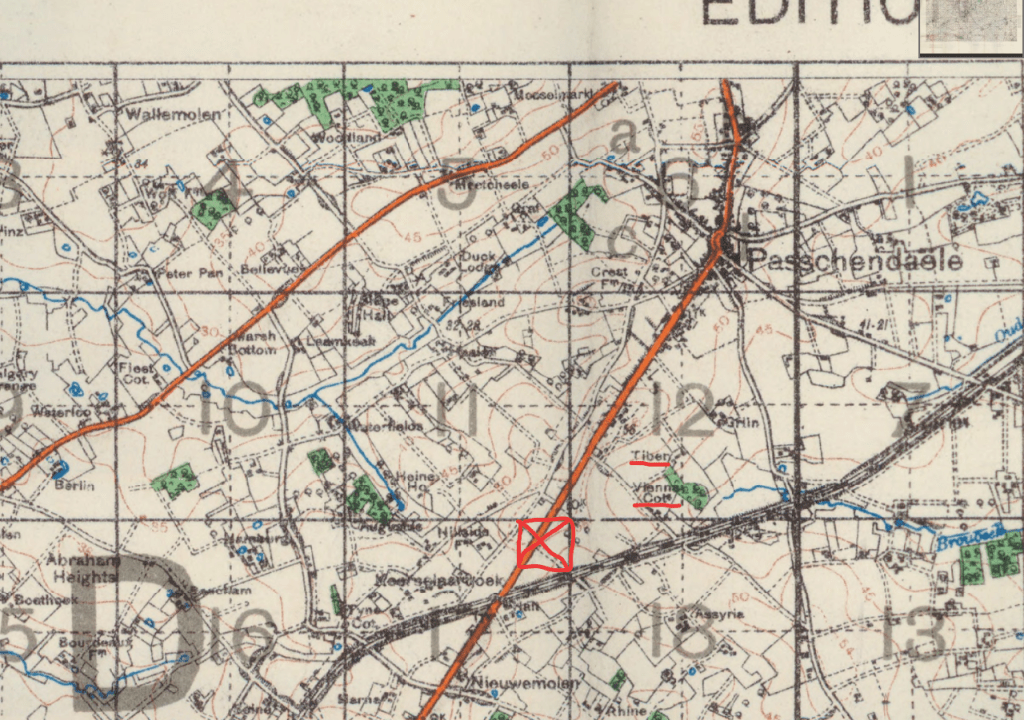
The red square is where HQ was. Underlined are the two main objectives of the 85th on 30 October 1917. Tyne Cot, where the famous cemetery now sits, is in D.17.a (bottom center left).
At zero hour – 5:50am – machine gun fire began the attack and all the companies leaped out into a hail of heavy machine gun and rifle fire from the Germans. The 85th’s artillery barrage, meant to drive the Germans from their trenches, had been too light and aimed too far behind the German lines to be effective. Rather than fleeing, the Germans were still in their trenches, warned and prepared. The men of the 85th could only stay low, scrambling from one water-filled shell hole to the next; to stand meant instant death. Despite this setback, and a fierce fire fight that lasted from 10 to possibly 30 minutes, they broke the German defenses and swarmed their objective by 6:28am. The cost, however, was horrific. A message was sent to HQ: “We have gained our objective… Casualties are very heavy…”. Of the 26 officers and 662 “other ranks” (OR) who went in, 12 officers were killed, 6 wounded, and 371 OR killed or wounded. Warren was one of those killed. In the end, all ranks – officers and men – roundly condemned the barrage as “not at all satisfactory”. They would have preferred no barrage at all and mount a surprise attack. I’m sure Warren would have agreed.
Warren was buried in Buttes New English Cemetery, very near to Robert McDonnell. The inscription his parents placed on his gravestone is from Revelations and a testament to their deep faith that their son was awaiting them in the peace of heaven: “They will see his face, and his name will be on their foreheads”.
*Princess Patricia’s Canadian Light Infantry
Serendipity
15 November 2024
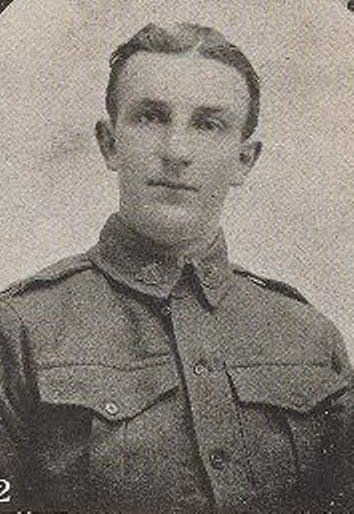
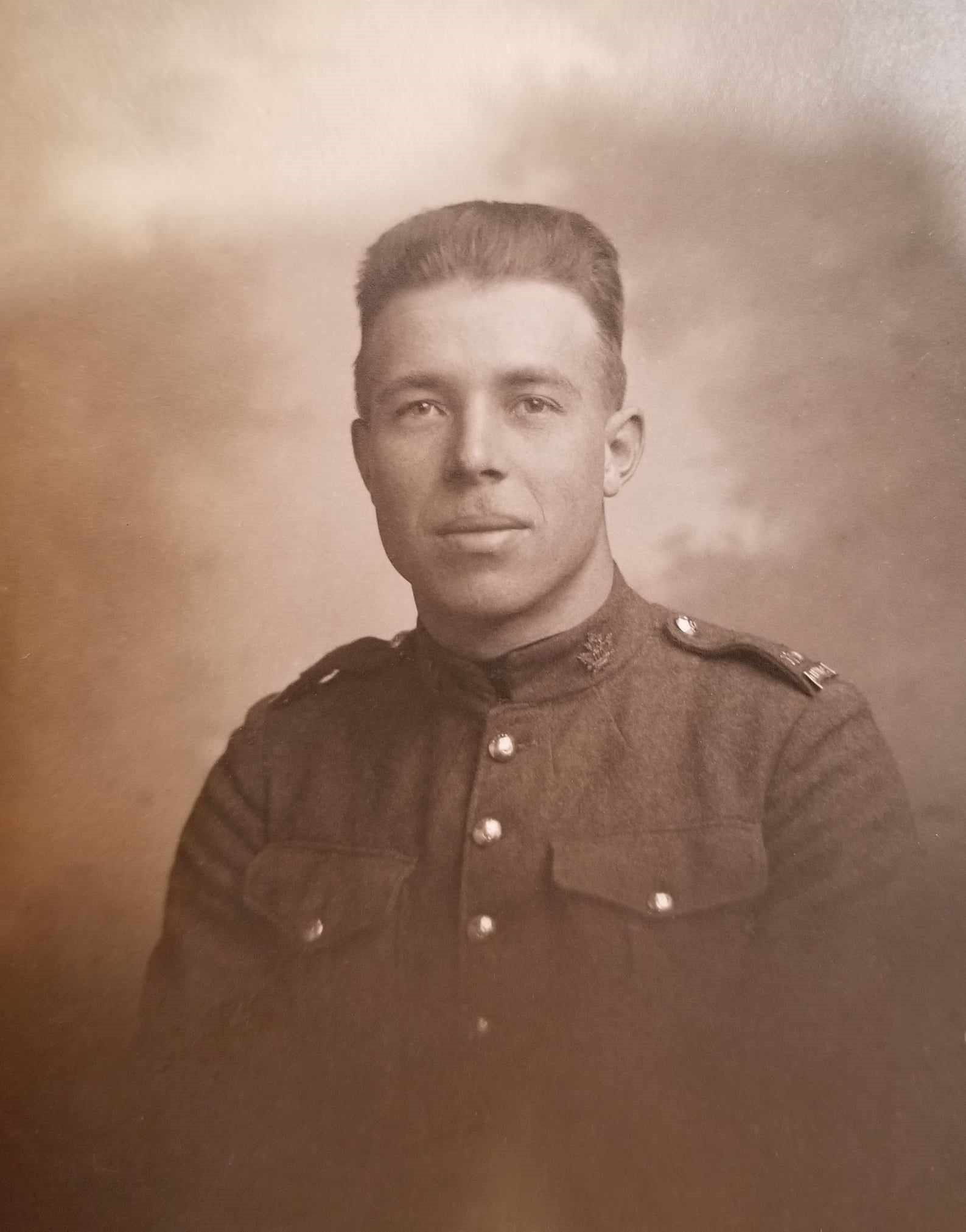
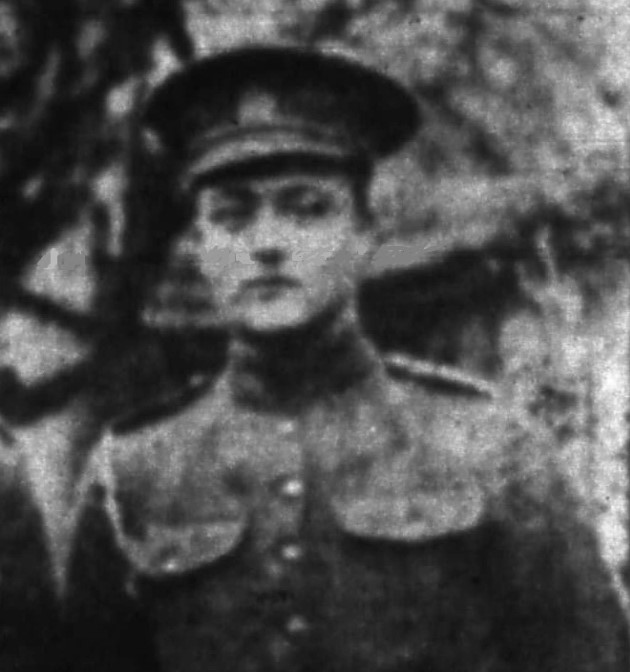
Bert Dobson, Fred Stockhausen and Jim Johnstone (L to R)
As Remembrance Day came and went this year, and feeling sorry for myself for not being over in Belgium, I spent time reflecting on its deeper meaning, on war, its justification, its lingering effects, especially for me personally, in the context of the 1914/1918 conflict. In France, there are areas still too toxic and dangerous for humans, more than 100 years after the end of the First World War. In Belgium, there are underground explosives and unexploded shells which kill or injure still. Around the world there are relatives who still ponder “what if?”. What if great-uncle so-and-so had returned, and for me, what if James Johnstone had returned and married my grandmother, as I suspect he wanted to. But sometimes, the ripples spread in subtle and beautiful ways. Such is the case of three young men who never met, never knew each other existed, and yet are united in their sacrifice and have united a disparate group of people from around the globe. Jim and I are newcomers to this group, invited into a family of long standing, but made welcome with open arms.
You have met Jim, via my first blog post or the book I put together telling his story of the war, in mostly his own words. You met Fred through my blog post of 5 October 2024. Now I would like to introduce another very young man, but this time an Australian, Herbert Wilfred Dobson. Bert, as he was known, was a 20-year-old farmer from Sprent, Tasmania when he enlisted in June of 1916 in the Australian Imperial Force. A tall, handsome lad, with brown hair, grey eyes and a slender boyish build, he’d been born in Tasmania on 19 January 1896 to George and Charlotte Dobson. The youngest of seven, Bert had two sisters, Edith and Ida, and six brothers, Morton, Sydney, Ernest and Alfred. Bert enlisted in June of 1916, sailed from Melbourne in September and arrived in Plymouth, England three months later. In February 1917, he sailed for France, joining the 40th Battalion in the field on 7 February. In June of 1917 there was a massive attack on Messine Ridge, and Bert was part of a Lewis gun crew. It was here he sustained devastating injuries, and though evacuated to the 3rd New Zealand Field Ambulance, he died of his wounds, almost exactly a year after he had signed on to the war. Bert is buried in Underhill Farm Cemetery.
What do Jim, Fred and Bert have to do with each other? Nothing really. They all served in different battalions, for different countries, were killed in different years. Their paths never crossed. And yet…
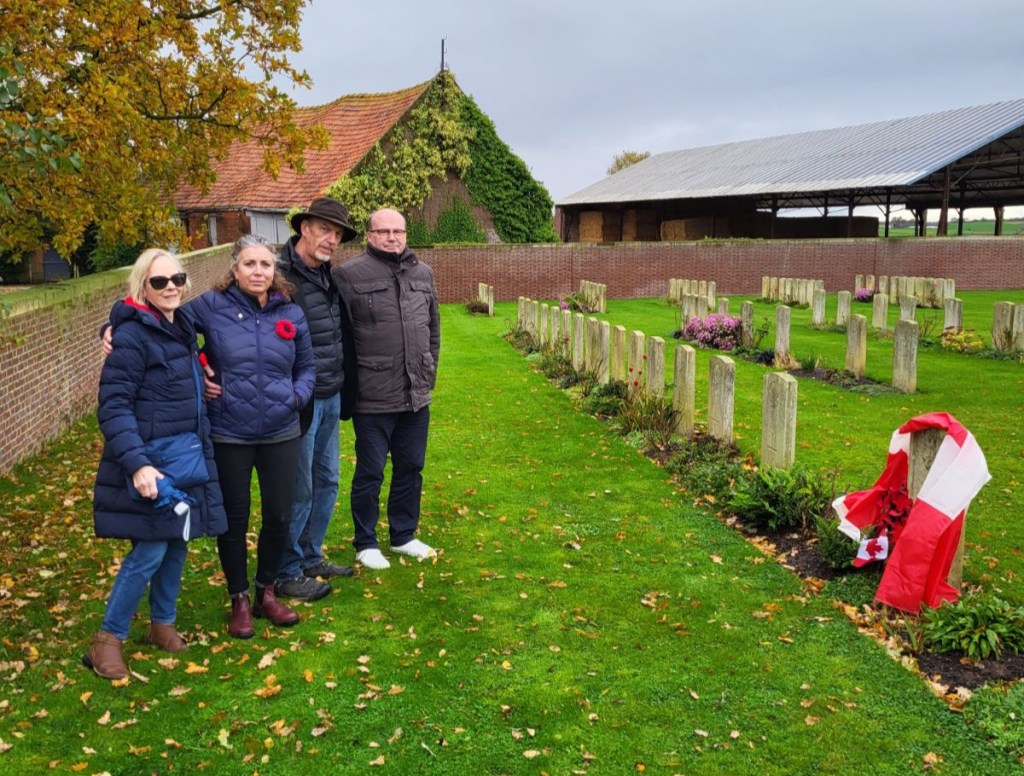
Jennie, me, Kelly and Johan on my first visit to Jim’s grave, November 2023. They were the best support group!
In 2018, while researching Jim’s experience for my book, I “met” a Belgian named Johan Moors. Johan runs a Facebook group honouring the fallen of the First World War. I asked if he was ever near R.E. Farm Cemetery, could he get a photo of Jim’s gravestone for me. He asked for more details, and upon learning Jim’s story, told me he would go the very next day. I got the photo, a new friend and Jim got a guardian angel over his grave. A few months later, Johan took his friend, an Australian named Jennie Blake, to visit Jim. She reached out to me on Facebook, wanted to know more about Jim’s story, and suddenly I had another new, dear friend halfway around the globe. When my book was finished, I wanted to send Johan a copy, but modestly, he declined, and so I set about detective work to find a mailing address for Johan. Jennie didn’t have it, but she had a friend in Ontario, Kelly Campbell, who she was confident did. Success! The book was mailed, and I had gained a third friend. Last year, I finally got to meet them all in person, in Ypres: Johan who is a dedicated volunteer with the Last Post Association and Ceremonial Assistant at the Menin Gate nightly ceremonies; Jennie, great-niece of Bert Dobson; Kelly, great-nephew of Fred Stockhausen; and me, granddaughter of Jim’s beloved Chiquita. Through the dedication to duty to King and country, and the meaningless deaths (useless waste of lives, as Jim described it) of these three men came a deep and meaningful friendship between four people from three far-flung countries, who might never have met. Admittedly, I am a newcomer to this group who have known each other for many years, but sometimes connections are instantaneous.
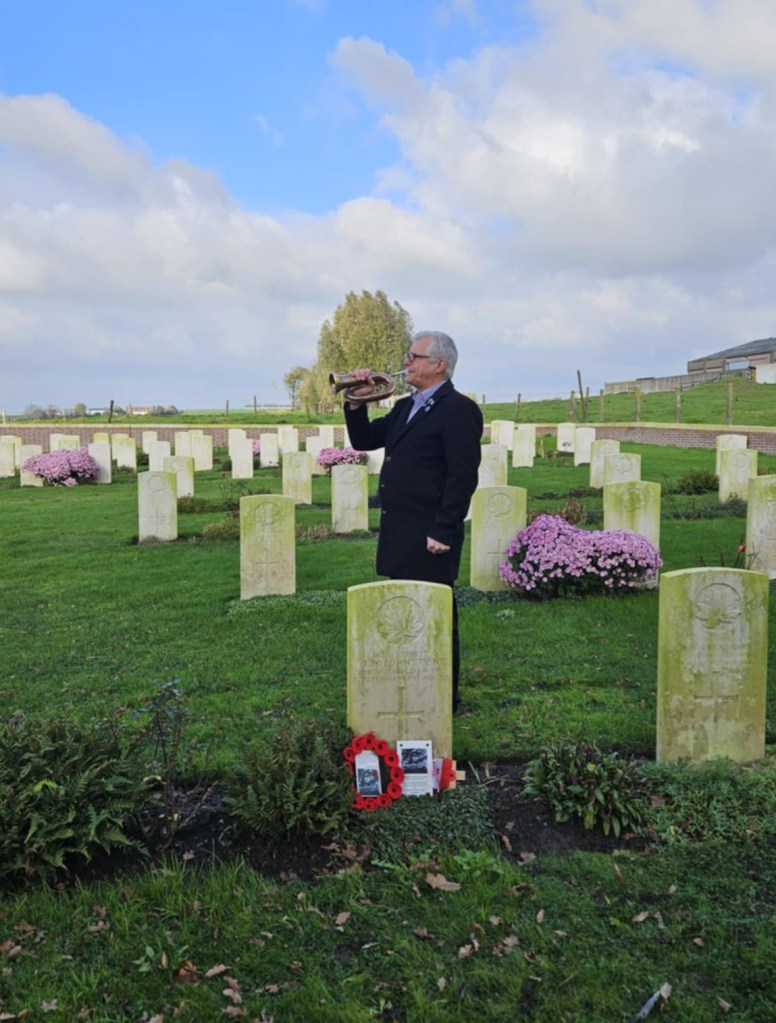
But the story doesn’t end there. This year, I was not able to repeat the trip, but my friends did not let Jim or me down. No, indeed, they arranged a very special playing of the Last Post, by bugler and professor of music from the USA, Brad Ulrich. I can’t help but feel Jim, Fred and Bert would be tickled pink that they had brought us all together, that their deaths had been given some meaning, if nothing more than creating a web of friendship around the globe. In these troubled times, we all need to come together in peace and friendship, don’t we?
Muddy Hell
30 October 2024
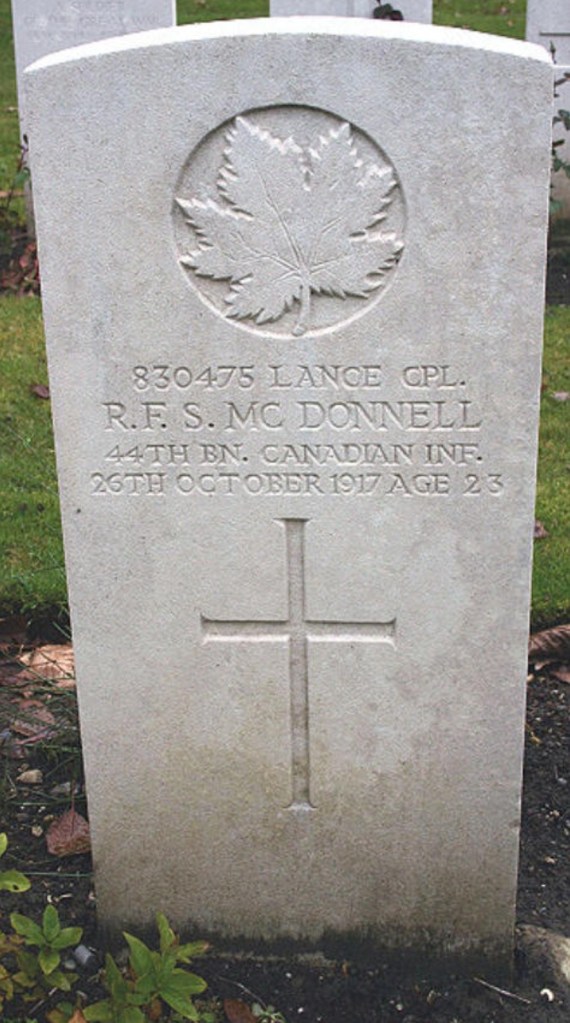
Lance-Corporal Robert Frederick Sharp McDonnell
On November 10th each year, an evening ceremony is held at the Canadian monument (near what was Crest Farm) on the edges of the village of Passendale (modern Flemish spelling). It is followed by a parade up Canadalaan to the heart of the village, hundreds of people carrying flaming torches, walking in the footsteps of Canadian soldiers, up the last 600m they fought to take what was then called Passchendaele ridge. I went in 2023, one of very few Canadians in the crowd, other than several soldiers, the staff from Vimy, my friend Kelly from Ontario and the Canadian ambassador to Belgium, although you’d hardly know it given the number of Canadian flags in the crowd and hung from homes. Most Canadians known nothing of this ceremony meant to honour those of “our boys” who sacrificed everything to capture this important high ground, including L/Cpl Robert McDonnell.
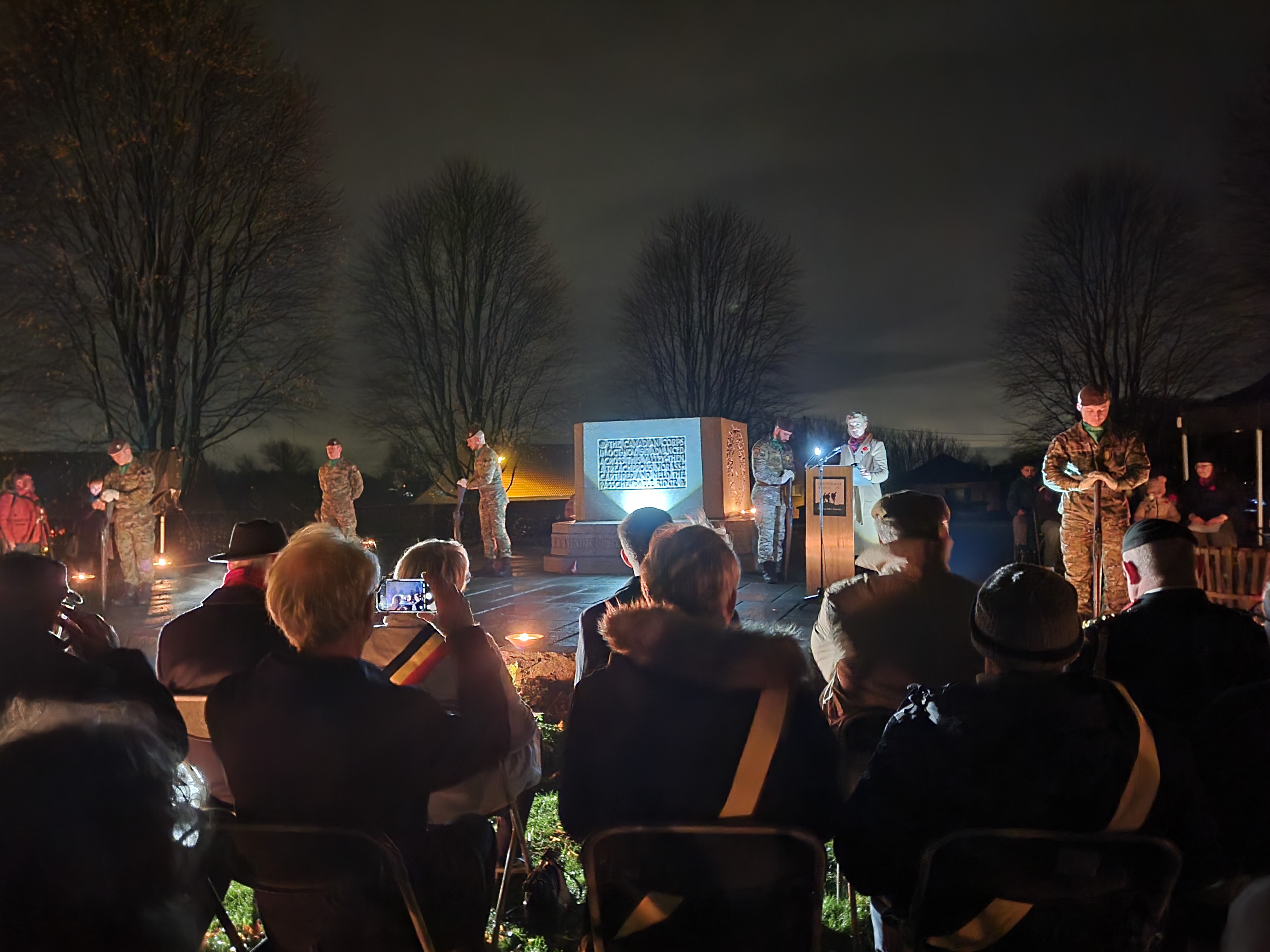

Ceremony at Crest Farm and torch light walk up Canadalaan, 10 Nov 2023
Robert was born on the 6 July 1894 in Nova Scotia to John and Agnes McDonnell. Their seventh child, he had three sisters, Kathleen, Eileen and Agnes, and five brothers, Lovell, Wrayton, John, Dow and Arthur. Their father John had emigrated from Ireland in 1868, married a NS girl and raised his family in the Maritime province. They must have been doing well, as the family employed a domestic servant in 1901. Sometime before 1916, the entire family moved to a farm near Winnipeg, Manitoba, and it was there, in January 1916, that Robert signed on to the 144th Battalion, Winnipeg Rifles. At 5’ 7” and 168 pounds, Robert was a big lad for the time, broad-chested with dark hair and eyes. He’d obviously filled out moving from a desk job as a clerk in NS, to working on the family farm. He was reported as being Absent Without Leave on two occasions that summer of 1916 – once in July when he forfeited 6 days pay, and once in August, for seven days that cost him 17 days pay! – and it is easy to imagine he went home to help on the farm. However, his days of being close to home would soon end, as he sailed from Halifax on the S.S. Olympic on 18 September 1916.
The 144th Bn was one of many that were broken up once they reached England, being absorbed into the 18th Reserve Battalion in January of 1917. In March 1917, Robert was transferred to the 44th (Manitoba) Battalion (later renamed the 44th New Brunswick Battalion) and one day later, 22 March 1917, he arrived across the English Channel. It would be nearly a month before he joined his unit in April, too late for the assault on Vimy Ridge.
In the summer of 1917, the Canadian Corp under General Arthur Currie were involved in the fighting in France just north of Vimy Ridge. The British began a major offensive at Passchendaele in the Ypres Salient, and Currie was ordered to take the city of Lens, France, an important coal mining town in the Pas-de-Calais region, as a distraction to draw off German resources from Passchendaele. Currie determined his first objective would be to take Hill 70, high ground on the outskirts of Lens where Germans could pour fire down on forces attacking the city. This was a successful if costly offensive and a victory some historians argue was more significant than the one at Vimy months earlier. However, it was soon followed by one of Currie’s few missteps: the attack on the “Green Crassier”.
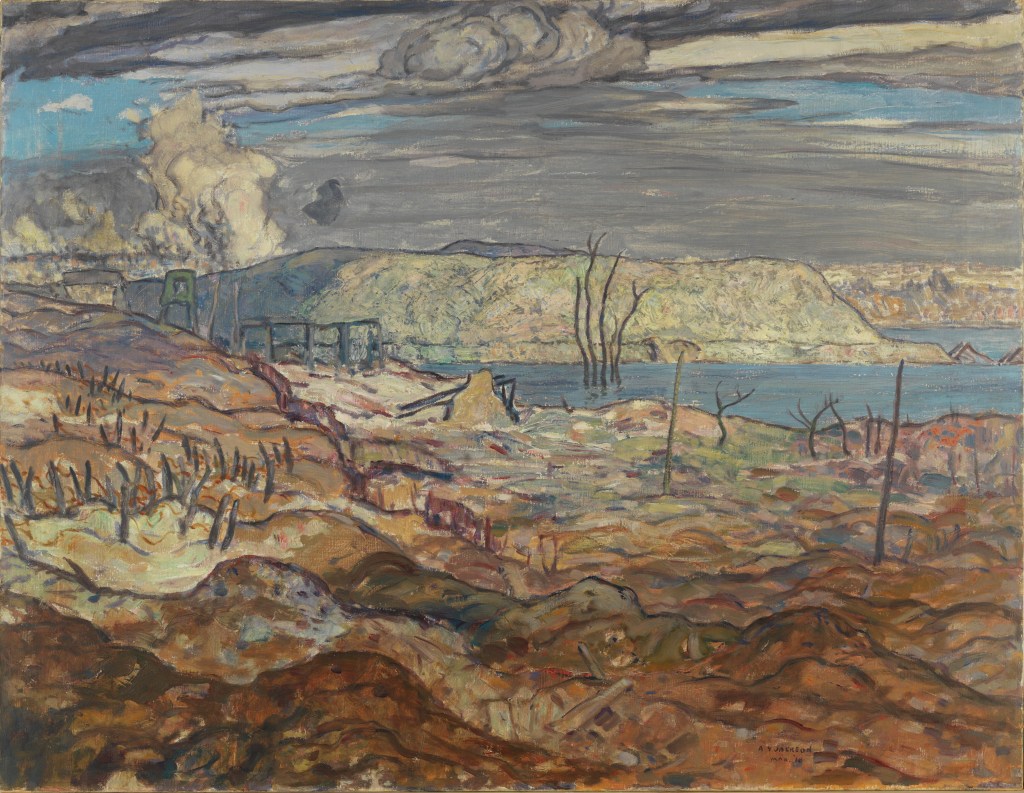
By A. Y. Jackson – http://www.warmuseum.ca/collections/artifact/1016417/, Public Domain, https://commons.wikimedia.org/w/index.php?curid=63577538
The 44th Battalion, reinforced by the 50th were to capture this large, overgrown slag heap south of Lens on 21 August 1917. The 44th was under-manned; the 50th didn’t make it in time. After successfully taking the top of the Crassier, the men of the 44th – Robert in their midst – found themselves cut off from reinforcement, from communication, and from supplies. Overpowered by the German counteroffensives, the men ran out of water and ammunition. Some platoons were killed to a man. Those who could, attempted a retreat. Robert could not be found, one of 46 reported missing. Fortunately, he was later found safe, unlike the 23 killed and 116 injured. This defeat effectively ended the campaign to capture Lens, an operation that resulted in nearly 10,000 Canadian casualties. However, the Canadians were not allowed rest; they were ordered back into the mud of the Ypres Salient to attempt what the exhausted British, Australians and New Zealanders had failed at: taking Passchendaele.

Passchendaele, https://www.warmuseum.ca/firstworldwar/wp-content/mcme-uploads/2014/07/eo-2249.jpg
The Ypres Salient is wet. The water table lies just under the surface, and in the summer of 1917, the drainage ditches between the fields had been obliterated. On July 31st, the rain began and nearly didn’t stop for four long months. What once were farm fields had become the nastiest, most waterlogged morass of mud, water-filled shell holes and unburied bodies. It was the epitome of the muddy, hellish front, the stench of the dead filling the air for miles around. British General Haig ordered the Canadians into this surreal landscape. A plan was made for four set-piece battles, utilizing the “bite and hold” technique, on October 26, 30 and November 6 and 10. But first the Canadians had to get men and artillery guns up through mud that would suck into its merciless depths any man, beast or gun who dared step into its grasp, building networks of duckboard pathways in the open under the German guns. While the Canadians were ultimately successful, capturing Wolf Copse, Vapour Farm, Furst Farm, Crest Farm and finally the annihilated mess that had been the village of Passchendaele, over two weeks of hard fighting, gaining higher, drier ground for winter positions, L/Cpl Robert McDonnell’s luck would run out the first day.
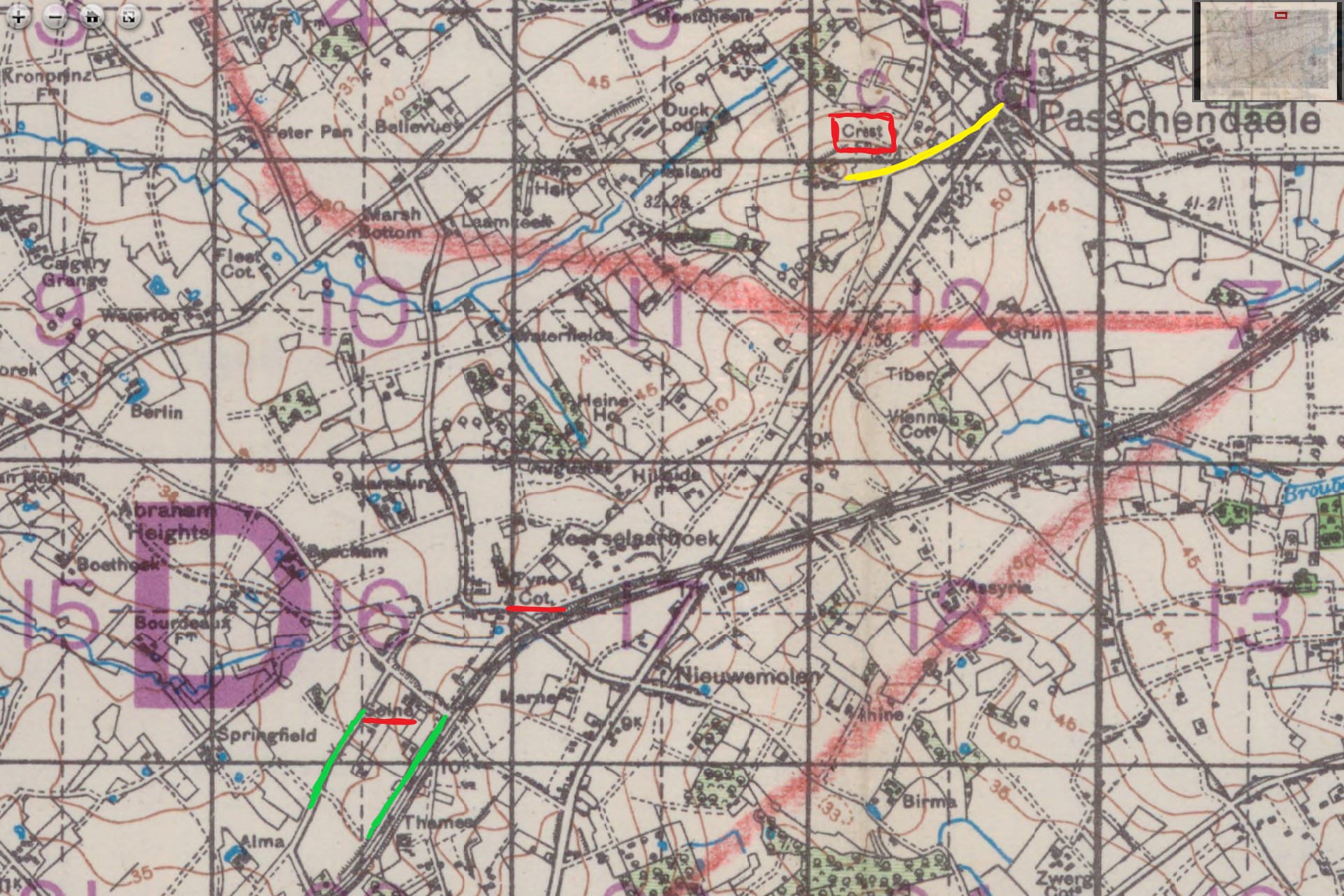
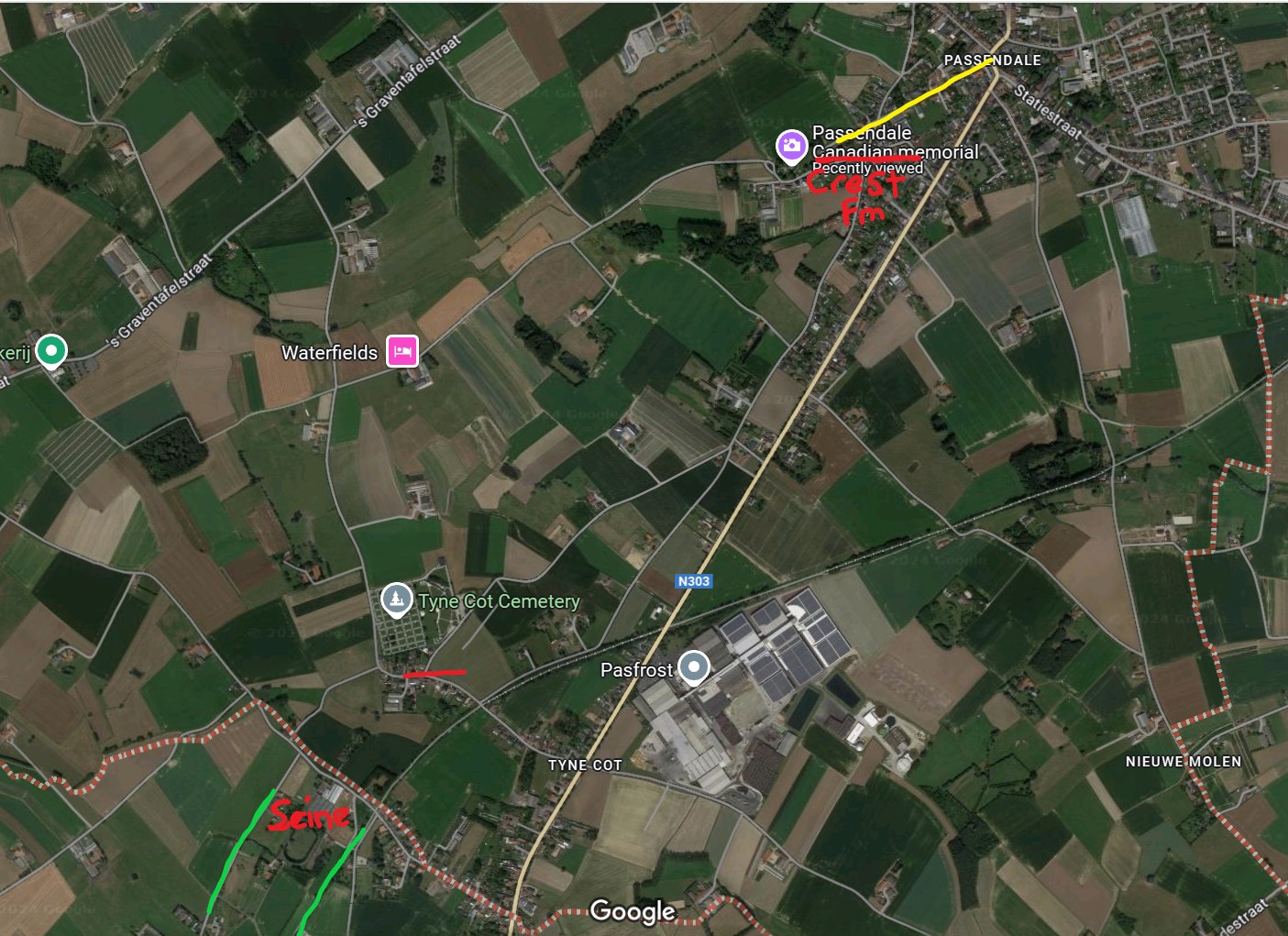
Left is a battle field map from 1918. Right is a modernGoogle map view. From lower left to upper right on both maps, red underlines in order, Seine, Tyne Cot and Crest Farm. Yellow lines the route of the last Canadian push/torchlight walk to the center of Passchendaele/Passendale, and green lines two possible trackways where Robert’s body was been exhumed. Note the roads are all in the original locations.
The artillery barrage began at 5:40am on 26 October in heavy rain, and seven battalions of 600 men each advanced on the first objective. It became the turn of the 44th Battalion later that afternoon. After evacuating the wounded of the 46th Battalion, they were ordered forward to recapture the objective lost by the 46th. HQ occupied a pillbox near Seine, an area just slightly southwest of where Tyne Cot Cemetery, with its line of ruined German machine gun pill boxes, is today. A transport nearby bringing in much needed rations was hit by heavy shelling, killing ten and injuring nineteen. Was Robert among them? It is possible. His body was later exhumed from a trackway 200 yards south of Seine, possibly where there is a bike path currently. He was buried in The Buttes Cemetery – now called Buttes New British Cemetery – near Polygon Wood. I visited there in November 2023, while on a tour to see some Australian sights including the Brother in Arms memorial park. I “met” Robert McDonnell, instead.
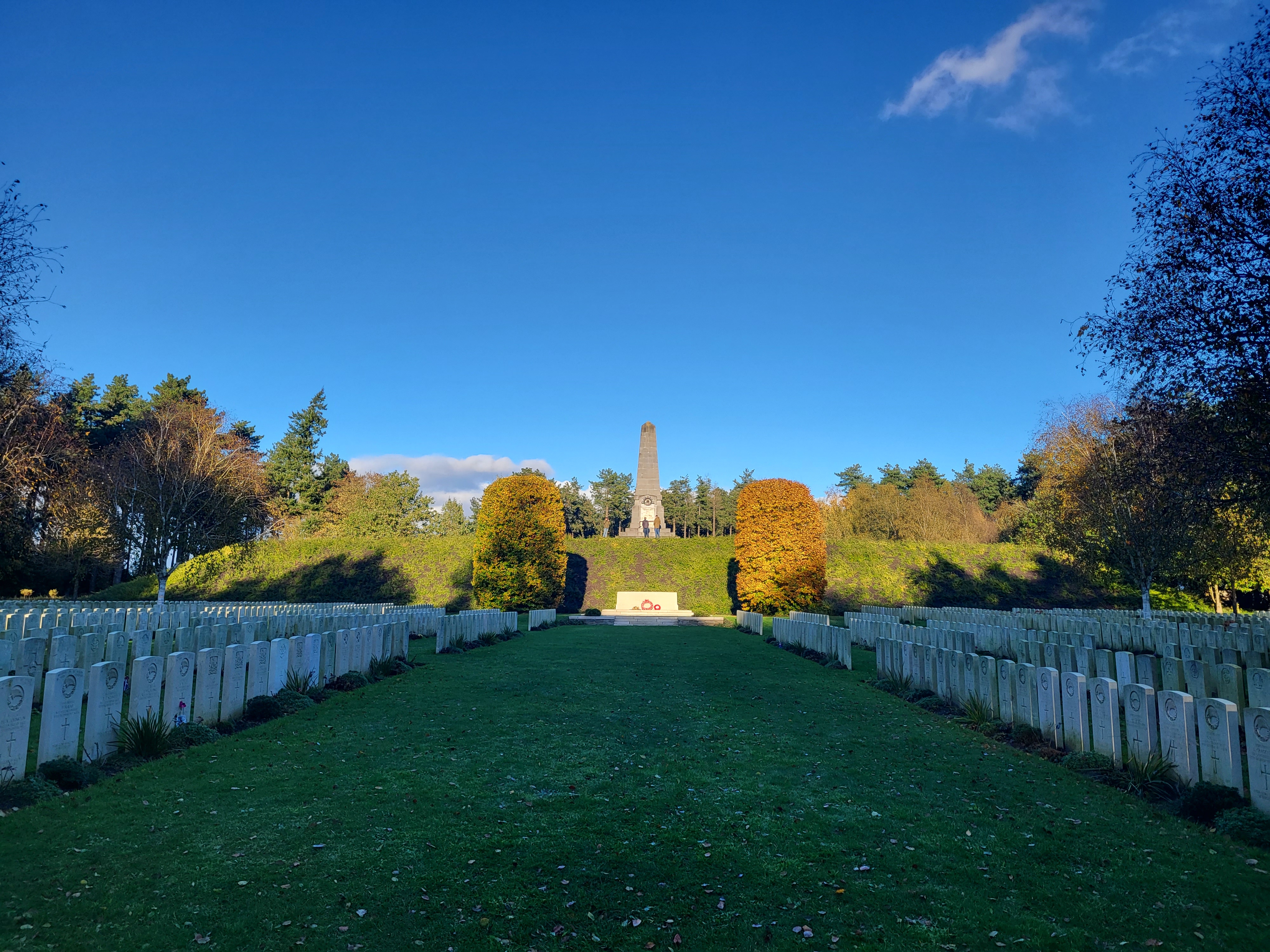
Australian monument atop the butte at Buttes New British Cemetery, Polygon Wood, Zonnebeke, Belgium
The Best Pal
5 October 2024
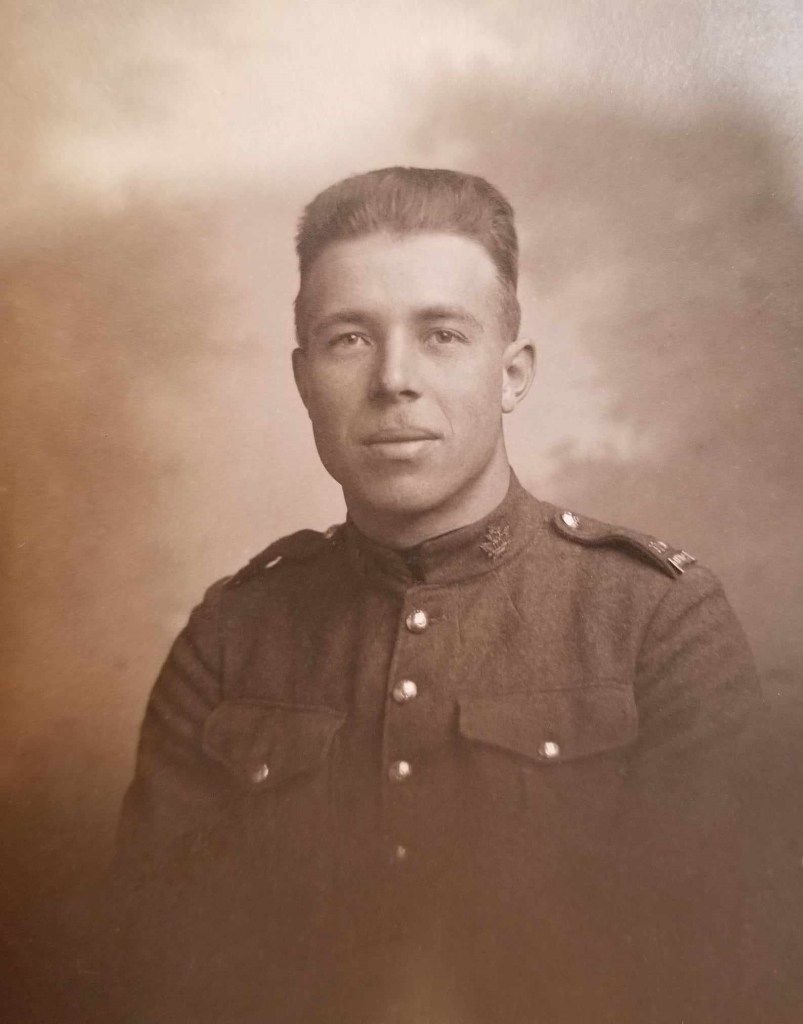
Lieutenant Frederick H. Stockhausen
When the war ended and Canadian troops were repatriated in 1919, a very young soldier traveled to Toronto on a mission. He wanted to offer his condolences in person to the family of his very best pal lost at the Front mere days before the end of the war. As Lewis Campbell met and befriended the family, he fell in love with his friend’s younger sister, Beryl. Love became marriage, children arrived and eventually grandchildren. It was one of those grandchildren, now dear friend, Kelly Campbell, who gave me permission to tell the story of his great-uncle, Frederick Hope Stockhausen. Sometimes it seems the senseless loss of life in the Great War serves to bring together people who might never have met otherwise.
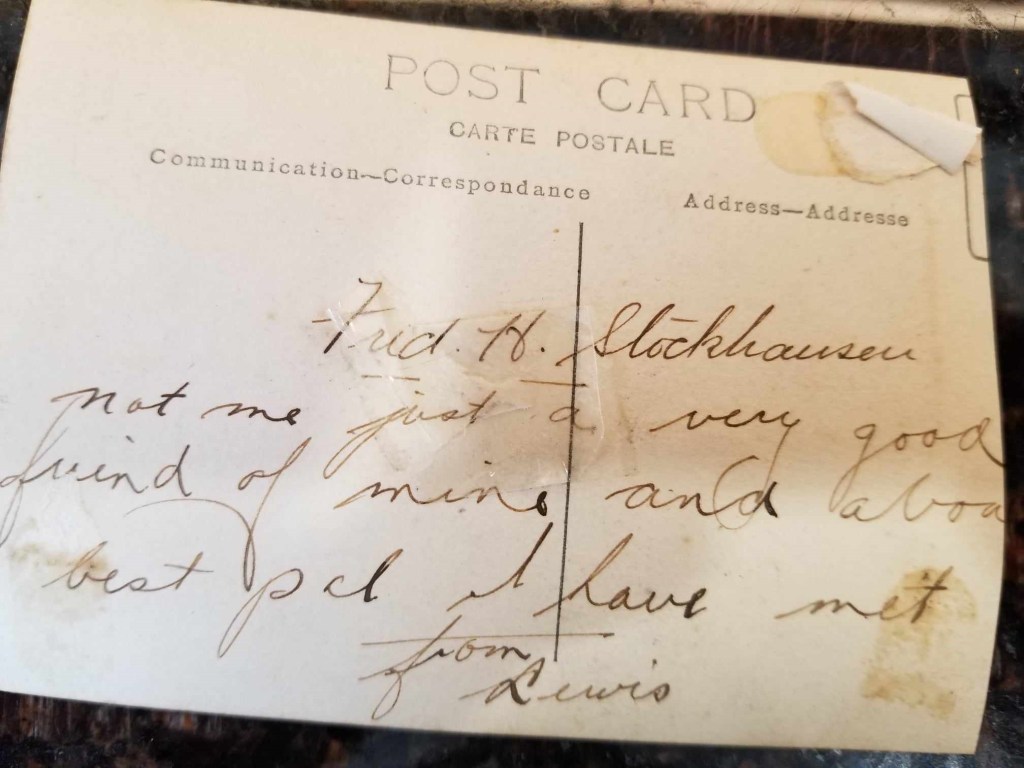
From the collection of Kelly Campbell
Fred Stockhausen was a lively fellow, at 5’ 7.5” relatively tall for the time, with dark hair, blue eyes and an irresistible grin. The only son of Frederick W. and Louise Stockhausen, he had seven sisters: Avis, Edith, Garnett, Ruby, Pearl, Beryl and Jesse. The family lived on a sugar plantation in Jamaica where he was born on 23 December 1892. Fred had been a popular and gifted student at the Collegiate High School in Kingston, Jamaica, excelling at his schoolwork as well as sports – cricket, baseball, rowing and football (presumably soccer!). In 1906, the plantation was lost in an earthquake, and after a few years in Kingston, the Stockhausen family moved to Toronto, Ontario in 1910. In Canada, Fred trained as an electrician and was working at the Toronto Electric Light company before the war.
At the age of 23, in February 1916, Fred attested with the 170th Overseas battalion, the Mississauga Horse. After months of training, the 170th left Halifax, NS, aboard the S.S. Lapland, arriving in Liverpool on Halloween day, 1916. Barely a month later, Fred found himself in France, assigned to the 58th Battalion, who he finally joined in the field just before Christmas 1916. He almost immediately would have been involved in the training undertaken that winter in the cold fields of northern France before participating in the assault and capture of Vimy Ridge in April 1917. In August of 1917, Fred, nicknamed “Stocky”, was promoted to Corporal. After a year in France, Fred enjoyed 14 days leave in England in early December 1917, arriving back on Christmas Eve. Four days later, Fred was on his way back to England; he’d been recommended for a commission.
Fred spent most of early 1918 at the Candian Officer Training Camp at Bexhill, just down the coast from Folkestone. On 15 May 1918, he was granted the rank of temporary Lieutenant. How proud he and his parents must have been, how excited Fred must have been looking forward to taking his first command. In a delightful photo, he smiles broadly wearing his new officer’s uniform. Fred might have stayed on as an instructor, it was said, but he chose to return as a fighting man. First, Fred spent time in the 8th Reserve Battalion, waiting for his posting. Unfortunately his journey back to the front was put on hold as he succumbed to influenza and was hospitalized in late June 1918. Was it the “Spanish Flu”? It is possible as the first cases hit England in April that year. However, after nearly a month in hospital, a raging fever and a persistent cough, Fred recovered and was ready to rejoin the fighting. On the 19 of September, he got word he was assigned to his beloved 58th Battalion, and arrived to join them on the 26th of September 1918.
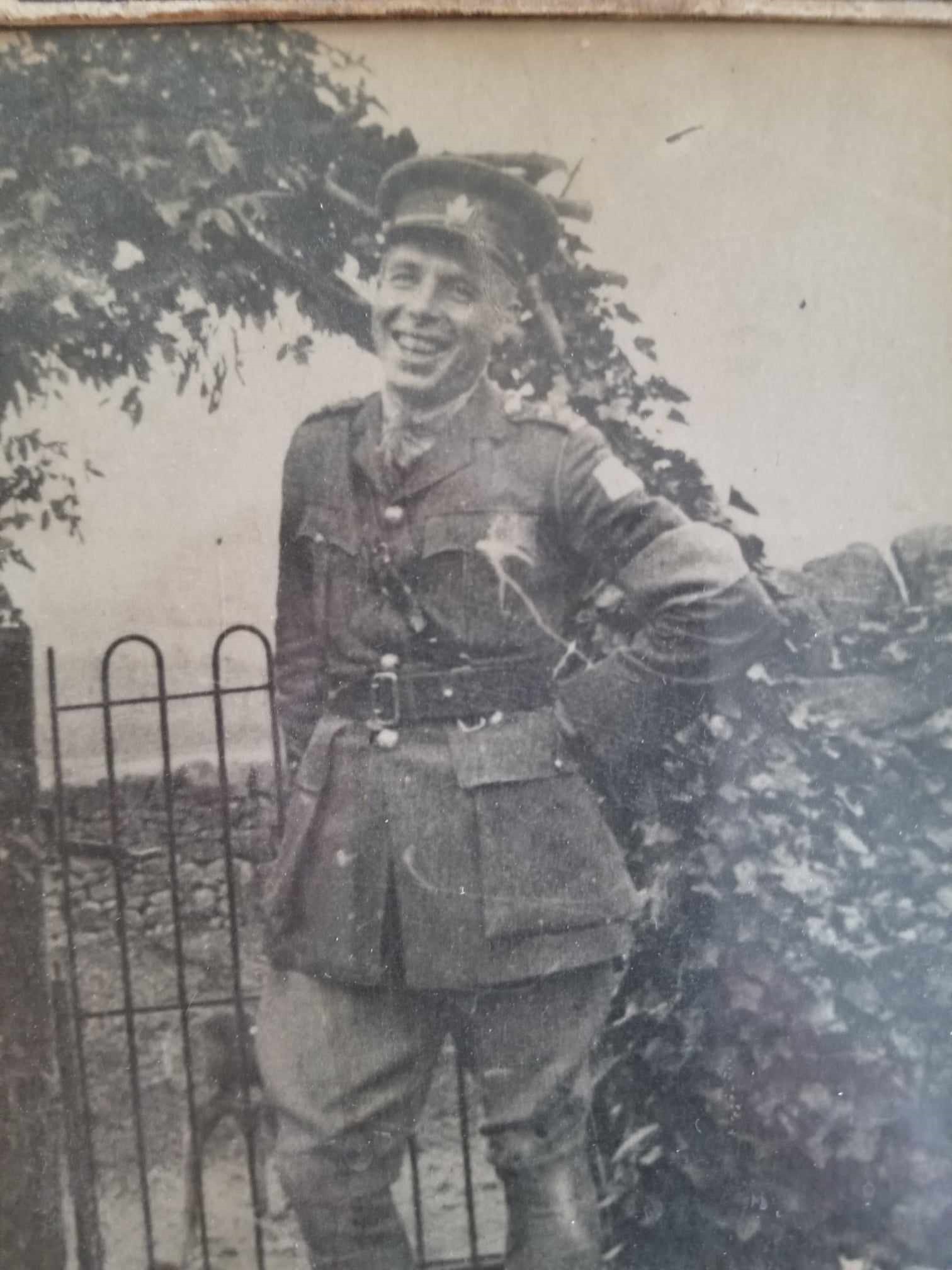
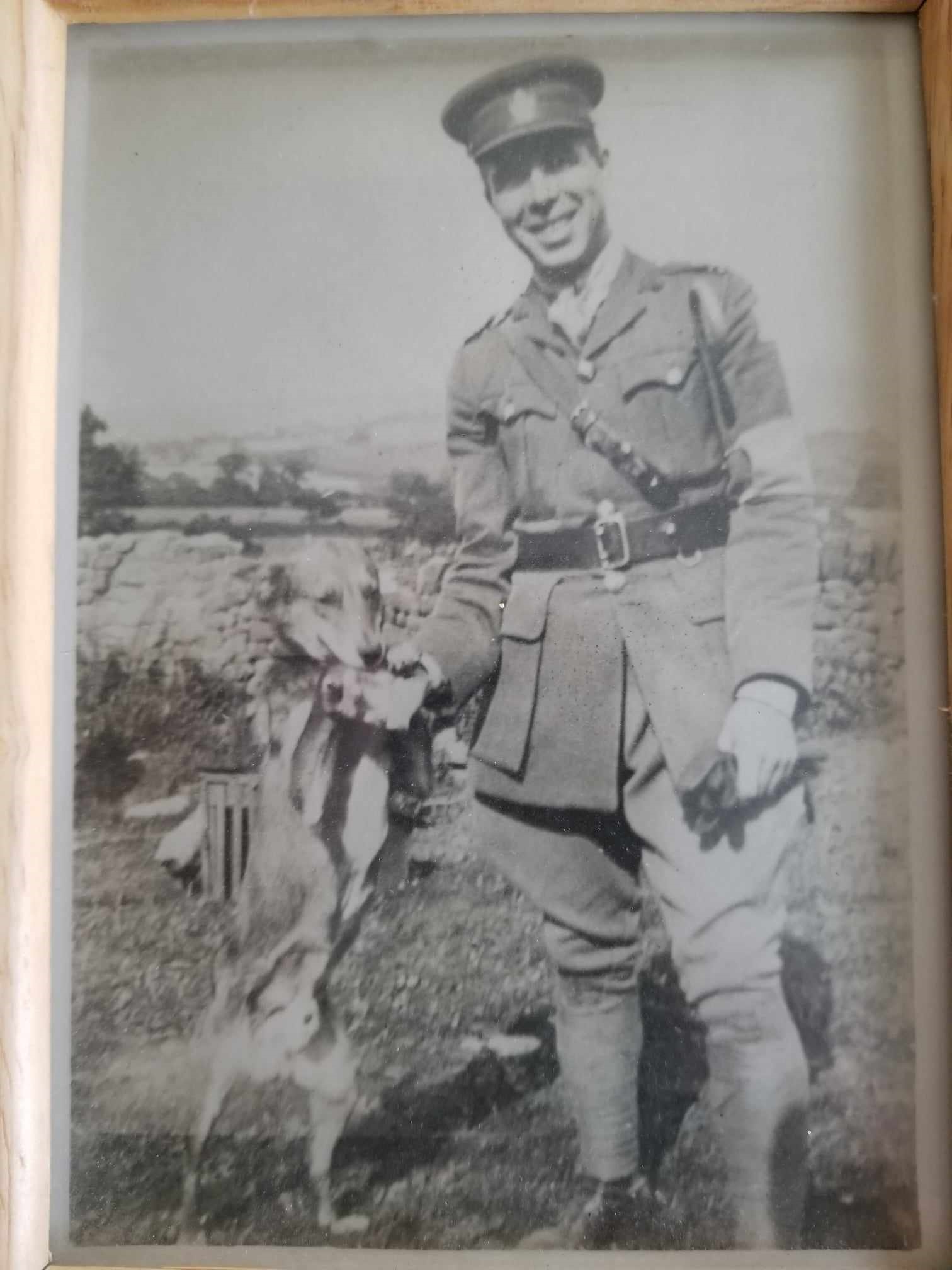
June 1918 From the collection of Kelly Campbell
The spring of 1918 had seen a desperate offensive from the Germans, trying to make the breakthrough both sides had despaired of for years. With newly released troops from their Eastern front, with the withdrawal of the Russians from the war, they did manage to push the Front westward in many areas before losing all momentum and sputtering to a halt in April. Morale at the front and in Germany was collapsing despite their spring gains. For the next few months, the British planned to push back, and to that end they placed their strongest forces, the battle-hardened, experienced Canadians at the sharp end. The Canadians spent their summer resting, and training in a new type of warfare: open versus trench. The troops and officers had to get past the idea that 1000m taken was sufficient and that out-pacing the reach of artillery was to be avoided. August began what became known as the Hundred Days offensive. German General Erich Ludendorff called 8 August 1918 the German’s “black day…in all the war”. The Battle of Amiens saw an unprecedented 13km advance. Behind that was the Hindenburg Line, a 30km deep series of defensive trenches, the strongest of which was the Drocourt- Queant Line, and masses of barbed wire. With Canada at the spearhead, one by one these fell during the final days of August and early September. Germany retreated behind the Canal du Nord, desperate to hold Cambrai, an essential railway hub for bringing supplies, munitions and men to the front. The attack on Canal du Nord was set for September 27th and Fred had arrived just in time for the “party”. Cambrai had to be captured; Canadian General Arthur Currie’s career was on the line.
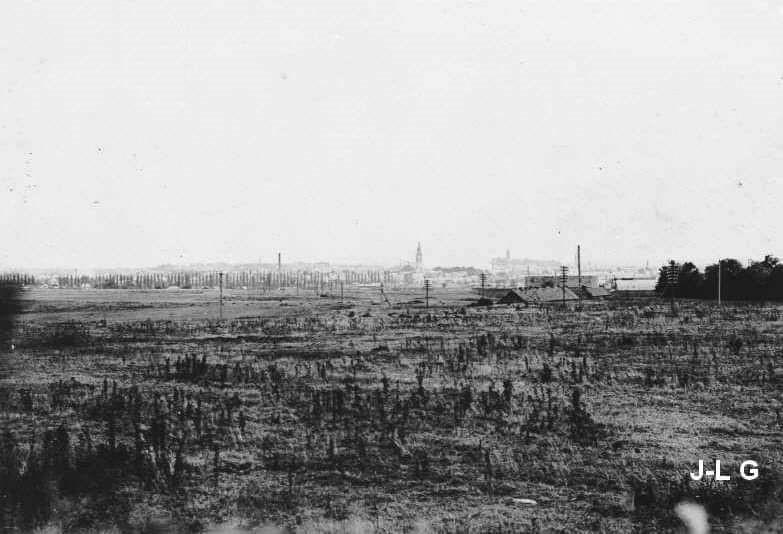

Cambrai looking from the Canal du Nord, 1918 (L) and present (R) from the collection of Kelly Campbell
At 5:20am, the attack on Canal du Nord began, as usual, with a heavy artillery barrage. The Canadian Corps was tasked with crossing a narrow, dry section of the canal, before fanning out and working their way toward Cambrai. Although men could walk across the canal at this point, the steep sides prevented tanks and trucks from following, and so the well-equipped engineering sections hastily built, under heavy fire, seven bridges in those first few hours, ten more in the next 24 hours. The Canadians had one battalion, depleted by the fighting at Amiens and Arras, for every 4 and a half German battalions, an astonishing disparity to overcome. Currie admitted it was some of the most difficult fighting the Canadians had faced and the 10,000 resulting casualties paid testament to that. Yet, due to their training and experience, the Canadians prevailed, and within 42 days the war would be over. Unfortunately for Fred, only days into his return to the front lines, he would never see this end. Officially on October 1st – but possibly in the day or two preceding this – Fred was hit and wounded. He refused to leave his men, likely determined to be the officer and leader he dreamed he could be, and he remained with his men after having his leg bandaged. Some hours later, near a little wood that had just been captured, this “excellent soldier and… gallant gentleman”, according to Lt.-Col, J. F. Lamb, Officer Commanding of the 58th Battalion, was hit in the head by shrapnel and died. Fred was buried in the Canada Cemetery, Tilloy, a difficultly accessed little cemetery overlooking Cambrai.
When the end of the war came a few short weeks later, the country burst out into joyful celebration, but not all. For some it had come only days too late. Beryl Stockhausen Campbell recounted her experience to her grandson, of walking the streets of jubilant Toronto, through crowds of flag-waving, celebratory citizens, barely able to see through the pouring tears; she had just learned of the loss of her dear, only, brother, Fred, a loss Beryl would feel for the rest of her long life.
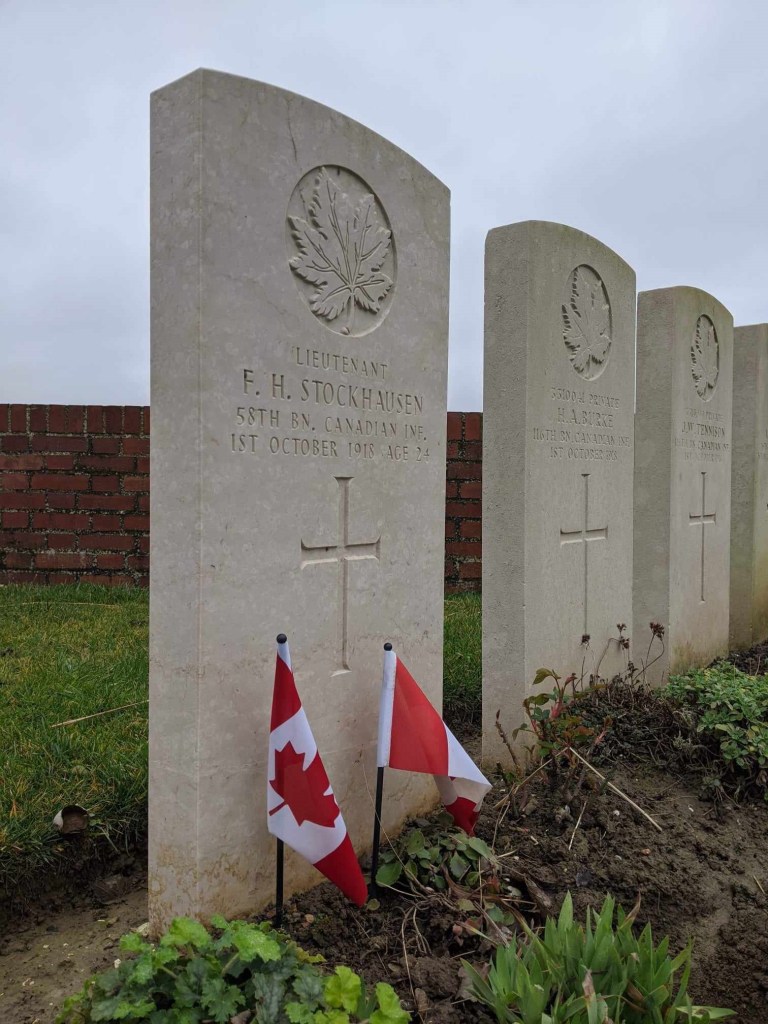
Pip Pip!
8 September 2024
Private Harold Ross Shearer
Harold was 19, fresh out of high school and beginning at the college in Calgary, Alberta in the fall of 1915, when he made the decision to enlist in a war that had been raging for a year. An athlete, in fact president of his college’s athletic association, and popular, Harold was a slim 5’ 6.5” with dark hair and eyes. He had been born in Sherbrooke, Quebec on 23 August 1896 to Reverend William and Isabella Shearer, the eighth of their nine children. It would have been a lively if God-fearing household. James, Winfred, John, Andrew, William, Thomas (who went by Ralph) and Harold were booked ended by two sisters – Helen and Jennie; their father William was a Presbyterian minister of Highland Scottish extraction.
After 20 years in Sherbrooke, and the loss of ten-year-old Andrew by accidental drowning in 1910, the family moved across the country to Medicine Hat, Alberta, with its wide-open skies, hidden coulees, and miles of rolling grassy plains, where they were living by 1911 according to the census. By 1914, the family – or most of it – had moved north a few hundred miles that spring, to Calgary, a growing city built of sandstone and fueled by the discovery of oil. Calgary would go on to be home of one of the largest training camps of the war in the aftermath of the August 4 declaration.
However, in a year of recruiting drives across the country, none of the Shearer boys enlisted. Perhaps their father disapproved of the fighting; perhaps their parents feared the loss of another son and refused permission for their older sons to fight. Certainly James, now married and a father, was not expected to enlist at all. Perhaps by that fall of 1915, Harold was caught up in the recruiting fervour of his college, and managed to change his father’s mind. By 2 October 1915, he had signed his name on attestation papers and joined one of Canada’s most storied and respected regiments: the Princess Patricia’s Canadian Light Infantry.
The PPCLI, called the Pip Pips, was founded on 10 August 1914, funded privately with a grant of $100,000 from Montreal entrepreneur, Captain Andrew Hamilton Gault. It was named for Queen Victoria’s granddaughter, Princess Patricia of Connaught, who was the daughter of Canada’s Governor-General, the Duke of Connaught and Strathearn. The “Patricia’s” have served Canada continuously ever since in every theatre of war through to Afghanistan. The first regiment to leave Canada for England in September 1914, it was deemed so well trained by the British that the PPCLI landed in France on 21 December 1914, the only Canadian regiment to serve in the field in 1914, albeit within the British 27th Division. It was not until December 1915 the PPCLI would serve as part of the 3rd Canadian Division.
Harold was whisked overseas very quickly, arriving aboard the S.S. Lapland on 7 December 1915. At that point he was taken on strength with the 11th Battalion in Shorncliffe for training. Shorncliffe was handy to Folkestone in Kent, the closest port for transporting soldiers to France and wounded back to England. In April 1914, the Canadian Training Division was sited in this camp which had been in existence for well over 100 years. After four and a half months of training, Harold was ready to go to France, joining the Canadian Base Depot on 24 April 1916. On the 14 May, he finally joined the Patricia’s in the field. Little did he know, he was just in time for one of the most ferocious and costliest battles Canadians faced of that year.
At that point, the Canadians controlled the only portion of the Ypres crest, running from Hill 60, east and north through Mount Sorrel to Hill 61 and 62. With commanding views of the town of Ypres, the Germans wanted this high ground. In May, it was reported the Germans were digging saps forward at Tor Top, Mount Sorrel and further north.
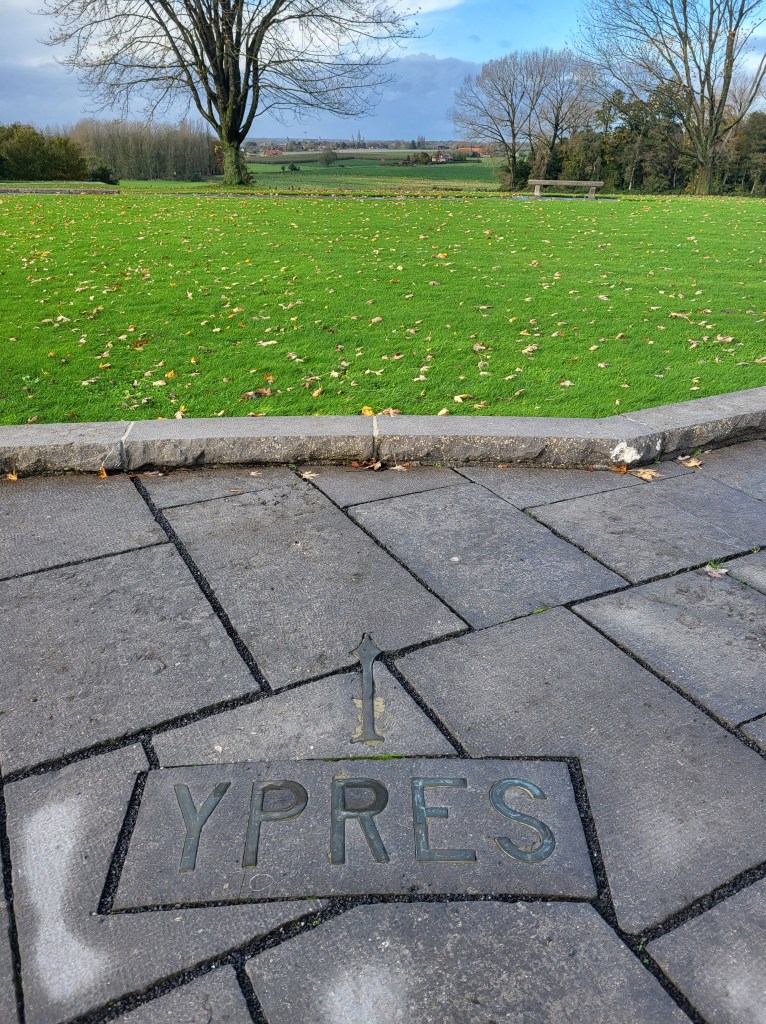
Looking from the top of Mount Sorrel Canadian monument toward Ypres. Author’s collection
At 6am of 2 June 1916, Major-General Malcolm Mercer, who had enlisted in 1914 and participated in the Second Battle of Ypres, and Brigadier-General Victor Williams, set out to scout Tor Top and Mount Sorrel when the German’s began their preliminary bombardment. Lord Beaverbrook wrote that it was “…the heaviest endured by British troops up to that time.” Mercer was killed, the most senior Canadian officer of the war to be killed in action; Williams was taken prisoner by the Germans.
At 2pm that day, Harold Shearer, having been at the front for 18 days, was seen in a trench, unharmed. The fighting was particularly fierce where he was at Sanctuary Wood. Sometime later, during the heavy shelling, Harold’s trench was hit and the young man, only 19 years old, was not seen again. He was one of 8000 Canadian casualties, killed, wounded, or like Harold, missing in action.
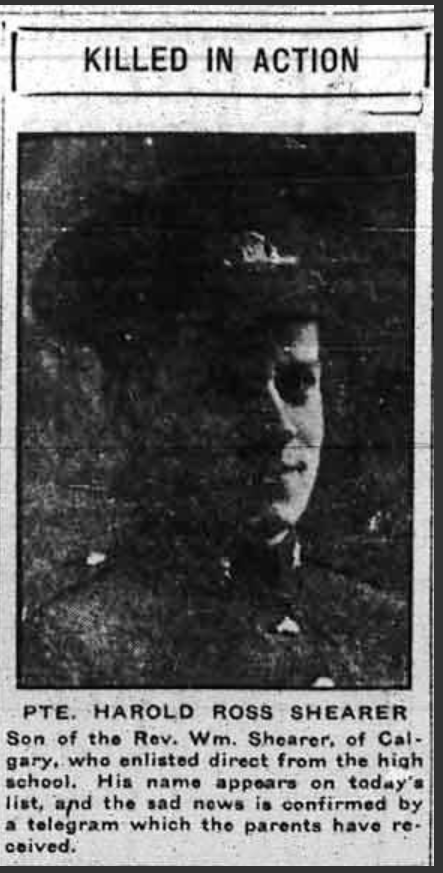
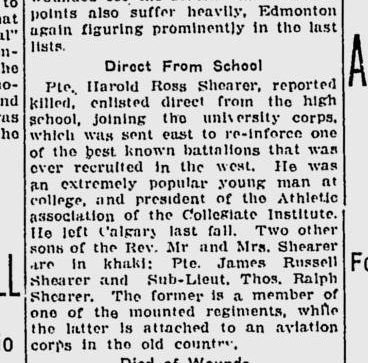
For a year or more, the Shearer family would have held out hope that Harold would be found, that perhaps he was a prisoner of the Germans, that they would be reunited. For many families, this hope continued for years, even after the official designation of “presumed killed on or before…” was sent by telegram, after the war was over and all the prisoners were returned. The (then) Imperial War Graves Commission did not give up on recovering these lost men. For years, recovery teams had the unenviable task of combing the abandoned battle fields, looking for telltale signs of an unmarked or unintentional grave, retrieving whatever was left and hopefully identifying the remains. So very many would never be identified but be buried as “Known Unto God”. To this day, 150 First World War casualty remains are reported to the (now) Commonwealth War Graves Commission each year. Every effort is made by forensic anthropologists to return the identity to these men. In Canada, Dr. Sarah Lockyer works full time to return names to soldiers, and has spent up to ten years researching an individual. Once an identity has been rigorously verified or any possibility of one ruled out, that Canadian is laid to rest in a custom, Canadian maple casket, with full military honours.
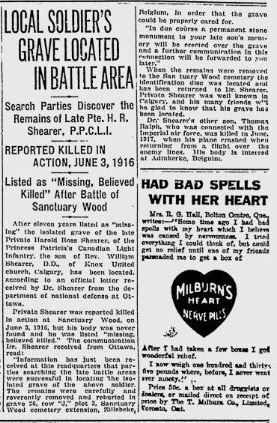
Harold was a lucky one. Eleven years after his untimely death, Harold’s remains were found, his identification discs with him. These were returned to his family, a slightly grisly memento. Harold was buried with honour in the Sanctuary Wood Cemetery Extension. His would not be the only loss of the Shearer family, but that is for another story.
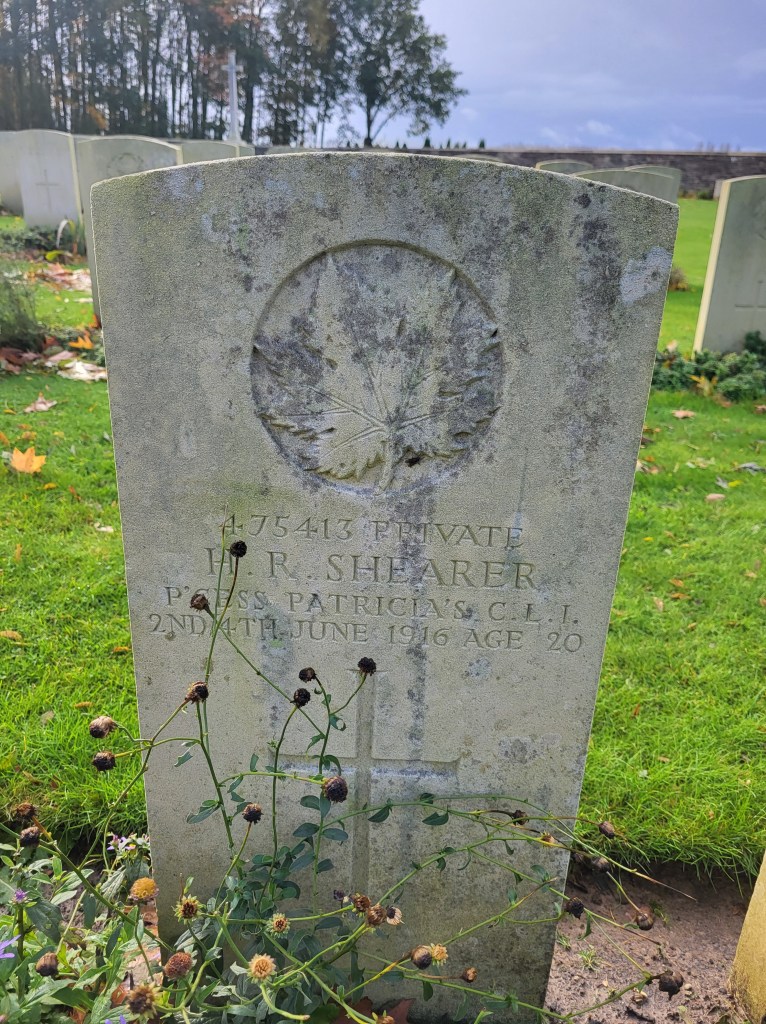
O beloved Belgium, sacred land of our fathers
23 July 2024
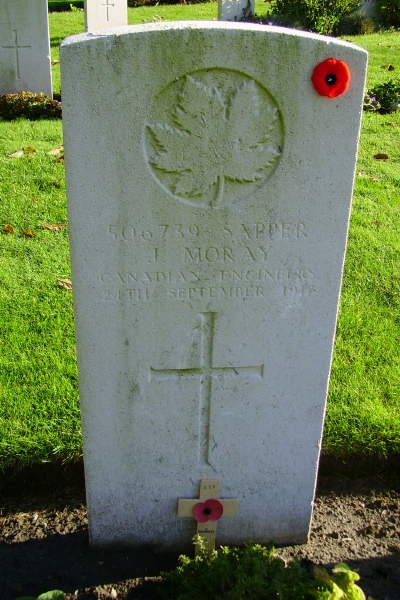
Sapper Jules Moray
Arguably one of the most beautiful and serene cemeteries of the Western Front is the Ramparts Cemetery, Lille Gate, Ypres. Nestled in against the solid medieval city walls, it is rimmed by the quiet waters of the Majoorgracht – the main moat – at the southern tip of the old walled town. I went there on a late November afternoon, one of the rare sunny days we had on that visit. The sun hung low over the far shore, gilding the still water of the moat. Trees glowed in orange and yellow, a few fallen leaves drifting over the pristine green lawn. Distant traffic and the croak of magpies (no larks!) were the only sounds. And as I had made my habit, I looked for the familiar maple leaf graven into a white stone. Thus, I found the grave of Sapper Jules Moray.
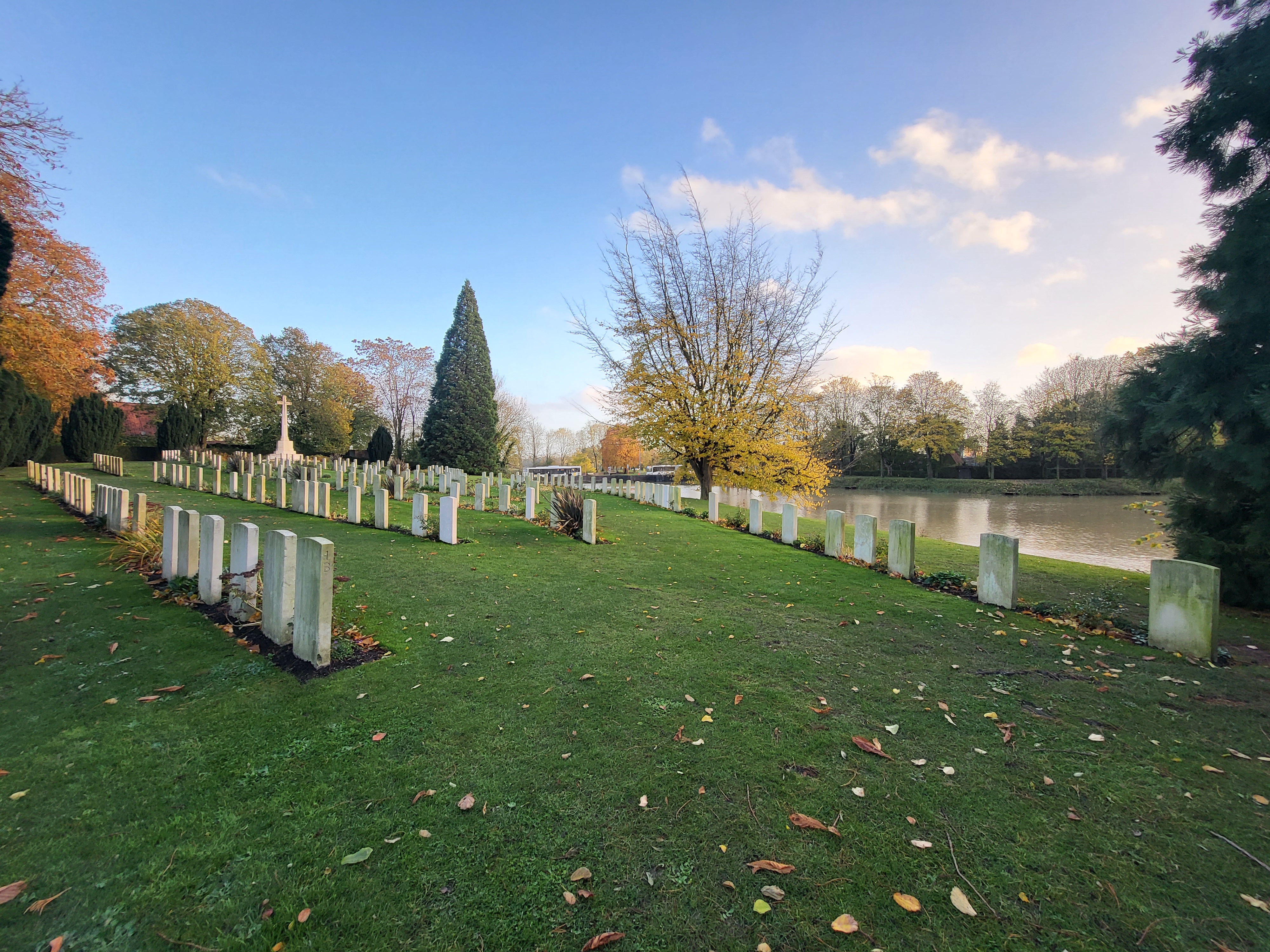
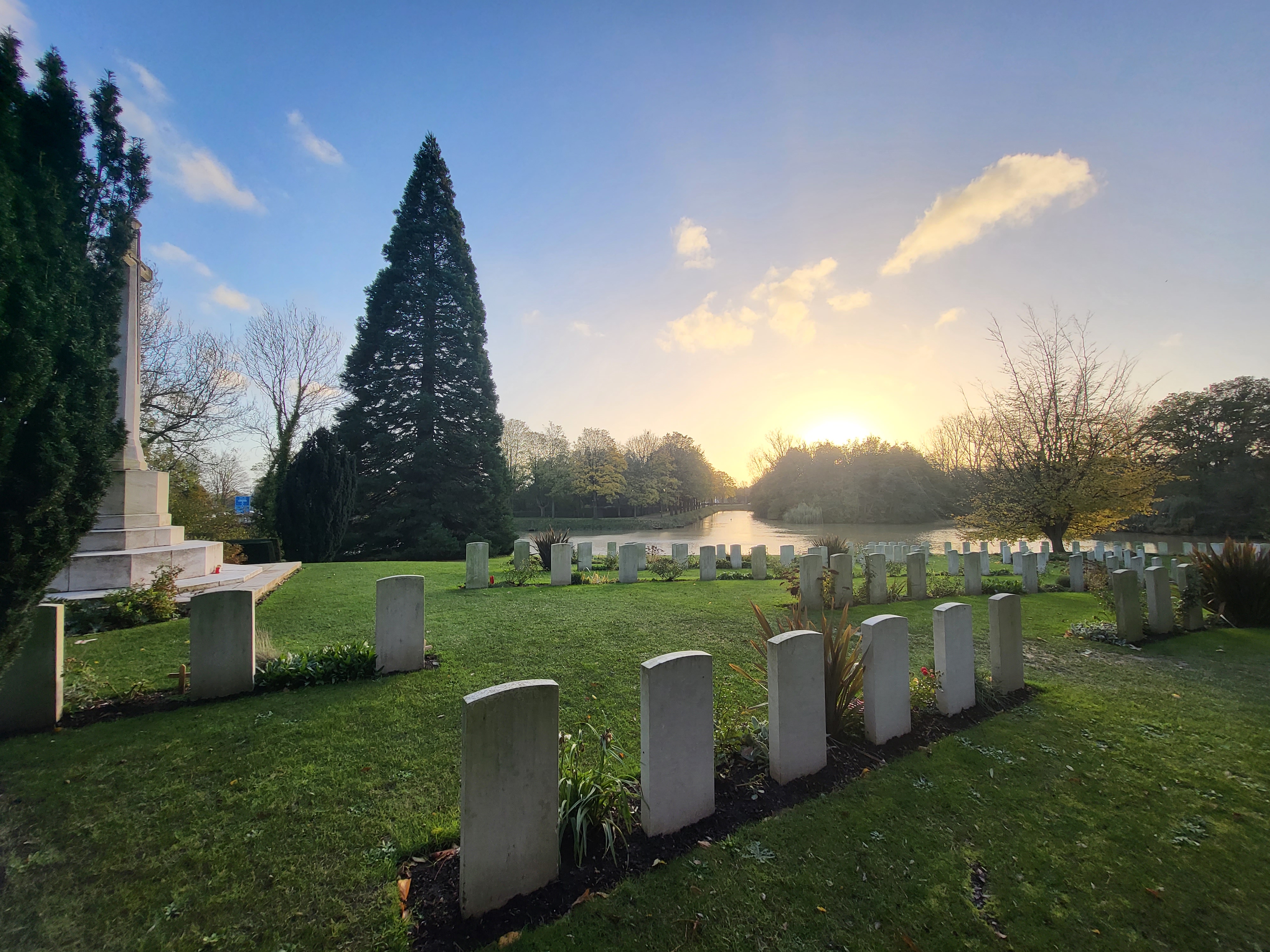
Most are familiar with the notion that most of the Canadian Expeditionary Force was made up of English-born ex-pats, at least in its early years. While this is true, many nationalities and races were eventually accepted into its ranks: other Europeans such as Ukrainians, Polish, Russians, thousands of Americans (many of whom were transplanted Canadians), and somewhat reluctantly, later on Japanese, First Nations and Black Canadians. Also true is the fact that many CEF casualties were not, it turns out, buried far from home. Such was the case of Jules Moray, who was, until age 31, a native son of the land where he fought and fell, Belgium.
Jules was born in Liege, Belgium on 13 April 1879. He had a sister, Charlotte and a brother, Walter. I can find no reference to his parent’s names. Jules arrived in Canada, via Bristol, England, on 24 August 1910 on the Royal George to Montreal. He was all alone, apparently unmarried at age 31. He found work in the coal mines of Cape Breton, Nova Scotia before moving to Eastport, Idaho in November of 1910, an area rich in metals and minerals being mined. Five years later he was living in Fernie, British Columbia, still working as a miner, still unmarried. It was here in January 1916, that the tall, red-haired, blue-eyed 35-year-old enlisted in the 103rd Battalion. Permanently tattooed by the coal he dug – his face and hands were noted as having coal marks – Jules put his sister Charlotte of Wandre, Liege, deep in occupied Belgium, as his next of kin. His brother, Walter, it was noted, could be contacted care of the Consulate General of Belgium in Ottawa. His religion was documented as “Free Thought”.
Jules left Canada on 5 August 1916 on the S.S. Scotian, arriving in the UK two weeks later. He was in the field by September 1916, back in his native Belgium after six years away. Jules transferred from the 103rd to the 143rd Battalion, ending up – unsurprising given his profession – with first the No. 4, then the No. 3 Tunnelling Company. Jules spent the first part of his field service at Hill 60. This “hill” was the spoil heap from a railway cut, rising 60 feet above sea level. On the other side of the cutting the spoil heap was named “The Caterpillar”. In the relatively flat ground of the Ypres Salient, it gave German artillery an excellent vantage point over Ypres itself. Much fought over, it traded hands in the early years of the war, but in late 1916, a concerted effort was made by the British to root out the Germans. To do so, they dug deep into the earth and stacked these mine shafts with explosives. While the memorial at Hill 60 pays great tribute to the Australian mining efforts here, Canadian tunnelling companies, including Jules’ made contributions as well. By October 1916, the mines at Hill 60 and The Caterpillar held over 53,000 and 70,000 pounds of explosives respectively. Jules then moved not far away to the area of Messine Ridge where more extensive mining was underway. Twenty-four more mines were laid, with Jules working at trenches 127, 122 and the “Birdcage”. On 7 June 1917, at 3:10am twenty of the mines were detonated in the space of 20 seconds. Considered the loudest man-made noise, possibly heard as far away as Dublin, and one of the largest non-nuclear explosions, it was described by journalist Philip Gibbs:
“Suddenly at dawn, as a signal for all of our guns to open fire, there rose out of the dark ridge of Messines and “Whitesheet” and that ill-famed Hill 60, enormous volumes of scarlet flame […] throwing up high towers of earth and smoke all lighted by the flame, spilling over into fountains of fierce colour, so that many of our soldiers waiting for the assault were thrown to the ground. The German troops were stunned, dazed and horror-stricken if they were not killed outright. Many of them lay dead in the great craters opened by the mines.”
So thorough was the work of the miners like Jules Moray, the operation was deemed such a success that six of the mines were left undetonated. One was accidentally detonated in the 1950s, after a lightning strike, I was told. The largest of them, at La Petite Douve, still sits in uneasy slumber under the barn of a local farm.
I visited the Caterpillar mine crater, and it was truly impressive in size. A few craters are a short walk up from where Jim is buried at R.E. Farm Cemetery. Another that I visited is now called the Pool of Peace and is wrapped in a small copse of trees. It was both an eerie and peaceful place.
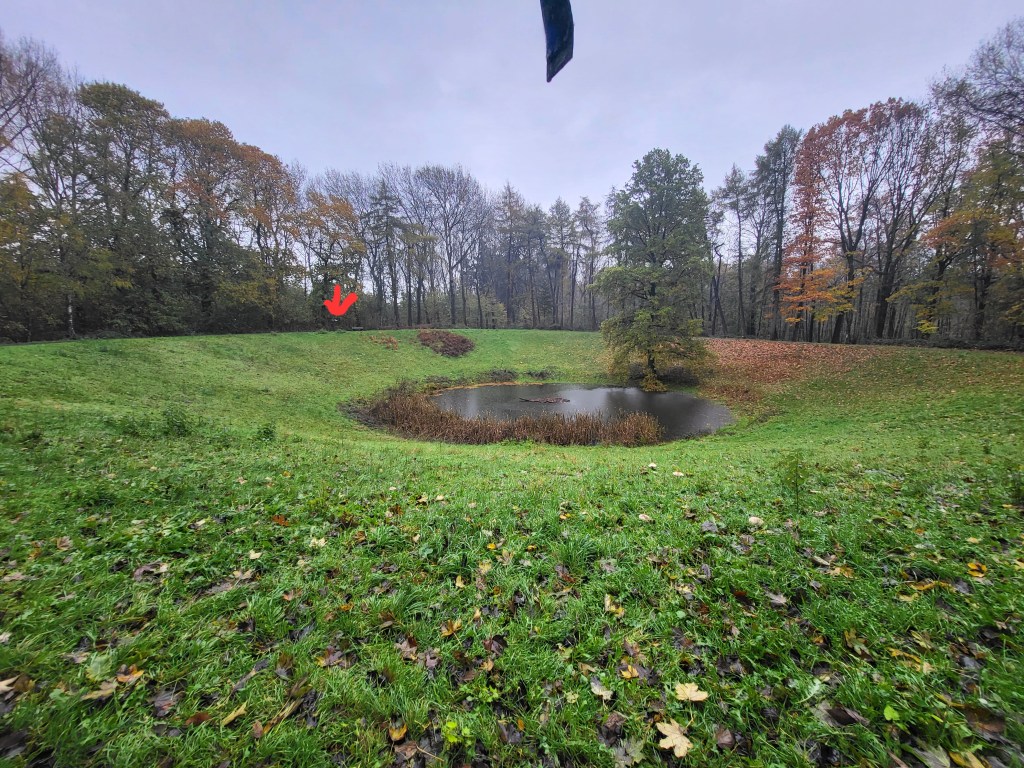
Caterpillar crater, my husband is standing on the far side under the arrow. November 2023
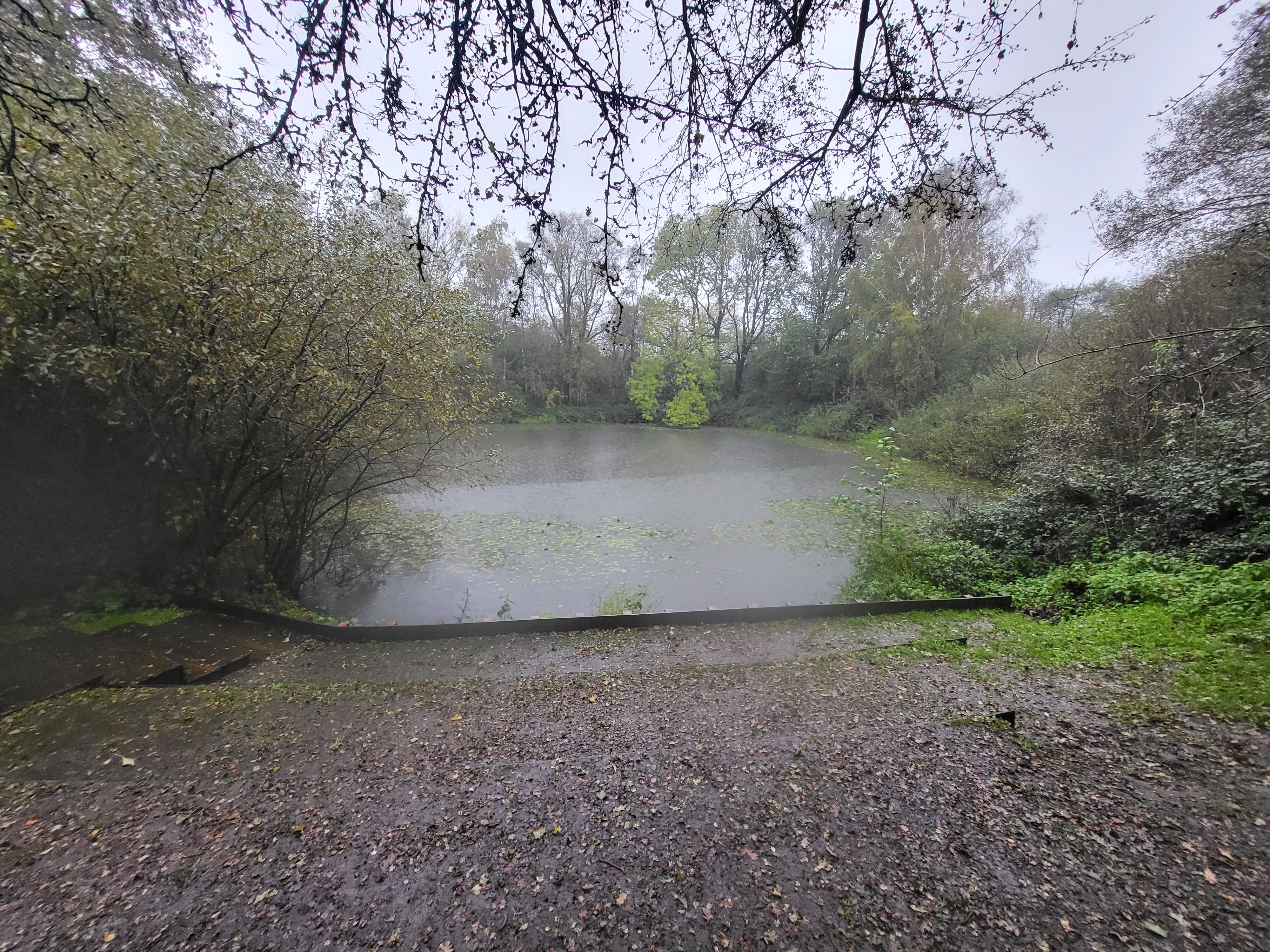
Pool of Peace, Kruisstrat, Heuvelland, Belgium
Sometime during what would come to be known as the Third Battle of Ypres, which culminated in the Canadian capture of Passchendaele Ridge, Jules and the No. 3 Tunneling Company returned to the area of Ypres. It was here in late September that Jules was mortally wounded. He was carried as far as the #69 Field Ambulance, a British unit supporting the Battle of Menin Road. Field Ambulances were not vehicles, rather mobile, front-line units of 10 officers and 224 men, maintaining a series of dressing stations, capable of caring for 150 wounded. Doctors here would have triaged Jules and either initiated care or set him aside as unsavable. Unsavable he was whatever their decision; Jules died on 24 September 1917 and was buried in his home soil in the sheltering arms of the Ypres ramparts. When the war finally ended just over a year later, Charlotte and Walter, unlike most other families, would have been able to come see their brother’s peaceful final resting place.
A Dandy Chap
18 July 2024
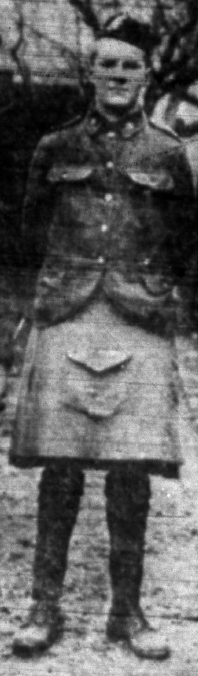
Private Lewis Murray Southgate
I’m not sure why it took me so long to write this story. Murray’s death broke my great-aunt’s heart, and she didn’t marry until after the next world war stole more young men’s lives. Murray also became a good friend of Jim’s: they both were smitten with sisters from Halifax. I get the sense, through Jim’s letters, that Murray was good fun, loved a laugh, was up for an innocent lark. His war lasted two months.
Lewis Murray Southgate was born 21 April 1893 to Lewis Murray Sr and Frances Elizabeth Southgate, in the bustling historic city of London, England – 8 Leister Square, Bayswater, London to be exact. In that, he was like many of the early volunteers in the Canadian Expeditionary Force, an English ex-pat. His father was a “wasteman” which does not mean a garbage man but rather a person involved in keeping mine sites neat. In the early years of the century, Lewis Sr. began work in Springfield, Nova Scotia, likely in the coal mines there. In April 1907, 13-year-old Murray, his mother, 15-year-old sister, Frances, and 11-year-old brother, Frank, joined their father in Canada. Murray graduated from Mount Allison University in near-by Sackville, New Brunswick and took a job as a clerk with the Canadian Express Company in Halifax. In 1913, the senior Southgates moved back to England, settling in fashionable Kensington Square with three servants but none of their children, not even their unmarried daughter. It would not be long before Murray visited them, in uniform.
Murray, a member of the 63rd Halifax Rifles militia, signed on to the Canadian Expeditionary Force in the first wave of volunteers. He arrived in Valcartier, QC in August of 1914 where Murray joined the Royal Highlanders of Canada (Black Watch), donning the famed kilt. The RHC, designated soon after the 13th Battalion, was formed mostly of men from the Montreal region and was noted as having 18 of their 27 officers being millionaires. One was a billionaire! One the 13th Battalion’s members would be Canada’s first Victoria Cross recipient of the First World War, in the conflict now named the Second Battle of Ypres.
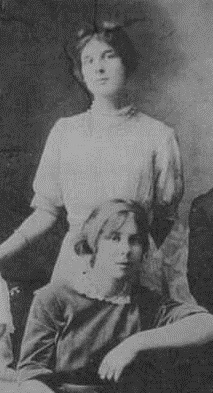
Isobel (standing) and Daisy (sitting) McCurdy
It was in Valcartier that Murray met Jim Johnstone. The two had a profession and the McCurdy sisters, Daisy and Isobel, in common, and a friendship bloomed. The two young men spent their time off duty socializing and even sneaking out of bounds to go swimming in the Jacques Cartier River. Murray, at 5’9”, was taller than the average recruit, with blue eyes and light brown hair. A handsome lad, he wore his kilt with style. In October 1914, the CEF moved overseas – Murray on the S.S. Alaunia – and then to Salisbury Plain. I am quite positive, given the generous amount of leave granted to the Canadians, he was able to visit his parents frequently and they him. What a gift, for when Murray was finally sent to the Front, they would never see him again.
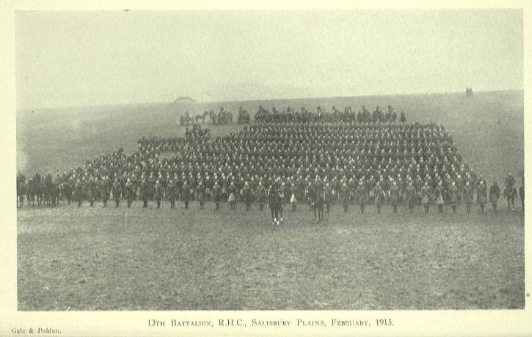
Photo of the 13th Battalion in February 1915 from the book, “The 13th Battalion Royal Highlanders of Canada 1914-1919” by Robert C Fetherstonhough
In February 1916, the 13th Battalion was finally sent across the Channel and into the fighting. They embarked on the 12 February straight into the teeth of a gale, and Murray may have been one of the many felled by seasickness. An inauspicious start! After a few weeks learning from experienced British battalions, in March 1916, the CEF was tasked to relieve the 7th British Division in the trenches around the Ypres Salient. On 15 April, riding on re-purposed London omnibuses still resplendent with pre-war advertising, the 13th was brought through Poperinghe to Vlamertinghe, where they disembarked and marched through the brutalized medieval town of Ypres and on to St. Jean (Sint-Jan). On the night of 21 April – Murray’s 23rd birthday – the 13th took over trenches near Langemark-Poelkapelle. To their left were a battalion of French Turcos, soon to be victims of the first large-scale gas attack of the war; on their right was the Canadian 15th Battalion. The morning of 22 April revealed the incredibly poor state of their trenches, however, the Germans – only 50 -75 yards away – were surprisingly inactive, only sending over the occasional rifle shot or short burst of machine gun fire. The reason for this became clear at 5pm, when after 2 hours of heavy bombardment, the Germans released a wave of chlorine gas which destroyed the Turcos line. Investigating, the 13th Battalion officers found the Germans had punched through and were swinging in to flank the Canadians on their left. Despite heavy casualties from the shell fire, a number of companies of the 13th dug in to defend along the Poelkapelle Road. The attacks were unrelenting, from shelling, and machine guns. The 13th pulled back into their former trench lines. Rivers of wounded were evacuated through the 15th’s position. Some companies fought until overwhelmed, their members killed or captured. In this hellscape, Murray went missing.
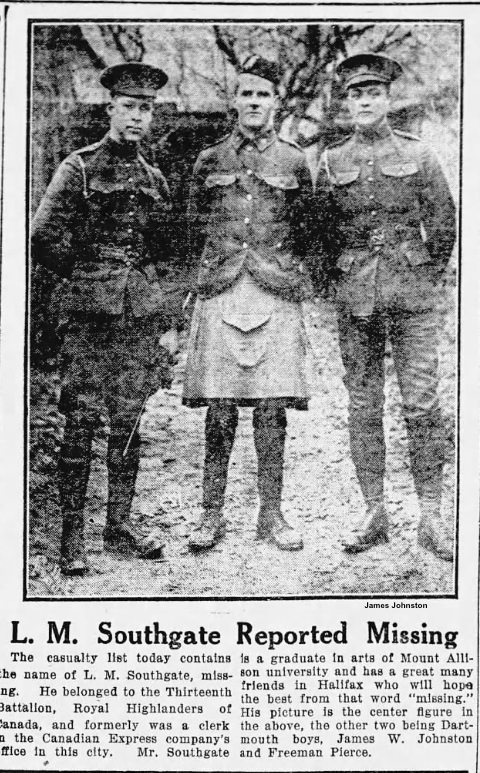
The Second Battle of Ypres would go on to become one of those near-legendary battles in Canadian history: plucky Canadians holding off overwhelming opposing German forces until the British could come in to reinforce them, saving the Salient. It is mostly true and mostly a huge success, of which Canadians should be proud. That does not diminish the horrific cost in men lost, men who disappeared into the Ypres mud, never to be seen again. For months, Jim wrote to hospitals, looking for his friend Murray. He corresponded with Murray’s sister Frances. He reassured Daisy McCurdy, through his letters to his beloved Isobel, that men got mixed up in other battalions all the time, that he heard Murray was taken prisoner, was in hospital, would someday turn up. Who was he trying to reassure more, them or himself? Jim would be dead in those awful killing fields when the final pronouncement was made a year later: for all intents and purposes, Murray was presumed dead on or before 24 April 1916.
Murray’s story would be another one lost to history but for Jim’s letters. Murray’s sister Frances married but had no children. His brother, Frank, also a volunteer in the CEF who served in France and Belgium, died by accidental drowning in 1922 in Newfoundland. Murray is not remembered by any generations down the line. His only memorial is an inscription on the Menin Gate, one of 55,000 men there named who sacrificed everything and have no known resting place.

On The Wings of The Morning
7 May 2024
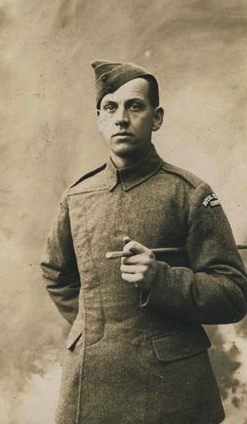
Lieutenant Arthur Clair Gilmour
As a teenager, I read the Bandy Papers, a three-time Leacock Award for Humour-winning, FWW series of novels by author Donald Jack. Jack’s horse-faced anti-hero, Bartholomew W. Bandy, when thrown out of medical school in 1916, enlists in the infantry. His face drives nearly everyone he meets to murderous rage, including his Colonel who transfers him to the Royal Flying Corps. The joke of the novel being, with the life expectancy in the RFC merely a few weeks, Bandy’s promotion was an almost certain death sentence. Of course, Bandy proves the exception, surviving, becoming an unlikely Ace and nearly killing his former Colonel by running him over with his airplane. It set up a lifelong dream to fly in a Sopwith Camel for me. This RFC reputation was, in reality, no joke, and many young flyers and their observers did indeed come to a premature end. One such Canadian loss was Lieutenant Arthur Clair Gilmour.
Gilmour was born in Saint John, New Brunswick on 26 May 1893 to Arthur Burrell and Helen Bertha (Jenks) Gilmour. Arthur’s only brother Francis, born in 1891, died at 10 months of age in 1892. His younger sister, Margaret joined the family in 1899. There would be no other children. Arthur Sr. was a clothier or “merchant tailor” and his son followed in the family business. In April of 1915, 22-year-old Arthur married Miss Nellie Beatrice Williams, daughter of Frank and Isla Williams. The young couple set up housekeeping at 315 Union St, then an area on the edges of the city, now home to a large shopping mall/office complex. By January of 1916, Arthur had enlisted in the newly formed 115th Battalion and Nellie was expecting their first – and only – child. Arthur had spent three years with the 62nd Fusiliers, Saint John’s volunteer militia regiment which is most likely why he entered the CEF as an officer. He was placed in command of a platoon – usually 24 to 40 “other ranks”, NCOs and an officer – during training in Saint John and Valcartier, PQ. It was an intimate group, compared to the massed thousand or so who made up the battalion and it seemed Arthur came to know them all well.
I get the impression that both Arthur and Nellie were generous and caring people, and that business must have been good for the two generations of the Gilmour men because of two incidents mentioned in letters home from James Gilmore, one of the men in Arthur’s platoon. First, when the 115th arrived in England in July 1916, it was quickly broken up to reinforce depleted battalions at the front. This often happened if battalions hadn’t recruited their full strength. When Gilmour was faced with parting from his men, he was so moved, he wept openly in front of them as he bid them goodbye. That Christmas, Nellie, her newborn son only a few weeks old, made boxes of goodies for all the men of her husband’s former platoon and shipped them overseas. Arthur himself sent gifts to certain members of the platoon as well.
It appears Nellie moved in with her in-laws at 197 Germain St in the summer of 1916, an upscale neighbourhood of elegant brick townhouses built in the 1880s after the Great Fire of 1877 leveled the city. The house where they lived burned in 1918 and a 7-story Italianate, heritage-designated apartment building stands in its place. Arthur (III) Clair Gilmour was born there on 3 October 1916, long after his father, whom he would never meet, had left for England.
In January 1917, Gilmour was placed in a Garrison Duty Battalion and a month later was transferred to the 3rd Labor Battalion. On 10 February 1917 he was on his way to La Havre, France. This battalion worked in the rear areas, as most of the men were considered not fit for service in the trenches. Because most of their work was building rail lines to funnel ammunition, supplies and men to the front, the 3rd became the 11th Battalion, Canadian Railway Troops in November 1917. Perhaps this was not glamourous enough work for Gilmour, perhaps he wanted to see more action. Whatever the reason, in August of 1917, he was probationally attached to the RFC, as an Observer.
While not pilots, and initially looked down on by pilots as mere ballast, by 1916, Observers were an integral and highly trained part of an aerial reconnaissance team. Working with their pilot, Observers mapped routes, determined compass bearings, distances and times for a search. In the air, they were tasked with documenting sightings, troop movements, gun emplacements and any other relevant details of the enemy trenches and fortifications. They often photographed the layout of these. They were often the targets of enemy fighters and guns from below as they carried vital information back to HQ. Their badge was a single wing (pilots had double wings) sprouting from an “O” to distinguish them from pilots.
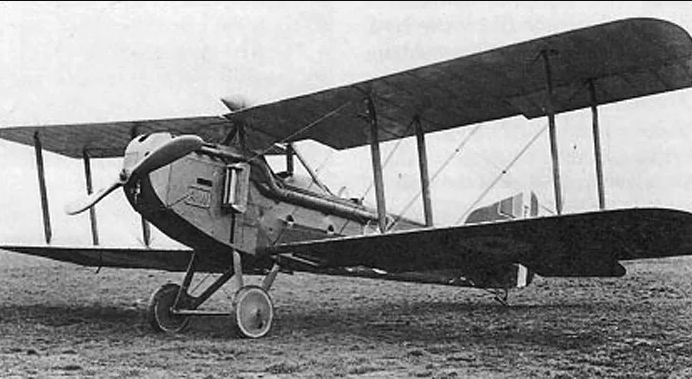
Armstrong-Whitworth F.K.8
Arthur likely spent time in England training for his new role, and arrived in France on 16 November 1917 with the RFC. In January 1918, he was attached to the 82nd Squadron and officially appointed Flight Officer (Observer) on 19 February 1918, with his senority backdated to November 1917. It was probably around then that he had his photo taken, wearing the so-called “maternity” tunic of the RFC, and sent home to his beloved wife and one-year-old son.
On 6 March 1918, 24-year-old Arthur and his 19-year-old pilot, Second Lieutenant Donovan L Sisley, hopped in their two-seater Armstrong-Whitworth FK8 to undertake a photographic mission southwest of Itancourt, France. In the formation was Lieutenant J. Kernahan. At the same time, five German Fokkers from Jasta 48 under the command of Ltn. Kurt Küppers was on patrol.
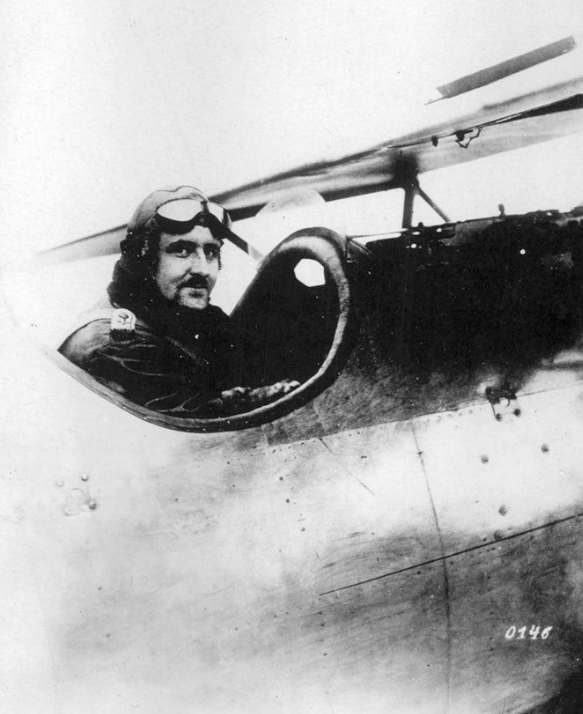
Ltn K. Küppers (1894 – 1971)
Fokkers were one of the most feared airplanes and the more pedestrian F.K.8 didn’t stand much of a chance when the two groups met near Séry-lès-Mézières. Gilmour and Sisley’s airplane was seen going down in flames on the German side. Küppers was credited with shooting down Sisley and Gilmour’s plane.
The initial report offered the family hope that both young men had survived, but stated that no further “particulars” could be expected for 3 weeks. Rumour ran that Arthur was in hospital and a prisoner of war. Unfortunately, word soon came from Kernahan that he had seen Gilmour hit and slump over in the cockpit. The F.K.8 fell in flames and was seen by officers of the 122nd Siege Battery to crash on its back and burst into flames. Arthur’s body was retrieved and buried in the military hospital cemetery at Itancourt. All this information was sent to the young widow in a letter by a Red Cross Society official, Florence K. Ellissen. Its hard to know whether knowing such details would have made it easier or harder for the family. Perhaps there was some comfort in knowing Arthur was likely dead already before crashing and burning.
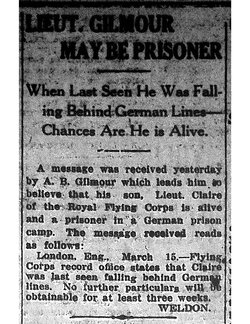

When Arthur’s medals arrived in September of 1922, and his “death penny”, the memorial plaque, nearly two years later, that wound would have been ripped open anew. It doesn’t appear Nellie ever remarried. Gilmour is remembered on the Flying Services Memorial in Arras, France
Our Darling Soldier Boy
16 April 2024
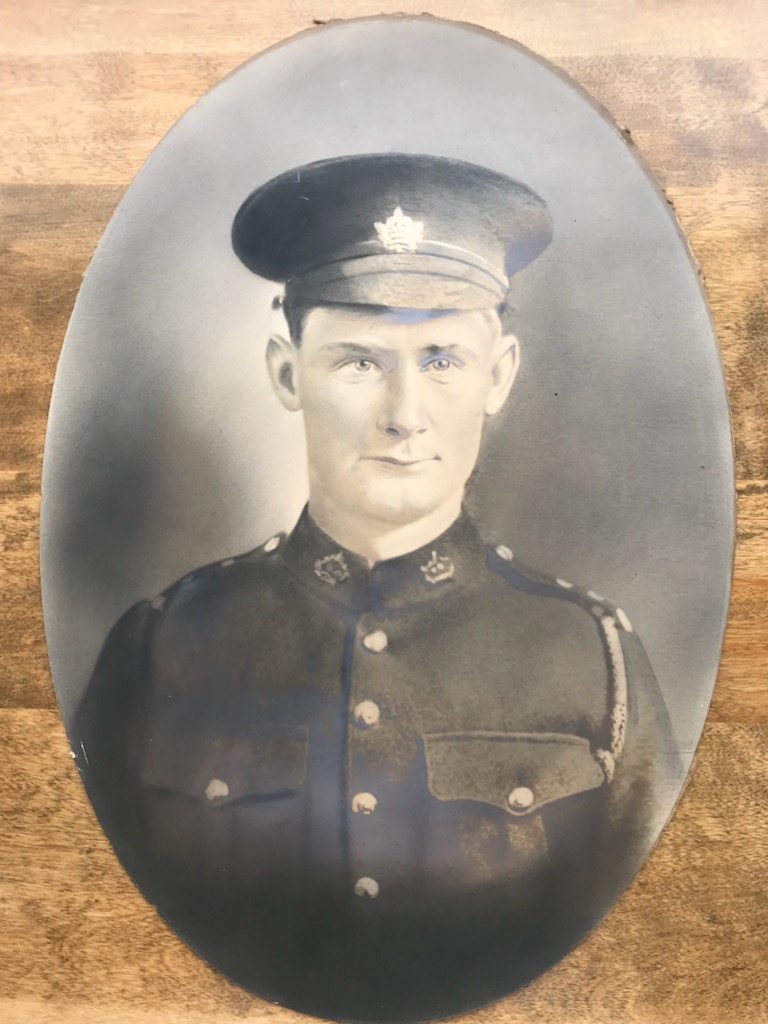
Private James Alec Gilmore
Grand Manan is a small island sitting in the wash of the mighty Bay of Fundy currents, part of the province of New Brunswick. Lashed by storms coming up the Atlantic coast and often muffled in the dense fog the Bay is known for, it is the site of numerous shipwrecks, old and new. Its population today is barely over 2500 people; in the 1880s it was half that. But the residents – most of whom wrest their livelihood from the unforgiving seas around Grand Manan – are resourceful, hardy, pragmatic and deeply in love with their stunningly beautiful island home. One such fisherman was a young man named James Alec Gilmore.
James – Jimmie to his family – was born on 20 October 1888 to Alexander (Sandy) and Lydia (Smith) Gilmore, the seventh of their ten children. Sandy was a farmer rather than a fisherman; Lydia was originally from Maine. When James was only 8, the sea claimed his eldest brother, 18-year-old Leeman. That seems not to have discouraged James from following in his brother’s footsteps to becoming a fisherman. Or perhaps that was just the pragmatism: fishing is one of the few options for a young man living on a small island.
James was an educated young man; his handwriting is neat and practiced in the letters he sent home. Fair-haired and blue-eyed, of average height, he was not particularly young for the time when he enlisted. The war had been raging for nearly a year and a half in January of 1916 when 28-year-old James – unmarried and still living at home – ventured to the mainland to sign on. He was attested in nearby Saint John. Perhaps he had hesitated when the original recruiting drive of August 1914 happened, and when the 26th Battalion was formed in New Brunswick in November of 1914, it may have been that his parents – having lost a son already – talked him out of going. The 115th Overseas Battalion was commissioned on 22 December 1915, and on 13 January 1916, James had submitted his name.
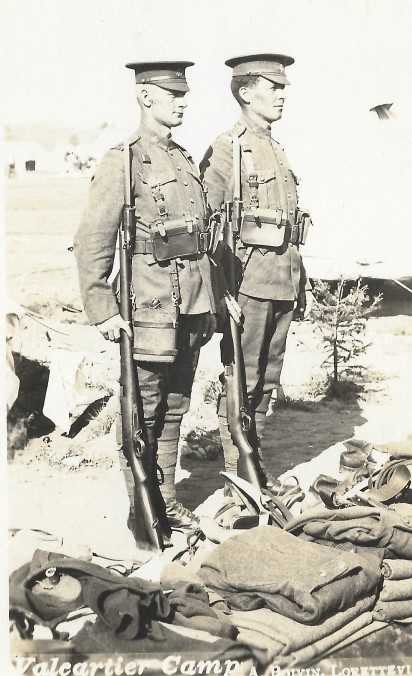
James (left) at Valcartier
The battalion trained that winter and spring in New Brunswick before travelling to Valcartier Camp in Quebec late in May/early June. They weren’t long there before sailing from Halifax, NS on 23 July 1916 on board the S.S. Olympic. James wrote home with delight, describing the ship for his father and mentioning a swim he’d had mid-Atlantic! They landed in Liverpool eight days later, traveling to the Bramschott training camps near Folkestone, where their training would have continued. James was able to get a pass to visit London, coming home, he said, broke but well pleased with his time there.
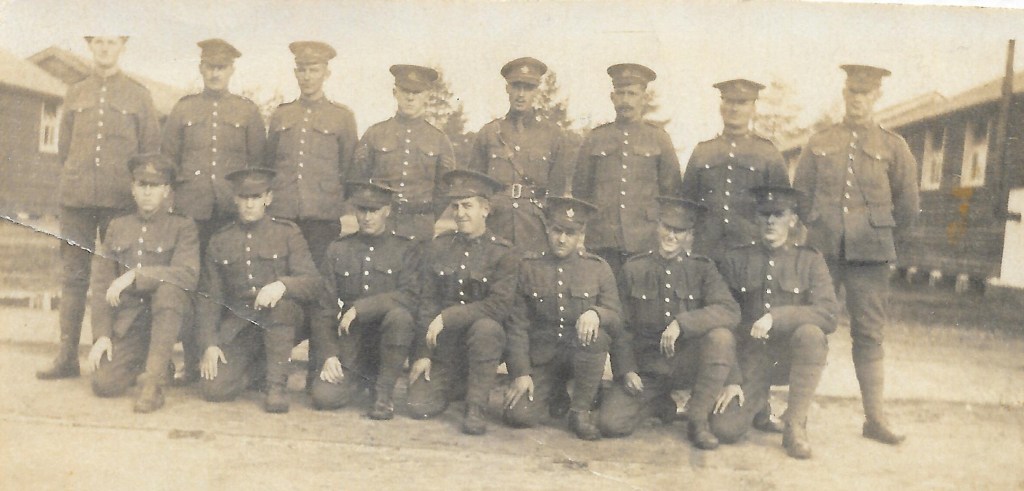
ames’ platoon, likely at Bramschott (based on the huts). James is back row on the right end.
In late September, James wrote his last will and testament, a typical action for men bound for the front. Sure enough, a week later, James – in a draft of 200 men, no officers – was transferred to the 24th Battalion, Victoria Rifles, a unit who had seen some of the devastating fighting at the Somme – at Thiepval, Flers Courcelette and Ancre Heights. They had been involved in the disastrous attack on Regina Trench on 1 October 1916, and were in need of men to fill their depleted ranks. James arrived on 13 October, as the battalion was relieved from their front-line duties. In fact, the subsequent winter was free from any major operations for the Canadian Corps, and James would have had a relatively “easy” time in his first months. In a series of letters home, addressed to his “Mamma” James assured his family he was well and “fit as a pig”. He often requested smoking and chewing tobacco, mentioned the many boxes of goodies received from home, including bottled lobster. At Christmas he received a box from the wife of his former platoon officer, Saint John native Lieutenant Arthur Gilmour. Mrs. Gilmour had sent a gift to each of the original platoon members. James had noted that Lte. Gilmour was deeply saddened to be parted from his men, moved to tears at their separation. 25-year-old Lte. Arthur Gilmour transferred to the Royal Flying Corps as an Observer in 1917 and unfortunately was lost over German territory in March 1918.
In the winter of 1917, a major attack was in the plans and those months were spent in preparing for an assault that would become infused with myth and lore: the attack on Vimy Ridge. The Canadian Corps had come under the capable command of General Sir Julien Byng (later Viscount Byng of Vimy) and Canadian Lieutenant-General Sir Arthur Currie, whose meticulous planning resulted in the stunning victory over the formerly impregnable German stronghold on Vimy’s slopes.
It was a nasty, squally Easter Monday, 9 April 1917, when the Canadian Corps attacked. The 24th Battalion and James Gilmore, were posed to attack up the shallower slopes of the Ridge directly in front of the town of Neuville St. Vaast. A hot meal and a tot of rum in their bellies, the troops were in place by 4am, many in the former mine tunnels dug deep in the chalk. At 5:30am, nearly 1000 guns barked out, laying down the creeping barrage behind which the Canadian troops marched up the Ridge. Every three minutes the guns would lift the line of fire 100 yards and the soldiers would surge forward following the grey-white puffs of shrapnel, leaping over shell holes, barbed wire entanglements and destroyed trench lines. They faced hand-to-hand combat and machine gun fire, but at 6:15am, exactly on schedule, they had reached their objective, the Black Line. While the fighting continued for days more, the majority of Vimy Ridge was captured that day, and it had become very clear to the Germans by mid-morning, that they had lost. What wasn’t clear was where James Gilmore had gone.
He was reported missing on the 2 May; three months later they concluded he had died in the action that snowy, sleety Easter morning. Canadian casualties numbered 10,600, of which nearly 3600 died, either that day or later of wounds. For three long months, Sandy and Lydia prayed and hoped to hear word their son was safe, only to have their hopes dashed with the follow-up telegram and perhaps a handwritten letter of condolence – small comfort that that would have been. Lydia, obviously a well-educated and well-read woman, poured out her grief in a poem that still hangs, framed, beside James’ photograph in the family home in Grand Manan. I saw the photo and the poem in person – James’ great-nephew is a friend – and I was honoured to have made a visit to Vimy Ridge, to walk that now-peaceful and hallowed ground up to Allward’s stunningly beautiful monument where James’ name is inscribed.
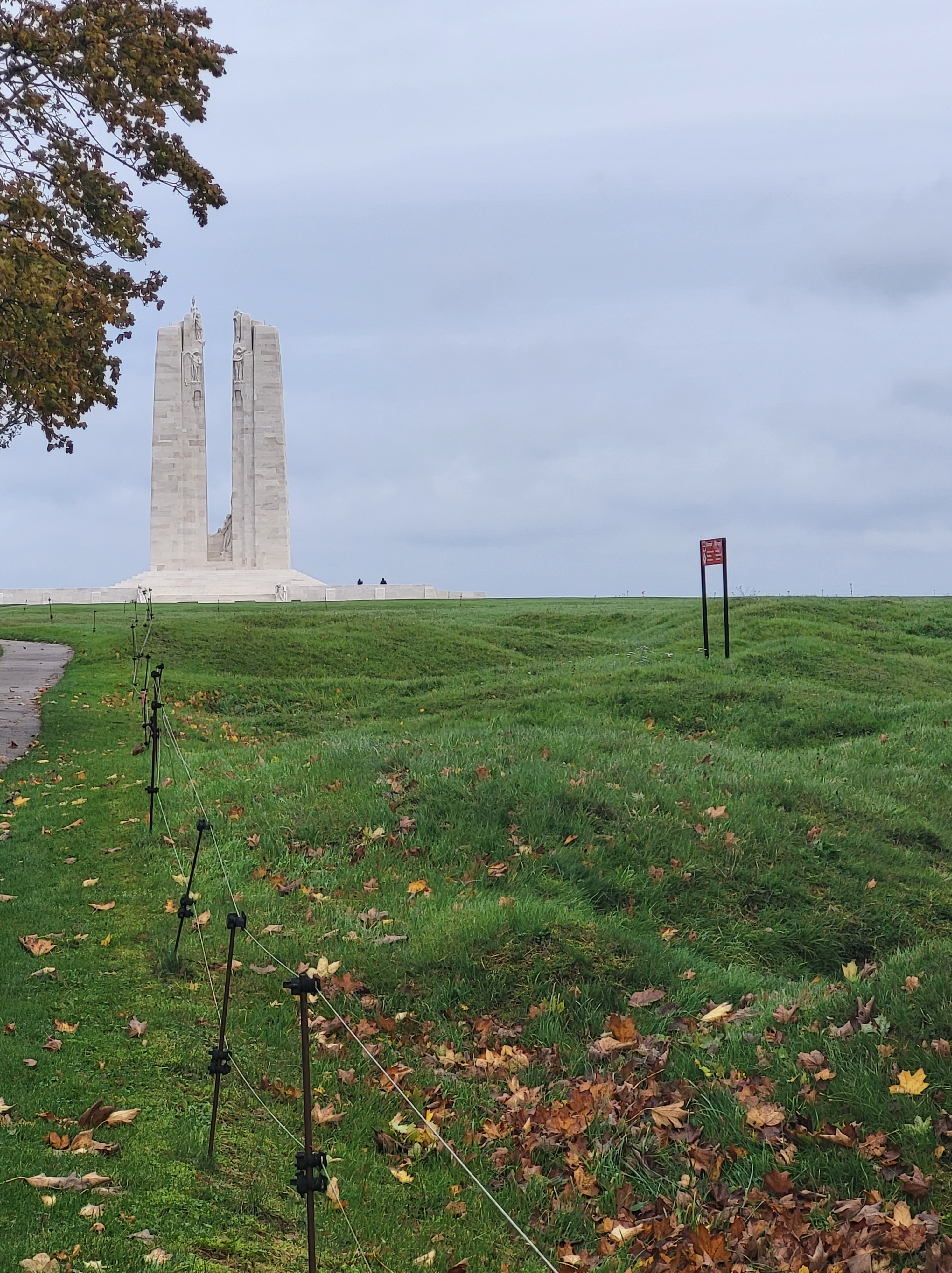
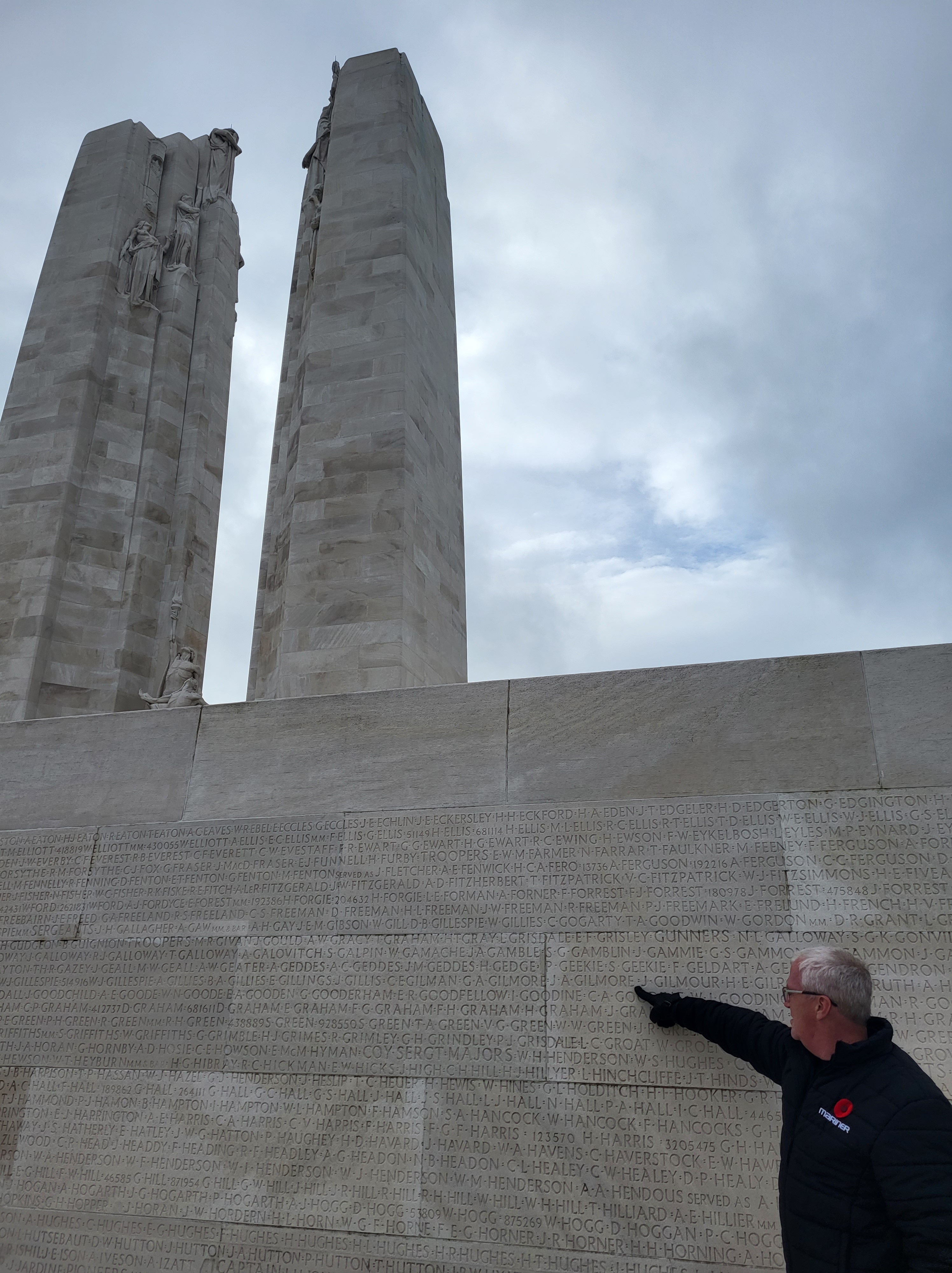
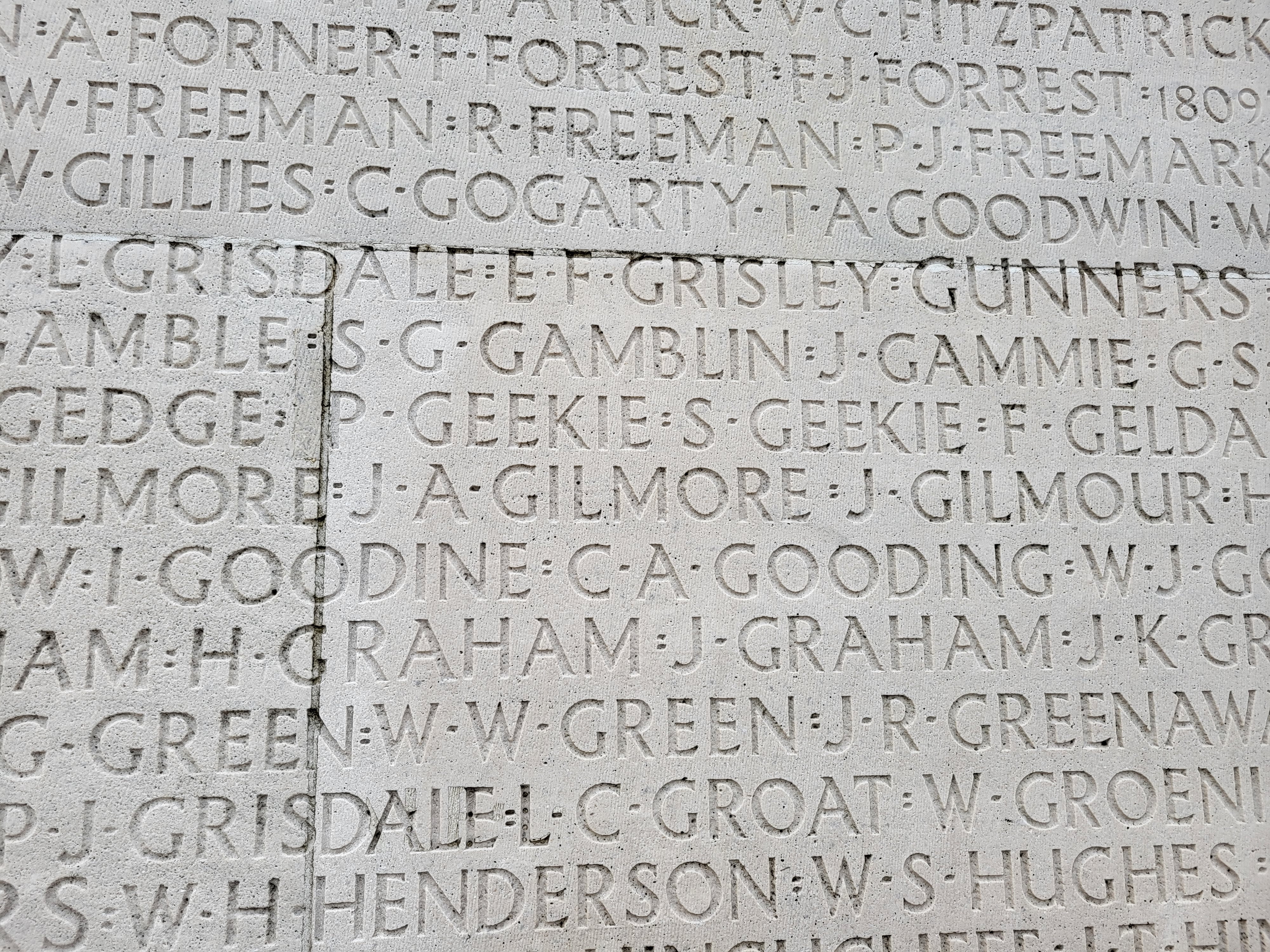
Our Darling Soldier Boy by L.J. Gilmore

I can see my darling
I can see him everywhere,
I can see him in his home
A sitting in his chair.

I can see him coming along the road
He’s nearly to the gate;
To me he looks so lovely
He seems both tall and straight.

I can see him coming up the lane,
Oh how I loved that form!
I can see him coming up the lane
Clad in his uniform.

I hear him coming in
I hear his gallant tread,
I hear him coming up the stairs
A going to his bed.

I knew he had to go away
Those awful Huns to fight,
I crept into his room
And kissed him goodnight.

And when he went away
He kissed me goodbye.
He turned, and looking back
He told me not to cry.

And could a mother help it?
You can all your art employ
To stay a mother’s tear
In parting with her boy.

They say he is gone
And I shall never see him more.
They say he was killed
Upon a foreign shore.

Twas on an Easter morning
In that land so far away
In the midst of the battle
They say he passed away.

They say in France he’s sleeping.
It takes from us such joy,
For at home we are weeping
For our darling soldier boy!
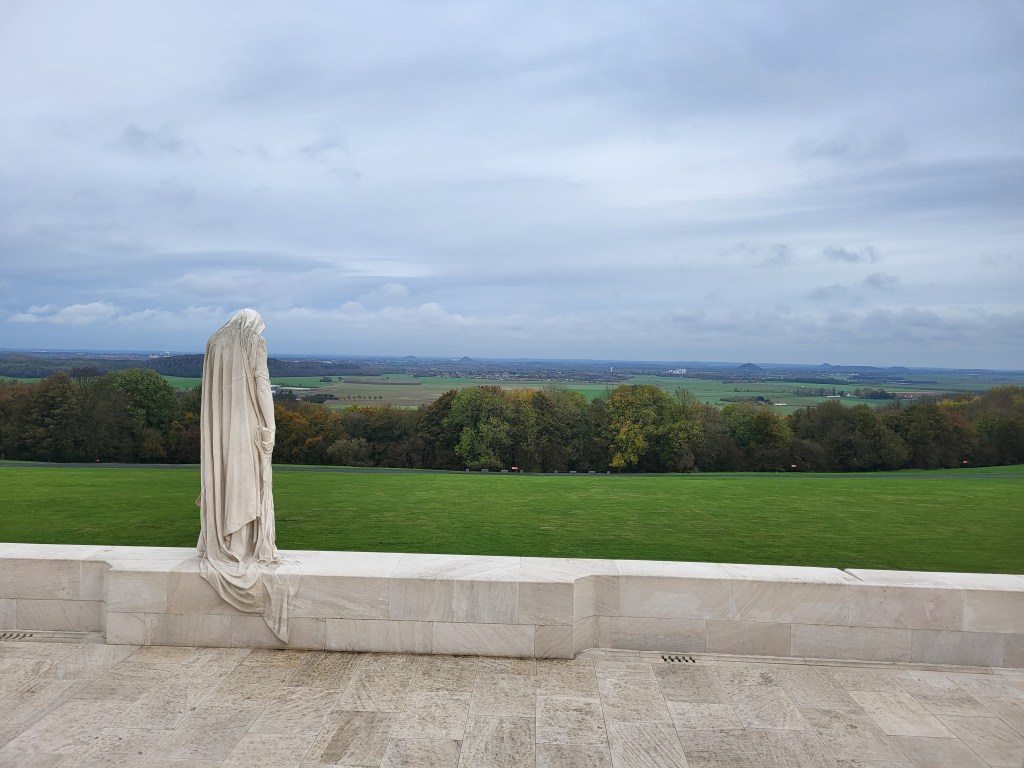
Mother Canada weeping for her lost sons – Vimy Memorial overlooking the Douai Plain, France
The Boys from Alberta
20 February 2024
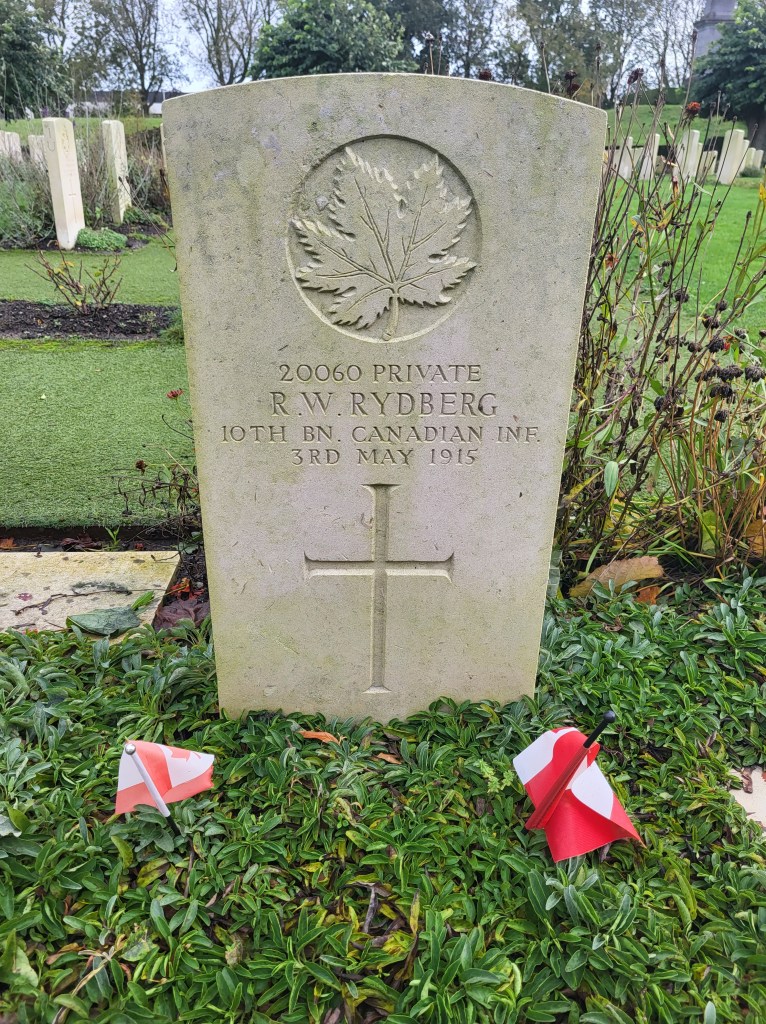
Private Roy Weldon Rydberg
Two brothers: both big Viking men, both violently killed, but five years apart. How much pain would their hard-working farmer father have felt?
Emil Rydberg was an 18-year-old with big dreams when he moved from his hometown of Alingsas, Vestergotland, Sweden to the United States in 1881. He married 14-year-old Jenny Era from Missouri and soon had two blue-eyed, blond sons, Roy Weldon and Ray Victor. Emil worked as a driller, presumably in the zinc mines of Missouri, but in December 1901, Jennie died, leaving her 7- and 5-year-old sons in their father’s care. In 1904, Emil uprooted his life once again, moved his family to Alberta, Canada and took up farming. In 1907, he married an ex-pat English girl, Caroline, from the farm next door, and Ray and Roy soon had a small herd of half-siblings: Annie (1908), Selma (1910) and little Emil (1913). Roy would, however, never meet the youngest of his sisters, Mary (1916) and Jean (1919).
Roy was only 16 years old when he applied for a parcel of land of his own, declaring his intention of becoming a British citizen; Canadian citizenship was still nearly 40 years in the future. In 1914, he was still unmarried and so he ventured into Calgary to sign up with the 103rd Calgary Rifles in September 1914, in time to train in Valcartier, PQ and sail on – appropriately enough – the SS Scandinavian with the First Canadian Contingent. In Salisbury, Roy got into a bit of trouble, earning 14 days’ detention while at Sling Plantation, but that wasn’t an uncommon occurrence for the rowdy Canadian troops. Roy was transferred into the 10th Canadian Infantry Battalion, and in April 1915 was in the Ypres area. On the history-making day of 22 April 1915, the 10th was in Divisional Reserve in the town of Ypres, having been sent there on the 19th. Two of the battalion majors and a captain were riding from Elverdinge, 6km northwest of Ypres, to Breilen, when they noticed a “peculiar” coloured cloud – described in the war diary as “greyish, yellowish, greenish” and dark – hanging low to the ground. It was the German release of chlorine gas, the first large-scale, successful gas attack of the war. The French territorial troops in its path had no idea what was happening and no chance at all.
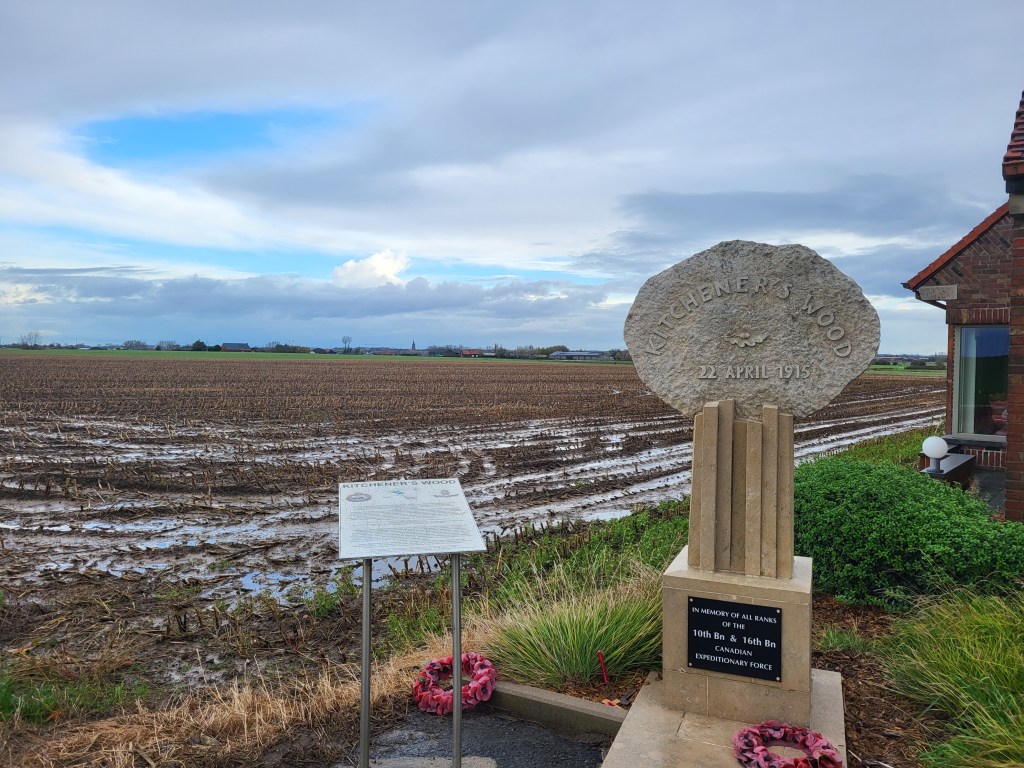
View of the area where Kitchener’s Wood used to be. The 10th Battalion attacked across this field; hundreds of Canadians died in this spot. (photo author’s collection)
At the same time, the shelling of Ypres had intensified, the Germans using what was noted as their “heaviest of guns”. At 5:20pm, Roy’s 10th Battalion was told to report to Weiltje, a small village NE of Ypres, deeper in the Salient. They arrived at 7:45pm and were given orders to take back Kitchener’s Wood and its captured British guns from the Germans. At 10:47pm, the 10th was lined up waiting for the 16th Battalion to join them. The moon was full enough that the woods and the fields they must cross were clearly visible. An hour later the order to advance came. Fifteen hundred men, shoulder to shoulder, walked across the dark fields. Not a sound was heard but the “soft pad of feet and the knock of bayonet scabbards against thighs” wrote Major D.M. Ormond in the battalion war diary. Halfway across, the men found a hedge and the sound of them breaking through “brought on a hail of bullets”. A moment’s panic, and the Canadians burst out running, but their close formation – a hold-over from 18th century battles – meant casualties were massive. Despite this, they took the woods, recaptured the guns but it was futile. HUndreds of yards deep into the enemy lines, surrounded on three sides, their position was untenable. Destroying the guns, they retreated and entrenched just south of the woods; the cost of their attack was terrible. At 6:30am on the 23rd, it was noted that out of 816 “other ranks” (all those lower than officer rank), there were 188 men left – Roy one of them. The 16th faired little better, having 263 other ranks left. Only 5 officers were left in each battalion.
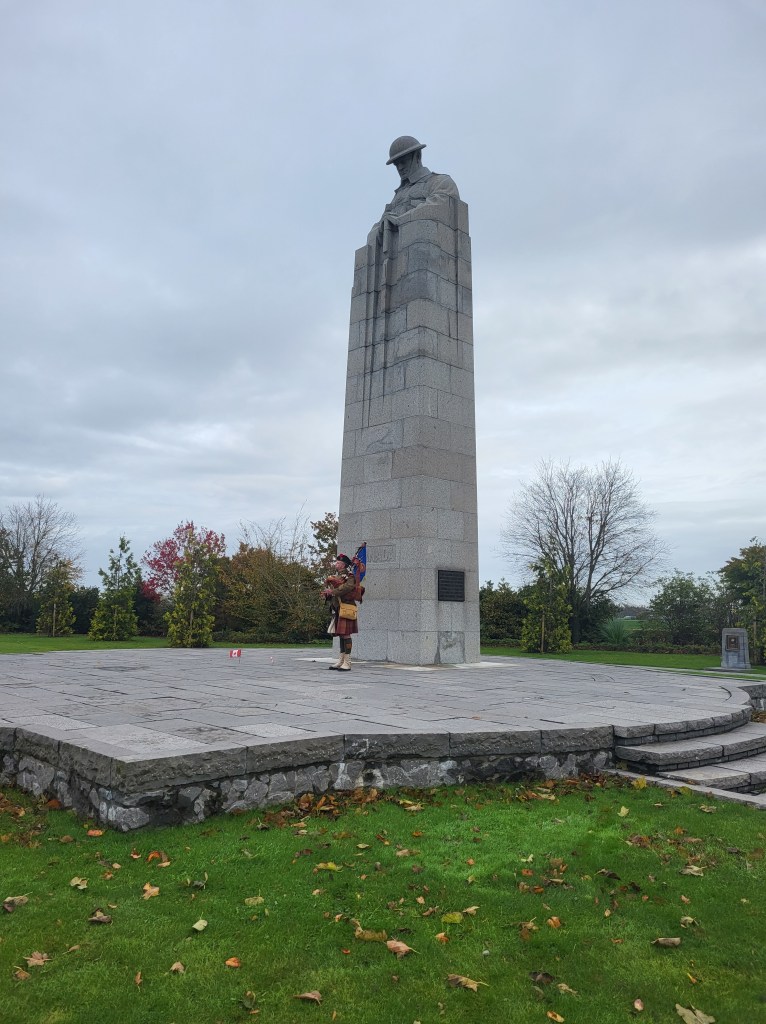
The Brooding Soldier Monument to the First Canadian Division at St. Julien (photo author’s collection)
What remained of the 10th fought on that day where they had dug in, and on the 24th of April, were moved to Gravenstafel Ridge, halfway between St. Julien and Passchendaele. By the 25th, the battalion had no senior officers left, no one to keep the war diary updated, but we do know they saw continuous action. On the 29th of April, they were pulled back and took up a position on the west bank of the Yser Canal just south of a regimental aid station in a make-shift bunker, manned by then-Major John McCrae who would in the coming days pen the most famous and popular poem of the war. On 1 May 1915, the remnants of the 10th Battalion endured heavy shelling and heavy casualties, and still Roy survived. But his time was limited, and just two days later, on 3 May 1915, under another bout of heavy shelling, Roy was killed. The same day McCrae took pen to paper. Roy was laid to rest in what became Essex Farm Cemetery, and where today, a monument is erected to McCrae’s poem, In Flander’s Fields.
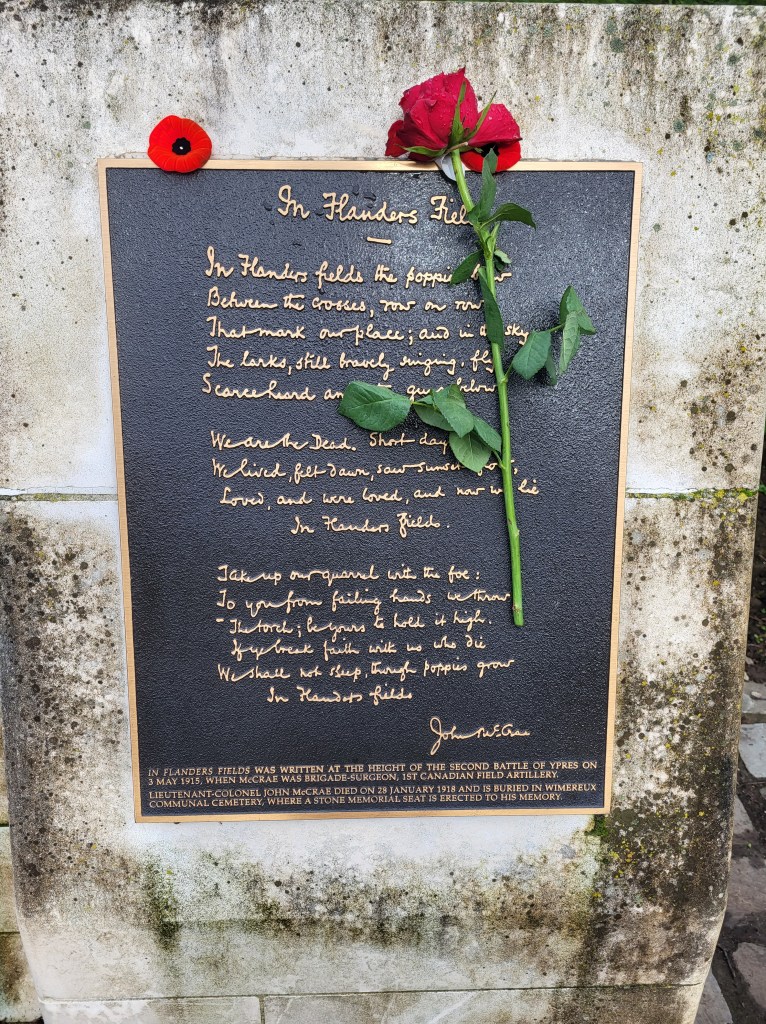
Monument at Essex Farm (photo author’s collection)
And what of the other Rydberg brother? Ray, who went by Victor, was listed as a farmer but may have been part of the Royal Northwest Mounted Police (later to become the RCMP). He finally enlisted in May of 1918. While he made it to England, as part of the Canadian Reserve Cavalry Regiment, he was struck down by pneumonia and discharge with asthma, arriving home a year later. He never made it to the Front. It seems Victor became unsettled in life and fell into bootlegging. In 1920, at just 24 years old, he was shot and killed by police near the American border. His despairing father and step-mother had to fight the American authorities to retrieve his body. An article documenting the event seems to have mixed him up with his brother Roy, placing Victor incorrectly in the 10th Battalion. Emil had lost both his sons from his first marriage, and his three youngest children would never know or remember either of their older brothers.
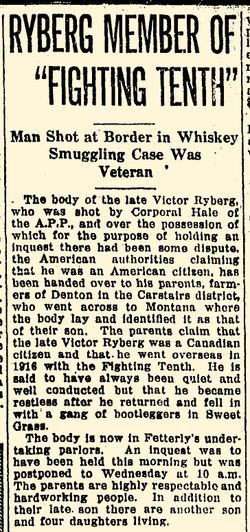
The Gales of November Came Early
15 February 2024
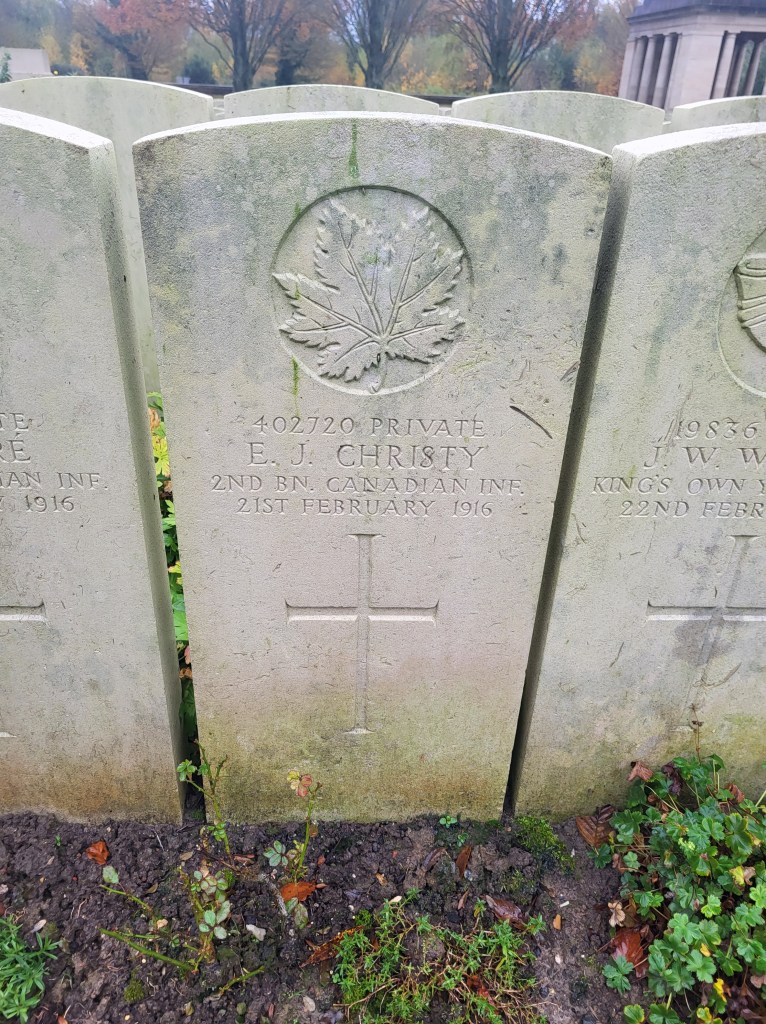
Private Edward James Christy
Every Canadian – at least those over a certain age – feels deeply when they hear these words sung:
The legend lives on from the Chippewa on down
Of the big lake they call Gitche Gumee
The lake, it is said, never gives up her dead
When the skies of November turn gloomy
With a load of iron ore twenty-six thousand tons more
Than the Edmund Fitzgerald weighed empty
That good ship and true was a bone to be chewed
When the gales of November came early[1]
And what does the 1975 wreck of an American ship in a November storm on Lake Superior have to do with a soldier killed in the First World War? Edward James Christy was a survivor of the worst – if not the most famous – November gale to hit the Great Lakes. And perhaps that gave him an overly optimistic view of his chances of surviving a war.
There is very little information available about this young man, aged only 23 when he died. His parents, it seems, registered neither his nor his sister Lillian’s birth; she registered her own at age 71 in 1966. If Edward had more siblings, I can’t find them, but I suspect not. There is no record of his parent’s marriage, or Edward’s. It seems his local newspaper knew of one, even though Edward denied being married on his attestation papers. What we do know is he was born 6 August 1892 to Hugh and Nellie (Sullivan) Christy; Lillian came along three years later. Blue-eyed and blond, he must have been his parent’s delight, their literal “fair-haired child”.
The family lived in the Barrie, Ontario area but it seems later Nellie was living in Collingwood on the shores of beautiful Georgian Bay, Lake Huron. In 1908, Hugh, a plasterer, died at age 44 of pulmonary TB, perhaps from years of breathing plaster dust, leaving 16-year-old Edward as head of the family. In 1915, Edward’s profession was listed as a steward, on a ship plying the Great Lakes presumably, and I also assume he was working as such, or at least some position on board, two years earlier.
The Great Lakes are so unfathomably large and deep – carrying over 20% of the world’s fresh water supply – they act like seas, and with hundreds of miles of open water, the winds can build the waves into monsters. When the cold north winds start to blow over the still-warm water of the lakes, the result is the Great Lakes’ famous “gales of November”. In 1913, two fronts collided to create the deadliest lake storm in recorded history, a blizzard with hurricane-force winds that killed 250 people, sank 19 ships and stranded 19 others, and dumped many feet of “lake-effect” snow. Called the “Big Blow”, the “Freshwater Fury” and the “White Hurricane” by the press, winds topped 140kph and the lakes saw waves up to 11 metres. Somewhere in this storm, Edward was on board ship, was one of the lucky ones and survived. His mother was probably incredibly relieved to have her son safely home after that!
In January 1915, with the First Contingent of men not yet at the Front, Edward decided to sign up for the war. Perhaps his adventure of two years before gave him a taste for more. Perhaps life seemed a little dull compared to the excitement of travel to Europe and a little fighting. He ventured to Sarnia, Ontario and on 28 January 1915 passed his medical exams. At 5’ 6”, he wasn’t terribly tall – he’d never make a gunner – but was of average height for the time and fit. He was signed on to the 34th Battalion and set sail from Montreal on the SS Hesperion on 17 August 1915. On arriving in Shorncliffe, he was placed in the 9th Reserve Battalion. Hundreds of thousands of Canadians – the ones that came after the First Contingent – spent their first months of overseas training in the lush, bucolic fields around Folkestone and lived in the army camp at Shorncliffe. It must have been beautiful that late summer and fall. But all good things come to an end, and on 3 January 1916, Edward finally made it to the trenches, joining Jim Johnstone in the 2nd Battalion, then in the Messine area, near Wulverghem, Heuvelland, Belgium. Over the next few weeks, the battalion was rotating in and out of the front line, but always in this location, marked D1 to D4 in the war diary. I was able to match these locations to current maps and visited the exact site. Now it is a quiet, peaceful place of rolling fields, small stands of trees, the steeple of the church in Mesen (Messine) easily visible. Then, the Germans were in lines a few hundred yards away, and raising your head to look at that steeple would have risked a sniper’s bullet. But it wasn’t the enemy who ended Edward’s war. He took care of that himself.
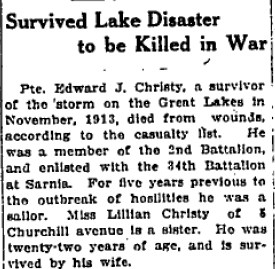
In the FWW, hand grenades were called “bombs” and special training courses were held to learn how to make and throw them. By 1917, they were standard kit for Canadians, but this was early 1916, and the armies had only been issued them late in 1915. Perhaps Edward was given one, perhaps he’d had some bomb training. Perhaps he picked it up thinking it was a lark to have one. Either way, he stuck it in his pocket, and somehow, while Edward was on sentry duty, it detonated. Despite immediate medical care, and despite being rushed to the No.8 Casualty Clearing Center, where teams of surgeons had state of the art surgical units, Edward died of his wounds. Abdominal wounds, of which this most likely was, had a more than 50% mortality rate.
Mrs. Christy’s fair-haired child’s luck had run out after just seven weeks at the Front.
Edward is buried at the Bailleul Communal Cemetery Extension, in Bailleul, France, 14.5km southwest of Ypres.
[1] Gordon Lightfoot “The Wreck of the Edmund Fitzgerald”
A Tale of Two James
12 December 2023
Private James Ward Maxwell/Sidey
James W. Johnstone and James W. Maxwell. They were both in the 2nd Battalion, occupying a quiet line of trenches just northeast and up a slight rise from R.E. Farm cemetery. Maxwell fell the day after Johnstone: the 23rd of February 1916. Neither were mentioned in the battalion war diary as having given up their lives, but James Maxwell was accorded even less attention (if possible) than Jim Johnstone. The war diary coldly states “Day very quiet. Nothing of note.” James Maxwell – somehow, I do feel he went by Jimmy – was not nothing. Maxwell, like many of the first Canadians to enlist was British born, in Edinburgh, Scotland to be precise. And Maxwell was not his real name.
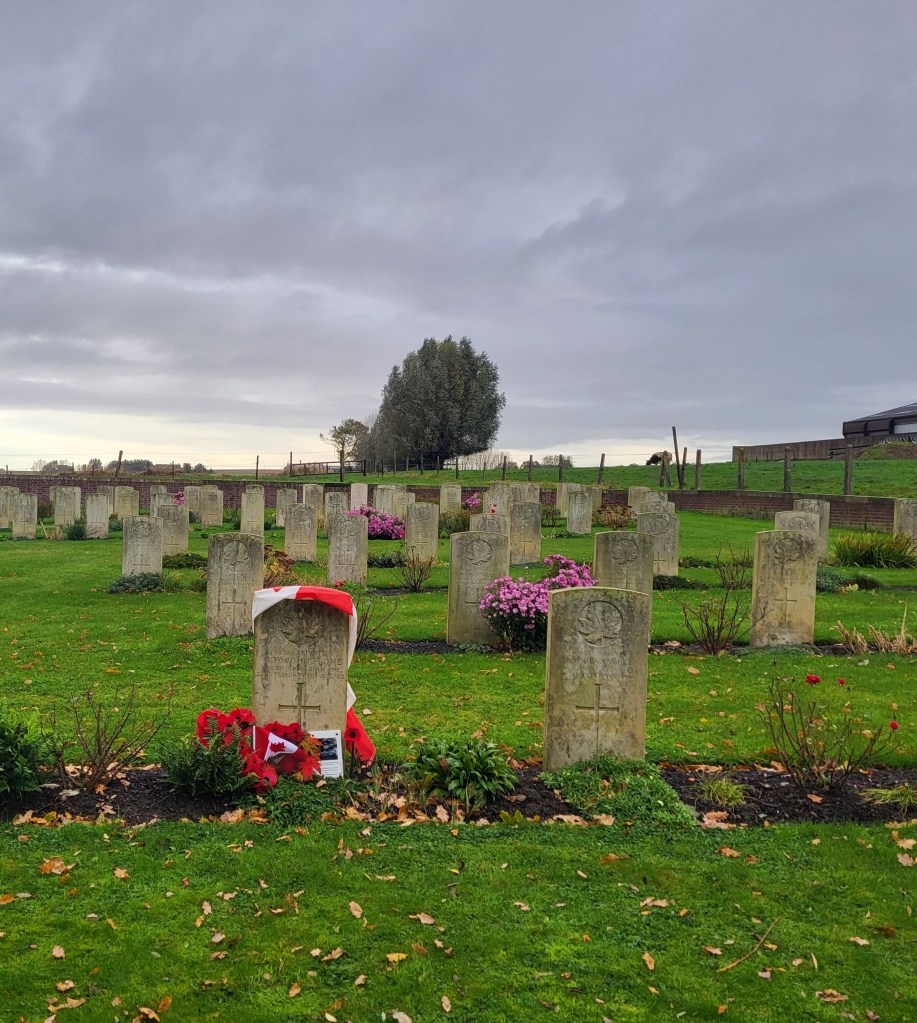
James Johnstone (left) and James Maxwell (right)
James Ward Sidey came to Canada in 1911 with his father William Sidey, and brothers John, Robert, and Thomas, from Dublin, Ireland. He left behind a sister Isabella and his mother, also Isabella, who had remarried a man named William Maxwell. The Sideys joined James’ older brother William Charles who had come to Toronto, Ontario in 1908. James worked as a painter and in 1914 was care-free and single.
At the outbreak of the war in August 1914, brother Robert likely left for the UK to enlist with the BEF, as there seems to be no Canadian records. He was killed in January 1915 in action, before the Canadian First Contingent (excepting the Princess Patricia’s Canadian Light Infantry) got to the Front, which goes somewhat to confirm this. On the 26th of January 1915, James signed on, too, perhaps because of his brother, but using his stepfather’s last name – Maxwell – and giving their address in Dublin for his next-of-kin. He assigned his pay to his mother.
At 5’ 3” and a slight 125 pounds, James was unlikely to have been accepted in the first round of recruiting. However, he was accepted into the 34th Battalion that January and began training. From the very beginning, he proved full of high-spirits, or just plain defiance, or maybe it was the beautiful summer weather. On six occasions between May and August of 1915, he was deducted pay for misdeeds, and served 5 days in detention on one occasion, and 96 hours on another. He hadn’t even left the country, yet! On the 23rd of October 1915, he finally sailed for England. At this point, James was transferred into the 9th Battalion, Jim Johnstone’s original one, which was in reserve in England. Sidey was not done with his bad behaviour, though. In December 1915, he decided to travel to Dublin to visit his family there, whom he hadn’t seen in 4 years most likely, so one can’t blame him, being the Christmas season and all! However, James had no leave and was 14 days “Absent without Leave”; he lost 17 days’ pay.
Just before Christmas, James Sidey finally was transferred into the 2nd Battalion and on the 3rd of January 1916, arrived at the Front. For the 2nd Battalion, this was a line of trenches just north of the tiny village of Wulverghem, Heuvelland, Belgium, within sight of Mount Kemmel and the Messine Ridge where 19 mines would be blown in 1917, one of the largest non-nuclear explosions and considered then the loudest man-made noise in history. Six of these mines were never used; one exploded in 1955 after a lightning strike, one sits currently under a farm and is still a danger to the family living there.

Looking east from the approximate line of the 2nd Bn trenches in February 1916, toward Messine Ridge (Mesen).
Jim Johnstone was on leave in London when Sidey arrived to join the battalion, and in his own words, was not much interested in meeting new people at that point anyway. He had lost so many friends, it seemed pointless to make new ones. The two James’ perhaps never met or interacted much. How ironic that they would die a day apart – Johnstone having served a year at the front, Sidey 7 weeks – and lie forever side by side, companions in death if not life.

John William Sidey, James’ oldest brother, on hearing of the loss of a second brother at the front, said “I am going now.” At 35, John was getting a bit long in the tooth, and while his attestation papers were signed in March of 1916, he was discharged in August as medically unfit, with the comment that he should never have passed the medical to begin with. A newspaper clipping mentions two other brothers in khaki. I found one: William Charles, who also gave a false name, Wallace this time, and his father as William Wallace, when he enlisted in December 1915. William, a sapper, was gassed and in hospital in Etaples in May 1918 when he was further wounded in the air raid on the Canadian hospital which killed 66 staff and patients, including two Canadian nursing sisters. William never returned to the front, being discharged in October 1918. James’ father was denied his War gratuity for deceased soldiers, having been granted money for William. Of the fifth brother “in the ranks” – presumably Thomas – there is no evidence he signed up in Canada under the name of Sidey. Perhaps he, too, used an alias.
A Pilgrimage to the Sacred Lands
8 – 14 November 2023
A dream came true this November, when I finally made my long-delayed trip to the Ypres Salient and paid a visit to Jim Johnstone. It absolutely was a pilgrimage, a journey of remembrance. A person cannot travel the roads of northern France and Belgium without being struck forcefully by the world’s loss in young men. Who knows what they may have accomplished, had they lived?
We flew into Paris early in the morning, and rented a car, immediately setting out for the Front. Stops that first day included Thiepval, Beaumont-Hamel and Vimy, before arriving in Ypres. In the pouring rain, we attended the daily 8pm ceremony at Menin Gate. Unfortunately, the Gate is undergoing a 2-year restoration project and is completely shrouded from view. Despite this, the scale of its size was breathtaking and humbling; it is so much larger than I had thought. I did manage to peer in a few cracks to see some of the panels! Remembrance Day at the Menin Gate was an experience never to be forgotten. The dedication to honouring our fallen by the Last Post Association volunteers is unprecedented and unwavering; they celebrated their 33,000th ceremony this fall, and have daily honoured the 55,000 men named on the Gate since 1928 (other than during the German occupation of Ypres during WWII).
Over the next days, we visited the Brooding Soldier, Essex Farm, Langemarck German cemetery, Ploegsteert and Jim. We saw Hill 62, Sanctuary Wood, Hill 60, Tyne Cot cemetery, Sint Eloi, Mt. Kemel, Messine Ridge, and Passchendaele where we took part in the November 10th commemorative walk. As a side trip, we drove to Boulogne, where the many hospitals were based, Wimereax Cemetery, Calais, Dunkirk – site of the miraculous evacuation of British troops in 1940 – and Bruges (highly recommend!). We visited many, many cemeteries, from which I chose at random a Canadian soldier. These men will be featured here over the coming weeks and months.


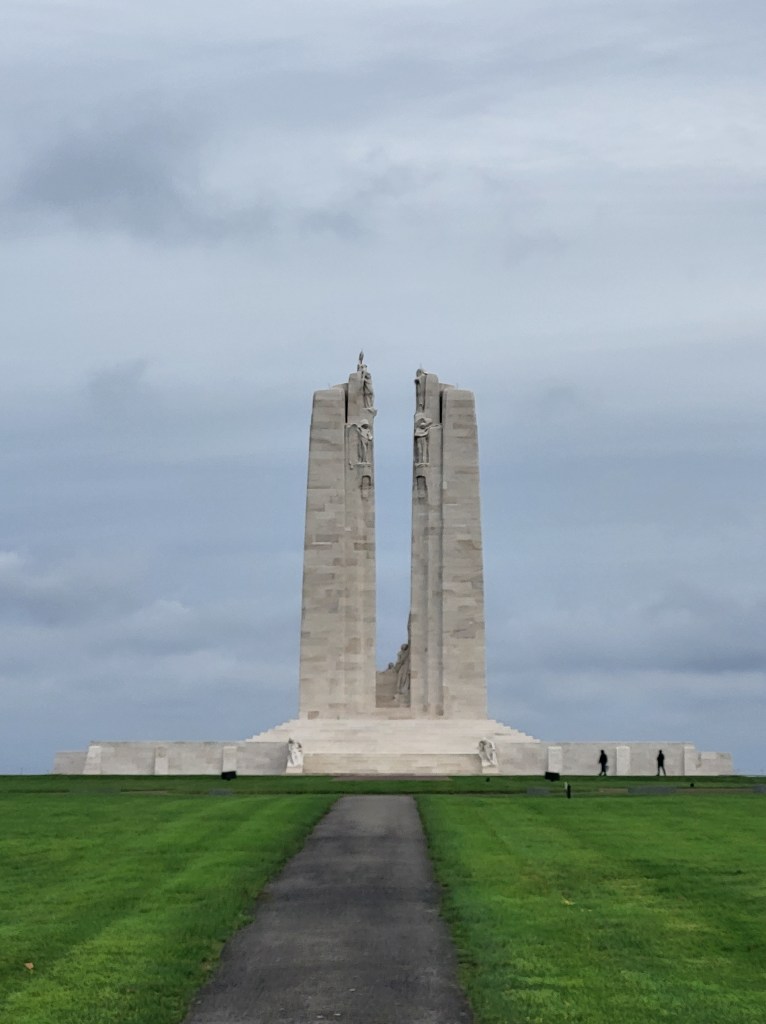
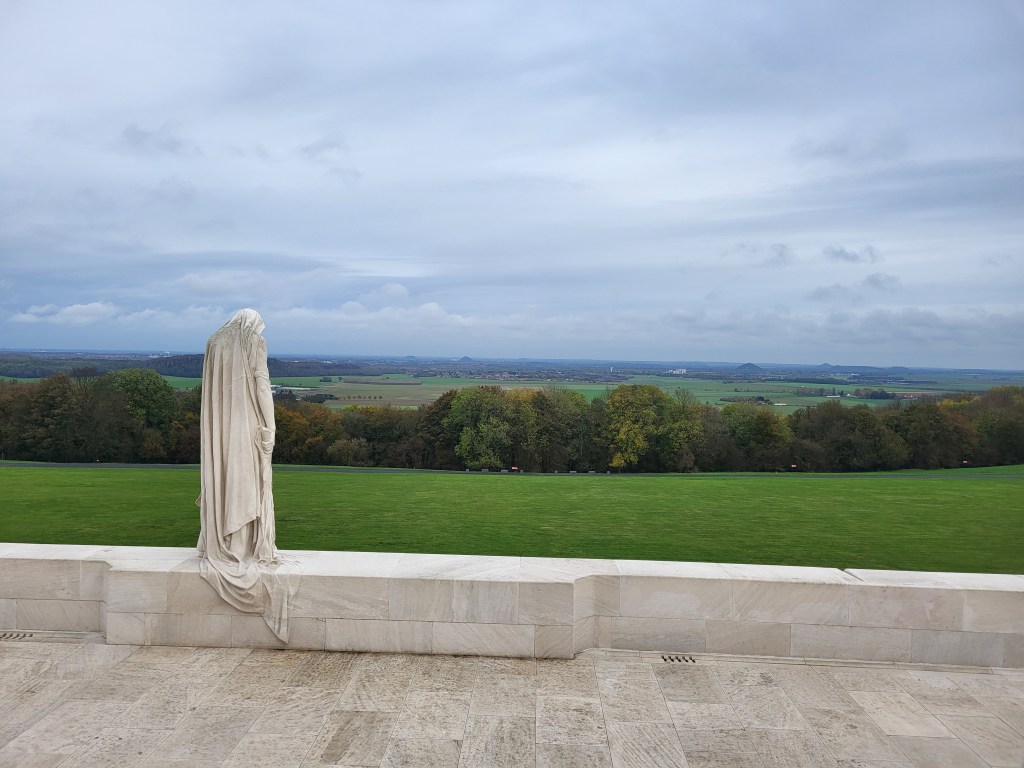

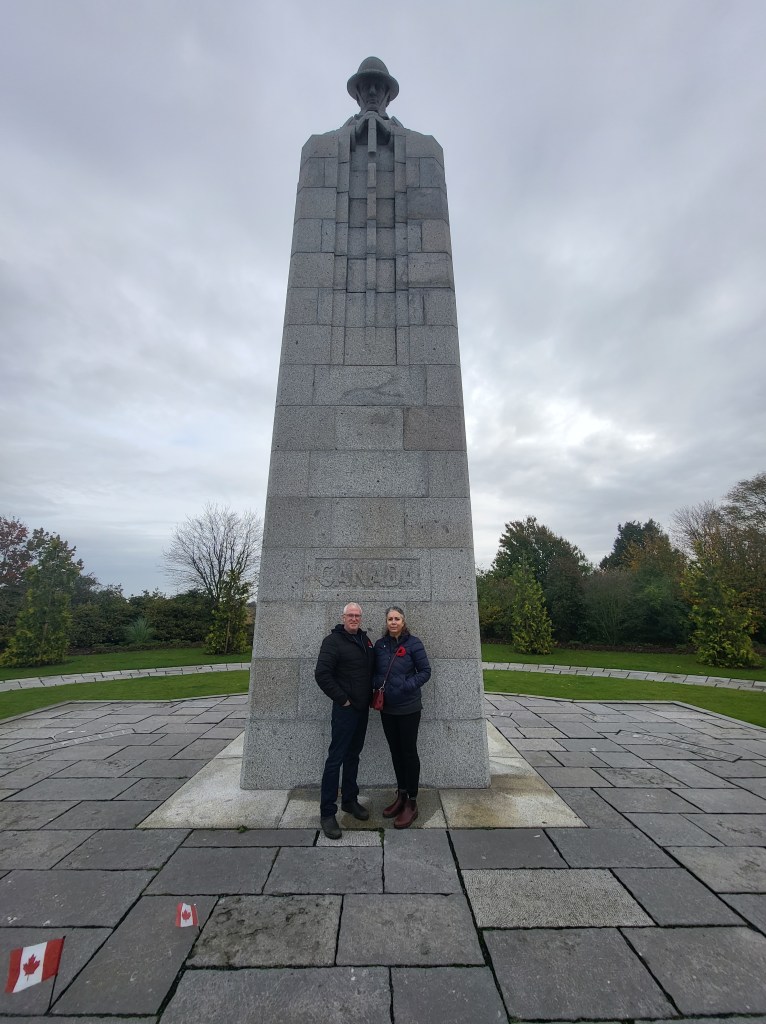
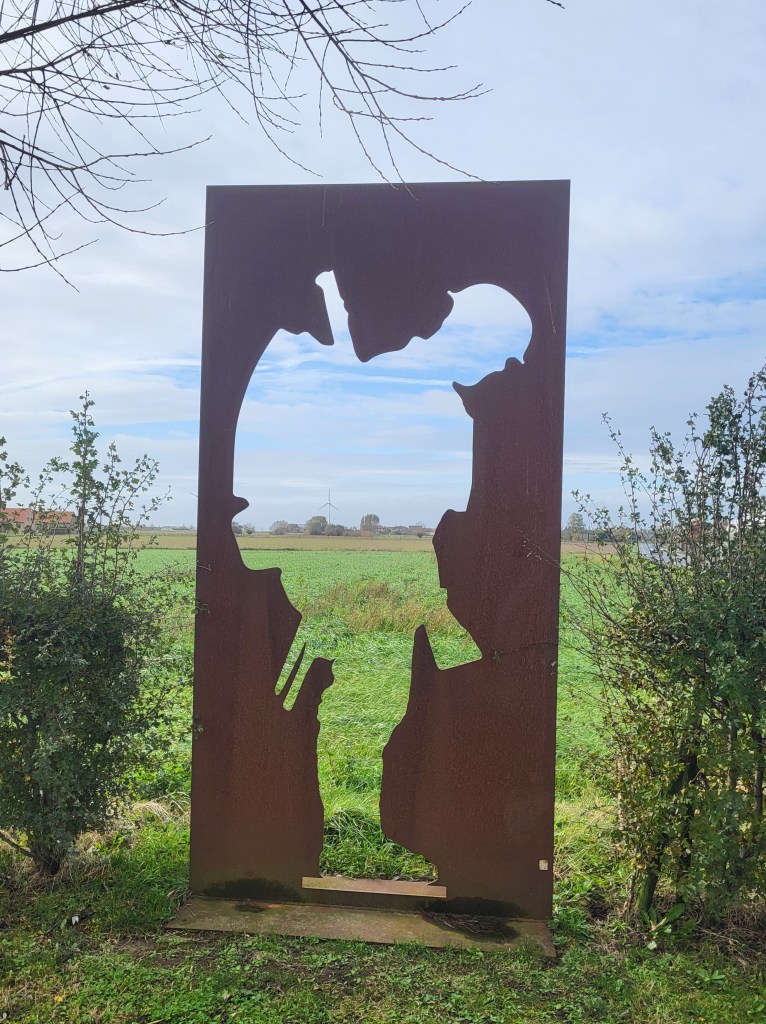
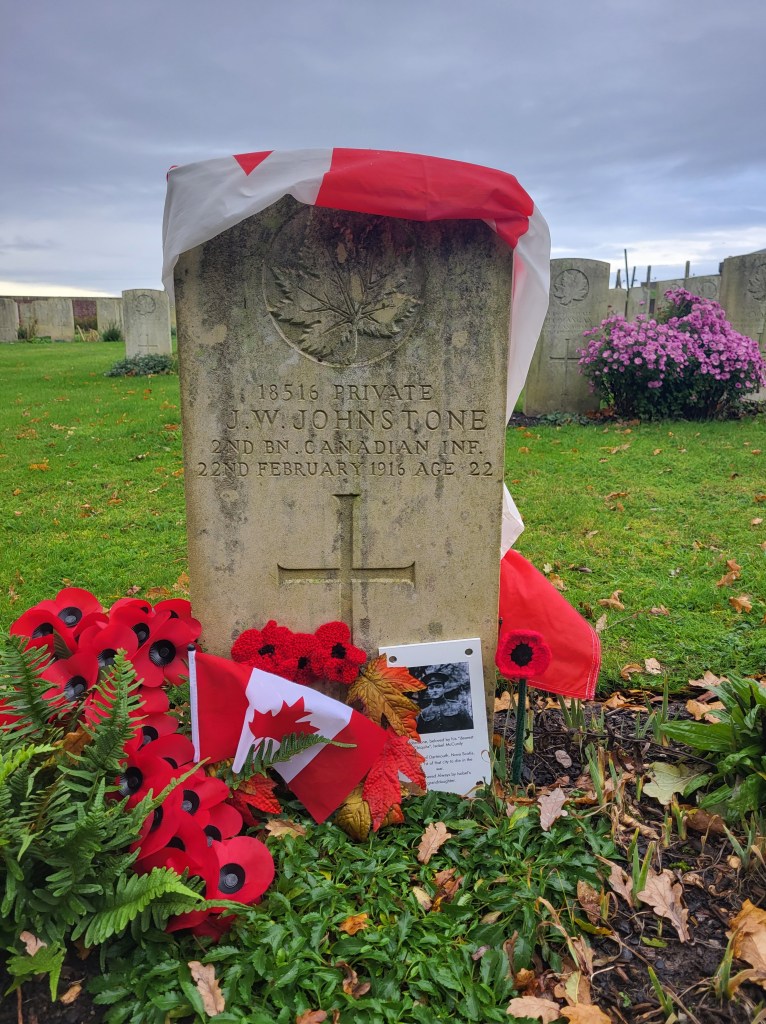
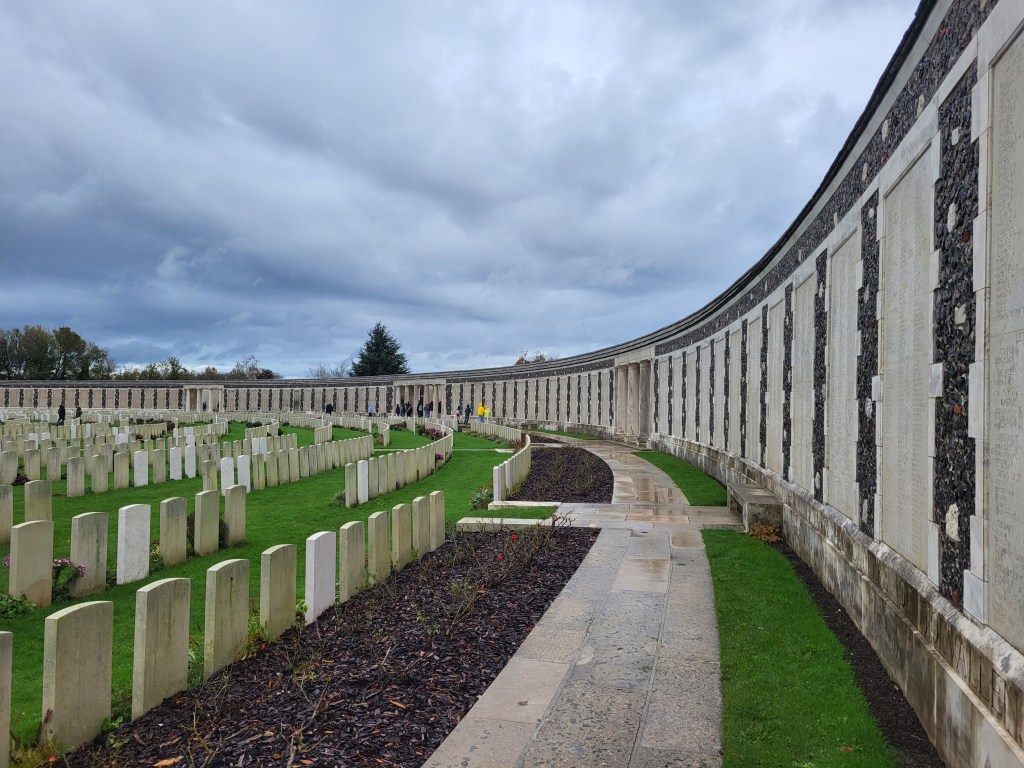
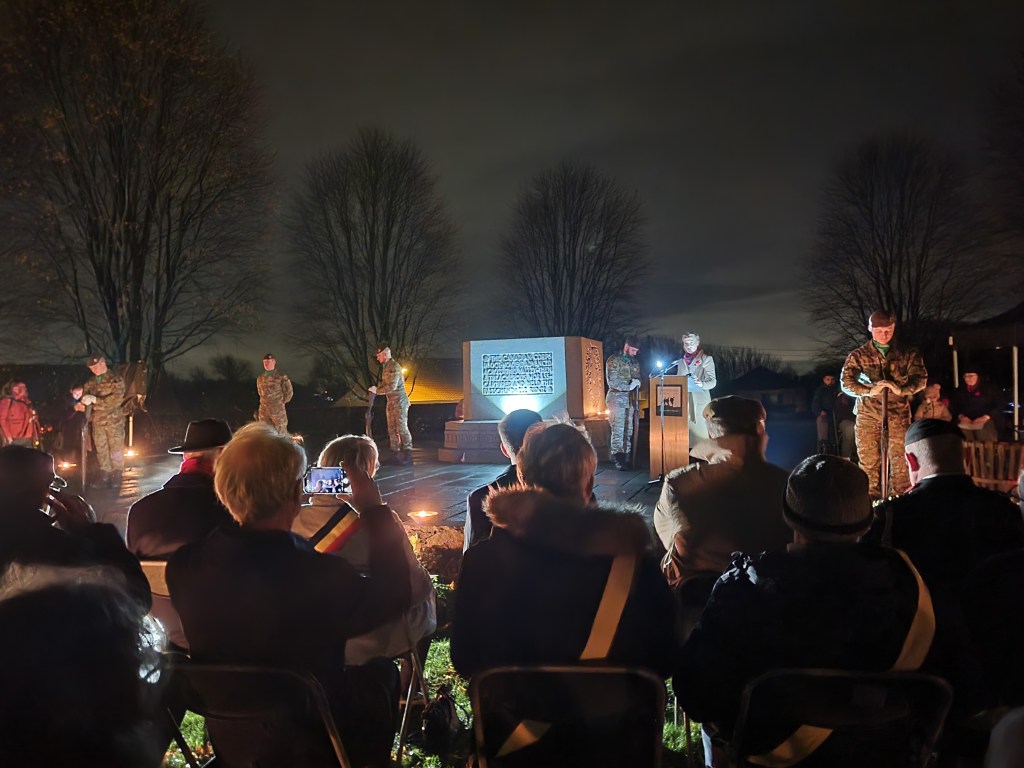
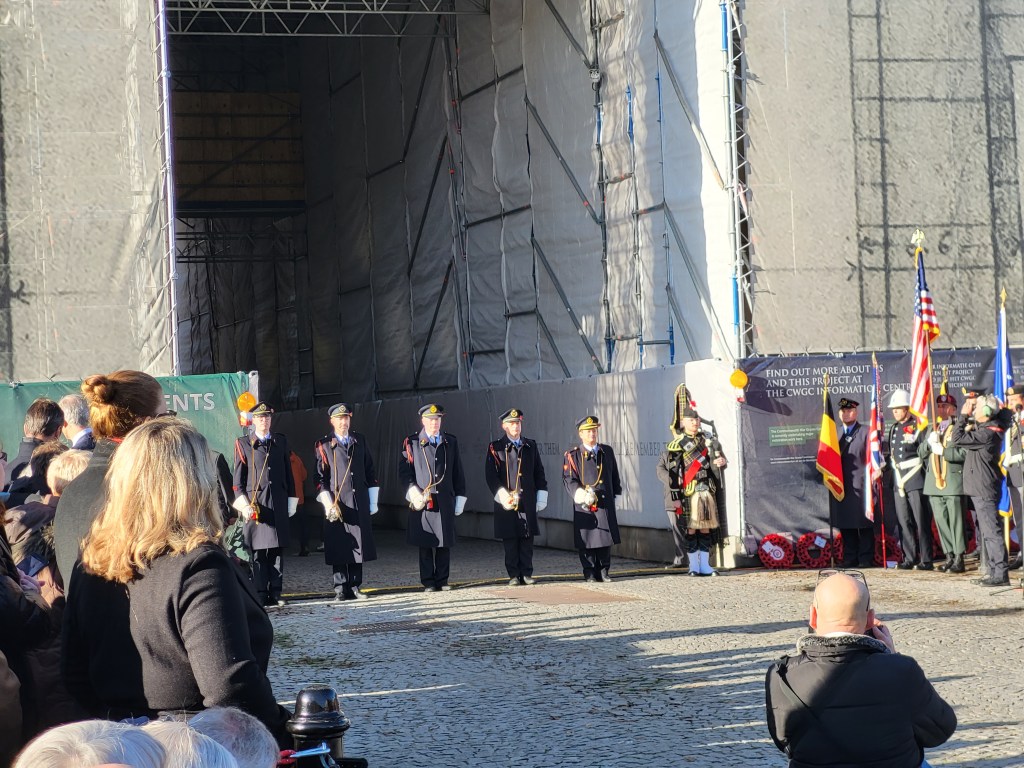
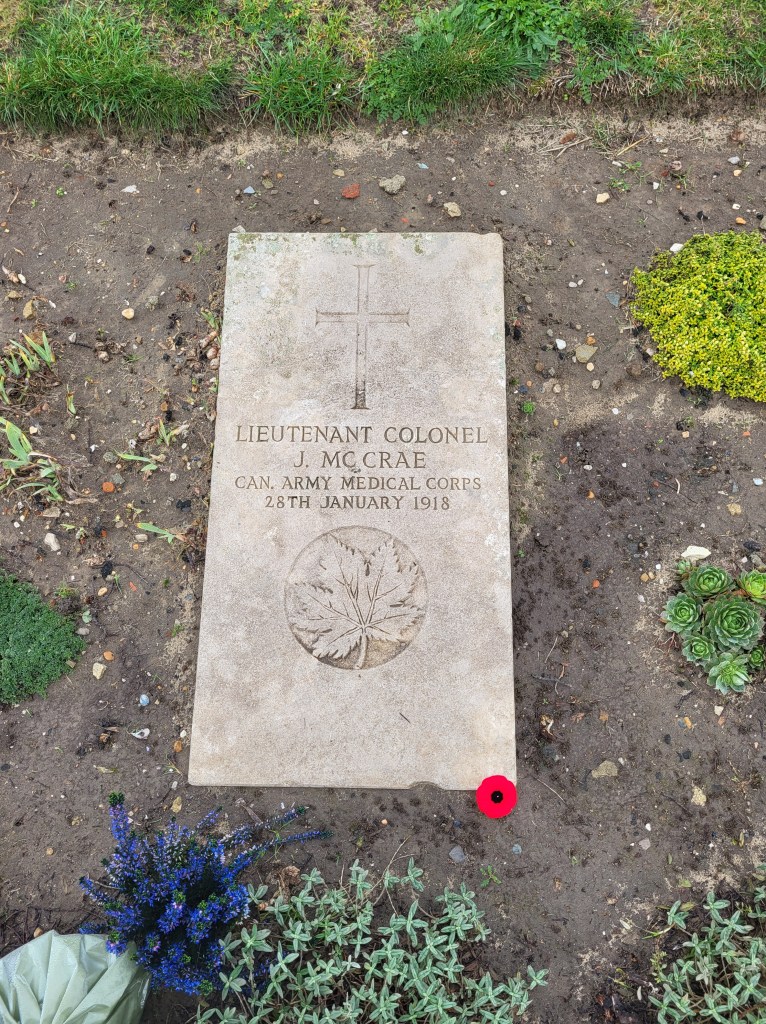
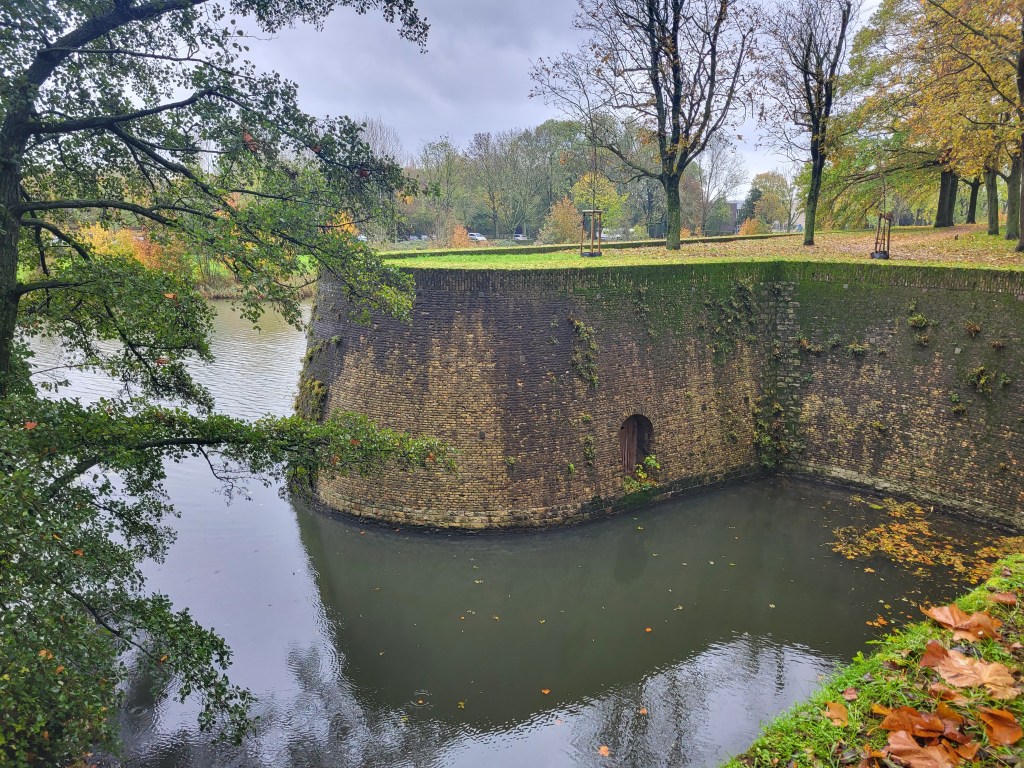

He Will Not Return To Me
23 August 2023
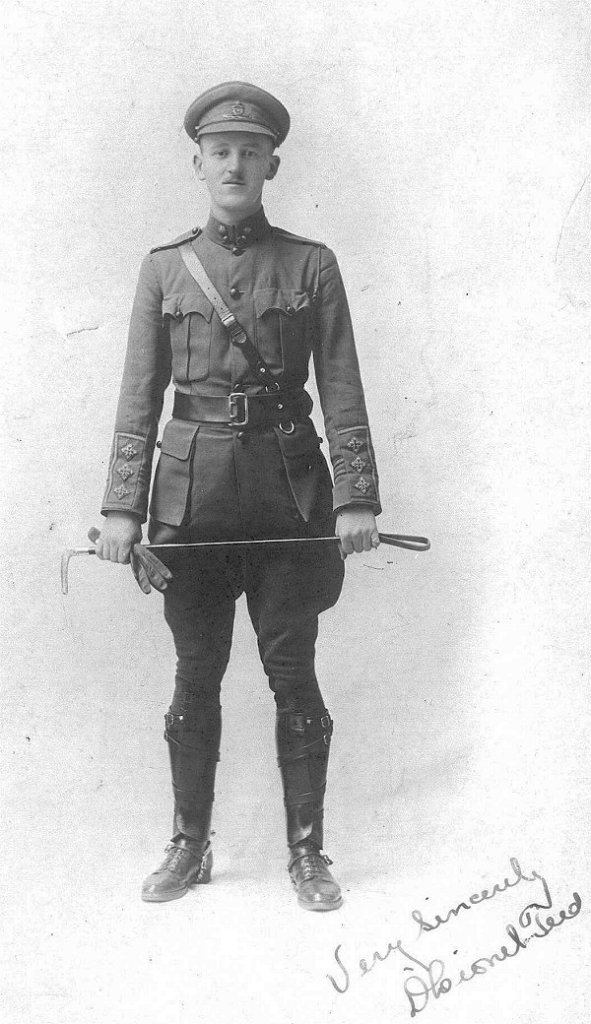
Lieutenant Daniel Lionel Teed, MC
He’d followed in his brother, Hugh’s footsteps, attending Rothesay Collegiate School and the Royal Military College in Kingston, Ontario, and in January 1916, he again joined his brother, enlisting in the Canadian Expeditionary Force as a Lieutenant. Daniel Lionel Teed – who went by Lionel – would also follow his brother in sacrifice. M. Gerald and Margaret Teed would endure the heartbreak of losing a second son just two months before Armistice, when the end of the war was firmly in sight and the Canadians were storming through German defenses in the Hundred Days Offensive that would help win the war.
Lionel was the Teed family’s third son, born 12 October 1893 and still a student living at home when he enlisted in the 36th Battery, Canadian Field Artillery. Tall like his brother, he wore his uniform with dash: jodhpurs, leather puttees and polished spurs, a riding crop in hand rather than a stick. Two months later, 13 March 1916, he sailed for England on the S.S. Missanabie, the same ship brother Hugh had traveled on when home on medical leave the previous summer. After attending a Howitzer course at Bramshott, Lionel embarked for France on 13 July 1916 and set up with the 36th Battery in one of the “hot spots”, in the Ypres Salient. Within 24 hours, they came under very heavy shelling, quite a trial by fire. In August, they were transferred to Kemmel, a quieter area, then in October 1916 headed for the Somme. One thousand yards behind the lines at Courcelette, the battery was still the target for their counterparts on the German side, but their Commanding officer, Major Daniel A. MacKinnon proudly stated they returned 100 shells for every one that came their way. In April 1917, Lionel participated in the attack on Vimy Ridge, his battery part of an unprecedented nearly 1000-gun barrage that opened the battle.
Trench fever felled Lionel in the late spring of 1917. Spread by the ubiquitous lice, it caused high fever, headaches, abdominal and bone pain. Treatable now (it is found among the urban homeless population) by antibiotics, then a man suffered through until it ran its course.
It was in August 1917, while engaged at the battle for Hill 70, that Lionel was severely wounded by a brand new and particularly vile form of chemical warfare: mustard gas. Mustard gas, “the king of battlefield gases” was, unlike chlorine or phosgene gas, an irritant rather than an inhaled gas, in that it caused severe blistering of skin, eyes and other mucous membranes. It could soak into the soldier’s uniforms and burn their skin or those who came to help them: fellow soldiers, the nurses and doctors who undressed the casualties. Gas masks were nearly useless against it. It would be weeks before Lionel rejoined his unit… in time to return to the hell hole of mud that was the Ypres Salient and the battle of Passchendaele.
By March 1918, the 36th Battery was back in France and defending Arras against the German Spring Offensive. The battery took a pummeling by an estimated 2000 German shells but as MacKinnon wrote “Some brave deeds were carried out by members of the battery…”. Lionel was awarded a Military Cross (MC). The German attacks had failed, and the demoralized army was soon under fierce pressure. Beginning 8 August 1918, Canada’s Hundred Days Offensive began: first the Germans were pushed out of their lines at Amiens, then the Drocourt- Queant Line; the Canadians crossed Canal-du-Nord, liberated Cambrai and finally, on the last day of the war, Mons where it all began for the British in August 1914. Sadly, Lionel would not see these final successes.
1 September 1918, the 36th Battery was ordered to blow the barbed wire at the Hindenburg Line and given 4000 rounds to do so. Their position was exposed, observed by enemy balloons. Their shells were falling short, so Lionel telephoned Major MacKinnon with this observation. Thinking he was not getting through, Lionel decided to run down to the No 2 gun to pass on the information to MacKinnon, the kind of brave, selfless action that likely earned him his MC. No sooner did he arrived at the gun when a German shell hit directly. Lionel, Sergeant MacKay, and Gunner John Cornfoot were killed instantly. MacKinnon called this one of the saddest blows in the 36th Battery’s entire war experience. Lionel Teed was, he said, one of the best, a brave, extremely clever officer and loved by all. But the war did not stop for fallen soldiers, not with victory in sight, and the battery moved on with the tide until the end. Lionel is buried at the Monchy-le-Preux Cemetery, Pas de Calais.
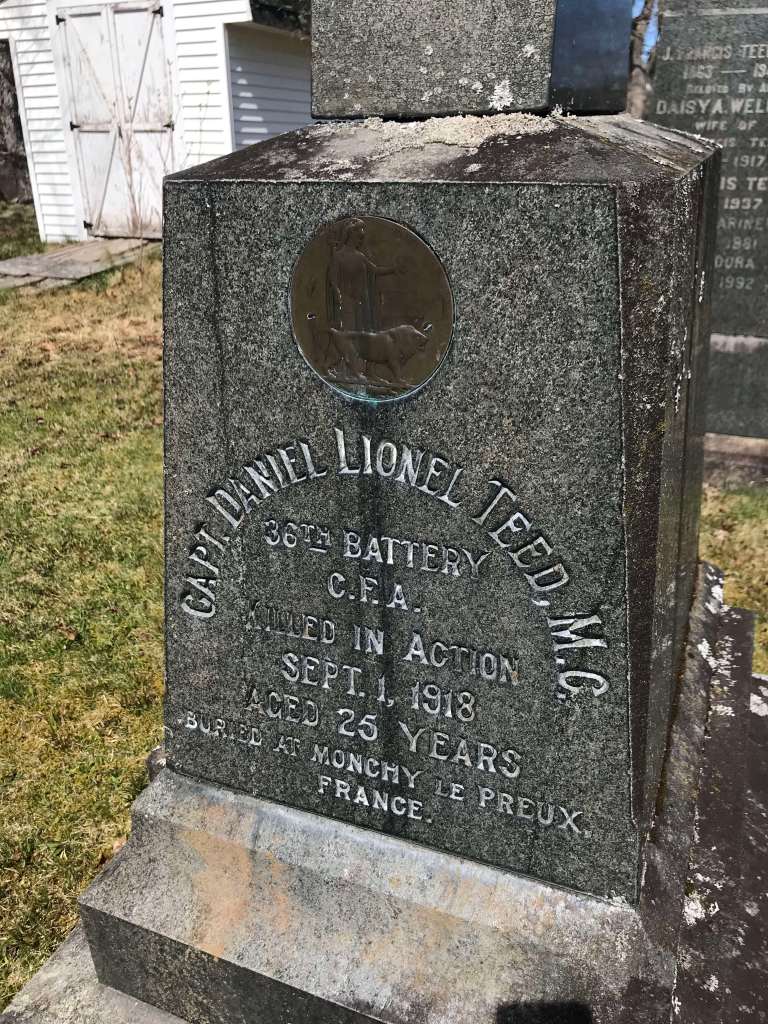
Twice in his service record, Lionel was appointed “acting Captain”, meaning he was temporarily serving in the role in place of another officer, rather than being permanently promoted to the rank.
Lionel’s oldest brother, John, welcomed a 4th son in December 1918. He named the little boy Daniel Lionel in his uncle’s memory. John’s previous son, born in June 1917, had been named Hugh Mariner. Lionel and Hugh’s sister Emily would also welcome a son in 1923; he was named Lionel Mariner in honour of both the lost Teed brothers.
To Live In The Hearts We Leave Behind Is Not To Die
14 August 2023
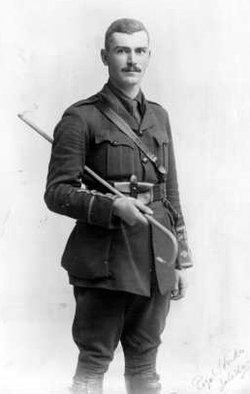
Lieutenant Hugh Mariner Teed
He was tall, a handsome young man who wore his meticulous officer’s uniform and neatly clipped mustache well. His square, dimpled chin was at home with his upright posture. No doubt he was at ease in that uniform having been a cadet at the Royal Military College. His manners were those of gentleman; his father, a well-to-do barrister and King’s Council, had sent his sons to be educated at one of Canada’s elite boarding schools. It is little wonder the daughter of a postman was swept off her feet. In January 1915, Violet M. Stacey married a dashing Canadian officer, Lieutenant Hugh Mariner Teed, who had only arrived in the Salisbury area three months before as a member of the First Canadian Contingent. A week after the wedding, he was sent to the trenches. How well did she really know her husband? How could she know what would become of the confident young man she had, in all innocence, capriciously married?
Hugh Teed was born on 21 January 1892 in Dorchester, New Brunswick, and grew up in the port city of Saint John in an elegant three-story brick home in an upscale neighbourhood. He attended Rothesay Collegiate School in the nearby community of Rothesay, NB, home to the province’s oldest and most wealthy families. Hugh was at home in Saint John, working as a civil engineer when war was declared in August 1914, and he immediately joined at the rank of lieutenant. He trained at Valcartier, PQ, and shipped overseas to England in October 1914, where the Canadians would spend the winter of 1914/15 in camps on Salisbury Plain. The soldiers and officers spent much time in the surrounding villages, and it is likely Hugh and Violet met while she was a cashier in a local book shop, a job she was doing as recently as 1911, according to the census. War gives great urgency; hasty marriages were common in the 1914/1918 conflict. Hugh, age 23, and Violet, 21, married on 30 January 1916, knowing he would soon be sent into the fighting. Indeed, Hugh proceeded to France on 7 February 1916 with the 1st Infantry Brigade, completely unprepared for what he was about to face.
April, May and June 1915 were truly a baptism by fire for the fledgling Canadian Division. First came the Second Battle of Ypres in which the Germans launched the first large scale gas attack of the war and might have overwhelmed the Ypres Salient but for 18,000 untested Canadians. Casualties were an appalling 6035 men, of which 2000 were killed. This was followed in May and June, by bloodbaths at Festubert and Givenchy; another 2900 were killed or wounded in these battles. Hugh was traumatized; his mind was broken.
On 26 June 1915, Hugh was admitted to hospital as NYD: Not Yet Diagnosed. The physicians of the Canadian Army Medical Corp (CAMC) were being confronted with a new mental disease that was to cause much controversy. We now call it Post Traumatic Stress Disorder (PTSD); it would then come to be called shell shock or neurasthenia. While the term shell shock was used as early as February 1915, it quickly fell out of favour and by May of 1915, Dr. Aldren Turner described it as a “…form of temporary ‘nervous breakdown’, exactly what was written in Hugh’s records. By July 1915, and having been sent to hospital in England, the medical boards decided Hugh had had a nervous breakdown.
While officers were given more leeway than the other ranks, this would have been hugely stigmatizing. The military felt the term “shellshock” legitimized what amounted to malingering and cowardice. Decisions in labeling and treating it were made, like many others, in an effort to get men back in the trenches, reduce the numbers invalided out of the trenches, and, in the long run, reduce the monetary liability of the government for post-war pensions. In fact, the term “shell shock” was disallowed in military and medical reports by 1916. The result was that sufferers often went from objects of sympathy, to ones of contempt.
By his medical board hearing in August of 1915, perhaps in recognition of the stigma, Hugh’s debility was now referred to as “anemia”. He complained of shortness of breath and “extreme weakness”. Blood work found his cell counts low. He was found unfit for even light duties and granted leave home to Canada from 12 August to 11 October 1915. This leave was extended to 15 November 1915. Violet joined her husband in Canada on 29 August, travelling to the family’s summer home in Dorchester, Rocklyn, a mansion built in 1831 by Father of Confederation, Edward Barron Chandler.

Rocklyn/Chandler House
The couple returned to England together on 22 November 1915. Perhaps those long months in peace, at home, went some way to healing Hugh’s trauma, but how difficult was it for him to face his return to the war?
In December 1915, Hugh was appointed acting Captain, and in January was cleared as fit for general duty. He was not returned to the front, however. Hugh bounced around for several months, from HQ in Shorncliffe to a training camp at Bramshott, and staff duties with the 17th reserve battalion. Not until 30 August 1916 was Hugh finally sent back to France, attached to the 2nd Battalion in the field. Two weeks later he was off teaching a grenade course for three weeks, having been appointed the Battalion Bombing Officer.
Hugh may not have been a prolific letter writer; his last letter to his family was on 23 November 1916. In it he seems very cheerful, happy to be at the front fighting, calling the sights over the war-torn ground “wonderful”. He described a rescue mission to the enemy line to bring back the wounded and dead, and was looking forward to his leave in December, ten days in England.
Letter to his father, dated 23 November 1916
It’s impossible to know Hugh’s mental state at this point. PTSD isn’t easily treated or cured, that we do know, and a return to the front would have been triggering for him. What we do know is on 9 January 1917, only 24 years old, Hugh died by “accident”. His circumstances of death register – registers Sip to Z all together – have not survived. We will never know if he was fatally injured by “friendly fire”, by an unfortunate mishap with a grenade during training (most likely) or worse. The family were told, or chose to believe, he was “killed in action” and they were not wrong. Hugh Teed deserves to be remembered with compassion, and to be honoured for his sacrifice, as much as any of the men killed by enemy fire.
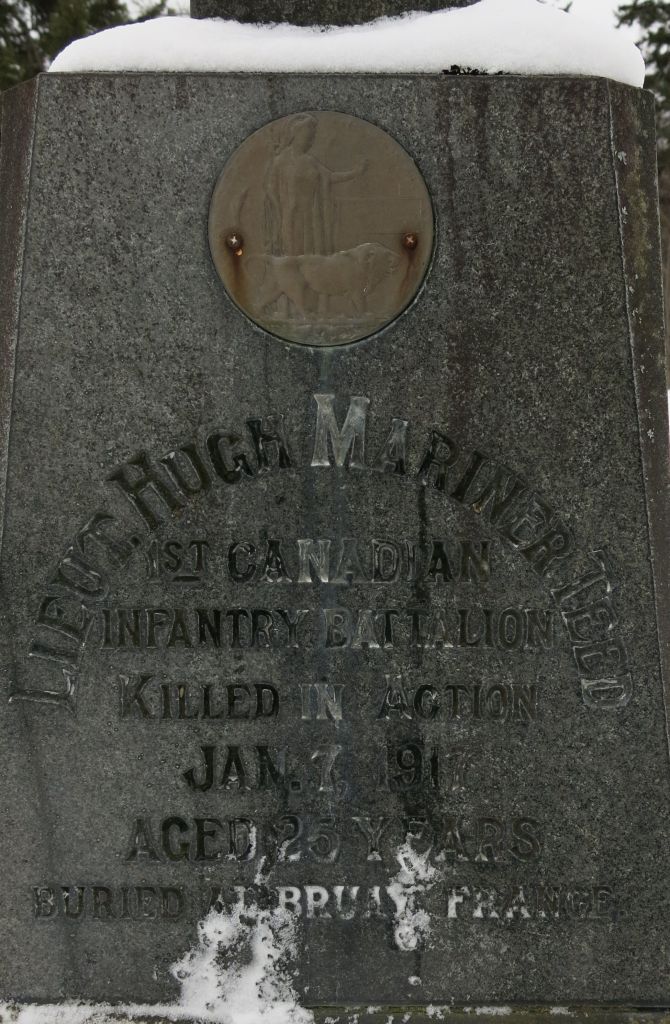
Hugh’s “death penny”, the memorial plaque issued to families, has been embedded in the family memorial stone.
“To live in the hearts we leave behind is not to die.”
– epitaph on Hugh’s gravestone in Bruay Cemetery, Pas de Calais, France
Capturing the Hangstellung
11 August 2023

Most Canadians have heard of the Easter Monday attack that captured (much of) Vimy Ridge on 9 April 1917. Some have heard of the longer time it took to capture Hill 145, where the now-iconic Canadian memorial stands today, and the final attack to capture the “Pimple” on 12 April that completed the objective. Fewer still may have read of a small but essential skirmish on 10 April, in which the Canadians fought downhill, off Hill 145, to capture the German-occupied Hangstellung, a line of trenches at the bottom of the hill. In the late afternoon, the 44th and 50th Battalions followed a creeping barrage into heavy shelling from the Germans. “Down went a dozen of Canada’s finest chaps in the first 60 seconds” according to Private Victor Wheeler of the 50th Battalion. One of those who died on the second day at Vimy was 27-year-old Lieutenant, and new father, Guy Randolph Yerxa. I’ll admit feeling a special poignancy for this story: Guy was my 2nd cousin, twice removed.
Guy was born in Fredericton, New Brunswick on 15 February 1890, son of Randolph K Yerxa and Mary E Torrens. Guy was 12 when his father died at only 38 years old while away from home working in Massachusetts. Eight years later, tragedy would strike the family, when Guy’s older brother Roy, then 22 years old, died. A tall young man with striking colouring – bright blue eyes and dark hair – Guy worked first for the Royal Bank in Fredericton before transferring out west. By 1914, he was working as a government surveyor in Calgary.
In December 1914, the former militia member (71st Battalion in Fredericton) signed on when the 50th Battalion began recruiting in Calgary and was quickly assigned as Regimental clerk. The 50th would remain in Calgary for much of the next year, and it was during this time that Guy married 17-year-old Louise M. King, living with her family in the upcoming neighbourhood of Parkdale on the Bow River. When Guy was shipped out in the fall of 1915, Louise was pregnant. Little Randolph was born in March 1916. Guy would have received the happy news in England where the battalion was stationed, and he was promoted to Company Sergeant Major then commissioned as a Lieutenant. He completed a training course in July and in August 1916 the battalion finally embarked for France.
Guy’s first real taste of battle was part of the larger Somme campaign, more specifically the Battle of Ancre Heights. This disputed ground was southeast of Beaumont-Hamel, between Thiepval and Courcelette. The battalion had arrived in the area in early October, having spent August and September north of the area as part of an amalgamated Allied unit. The 50th was involved in the renewed attempts to capture Regina and Desire Trenches in November. At this time Guy was appointed adjutant, becoming a staff officer assisting with unit administration. This was not merely a backroom position as Guy would see action in the trenches.
The 4th Canadian Division, of which Guy’s 50th Battalion was a part, joined the rest of the Canadian Corps north in Artois in November 1917. The winter of 1916/17 was mostly free of large-scale operations, but rather kept the Canadians raiding, and training for the planned offensive at Vimy. In March 1917, in what might have been a raid to collect prisoners and information, Guy led a group of men to the enemy line under heavy fire. Later he organized the rescue of the wounded. For this “conspicuous gallantry and devotion to duty” he was awarded the Military Cross (MC). It is unlikely Guy knew anything about it, as the award was not authorized by Sir Julien Byng, Commander of the Canadian Corps, until May 1917.
Guy’s story was edging toward its end. He’d turned 27, and enjoyed a long leave, likely in England far from the fighting. Now he and the Canadian Corps were facing a monumental task: the taking of what hundreds of thousands of French and British soldiers had failed to take, Vimy Ridge. The battle itself is too complicated for a short blog post. It has entered the realm of myth, a legend of nation-building, and Canadian unity, grit, and determination. I highly recommend Dr. Tim Cook’s book on the subject for anyone who wants to learn more. In it he states: “There were many ways to be killed on Vimy Ridge.” Victor Wheeler described men “impaled like grotesque scarecrows” or “scattered… in gruesome fragments”. The operation that took Guy’s life hardly rates a mention in most descriptions of the battle and only one page in Cook’s hefty tome. Like many others, Guy’s death was swift and unmarked by many other than his mother, who had now lost her husband and her only two sons, and his young widow. Of Guy himself nothing was ever found to recover and bury properly. His only monument is Allward’s masterpiece on Hill 145.
Louise King Yerxa received Guy’s MC medal in a presentation by the Lieutenant-Governor of Alberta in June 1917. She later forwarded it on to Guy’s mother, Mary, small solace for the gaping hole in her life. Louise remarried in 1922. Of their son Randolph there is not much information. It appears he lived until 1981, dying in the US where he moved to marry his third wife, after two divorces in 12 years. There is no evidence he ever visited or met his grandmother, Mary who died in 1951.
Two Brothers, Three Telegrams
28 June 2023
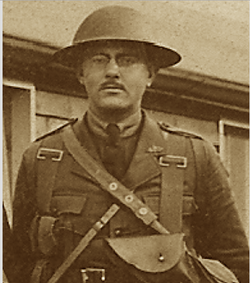
Frederick (L) and James (R) Manning
They were the first and second-born sons of Dr. James and Helen Manning’s five children. Their father was a prominent and well-respected city dentist; their mother, the niece of Sir Samuel Leonard Tilley, Premier and Lieutenant-Governor of New Brunswick, as well as member of Sir John A. MacDonald’s first federal government. They grew up on a street of elegant brick and stone homes, most of them constructed after the 1877 fire that had burned two fifths of the city. A live in servant cared for their needs. Fred was the oldest, named for his mother’s brother, and James came along 19 months later. No doubt the brothers were close companions growing up. Both were dark haired with brown eyes; Fred stood five inches taller – the big brother in all respects – at nearly 5’11”. Both enlisted and were commissioned as Lieutenants in 1916 and both fought at the Battle of Vimy Ridge. Only one came home.
Frederick Charles Manning was born on 24 July, 1895 just a year after his parents’ marriage. A bright boy, he graduated at the head of his class at Saint John High School, and promptly headed to Fredericton to the Normal School where he achieved the top classification for a teacher’s license. Fred, only 18, then took over teaching at the school in Fredericton Junction. A year later, he enrolled in Arts at Acadia University, Wolfville, Nova Scotia, perhaps to upgrade his teaching qualifications. It was here that Fred took command of the C.O.T.C. and where a recruiter for the 219th Highland Battalion of NS came calling in early 1916. Fred immediately stepped up, the first in the university to do so, according to an article in the Saint John newspapers. Fred arrived at Aldershot Camp, NS, in May 1916 for training. By June, his “ability was recognized and he was promoted” to a commission. After the summer in Nova Scotia, his battalion headed overseas, sailing from Halifax on the S.S. Olympic on 12 October 1916, and landing in Liverpool a week later. His next four months were spent in England, the training a seemingly endless process, but on 9 February 1917, Lieutenant Frederick Manning was taken on strength by the 85th Battalion and on the 10th was finally on his way to France.
James Harold Manning, born 15 February 1897, took a different path than his older brother. He was determined to follow in his father’s footsteps, and so enrolled in the same dental school in Pennsylvania as James Senior. Like his father, he had served in the 62nd St. John Fusiliers, where his father had made a name for himself as a marksman, even competing in 1890 at the prestigious Bisley shooting competition in the UK. It is unsurprising after his first year completed and with his older brother enlisted, that James came home to do the same.
In June 1916, he joined the 140th Battalion. This path led him to Valcartier for training. Oddly, he made it to England months before Fred, sailing on the same ship as his brother would, the S.S. Olympic, on 18 August 1916. I have to wonder if the brothers had any opportunity to visit each other; I certainly hope so.
James, promoted to Lieutenant as well, was sent to the Crowborough Military School for an advanced Field Officer course. He was attached to the RCR and the PPCLI, taken on strength of the 144th which was absorbed into the 18th Reserve Battalion before finally being drafted into the 52nd Battalion on 10 February 1917, following his brother to France two days later. Quite a convoluted path!
Both brothers were now on an inexorable path leading to one of the biggest battles in Canadian history, that at Vimy Ridge, and surprisingly both survived the initial assault on Easter Monday 9 April 1917 even though Fred’s 85th was at one of the worst ends of the ridge, at the well-fortified Hill 145 where the memorial now stands. They would have known about the victory but perhaps unaware of the sensation it was causing at home. After the incredible tension and anticipation leading up to this attack, the following days might have seemed anti-climactic, winding down to “normal”. Well, as this war has shown again and again, bad things happen when least expected.
On the 15 April 1917, a knock that no family wanted came to the door of 158 Germain St in Saint John. A telegram that surely sent hearts plummeting had arrived. James and Helen knew they had two sons in the big battle that was making the newspaper headlines. But all was not lost: Fred had been wounded and it was “serious but not dangerous”. Little did they know, it was more than that. Fred sustained a gunshot wound to the head and had a fractured femur, the long bone in the thigh. Both were life-threatening injuries. It had happened two days earlier and Fred had been whisked by the now efficient medical system to the No. 14 General Hospital south of Calais. Three days later another telegram arrived, this time with the horrible news that Fred, only 21 years old, had died of his wounds, ironically on the same day the first telegram had arrived. The blows did not stop there. The very next day, 19 April, a third telegram came. I can only speculate what the mourning family – younger siblings Laurence, Marjorie and Thomas, ages 18, 17 and 15, were still at home – thought. Perhaps it brought a piercing shaft of hope that Fred hadn’t really died. Perhaps it brought the terror that James had also died. What it said was that James was wounded, not seriously, and on the same day the first telegram had arrived.
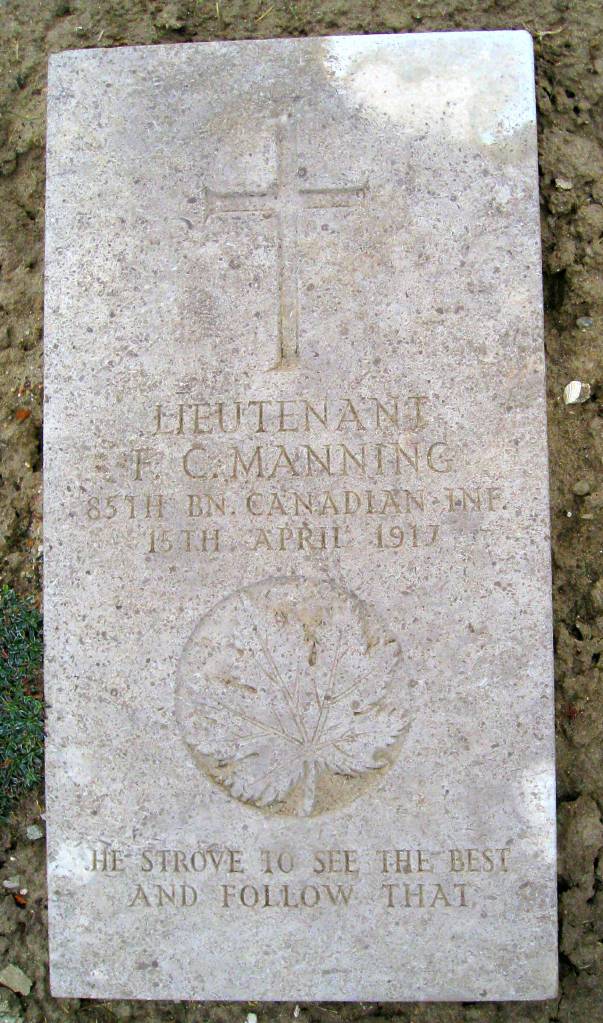
James had taken a shrapnel wound to his left forearm and two fragments had to be surgically removed. It was a “Blighty”, one of those wounds serious enough for a long recovery but not serious enough it would risk the patient’s life moving them across the Channel. James was off for an extended stay in England at the 2nd Western General Hospital in Manchester. Four months later, on 15 August 1917, he was fit for duty and back with his unit, but not for long.
On 27 August 1917, less than two weeks since his return to the front, James led a party tasked to capture a German machine gun nest. Nine miles behind their position a British artillery unit was laying down a barrage but due to errors in their ranging, the shells fell near James’ position. The telephone wires had been cut so they were unable to message the British. A terrific explosion buried James, but he was dug out by his men. Shaking off the trauma and rounding up seven or eight others, he continued his attack, driving off the Germans and seizing their machine guns. It was this action that led Major General (then Lieutenant-Colonel) Forster, VC, to call James “a born leader of men…”
As he made his return a whizzbang, a small caliber German shell, hit within six feet of James, throwing him violently across the ground and leaving him concussed. A piece of the shell drove through the palm of his left hand, shattering the bones. James found himself back in Manchester at the 2nd Western as doctors struggled to save his hand from both the physical damage and gas gangrene, a dread result of the filth of the trenches. In the era before antibiotics, surgically opening the wounds and exposing them to air was the only way to stop gas gangrene. Not only did he have the hand injury to contend with but the site on his thigh where they had removed skin for a graft on his hand had become badly infected and he was still suffering a back injury from being thrown by the shell.
By November, the medical boards saw no hope for James’ hand, and he was medically invalided back to Canada on 19 December 1917. What a sigh of relief his family must have breathed to have him back home again. He was sent to Toronto in one last attempt to fix his hand, but James was left with a clawed hand, the fingers immovable, all their joints fused, the palm and back crossed with scars. James’ dream to follow his father into dentistry came to an end.
Undeterred, James took up town planning and landscape gardening, working in Boston, before attending Harvard University. He ended up in NYC then traveled to Maturin, Venezuela as part of the engineering staff for Standard Oil. Six months into his stay in Venezuela, James caught what might have been malaria or hemorrhagic fever or both. That spring of 1924, seven years after surviving the fighting at Vimy and Lens, James Manning died at age 27. He had lived a life packed densely with experiences, almost as if he had known he would not make old bones. Despite his roaming, James never lost his nostalgia for his foggy port city home by the Bay of Fundy, writing this poem:
If I were ruler of this land with majesty complete,
If I owned all these many leagues and not a yard beside,
I’d give them up without a sigh for room to place my feet,
By the fog-bank and the rain, and the sound of Fundy’s tide
Follow Me to Hell
19 June 2023
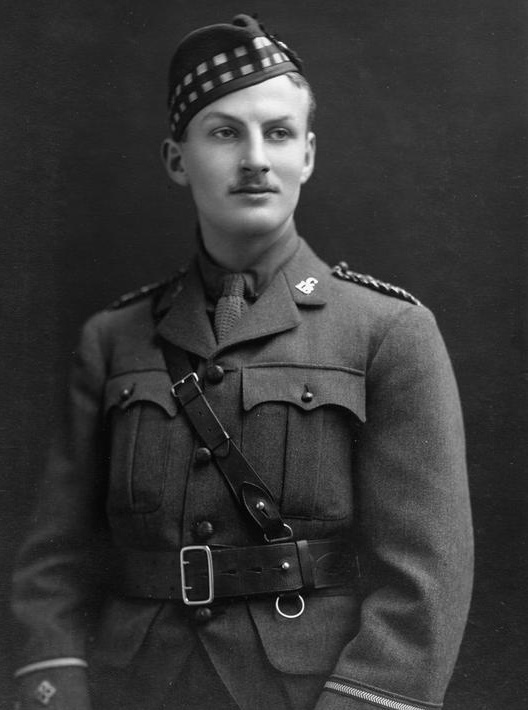
Original Source: http://www.iwm.org.uk/collections/item/object/205389952
Captain Victor Gordon Tupper, MC
He called it the “biggest push that has ever been launched” and he had just made the German barbed wire when struck in the hip by a shell. Gordie slipped to the earth with an “expression of surprise, the faint flicker of a smile” and, according to a brother officer who witnessed it, “died within seconds”. Tragic, romantic, heroic, and, from descriptions of the young Captain, possibly true, kind of like the battle of Vimy Ridge itself.
Gordon Tupper was a cheerful, active, outdoorsy young man. His older brother described him as having a great love of hiking, fishing, and the unruly game of rugby. It seems little wonder that when the war began in August 1914, he immediately joined up at the tender age of 19. He enlisted as a Private and his profession was listed as chauffeur, but in fact, he came from quite an illustrious family as his last name suggests. Gordon was the 4th son and youngest of six children born to the Honorable Sir Charles Hibbert Tupper, KCMG, and Lady Janet Tupper. His father was a lawyer from Halifax, NS, who followed in Gordon’s grandfather’s political footsteps, becoming an MP, then Justice Minister, and the Solicitor General in a number of Conservative governments. Charles H had been knighted in 1893 after helping broker a deal in the Bering Sea Arbitration. Gordon was born in Ottawa on 4 February 1896 and his godmother was Lady Aberdeen, wife of the Governor-General of Canada.
Gordon’s grandfather was the Sir Charles Tupper, a Nova Scotia physician, politician, former Premier of the province, Father of Confederation, and 6th Prime Minister of Canada. The senior Sir Charles was a protégé and good friend of former NS Premier James William Johnston – yes, that J.W. Johnston, great-grandfather of my Private James W. Johnstone (even though the last name has a slightly different spelling!). Sir Charles Tupper, senior, has the dubious distinction of being the shortest serving Prime Minister, one who never sat in Parliament. After 68 days in the PM’s office, in May of 1896, Sir Charles was out, the Conservatives defeated. Charles Hibbert promptly moved his family all the way across the country to British Columbia, first to Victoria, then to Vancouver, where Gordon grew up, and Charles H, oddly, continued to serve as MP for Pictou, NS.
In September of 1914, Gordon found himself in Valcartier, PQ, with thousands of other eager young volunteers. Traveling from there to England in October 1914 on the S.S. Andania, he spent that winter in misery on Salisbury Plain, coming down with, as so many did, pleurisy and pneumonia. In February 1915, Gordon was left behind with the 17th Battalion in reserve as the rest of the Canadian men shipped to France. He missed the big show in Ypres in April 1915, but because of the horrific losses, was transferred to the 13th Battalion in May 1914. In July, he was transferred to the 16th Battalion, recommended for Cadet School, and by August was promoted first to Lance Corporal then temporary 2nd Lieutenant. His former commanding officers described him as brave, cool in action, and courageous, as having judgement, tact, and true leadership. It certainly would explain his meteoric rise. By October 1916, he was a Captain and in February 1917 an acting Major.
Tupper was initially assigned as a Transport Officer but later went to Communications. It was in this role he earned his Military Cross. Under heavy shell fire and personal peril – he was wounded – and “displaying great courage and determination” staying at his post while wounded, he kept the communication lines open between the front lines and HQ, and between the spotting officers and the artillery. In November of 1916, he was “gazetted” – written up in the London Gazette for conspicuous gallantry in action and awarded the Military Cross, the second highest decoration an officer can receive.
Gordon seemed genuinely to enjoy his time in the war. He wrote repeatedly to his parents not to worry about him, that while, yes, there were stressful times, they were not constant, and he had a wonderful time while away from the front. Of the Battle of Mont Sorel, he wrote: ”Really I never enjoyed two hours more in my life than when we were attacking. Wonderful excitement!” Later, he wrote: “Will you believe me when I say that I have enjoyed the last two years more than any others in my life?”
In April 1917, he wrote his parents one of those letters, his third of the war, he said. He had been “over the top” on a few occasions, but this time he would be leading his own Company, 150 officers and men, who would, “follow me to Hell, if need be.” He was proud, calling it the “most glorious day of my life” and was convinced the path to peace was through the action that we now know as the battle of Vimy Ridge. His parents were not to feel sorry for him.
Promptly at 5:30am on Easter Monday, 9 April 1917, nearly 1000 guns and mortars opened up with a roar, pounding the German lines that wreathed the slopes of Vimy Ridge. Firing for three minutes, they lifted 100 yards and fired another three minutes, creating a creeping barrage, behind which poured four Divisions of Canadians. On the right, attacking toward Thelus, the 1st Division, commanded by Major-General Arthur Currie, and including the 16th Battalion and 21-year-old Captain V. Gordon Tupper, would ultimately be successful in capturing their objective, as would all the Canadian Divisions, taking the entire ridge.
Gordon was one of the lucky ones whose body was retrieved and properly buried at Ecoivres Military Cemetery, his stone engraved with words chosen by his parents, Be ye faithful unto death and I will give you a crown of life. The battle of Vimy has become legend, almost mythical, a fantasy of nation-building and the crowning glory of Canadian bravado. The ridge itself is home to the foremost of Canada’s war monuments, eclipsing even the National War Monument in Gordon’s birthplace, Ottawa. His name may not be on that monument and its site is not the section of ridge he assaulted in his first command, but I like to think Gordon Tupper would still be proud that the memory of so many young men who sacrificed everything are remembered there, near the place where he, in his words, “went under”.
Absent Without Leave
6 June 2023
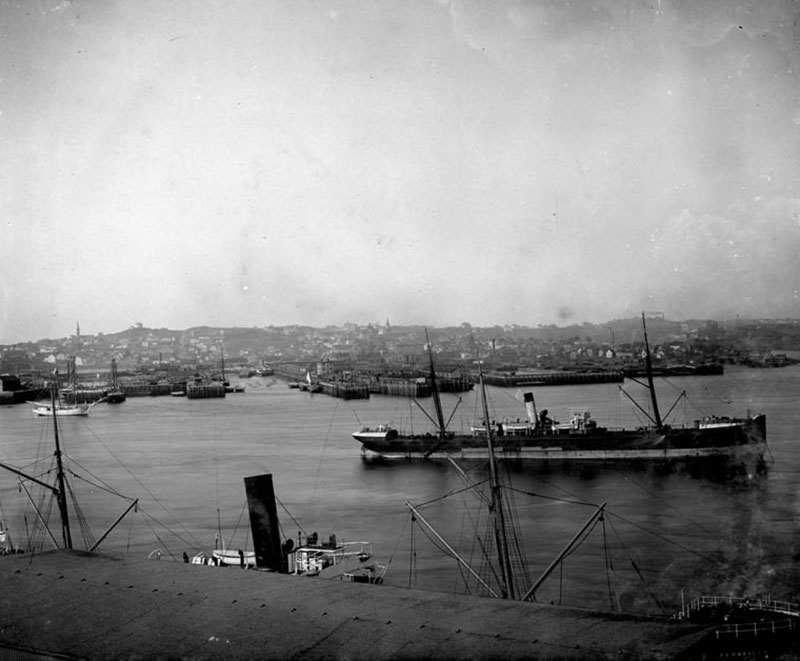
Harbour, Saint John, N.B. (1929)
Credit: Canada. Dept. of Interior / Library and Archives Canada / PA-049781
He was a stranger in town with few friends. Where would he go? The options were limited.
Not all my stories are about men who died in glorious battle, or even men with proper attestation papers, from which we can learn much about them. John Daniel Pike never enlisted in an overseas battalion, never signed those papers on which we might see his age, his eye colour, or his hair colour to form a picture of a young Canadian. John was part of the home guard, and all we can say about him is he had a mouth full of cavities that likely would have kept him home, if indeed he did try to go overseas. That is not to say protecting Canadian soil was not an important contribution to the war effort.
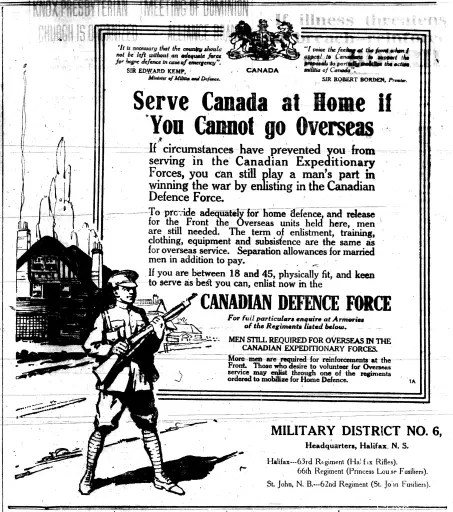
Canadian Defence Force Recruiting Poster. St. John Globe, April 7, 1917,
In April of 1918, the Canadian Garrison Regiment was formed to bring together the various detachments of home defense under one umbrella. In Saint John, it drew its strength in large part from the 62nd Regiment, the storied St. John Fusiliers, which had formed in 1872 (as the 62nd Battalion) and contributed members for the Boer War in South Africa. Changing its name to the 62nd Regiment in May of 1900, many members volunteered for the 26th Battalion in 1914, and as such the 62nd has been awarded a long list of First World War battle honours. Others of the 62nd had been guarding the port of Saint John, New Brunswick since the outbreak of the war.
John Pike was not a native of Saint John, having been born and raised far to the northeast of New Brunswick in Belledune, on the Baie de Chaleur. He may even have seen the convoy of the First Contingent when they gathered there to await escort to England in the fall of 1914. John was the first of Thomas and Mary Pike’s ten children. In 1911, 17-year-old John was living on the family farm, having no stated profession. Two years later, at 19, John was working as a labourer to support his 25-year-old new bride, Mary Ella Hamilton. Their only child, a daughter Margaret Hannah, was born six months after the wedding. It was not an auspicious start to a marriage that would deteriorate.
When John joined the 62nd Regiment is yet unknown to me. I am sure deep digging could find that information in the NB Archives, but it is mostly irrelevant to this story. I suspect it was not until late in the war that he moved to Saint John to join the home guard, as he was a relative stranger to the city in 1918. What is clear is John and Ella had parted ways and not amicably. According to Major C.J. Morgan, John had “serious family troubles”. On what must have been his transfer into the Canadian Garrison Regiment, in April 1918, he refused to sign papers transferring his pay to his wife. Further, Morgan said, without elaborating on specifics, Pike defamed his wife’s character. After “outside influence was brought to bear” – on Pike presumably – Morgan was directed to pay Ella Pike $248 on April 24th, a large sum in those days. Three days later, John was back in Morgan’s office, anxious to see if Ella had received it, perhaps hopeful she had not got all of it, and asked if he could have a share.
According to the official records, John Pike was absorbed into the 7th C.G.R. on 1 May 1918. In fact, on the early morning of 1 May 1918, John was posted by Sergeant C. Tracey to the #3 post, 3rd relief (4:30-6:30am) on the docks on the west side of the harbour, relieving Private Frank Galley. Lying alongside of the “beat” which John was required to patrol, was a cargo ship, perhaps laying in supplies to go to an increasingly desperate England. Galley and Pike had had time to chat recently, as they sat waiting for their Medical Board examination – presumably on their transfer to the 7th – and John had discussed his desire to transfer to the 9th Siege (overseas) Battery. John may have really wanted to flee his home situation.
At 6:30am, May Day, when the sun at that time of year is well up and shining (if no rain or fog) over the harbour toward the west side docks, Private C. Daigle marched with the 1st relief to take over #3 post from Pike. The beat was empty. P. Lumsden, Corporal of the Guard that morning, not finding Pike, posted his guards then returned to report the missing soldier to the Sergeant of the Guards, Tracey. Tracey immediately went to look for himself, and soon called all the guards to search the sheds. At 7am, the news of a missing guard made its way to Lieut. J. Harris, who reported it to Major Morgan and notified the Military Police. Not a sign of John or his equipment was to be found.
Just when was John Pike last seen? According to Private Earl Hawkes, who had spent the 4:30 to 6:30 guard duty at #1 post, immediately next to Pike’s post, John had been there, patrolling as required, not five or ten minutes before the relief came at 6:30. How could a man disappear that quickly, and without a trace? The immediate assumption was that John Pike had absented himself without leave. The Military Police were dispatched to search the city. Interestingly, the Saint John City Police were never briefed or asked to assist. But where could he go if he didn’t know the city and had few friends there? Neither was the coroner informed when Morgan’s thoughts turned to the idea that perhaps Pike had had an unfortunate accident and fallen off the pier into the cold and turbulent waters of the Saint John harbour; an unsuccessful grappling operation was initiated the next day, May 2nd.
On May 3rd, an inquest was held. Major George Keefe, 1st Depot Battery, Lieut. W. Colin Ewing, 9th Siege Battery, and Lieut. E. S. Cosman, 7th Bn, C.G.R. presided. After the testimony of Major Morgan, Lieut. Harris, Sergeant Tracey, Privates Galley, Daigle and Hawkes, the conclusion was drawn that, given Pike was seen after daylight and in such proximity to the other beat and the crew of the ship, it appeared “impossible for Pte Pike to have met death with an accident” without someone seeing or hearing something. Nearly two months later, Major Morgan completed the paperwork deeming Pike illegally absent and his pay was deducted $100.96 for the missing kit he had taken with him: his uniform and a weapon, presumably. Pike’s Active Service record baldly called him a deserter.
The harbour in Saint John is where the mighty St. John/Wolastoq River, eastern Canada’s largest, with a daily discharge of 3.5 billion cubic feet, meets the highest tides in the world, which rise and fall nearly 30 feet. The harbour swirls with treacherous currents, and the water temperature rarely gets above 12 degrees Celsius in the heat of summer. The harbour reluctantly gives up her dead, sometimes playing with bodies, sweeping them in and around the docks, carrying them out into the Bay of Fundy and back again, sometimes for months or years, often times never returning them at all. I have yet to find that John Pike was found. What is known: his wife remarried in October of 1919. Perhaps she took it upon herself to decide Pike wasn’t coming back or perhaps she had official word his body had been found. On 27 January 1920, John Pike’s “Part II DB#30, SOS [struck off strength] Deserter” was cancelled and the following substituted: “Pt II DB #27, SOS Deceased, drowned (acc[ident])”.
Despite his marital woes, and his money issues, John was a victim of this war as much as any of the men who fought overseas. Pulled (or driven) from his home in the north, he found himself in an unfamiliar port, doing tedious duty on a dangerous wharf. Sadly, there is no picture of him. We don’t know whether he was tall or short, fair or dark, handsome or plain-faced. What we do know is he was only 23 years old – too young like many of them – and father to a little girl, only 4 years old, whose memories of him likely faded with the passing years.
Four Days in October
21 May 2023
Clarence Buckley
28 days. Not even a month at the Front after 10 months of training and traveling to get to the big show. His parents might have got a letter saying he’d made it to the battlefields, if he’d written them, before getting that dreaded telegram on 26 October 1915 to say he was dead.
Clarence Buckley was the third son, one of nine children, born to a scandalous relationship: his father, James, was Catholic, his mother, Maggie, Church of England. His parents didn’t get married – may not have been allowed to by their families – until Clarence’s oldest brother, George, was nearly two years old. The children soon began arriving with regularity: Francis in 1892, Florence in 1894, Clarence in 1896, Mary 1898, Ellen 1899, Annie 1900, Margaret 1906 and finally Peter 1909.
Dark-haired and blue-eyed, Clarence was a big lad, handsome and cheerful, smiling even in his formal portrait in uniform. He’d graduated from St. Patrick’s School on the west side of Saint John (a Catholic school although he was raised in his mother’s Anglican denomination) and gone to work for the railroad as a gas engineer. When war was declared, he signed on to the newly formed New Brunswick 26th Battalion in November 1914. Although unnecessary, he fudged his birthdate by a year, as so many did, claiming to be born 27 March 1895 rather than 1896. Perhaps he thought being a bit older gave him a better chance of going overseas. Nevertheless, over he went in June 1915, along with his friend, Jack Cameron. Sadly, his mother did not get to wave him farewell. Maggie Buckley, worn out with childbirth and consumption (tuberculosis) died at age 44 in January 1915.
After months at Sandling Camp in Folkestone, the 26th Battalion and Clarence Buckley finally made it to France and Belgium in September 1915. Crossing to Boulougne on the 15th , they marched or took trains to Wizernes, then Hazebrouck and Bailleul, finally ending up in permanent billets in Scherpenberg, Belgium. On the 28th of September 1915, the 26th Bn went into the trenches for the first time. “A” company, of which I am relatively sure Clarence was a part, stayed behind in reserve. Was he disappointed at missing the “fun”? Likely, as so many were eager to do their bit. He would however have to wait 11 more days, while listening to the rumble of the artillery not so very far away.
On the 9th of October, it was Clarence’s turn to occupy K and L trenches. Four days later, the inexperienced “A” company was tasked to assault a mine crater, presumably occupied by the Germans. It was costly for the 26th Battalion: 3 officers and 30 “Other Ranks” (ORs ie the NCOs and privates) were wounded; 19 OR were killed. Clarence was, for the moment, among the wounded. One of “C” company’s stretcher-bearers, a good friend of Clarence’s whom he nicknamed “Doc”, had been detailed to support the action in which “A” company was involved. Doc found Clarence badly injured in the field and carried him back behind the lines. It was clear to all, including Clarence, that he was not going to survive his wounds. Doc gave him enough morphine to deaden his pain and checked on his friend at every possible opportunity. Each time, Clarence would smile and cheerily ask, “How goes it, Doc?” his cheerful personality undaunted at facing his own death. Jack Cameron came across his friend, but by that point, as Jack wrote home to his parents, Clarence was, mercifully, unconscious. Clarence died shortly after sunset on 13 October 1915 and was buried in La Laiterie Cemetery on the Kemmel-Vierstraat Road. He’d been in Begium less than a month and in the fighting lines for four days.
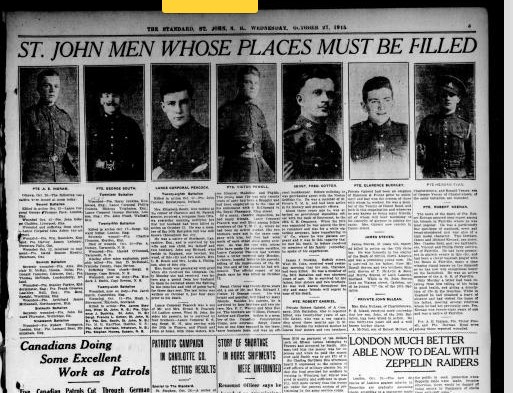
The Brothers Cameron
29 April 2023
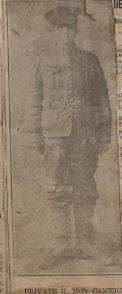
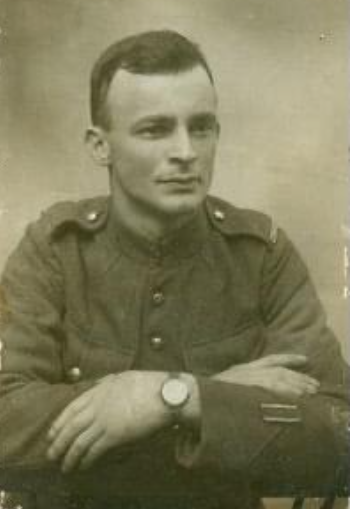
Hector and Jack Cameron (note Jack’s two wound stripes on his sleeve)
His friend liked to recount Hector Cameron’s first encounter with a bullet on the Western Front: laughing at the hole through his flimsy wool cap, the 15-year-old crowed “A close one doesn’t count!’ Less than a month later, Hector would be dead, lost in his first battle – the first real battle for the 1st Canadian Contingent – at Ypres.
Hector McDonald Cameron was the youngest child of Captain Lachlan “Lock” and Annie E. Cameron of Lepreau, New Brunswick. In 1914, his oldest brother Charles was living in Connecticut, one sister, Anna, was married and living in Woodstock, NB, and only his brother Ian Donald and sister Mary were at home. According to family lore, Hector had gone up to stay with Anna and her husband. At nearly 5’8” he was a relatively big lad for the time, and perhaps he was helping on a farm. Whatever the reason he was there, it made a much shorter journey for him to Valcartier, QC, and one far from his parent’s control, when war was declared, and recruiting began for a Canadian overseas contingent. Saying his birthday was 31 December 1892 (rather than 1899), the medical officers concurred his “apparent age” was 22. As such, he needed no written permission from his father to enlist. Further, he seems to have been coy about his name, giving only his initial “H”. Strangely, no one seemed to question it and his name is only later filled in, first as William, then as Hector. Regardless of the lies, Hector, only 14 years old, was accepted in the Canadian Expeditionary Force and, after spending a few weeks training in Valcartier, sailed on the S.S. Scotian to England in October 1914. He celebrated his 15th birthday in the miserable conditions of Salisbury Plain that December.
Ian Donald Cameron had been named for an older brother who drowned while his mother was pregnant with him, but as his mother found she couldn’t bear to use her late son’s name, he was called Jack. Seven years older than Hector, Jack enlisted in New Brunswick’s 26th Battalion in the fall of 1914. Perhaps he had had no intention of enlisting in those early days, and perhaps he hoped to look out for his younger brother when word came eventually from Valcartier.
The 26th Battalion formed in October 1914, and Jack attested in Saint John in November 1914. While Hector trained far from home in England, Jack spent the winter of 1914 through to the spring of 1915 near home, training in Saint John. The men were anxious to get overseas, and discipline became an issue, but Jack seems to have behaved, refraining from the clashes with police that plagued the 26th’s last months in Saint John.
Meanwhile Hector was off to France. After transferring to the 14th Battalion (the 12th, his original assignment, was retained in England as a reserve battalion), he sailed for the front at the end of February 1915. The Canadians were brigaded with British units to learn the ropes and helped with the fighting at Neuve-Chapelle in those early days. But as April progressed and the Germans secretly laid plans to release chlorine gas at Ypres, the Canadian battalions found themselves posed to take a huge role in the defense of the Ypres Salient. As the apex of the Salient collapsed inward on 22 April 1915, the result of the first large scale, successful gas attack of the war, Canadian battalions were thrown into the fire, including Hector and the 14th Battalion. On the morning of 23 April 1915, less than 12 hours after the initial gas attack, the 14th occupied positions near St. Julien. There, they faced renewed German advances, and as the firing began, Hector’s luck ran out. According to a letter from Sergeant L.E. Locke to Captain and Mrs. Cameron, Hector was hit in the head and died instantly. Whether this was the truth, or just what seemed the best thing to say to ease his parent’s grief is unknown.
By the time Jack sailed for England in June 1915, his parents would have been informed of the loss of their youngest son. One can only imagine the distress of Lock and Annie, having lost two sons already and now watching a third set off into danger.
Arriving in England in late June, the 26th trained near Folkestone before embarking for the front on 15 September 1915. Jack seemed determined to relieve his parents of their worry, writing home that “We are having the time of our lives here and are perfectly happy…” How much they believed this cheerful statement is speculation. Jack spent the winter of 1915/16 near Kemmel and St Eloi. In February, he sustained what must have been a relatively minor gunshot wound to his left leg, requiring a visit to the No. 4 Canadian Field Ambulance and three-week recovery at the Divisional rest station. By early March he was back in the line in time for the dismal fighting over the craters of St Eloi, the remains of British mines detonated to destroy the salient the Germans had formed in the area. However, before the next momentous Canadian offensive at Mount Sorrel, Jack was seriously injured again and this time it was a “Blighty”.
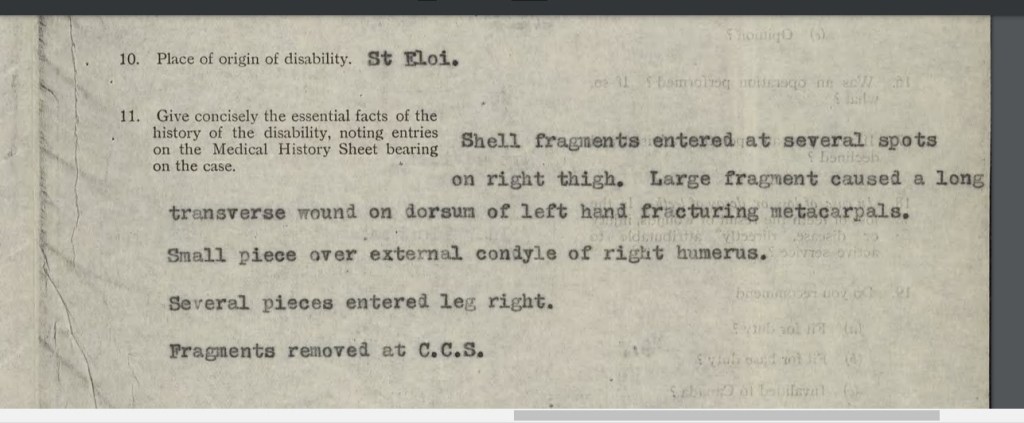
Blighty was the nickname British troops had for England, and a “Blighty” injury meant a trip across the channel for an extended stay in the comfort of a hospital far from the fighting. These were injuries too serious to mean a quick turn-around back into the fighting, but not serious enough that evacuation risked killing the patient. In Jack’s case, he sustained a gunshot wound to his right knee, his left arm above the elbow and a devastating shrapnel wound across the back of his left hand, shattering the bones. From the No. 11 General Hospital near Boulogne, Jack travelled to Folkestone, then the Bearwood Canadian Convalescent Hospital in Wokingham, and finally the Granville Canadian Special Hospital in Ramsgate. As the months wore on, it became clear that Jack would never regain much use of his left hand. Repeated infection – for which there were no antibiotics – in both his hand and elbow meant operations and procedures to clear infected tissue and which left draining holes. By December of 1916, Jack was sent home to Canada, no longer fit for active service. Convalescing in Halifax for much of 1917, Jack finally made it home that August and was formally discharged on 31 January 1918.
Their son was home and safe, if left with a permanent disability and a limp. Captain Lock Cameron did not have long to revel in this joy, dying at age 62 in December 1918. Despite a $270 pension, Jack’s life was forever changed, and he would need to use ingenuity to cope with his injured and useless hand. He married the sister of a fallen comrade of the 26th and rejoiced in the arrival of children. While he sought refuge in the bottle, as many survivors did, Jack also volunteered with the Royal Canadian Legion, and helped veterans of the Second World War negotiate the return to civilian life.
Hector, however, was left where he fell. In the chaotic days of 22 – 25 April 1915 there was no time to retrieve the dead, and his body was lost in the subsequent fighting, churned into the unforgiving mud of the Ypres Salient. His only memorial is on the Menin Gate.
Everyone Behaved Splendidly
22 April, 2023

Please excuse this card, etc
May 2/15
Dear Isobel:
Got thru battle of Ypres all right. Sorry to say we all have had many casualties but at present don’t know just who is missing or wounded etc. Very terrible battle while it lasted, everyone behaved splendidly. May go down to base and get reorganized. Was shot thru clothes three times but escaped all right.
Jim
No Life Like It
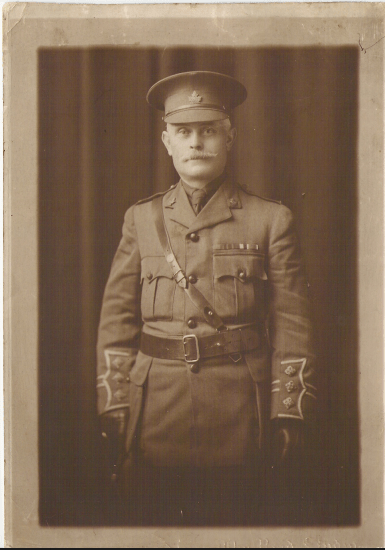
Captain William Pitt, DCM
11 April 2023
He was obviously proud, and it certainly was an achievement. A half-smile quirked up one neatly trimmed, grey mustache. His Sam Browne belt and gloves shone with polish. The gauntleted cuffs of his uniform showed the double line and three pips of his new rank. The photo, taken in a Saint John studio, was an extravagant memorialization of the moment. After decades in the military, and a previous rank no higher than Sergeant, William Pitt was a Captain. Honorary, to be sure, but a Captain, nonetheless. It was a far, far cry from where he began life as a poor orphan in Victorian England.
The young Princess Victoria called Wolverhampton a “large and dirty town”. During her reign it didn’t change much, only growing larger and dirtier, if richer. The hub of the Industrial Revolution, Wolverhampton in the Midlands thrived because of its geology – the rich seams of coal and iron which fueled the factories producing everything from bicycles to trains. The so-called “Black Country”, the Midlands is thought to be the inspiration for J.R.R. Tolkien’s Mordor. John Pitts worked in the iron factories as a “Moulder” creating the moulds for casting iron objects. It was heavy work, with long days, but the pay kept his family housed and fed. His wife, Maria, had been a servant until her marriage. Life was difficult for the family; at least three of their first five children died either as infants or in early childhood. In 1873, 35-year-old John himself was carried away by illness; Maria and their infant son died the next year. William Pitt, only two years old, and his two remaining siblings were left to the mercy of the over-crowded and under-funded Victorian orphanage system. It may not have been ideal, and he was not adopted, but William seems to have been saved from the cruelty of life on the streets. Once he was old enough, he was educated at the Blue Coat School on Little Berry St in Wolverhampton. Run by the Anglican church, it was the oldest charity in the city. By 1877, it housed up to 20 boarders behind its rather plain and severe façade and William was one of them. Education only went so far for poor children and by the time he was 16, William was out on his own. He headed for London, trying to find work. Apprenticeships took money, however, and William spent time in 1885 in London’s notorious workhouses.
It’s hard to compare a decorated Captain living and working a respectable job of bookkeeper in Saint John with Dicken’s Oliver Twist, but their stories are not far off. The workhouses of Victorian England were the bottom rung for impoverished people of the time and a last resort. Many preferred life on the streets to being admitted to the demeaning drudgery of a workhouse. Forced to give up their clothes and possessions, those admitted were issued a uniform (relatively clean at least) and required to perform hard manual labour – for the men it meant breaking rocks. For three months, William stuck out the miserable life of hard work and parsimonious meals of gruel. Fleeing back to the Midlands, William got work in a warehouse but the military life attracted him.
In October 1886, at age 17 – but claiming to be 18 – he joined the British Army. It would not be the last time he lied about his age. He was promoted to Corporal three years later in 1889 but could not seem to keep out of trouble. Maybe his hard life on the streets caught up with him, for less than a year after his promotion, he was tried for some wrongdoing and demoted back down the ranks. Perhaps that taught him a little respect; in 1891 was again promoted – to Lance-Corporal – and in 1893 back to Corporal. That same year he got married to Minnie Elman Cooke, none other than the daughter of his former Headmaster at Blue Coat School. That her father permitted the marriage, knowing William’s history in detail, speaks volumes as to the young man’s character.
The next ten years took the new family around the globe. It was a good life, if lived in a barracks, and allowed Minnie the luxury of a servant. William transferred to the Lancashire Fusiliers and with that regiment was stationed in India and Pakistan, where his second daughter was born, in Egypt, and in Malta where his third daughter arrived, before heading back to England. It was, however, in South Africa that he distinguished himself. The Second “Boer War” was fought from October 1899 to May 1902. William saw combat at the Battle of Spion Kop and took part in the relief of the siege at Ladysmith. He was promoted to Quarter Master Sergeant in 1899 and gazetted in 1903 with a Distinguished Conduct Medal (DCM) for “distinguished, gallant and good conduct in the field”. It is the second highest award given to non- officer ranks, eclipsed only by the Victoria Cross (VC).
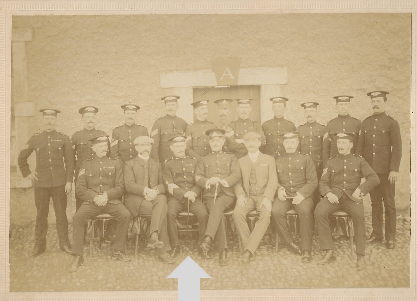
NCOs of 2nd Lancashire Fusilliers, Ireland, 1906 (Pitt marked by arrow)
Once William was home from South Africa, the Pitt family transferred to Ireland, where William and Minnie’s only two sons were born. Sadly, neither boy lived past the age of three. In 1907, William was discharged after 21 years in the British Army, and perhaps that was when he started thinking of emigrating to Canada, to a new life and better opportunities. In 1910, 41-year-old William, 43-year-old Minnie and their daughters, Dorothy, 16, Eva, 15, Lucie, 11, and Maisie, 7 set sail for New Brunswick. William was going to become a farmer.
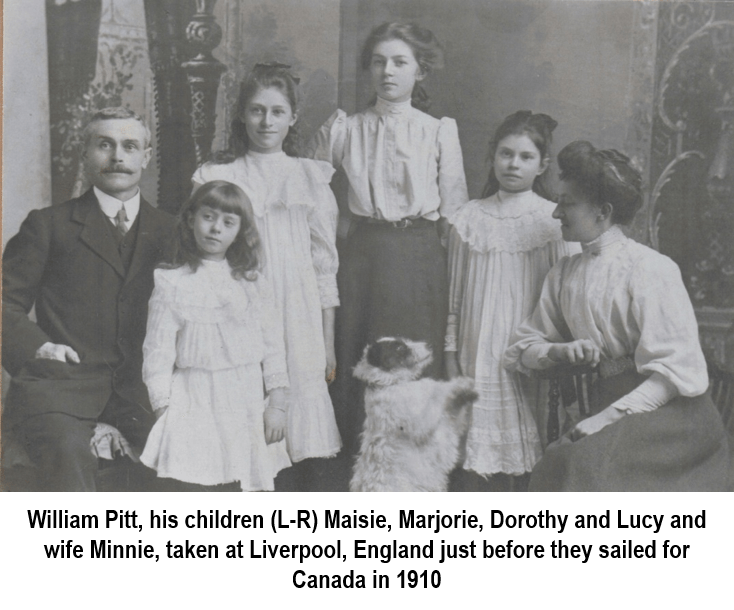
Steamships made regular trips from Liverpool to Canada in the early years of the 20th century carrying thousands of English immigrants across the Atlantic. On April 14, 1910, the family boarded the S.S. Southwark bound for Nova Scotia. The Pitts, unlike most immigrants who set off immediately for the Prairies, decided to go instead to New Brunswick and settle along the lush, rich farmland of the St. John river. The 1911 Canadian census finds them in Maugervillle, just down the river a few miles from Fredericton, on their own little farm. Beautiful and pastoral, with the river wide and placid and full of fish, it was a far cry from the Black Country, but the winter must have been a shock, for the area gets bitterly cold and snowy, worse than anything they’d have experienced in England. Perhaps the spring flooding that the river basin is prone to ruined them; perhaps it just was not the life for the family. By 1914, they were back down at the mouth of the river, living in Saint John and William was a clerk with the St. John Railway, collecting accounts. It certainly was not a life to which he was used.
Did he miss the comradeship of life in barracks, within the military brotherhood? A quiet, homey existence in a house of women was far removed from the masculinity of the military parade ground. Did his heart beat faster with excitement when he heard of the outbreak of war in August 1914? I expect there were some discussions at home. He was 45, too old; they were finally settled after a life of hopping around the world. But William was determined and resorted to a lie that had got him in before: in November of 1914, he went to the 26th Battalion recruiters and knocked three years off his age.
The now “42 year-old” with his military background, was promptly promoted from Private back – provisionally – to Sergeant and appointed Regimental Quartermaster. Like an old fire horse at the bell, he was likely excited to be back in uniform and off on the march, even though his back was getting creaky and his feet hurt more than they had 7 years before. By June 1915, he was in England and bunked down in East Sandling camp near Folkestone, Kent. In September, he scarpered. Gone for five days, he was severely reprimanded and fined five days pay; a mature and experienced military man should have known better. Where he went is a mystery. He had no family but his brother in Wales. Perhaps though, he went to visit his in-laws, certainly not telling them he was absent without leave. His escapade, however, did not prevent him being confirmed in his rank of Sergeant a few days later, and shortly thereafter, the battalion was in France.
The winter of 1915/1916 in the trenches was not an easy one for William. He was felled by influenza in March and his life was taking its toll on his body. Poverty and long years in the British Army had aged him. Arthritis was giving him grief. Hospitalized in May in Boulogne, France, he was soon transferred to England, and spent the next six months in one hospital after another. His back ached and his feet were sore, his knees and ankles were in bad shape, and he required a cane to get around. His body had betrayed him. In December 1916, his time overseas was done; he was sent home to Saint John. There the medical board examined his records and concluded that, contrary to what the English doctors had said, his disabilities were not due to exposure in the trenches but to his “advanced” age – 47. They recommended a discharge due to medical unfitness. It was not likely welcome news to William, On 30 April 1917, he was formally “struck off strength”.
But William and the military were not done with each other. Five days after being discharged, William’s appendix put him in the hospital for surgery. He was immediately reinstated, and in November given an honorary Captaincy. It was a heady rise and no wonder William had a photo taken. It is difficult to make out that despite the stiff, erect military posture, he was leaning heavily on his cane. He had risen a long way from the filthy workhouse in London.
William’s career continued through 1918 and 1919 with the 1st Depot Battalion, and as Adjutant and Quartermaster of the No. 7 Canadian Ordinance Corps in Saint John. He spent a few months as Accounting Officer of the 7th Canadian Garrison Regiment, but time and failing eyesight were catching up to William, then only 50 years old. To the medical board, he appeared much older. Once again, he was stuck off strength as medically unfit. Instead, William found himself a place in a militia – the 7th Canadian Machine Gun Brigade, where he was given the rank of Regimental Sergeant Major.
Determination was not lacking in the man. What his wife and daughters thought of it is unknown, but in February 1920, with the war long over, William was back in the 1st Depot Battalion recruiting office and signed up…again! The Canadian military took him in…again. He gave his profession as “soldier” and his military experience as 21 years in the Imperial (British) Army, 4 years in the Canadian militia and 5 years in the Canadian Expeditionary Force. He was reinstated as Honorary Captain. One must wonder if no one read or perhaps had access to any of his previous records. It does not seem likely they did. What is clear: the military was where William was happiest and most fulfilled. It had given him the first real home and sense of belonging as a teenager, a place where he was accepted and included, likely for the first time in his life. However, this was William’s last grasp at army life. It was soon obvious that he was unable to perform his duties. Three months later he was discharged for the final time. Even the militia – in which he served simultaneously – sent him on his way.
The 1920’s ushered in a vibrant new culture, short skirts and wild jazz. William, however, had to settle into quiet middle age and his career as a bookkeeper for Customs. It paid better than the military, but certainly was not nearly as exciting as travelling to exotic locations and fighting wars, yet worse was to come. The symptoms would have come on gradually: his appetite was not what it used to be. Perhaps he was losing weight, but no wonder with heartburn and nausea. Maybe he assumed he had an ulcer causing his indigestion, maybe that his normal diet just did not agree with him anymore. Eventually, William and Minnie would have realized something was very wrong. The diagnosis was a death sentence: just three days before Christmas in 1927, William Pitt succumbed to stomach cancer at age 58.
He was buried with his military honours: his rank of Captain, his DCM in full view. For a boy suppressed by the class system of England, it was far above what any but the most exceptional could achieve in the fiercely class-based British Army. But he had done it; he had risen, not to just a sub-altern rank, but to Captain.
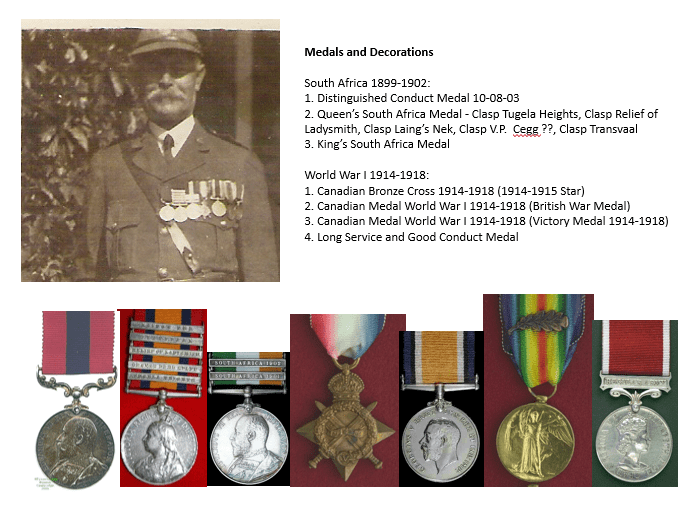
Photos courtesy of Captain Pitt’s great-granddaughter, Pat McKinney
A Tale of Two Brothers and a Ridge Called Vimy
Will and Steve Bird
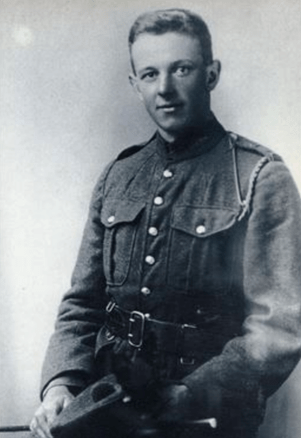
6 April 2023
Will R. Bird knew something was up when his brother, Steve, walked around the wagon Will was loading while working in Saskatchewan. First, his brother was wearing his full military uniform with kit. Second, Steve had arrived at the Western Front less than a month before in September of 1915. Sure enough a telegram came for their mother: Steve C. Bird had been killed 19 days after setting foot in France.
Will was 20, Steve two years younger, the year the war broke out. Steve enlisted in the 25th Battalion out of Halifax, NS. At nearly 5’9”, he was taller by far than the average (around 5’6”), a muscular 180 pounds, and fearless. Will told a story of Steve leaving two military police officers on the ground when they tried to prevent him popping home to see his mother before shipping out to Europe.
In early October 1915, the 25th Battalion was in the Ypres-Kemmel area; Will Bird says Hill 60. It was their second foray into the forward lines, and the weather was turning cold and rainy. They relieved the 24th Battalion on October 5th, and the next few days were spent learning their trench routines, repairing defenses, barricades and barbed wire fences. For two hours, centered on sunrise and sunset, the men were on “stand to”. These times were considered the riskiest for a German attack, so all hands were on watch at the trench walls, rifles at the ready. As the sun went down on the evening of 8 October 1915, the 25th Battalion men were in their positions, unaware that below their feet, the German’s had dug a mine tunnel. Either because the Germans thought the British were approaching with a counter-mine, or they worried about flooding with the coming rainy season, that evening, just before “stand down” they detonated their mine, and at the same time rained a hellfire of shells and machine gun fire upon the Canadian line. Where the mine blew, half of one platoon simply disappeared, 19-year-old Steve Bird among them. Only pieces were found, not enough to identify any of the casualties.
Will had tried to join his only brother in 1914; they were extremely close, and it was natural to want to be in the same regiment. Will, unfortunately, was turned down, and on more than one occasion, due to his bad teeth. It was after his brother’s death, that Will, who had gone out west to work, came home to Nova Scotia, determine to enlist. One can imagine his mother’s distress, having lost one of her two sons already, but Will was persistent and joined the 193rd Battalion in April 1916, landing in France in December 1916 with the 42nd Battalion. Will survived the war, earning a Military Medal for his actions in the dying days of the war in November 1918 at Mons. But it is his story from Vimy that is startling.
Will had missed the big show on Easter weekend due to coming down with mumps but he was soon back with a drastically altered battalion – some of his best friends had been killed in the attack – and working near Vimy village digging trenches. He had been invited to join some new men in their shelter in the railway embankment. Around midnight, he was wakened by a touch on his arm, and found his brother Steve standing over him. Motioning for Will to follow him, Steve led Will out of the shelter, down a path, then faded from view. Will waited, hopeful his brother would reappear. After ten minutes, growing cold, he wrapped himself in his great coat and found a spot in a nearby ruin to sleep. In the morning he woke to find men digging out the ruins of the shelter he’d been in earlier in the night. A shell had destroyed it and killed the two men Will had left behind. He fully believed Steve had saved his life. Will came home, became a prolific writer, publishing a memoir of the war in 1930, And We Go On. He later rewrote it as Ghosts Have Warm Hands in 1968, although many prefer the earlier version. Will died in 1984 at age 92. His only son, named for his brother Steve, was killed in July 1944, just days after surviving the Canadian landing at Juno Beach.
Llandovery Castle!!!
Anna Irene Stamers
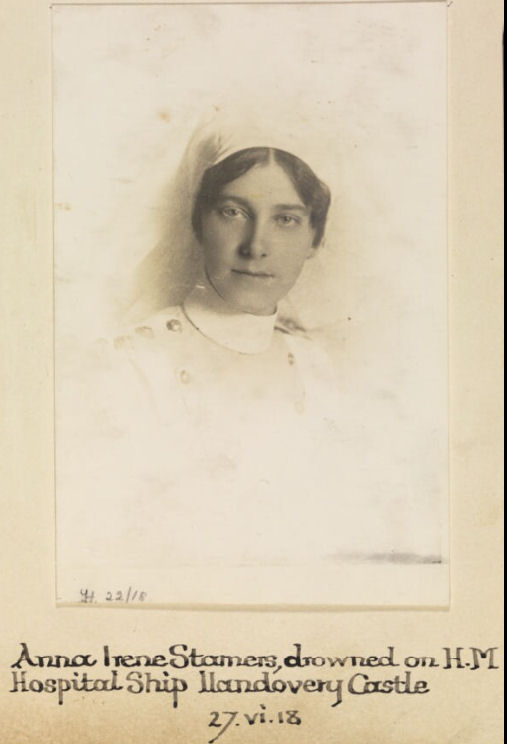
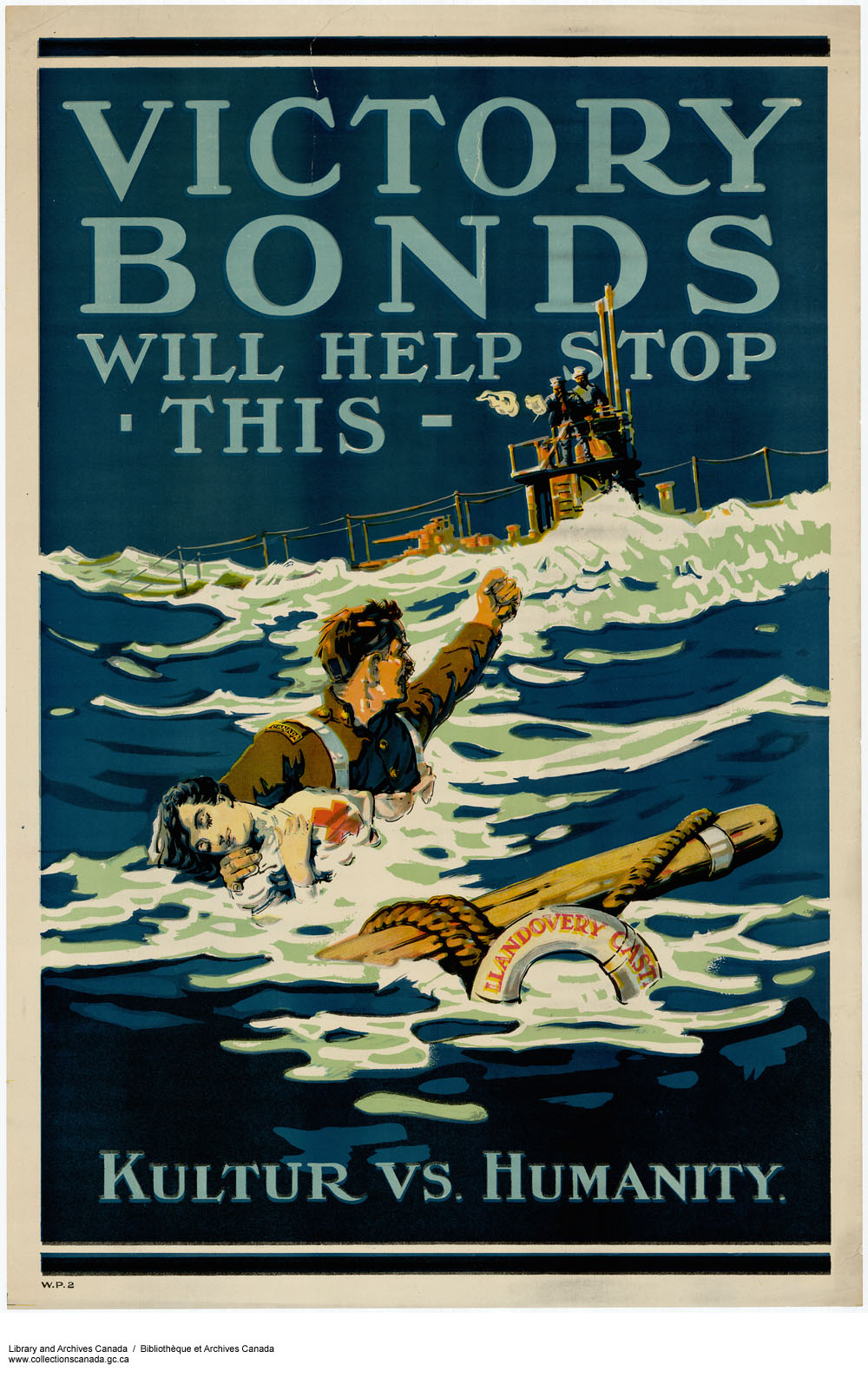
3 April 2023
June is a lovely time to cross the North Atlantic. The hurricane season is not yet beginning, and the seas are often flat as a mill pond. After an uneventful trip to Halifax to drop off 644 patients, the Canadian hospital ship, HMHS Llandovery Castle turned around 3 days later to head back to England. On board were 258 people, including 102 medical staff of which 14 were Canadian nursing sisters. One of those sisters was 29-year-old Anna Irene Stamers.
Anna was the daughter of a sea captain and had grown up on the seashore in a working port city. Her father, Benjamin A. Stamers, made a career of teaching navigation in Saint John, New Brunswick, and no doubt he’d kept his daughters entertained with stories of his voyages and growing up on Turks Island (now Turks and Caicos) of the British West Indies. Likely she thought often of her father on the many trips she’d already made across the Atlantic. Anna was no stranger to cool, salty sea air or the hazards of sea travel. A beautiful young woman, she was tall and slender, as tall as many of the men she nursed. Her dark hair was kept neatly tucked under her crisp white wimple, and black lashes framed her clear blue eyes.
She had grown up the middle of three sisters. Their father ran his own marine navigation school near the docks at the port, until his sudden death at age 42. Anna’s mother, at only 35, was a widow; Anna and her sisters, ages 14, 12 and 7 had no father. The next few years were undoubtedly difficult for the young widow and her daughters. At some point the family moved into the home of her uncle, John Stamers, his wife and their three boys.
Anna graduated from nursing school before 1914. At the outbreak of the war, Anna, at 26, was already working as a nurse. It is not likely that as a good Baptist, she would have joined the staff of the brand-new St. John Infirmary opened by the Roman Catholic Sisters of Charity that year. Instead, she probably worked at the much older General Public Hospital. Built in 1865, at the urging of Dr. Robert Bayard (whose name still graces the road leading to the former site) it occupied a 3-acre parcel of land just behind her mother’s home. In March of 1915, Anna presented herself to a medical examiner in Montreal; in June she signed her attestation papers. It was likely here in Montreal that she was recruited for her first military assignment.
In January 1916, Anna arrived at Moores Barracks Hospital at Shorncliffe, not far from Folkestone on the coast of southeast England. Folkestone’s harbour had become the jumping off point for Canadian troops heading over to the front, and the training camps were set up there. It was also the closest point to bring in the wounded to England’s hospitals, lying at the narrowest section of the English Channel across from Boulogne, France. From Shorncliffe, Anna was sent to Boulogne in February to the No. 1 Canadian General Hospital.
The General hospitals received casualties from the front, from casualty clearing stations and field ambulances. Their patients were either not too badly injured and expected back in the lines quickly, or conversely, were those in such poor condition they were not likely to survive the trip to England. Neither were these hospitals the permanent buildings you might imagine. There were no buildings large enough to house the number of patients they served, so they were collections of huts, tents and other temporary shelters, tasked to house thousands of patients. Swamped during battles with the critically injured, the General hospital setting was fast paced and high stress. Anna would have seen the worst injuries, fresh from the front, in men plastered with the mud of Flanders, and she would have been working in freezing cold, wet conditions. In early June 1916, she was hospitalized herself with an ear infection. Without antibiotics, her recovery took almost three miserable weeks. Anna worked at the No.1 for more than a year, with her only time off a 14-day leave, likely in England.
Finally, in May of 1917, Anna was transferred back to England, to the Ontario Military Hospital in Orpington, Kent, endowed by the province of Ontario for the princely sum of $2 million. The hospital, later designated the No.16 Canadian General hospital, was a far cry from Boulogne. At the time it was one of the most advanced military hospitals in the world. Brand new, its rooms were large and airy, filled with light from the generous windows. One of the nurses wrote home in delight that the admissions department had 10 bathtubs, so no longer did they have to put filthy men in clean beds. Photos show gleaming clean floors, wide spaced beds and plenty of light. Working there must have been an absolute joy for Anna and all the medical staff.
Her initial time at No.16 was very brief, for a week later, Anna was transferred temporarily back to Canada, and that stay was extended. In July she was again granted leave, and likely headed home to Saint John to visit her family. How peaceful a summer in Canada must have seemed, the train journey through the countryside from Montreal to home, along the valleys of the St. Lawrence and St. John rivers, the war almost a distant memory. Her welcome home must have been enthusiastic; it had been a year or more since she’d seen her mother. And certainly, the visit would have been a consolation to Lavinia Stamers in the year ahead. By the fall of 1917, Anna was back at No. 16 General Hospital for the winter.
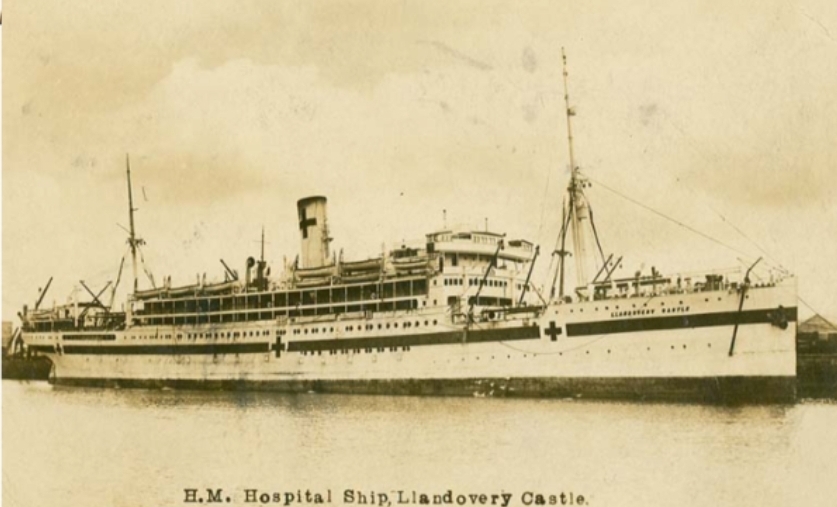
In March of 1918, Anna was transferred to a new position, as a member of the medical team caring for patients headed for Canada on HMHS Llandovery Castle. The Llandovery Castle was a beautiful ocean liner. Five hundred feet of sleek elegance from her upright bow to her graceful fantail stern. Only one smokestack rose amidships from her cabin top. Launched in 1913 from the yard in Glasgow, Scotland and finished four months later in January 1914, she was still practically new. In the summer of 1916, she was commissioned as a hospital ship and assigned to the Canadian military for the transportation of her wounded men. Painted white, a bold dark stripe circled her hull, interrupted only by large crosses, like the one on her stack, indicating her status as a non-combatant protected by the Hague Convention X of 1907. Unarmed, she ran with full lights, and brilliantly lit up Red Crosses. The Germans, however, seized on one restriction in the Hague Convention: that hospital ships should not be used for military purposes. The Allied hospital ships, they claimed, were carrying able-bodied soldiers to the fight, and therefore could legitimately be targeted and sunk as “combatants”. Nine hospital ships had been torpedoed already by the Germans (and one by the French) including Llandovery’s sister ship, the Lanfranc Castle.
The Llandovery Castle made a quick return trip across the Atlantic that June. In seven days, she was south of the Irish coast, nearly in the Bristol Channel. In another day or so, she would slide up the west coast of Wales and into the port at Liverpool to safety, another successful trip across the Atlantic under her belt. As the long summer evening slipped toward night on 27 June 1918, the Llandovery steamed through the choppy seas and many on board prepared for bed. Likely, they were excitedly looking forward to sighting land in the morning, and for yet another trip to be ended. Little did they know they were being stalked by the German submarine U-86, under the command of 27-year-old Iron Cross 1st Class recipient, Helmut Brummer-Patzig.
The impact of the torpedo at 9:20pm threw some on board out of their bunks where they had settled for the night. Panic, though, was minimal. The fourteen nursing sisters – some in nightdresses and Anna among them – promptly assembled at lifeboat No.5. The women were all hastened aboard; it was obvious the boat was going down and quickly. Sergeant Arthur Knight and eight other men were on board the lifeboat with them as they were lowered into the darkening, rough sea. All along the deck, this same procedure was being repeated with other lifeboats. As No.5 touched down, they were dragged along by the Llandovery’s forward momentum and smashed against her unforgiving flank. Desperately they tried releasing the tether lines which had fouled. Swinging an ax, Knight chopped, unsuccessfully, while others used the oars to push the lifeboat away, fearing they be dashed to pieces against the Llandovery. First one ax broke, then another. The oars snapped. But finally, the lines broke and lifeboat No.5 was set adrift. As she slid down beside the Llandovery, the liner’s stern suddenly broke and sank, creating a huge whirlpool. Disabled, their oars all broken in the attempt to free themselves, the passengers of No.5 lifeboat watched helplessly as they were pulled closer and closer to the whirling maw. Not one of the 14 women screamed or cried. Stoically, they remained erect, professional in their blue uniforms and white aprons, life vests pulled over top, waiting agonizing minutes for their fate. At one point, the Matron, Nova Scotian Margaret Fraser, asked calmly what all must surely have been thinking “Sergeant, do you think there is any hope for us?” and equally as calmly accepted his bleak “No”. As No.5 was pulled finally into the whirlpool, it tipped on its side and all aboard tumbled into the frigid water. Knight surfaced three times, finally grabbing a piece of wreckage and survived. He did not see the women surface. Likely pulled down by the weight of their heavy skirts, none were able to save themselves. It was a dreadful end but no more so than for the others in the rest of the lifeboats. To disguise his crime, Brummer-Patzig ordered the U-86 to surface and ram the lifeboats, viciously mowing down any survivors with machine guns. Only one lifeboat and its passengers escaped. The survivors, including Arthur Knight, were picked up 36 hours later by the HMS Lysander. The bodies and wreckage were left to the sea. The HMS Morea passed through later but were unable to stop and recover any of the lost. Her Captain, Kenneth Cummins was devastated. He wrote:
“We were in the Bristol Channel, quite well out to sea, and suddenly we began going through corpses. We were not allowed to stop – we just had to go straight through. It was quite horrific, and my reaction was to vomit over the edge. It was something we could never have imagined … particularly the nurses: seeing these bodies of women and nurses, floating in the ocean, having been there some time. Huge aprons and skirts in billows, which looked almost like sails because they dried in the hot sun.”
In all, only 24 of the 258 aboard survived, making it the worst Canadian nautical disaster of the war. Canadian soldiers took up the cry “Llandovery Castle!” during the Last 100 Days offensive of 1918.
Anna is remembered on the Halifax Memorial to those lost at sea, at Point Pleasant Park overlooking the Halifax harbour, likely her last sight of land. The 12-metre-high Cross of Sacrifice names her, as well as the 13 other women who died with her: Matron Margaret Marjory (Pearl) Fraser, Carola Josephine Douglas, Alexina Dussault, Minnie Aenath Follette, Margaret Jane Fortescue, Minnie Katherine Gallaher, Jessie Mabel McDiarmid, Mary Agnes McKenzie, Christina Campbell, Rena McLean, Mary Belle Sampson, Gladys Irene Sare, and Jean Templeman.
Halt! Who Goes There?
Walter Scott Hamm

2 April 2023
When the fog creeps into Saint John, it may not leave for weeks. As the summer heat rises in New Brunswick, the billows form on the cold Bay of Fundy and are swept in by the rushing tide. Swirling in the harbour, the fog creeps stealthily up Courtney Bay, past Partridge Island on guard at the river’s mouth. Swallowing first the West side, it sneaks tendrils along the uptown streets to the east. Finally, it wraps cold, wet arms over and around the ridge at the north end of the harbour where the tide sweeps west up through the river gorge. The ridge, a natural fortification as it stares majestically down at the length of the harbour, rises 140 feet above the water. It saw the arrival of American raiders in 1777, who were successfully repelled – twice. The ridge was soon crowned with a blockhouse, garrisons and eventually a palisade. It stood proudly unassailed during the War of 1812 and the Fenian raids of the 1860’s and bristled with guns during the First and Second World Wars. And on 4 July 1917, when the thick summer fog brought an early twilight, and Americans were celebrating their independence, this bastion of British Loyalists heard shots ring out in the dark.
In the middle years of the 1890’s, blacksmith William Hamm moved his growing family from the Mahone Bay area of Nova Scotia all the way across to the northern shore of the province. Eighty miles, through dense Acadian forest and the mountainous interior of the province, was a long journey in 1896. A region of rich farmland and orchards, the Annapolis Valley may have been a place to make a better life. Despite long roots in Nova Scotia – at least three generations – William and his children would be known as “German” or “Dutch” in the Canadian census’ in contrast to his “English” wife Viola. Not surprising though as his grandfather had spelled the name Heim.
William and Viola’s children arrived in quick succession and frequently; their boys, Ward, William, Edward, Walter, Charles and Francis, were joined by sisters Margaret and Kathleen, all before 1906. Little brother Henry died at a year old in 1909, and another sister barely survived two months in 1911 but they were followed by Lorne, Violet, Philip and Eugene. It may be no surprise then, given the crowded house, that the older boys soon flew the nest to make their own careers. Walter went a little farther than the others – all the way across the Bay to Saint John, where he worked as a baker while living with his maternal grandmother, Mrs. Rachel Moore.
No doubt he was champing at the bit when his older brothers enlisted in the great adventure happening in Europe. William signed up in December of 1915 and Edward the following March. Walter held out until the summer of 1916. He was only 17, but he claimed to be nine years older when he arrived at the recruiting office in Saint John. Recruiters, it turns out, did not have many scruples when it came to signing up boys.
Stories are so common as to almost seem apocryphal about volunteers being told to walk outside a recruiting office and “have another birthday” then come back in. Surely grown men – army officers and medical doctors – could not be so heartless as to knowingly accept teenagers? The truth was competition was fierce between battalions and warm bodies were so desperately needed in the later years of the war, that recruiters did indeed actively encourage young boys into lying about their age. While 18 (and later 19) was the lower age limit, the fact is an estimate 20,000 underage boys enlisted; 2000 of them were killed overseas. Determined young men, if turned away at one recruiting office, could easily try again elsewhere, seeing as there were no national records kept. In fact, with no real identification documents as we have now – driver’s licenses, birth certificates, etc. – it was easy to fake a birthdate or even a name. All Walter had to do was say he was 26 and was taken at his word.
Walter was a small boy – 5’ 2” tall and skinny as only teenagers are – he probably was not much more than 100 pounds. It is not likely anyone really believed that he was 26, so Walter was put to work on guard duty in the city. The busy west side docks, the Ordinance stores near the Armoury on Sydney St in the South end, and the magazines tucked in behind Fort Howe required the constant patrol of armed soldiers from the 62nd Regiment. Of the 120 men stationed in Saint John, most were those deemed “unsuitable” for overseas duties and unfortunately many were injured, on leave waiting discharge or just not “smart” enough to follow orders. Walter, it seems, was a bright lad and educated, so was soon promoted to Lance-Corporal and put in charge of guards much older than himself, but Walter was still very much a teenage boy. For Walter and his friend, Private Hermenigilde Arseneault – Hermeni to his friends – the summer days of 1917 must have been halcyon. Paid well, their duties were not onerous, and the girls seemed to like a “man” in uniform. Strolling or lazing on the grassy slopes of Fort Howe, they would talk and flirt like teenagers of any time do. Sergeant Henry Ricketts, foreman of stores, Canadian Ordinance Corps, who happened to also live immediately next to the magazine, noted the shenanigans with disapproval and fussily, reported the boys on many occasions. Not only were they not paying attention to their duties, Ricketts knew that they were not allowed beyond the fence that enclosed the magazine buildings and the guard house. The Officer Commanding, Major James Frost, was short of able bodies and let slide the “fraternization” and the offense of being out of bounds with nothing much more than a scolding.
The magazines they guarded were nestled in on the north side of Fort Howe out of site from the harbour, down below the hill on what is now Magazine Street. One brick, one stone the buildings were surrounded by a rather rickety fence that did not seem capable of stopping anybody from wandering through. The gate was gone, “blown down” according to witnesses, in a storm. A photo from the 1920’s shows most of the fence gone, so its not likely it was repaired at any time during the war. The guards patrolled a “beat” inside this fence. They were allowed out only to use the latrine and to smoke but never more than a few yards away and always in sight. The exception to this is when a patrol went up and over the hill to inspect the drill shed on the south side of Fort Howe. However, on that foggy evening of 4 July 1917, Hamm and Arsenault were chatting up a couple of young women up on the hill, as they were accustomed to doing. Private Harold Garland who was on beat from 7:30 to 9:30pm saw them. The two boys came down off the hill at 9:30 as Arsenault had to relieve Garland. Garland remained outside the guard house for a time. It was still not quite fully dark, warm despite the fog, and there was not much to do, sitting around in the guard house.
The first shot fired that night came before 10pm. Another guard, Private Joseph Pinette was, at 31, much older than the rest and spoke little English. He’d gone back up the hill briefly and was challenged by Arsenault on the way back. Challenges were quite literally “Halt! Who goes there?” With an appropriate response of “Friend” or “Visiting patrol”, the person would be asked to “advance and be recognized”. Pinette did not halt or respond on that first challenge, nor on the second, and Arsenault fired his rifle. The exchange between the two must have been tense; Pinette demanded why Arsenault shot at him and Arsenault would later claim Hamm ordered him to. Fortunately, no harm was done… unlike moments later.
Walter Hamm was a fun-loving fellow, and friends with everyone, according to those he served with. He likely played jokes with his brothers and teased his younger sisters long before he arrived in Saint John. Despite being a good soldier and being given a promotion, he did not take his duties completely seriously, preferring to flirt with girls and treat Fort Howe as his personal playground. But then he’d only been a Lance-Corporal for three months.
Coming down the hill again sometime around 10 – had he gone back up to see the girls? Likely! – he was challenged by Arsenault. Responding “Corporal of the Guard”, Arsenault told Hamm to advance to be recognized, however Arsenault did not wait for an answer, and continued his beat. It was at that fateful moment that Hamm decided to dash into the enclosure and hide near the porch of the magazine to wait for his friend to come back. Arsenault noticed motion at the gate. Excited, he turned and followed where he saw the figure. As he closed in on the porch of the magazine, the “unknown man” came at him, he later claimed. From Hamm’s statements, he did indeed jump out at Arsenault from where he was hiding. “You can’t get me here!” Hamm called out. Arsenault, his rifle in the on-guard position, claimed not to know who was yelling and pulled his trigger for the second time that night. This time he hit his target.
The bullet punched through Hamm’s lower right abdomen, missing vital organs and major blood vessels, and blew a hole in his pelvis and back, the size of a walnut, on its way back out. In a heartbeat, Arsenault, Garland and Pinette (who were still standing in front of the guardhouse, witness to it all) watched Hamm fall and slowly begin to bleed out. Arsenault ran and got a blanket to place under his friend’s head. Garland immediately dashed up the military road, east toward William E. Pye’s general store where there was a telephone. William Coholan was a wounded veteran who knew the sound of rifle fire all too well. He’d been walking from Main St, up Barber St headed for home when he heard the shot and saw Garland running up the military road in a panic. Coholan took him to the store to call for an ambulance then rushed down to the magazine.
Sergeant Ricketts had been at the Star Theatre up on Main St, and was nearly home, when his son John found him. John blurted out a garbled story: the soldiers at the magazine were fighting and shooting each other. Someone was killed. Ricketts turned and raced to the police station on Main St. The first that the military heard of the incident was when a reporter from the Telegraph walked into Major Frost’s office at 10:30pm. By that time, Coholan had already taken charge. Ricketts gave him permission to enter the enclosure and Coholan immediately disarmed Arsenault. Checking the rifle, he found it empty. Sitting the young guard down, Coholan questioned him, but Arsenault began to cry. Through his tears all he could say was he didn’t know it was Hamm.
The first police officer on the scene found Walter Hamm lying on his stomach, his head on a blanket, one hand under his forehead. He was pale and moaned in pain, as the blood seeped in an ever-widening pool around him, yet still he insisted to all who approached him
“I am not shot so bad as you think I am.” Perhaps he was reassured by Ricketts, who he had asked “Do you think I am going to die?” to which Ricketts replied “No” Strangely, not one of the men who gathered, not the soldiers, nor the police, attempted any first aid to slow the bleeding.
Detective Patrick Biddiscombe arrived with the ambulance crew who had called him at the station up town. They raced over, driving 25 or 30 mph “where they could”. It still took them ten or fifteen minutes to get there, less than a mile as the crow flies. Hamm was pale but remained surprisingly cheerful.
“I feel alright,” he reassured the ambulance attendants. “I’m a brick. Do not be afraid to move me!” He spoke to Biddiscombe. “It was an accident. We were only fooling around.” Hamm said.
The ride to the General Public Hospital above City Road must have been horrifically uncomfortable for the boy though. Fifteen or twenty minutes passed from leaving the magazine to arriving at the hospital and still Hamm bled, soaking his uniform and the stretcher he rode on. At first a nurse and another man at the General insisted Hamm should be sent to the military hospital. At that point Hamm began to cry.
“For God’s sake, do not move me again” he moaned.
Dr. Albert Leatherbarrow, the resident, recognized the seriousness of the wound and called for Captain Albert Macauley, the medical officer for the 62nd, who happened to be at the General.
Hamm was by this time – 11pm, an hour since the shooting – pale, weak and in considerable pain. But still he insisted it was not his friend’s fault.
“We were skylarking” he told Macauley. “It was my own fault.”
A magistrate had been called, to take down Hamm’s dying declaration, but the young man refused to acknowledge he was going to die. It would be another hour before any officer arrived at the hospital to check on their Lance-Corporal but by then Hamm was in surgery. At 1:05am the next morning, July 5th, 1917, it was all over; 18-year-old Walter Scott Hamm was dead.
A military court of inquiry was hastily assembled on Monday, 9 July 1917 and continued for four days. On 9 August 1917, Major L. Tilley, Captain H Bennett and Lieutenant D MacKenrick returned their findings: Hamm had intended to play a joke on his friend when shot by Arsenault; that no medical aid was rendered to the injured young man before he got to the hospital, an action that might have saved his life had a doctor been summoned immediately; and that the defenses of the magazine were severely lacking due to the deteriorating fences, and insufficient personnel. The fourth finding was most damning: Hamm was far too young to be expected to command a guard patrol, and Arsenault was far too young to be a soldier, period.
Arsenault, it turned out had been turned away from two recruiting offices in 1916 for being only 14 years old. The 3rd recruiting office in Moncton decided he could “pass” for 18 and signed him on. At the time of the shooting, Arsenault was only 15 years old. Despite this finding, the Canadian military did not release him for another 19 months. On 22 February 1918, after being handed his last payment of $8.60, Hermenigilde Arsenault was finally discharged for being underage.
One can only imagine the pain of the news received by the Hamm family in Nova Scotia. Of their three sons serving, Walter was likely the one they worried over the least. He was safe in Saint John with an easy job. His brother William had just been sent overseas a month before the shooting. Edward had already gone over in October 1916. Both these Hamms would suffer injuries similar to their younger brother’s, for both were shot. However, in an ironic twist, both Edward and William, at the front, would survive to come home to their family. Walter, safely on this side of the Atlantic did not.
The War That Won Me Over.
James William Johnstone III
2 April 2023
Until 2018, the First World War was to me ancient history, a sepia photo of
people and places that didn’t seem real. I knew the terms “Western Front and “trenches” but had no concept of where it was, what it meant and how it related to me as a Canadian. Sure, I had read as a teen the Stephen Leacock Memorial Medal for Humour-winning novels of Donald Jack, The Bandy Papers. The series follows the hilarious exploits of the horse-faced and irritating young Bartholomew Bandy as he enlists in the Canadian Army in 1916, eventually becoming an unlikely flying Ace in the Royal Flying Corps. Ever since the idea of flying in a Sopwith Camel has been on my bucket list!
It was not, however, until the fall of 2018 and almost the 100th anniversary
of the Armistice, that the Great War took on a whole new and very personal
meaning, springing to colour with a relevance I had not imagined it could. That fall, I read for the first time a long series of letters from the adorably
charming young man in the picture above, James William Johnstone III, or Jim as he called himself (although he wouldn’t mind you calling him Jimmy). Jim was in love with my grandmother, Isobel, and apparently, she was with him (she kept his letters all her life!), although her letters to him are long gone. Jim wrote so eloquently, with so much zest for life and so much longing to return to his family, his beloved province of Nova Scotia and to her, his dearest girl, whom he had nicknamed – for a reason no longer known – Chiquita. Jim died in those filthy trenches I was soon to learn more about, but had he returned, it seems likely he, not my grandfather, would have held her heart. My life might never have happened. Those small wrinkles of fate could have changed everything I knew. It is a massive idea to roll around in your brain. Despite these thoughts, as I grew to knew Jim, how I wished he had lived, had children of his own, grown old. I grieved a young life that never really got to live, despite seeing and experiencing something no one should have had to.
And so, the book “Somewhere in Flanders: Letters from the Front” was born. Jim’s story was, I felt, important and should be shared so that he would not be forgotten. I spent the final months of 2018 and nearly all of 2019, reading everything I could on Canada in the FWW, from scholarly books to memoirs of those who were there, to primary sources such as battalion war diaries. I read the Canadian Expeditionary Force’s official history, buried myself in the smallest details of battles and troop movements. With Jim at my shoulder, I was able to trace his path through this horrific war, and in November of 2019, a year after I began, his book was published.
Ultimately, for me, it was the stories of the men, their experiences, and their
families’ experiences at home that became important. It is through this blog, that I will share the stories of other men and women who did not come home, who gave up their futures for ours. You will meet the people who experienced what we can only imagine but were just like us. First, and coming soon, a young man who never even left Canada: 18-year-old Walter Scott Hamm.
 Heather McBriarty
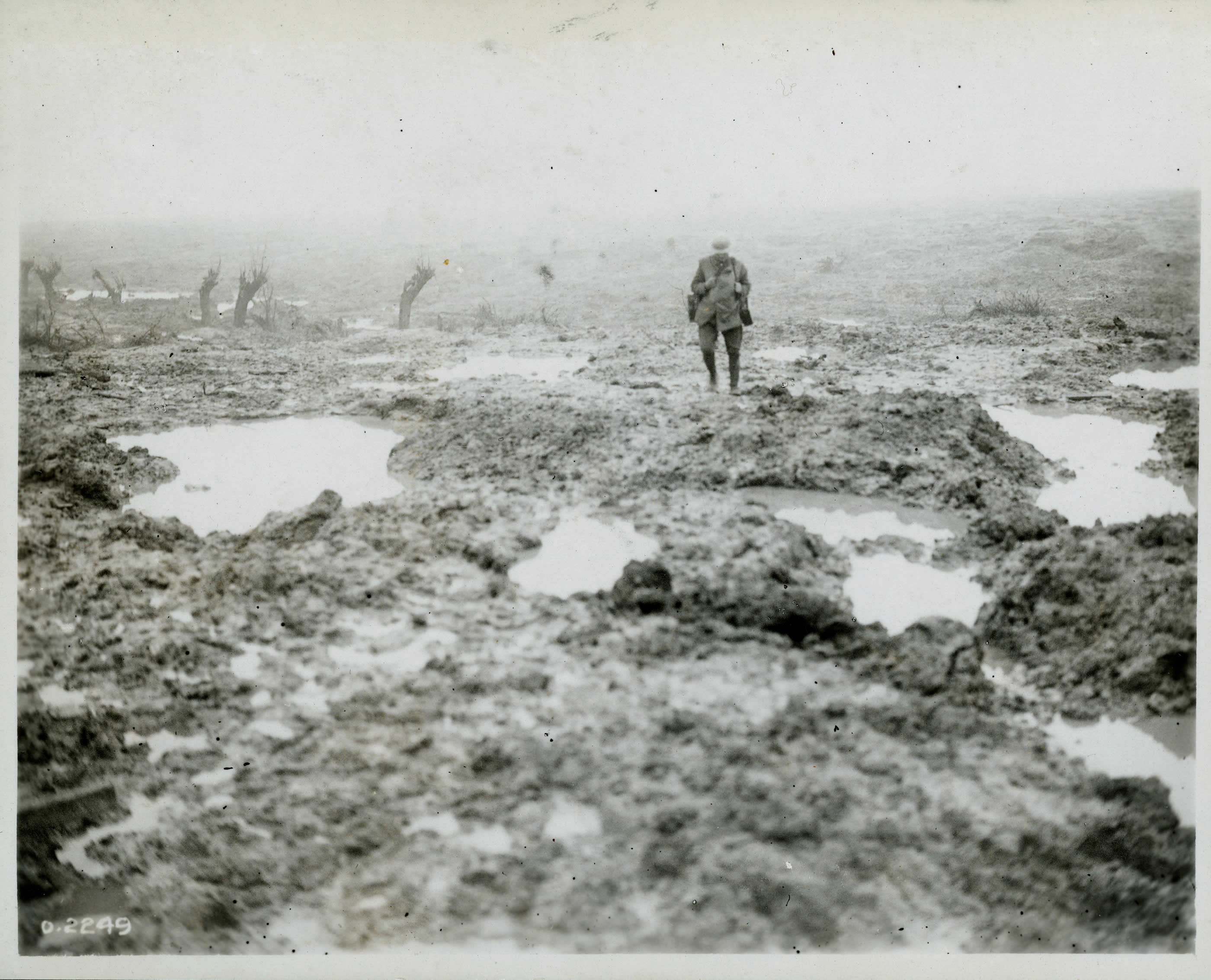
Leave a comment